
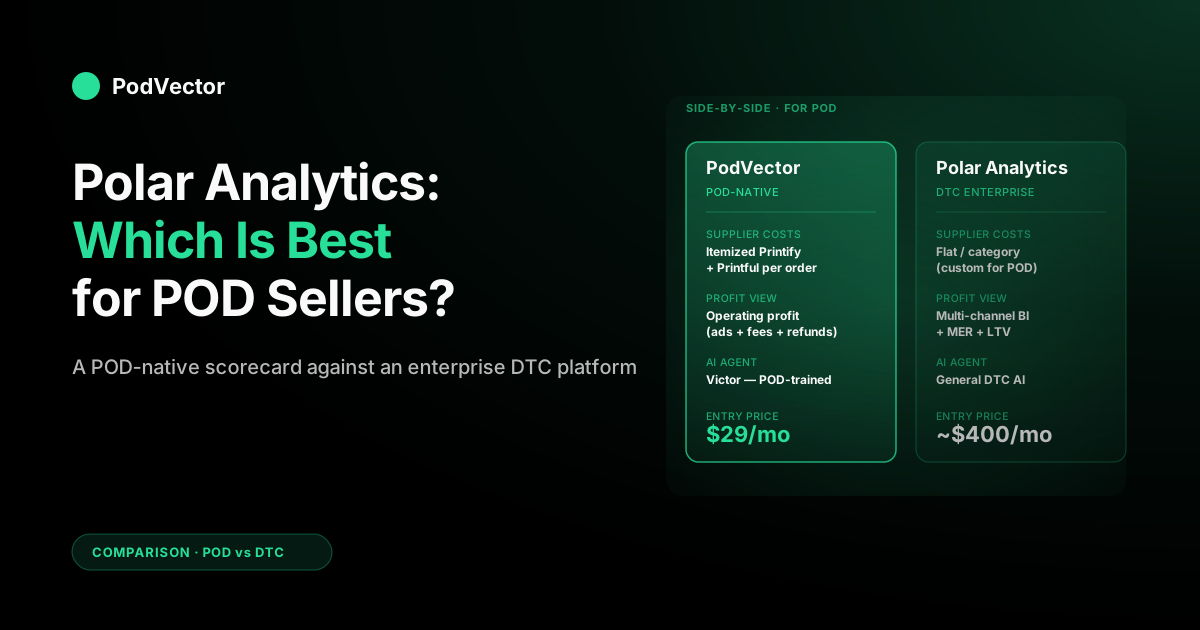
Quick Answer: Polar Analytics is a strong multi-channel BI platform for general DTC Shopify brands. It centralizes data from over 100 integrations — Shopify, Meta, Google, TikTok, Amazon, Klaviyo, and more — into a dedicated Snowflake warehouse, and ships a full suite of AI agents (data analyst, media buyer, email, inventory) plus a Polar MCP connector on top.
For print-on-demand sellers specifically, the fit is more uneven. Polar's profit math assumes a flat or category-level COGS — POD's per-order Printify and Printful supplier costs don't load that cleanly without custom modeling work, and pricing is GMV-tiered in a range that overshoots most POD operators below seven figures.
If you're a POD seller comparing options, PodVector AI is the closest direct alternative built around itemized POD supplier line items. Below is the side-by-side, where Polar wins, where it loses, and how to decide.
What Polar Analytics actually is
Polar Analytics is a warehouse-native business intelligence platform built for Shopify brands. According to the company, it consolidates data from over 100 integrations — including Shopify, Meta, Google Ads, TikTok, Amazon, Klaviyo, and email/SMS tools — into a dedicated managed Snowflake warehouse, then layers pre-built ecommerce dashboards, a semantic layer of pre-built metrics, and a suite of AI agents on top.
According to aichief.com, Polar Analytics is trusted by over 4,000 ecommerce brands and agencies. The company was founded in 2020 and, according to pricingsaas.com, has raised a total of $30.3M to date.
Their core pitch is consolidation. Instead of 12 dashboards and a Looker contractor, you get one analytics surface across the stack — with metrics like blended CAC, MER, true LTV, and incrementality testing already wired up.
That positioning matters here because it tells you who Polar is built for. The product is excellent for a multi-channel DTC operator running cross-platform attribution and LTV cohorts — and structurally awkward for the things that make POD different.
Polar Analytics vs alternatives for POD
| Tool | POD supplier accuracy | Best for | Entry price | AI agent |
|---|---|---|---|---|
| Polar Analytics | Flat / category COGS by default; itemized requires custom modeling | Multi-channel DTC brands, agencies | GMV-tiered; see pricing section | Yes (Polar agent suite + MCP) |
| PodVector AI | Itemized Printify + Printful supplier line items per order | Shopify POD sellers (Printify / Printful) | $29/mo | Yes (Victor — agentic AI employee for POD) |
| Triple Whale | Itemized but DTC-modeled; POD line items via custom mapping | Multi-channel DTC, creative-heavy ad operators | $129/mo | Yes (Moby) |
| Lifetimely (by AMP) | LTV-focused; supplier costs via Shopify cost-per-item | DTC focused on LTV / cohorts | $34/mo | No |
| BeProfit | Manual COGS mapping; no native POD integrations | General Shopify P&L beginners | $25/mo | No |
| TrueProfit | Itemized (Printify + Printful supported since 2024) | Multi-channel DTC with some POD | $35/mo | Limited |
The full apples-to-apples scoring across all eight major POD profit tools is in our PodVector AI vs competitors complete comparison, and the broader POD profit tool comparison hub covers the rest. The summary above is the slice that matters when you're specifically weighing Polar.
Where Polar Analytics is strong
If you're a multi-channel DTC brand at scale, Polar is genuinely one of the best tools in the category. Three things they do better than almost anyone:
Multi-channel attribution
Polar's first-party pixel and incrementality testing module are built for operators running spend across Meta, Google, TikTok, and Amazon simultaneously. The blended-CAC and MER views are well-designed and update in near-real-time.
For a brand spending significant budget across multiple ad platforms, that consolidation is worth the price tag on its own. The platform reconciles ad-reported spend against actual charges and surfaces the gap — which is where most generic dashboards quietly mislead you.
If you want to go deeper on how ad-side analytics fits into a POD operation, see our guide on ecommerce checkout conversion rate optimization and the section on reading ad signals before you scale.
LTV and cohort analysis
Polar's lifetime ID and cross-device tracking enable proper cohort views. You can answer questions like "what's the 90-day LTV of customers acquired from TikTok prospecting in March?" without exporting CSVs.
For brands with repeat-purchase economics — supplements, skincare, apparel basics — this is genuinely differentiated. Most POD businesses, by contrast, lean lower-frequency and one-off, which makes the cohort module less load-bearing for our use case.
Warehouse-native architecture
Every Polar customer gets a dedicated managed Snowflake warehouse. That means clean, queryable data you actually own — not a dashboard view you're locked into.
According to conjura.com, if your team has data skills, you can extend Polar with custom models, reports, and integrations with other downstream tools. That's a real architectural advantage over closed-box profit apps — though it requires data engineering investment that most POD operators don't have on hand.
AI agent suite and MCP
Polar has moved past a single chat assistant to a full agent product line. According to aichief.com, Polar's platform offers "business intelligence, incrementality testing, data activations, and AI-powered agents to help brands optimize marketing spend, increase retention, improve merchandising, and consolidate reporting." The agent lineup includes a Data Analyst agent that answers natural-language questions with visualized answers, plus Media Buyer, Email Marketer, and Inventory Planner agents. They've also shipped a Polar MCP connector that lets tools like Claude query your live Polar data directly.
The category direction here is right — analytics is moving from "dashboards you read" to "agents that act" — and Polar is investing seriously in it. Worth noting that AI agents for ecommerce analytics are still early; most are in answer-and-recommend mode, with autonomous action-taking still maturing across the category.
Smart alerts and scheduled reporting
Polar includes smart alerts on KPIs — drops in conversion rate, increases in CAC — delivered via email or Slack. Teams can also schedule snapshot reports on whichever metrics matter most. For a multi-brand operator or agency managing several Shopify stores, these monitoring surfaces meaningfully reduce manual dashboard checking. POD operators who run ad campaigns benefit here too: catching an early signal on ad frequency or ad fatigue before it burns the margin is exactly the kind of workflow these alerts are designed for.
Where Polar Analytics falls short for POD sellers
Now the honest part. Polar is a great DTC tool, but POD has structural quirks the platform wasn't designed around. Four gaps matter most:
1. Itemized POD supplier costs
POD margin lives or dies on per-order supplier accuracy. A Printify hoodie has a different base cost than a Printify tee, and both vary by garment type, print method, color, size, and ship-to country. For a real-world look at how those numbers stack up, see our Printify t-shirt cost and profit breakdown.
Polar's COGS model assumes you can map costs at a category or product level — a reasonable assumption for general DTC, where a SKU's cost is mostly stable. For POD, that flat or category-level mapping diverges from actual supplier charges on any given order, because the supplier charges a different amount per variant per region. You can fix this in Polar with custom warehouse modeling — but that's engineering work, not a built-in feature. POD-native tools handle it out of the box.
2. Shipping treated as supplier cost, not store cost
In standard dropshipping or DTC, shipping is something you charge customers and pay your carrier separately. In POD, the supplier (Printify, Printful, Gelato, Gooten) charges shipping as part of the per-order fulfillment line — bundled with the garment cost.
Polar's fulfillment cost modeling separates these by default. That separation is correct for a Shopify-plus-3PL setup and structurally misaligned for POD, where the "shipping cost" line and the "supplier cost" line come from the same Printify or Printful API call. The result: Polar's gross margin on POD orders tends to be optimistic until you build a custom transform. Most brands either eat the inaccuracy or pay an analyst to fix it.
3. Price tag designed for scaled brands
Polar's pricing is GMV-tiered, and according to conjura.com, "once your brand crosses the $5M GMV mark, costs can climb steeply, particularly if you want advanced features like pixel attribution or Snowflake access." That makes it an easy buy for a brand doing hundreds of thousands per month in revenue — and a hard buy for a POD operator with a thin contribution margin still building to scale. The platform isn't priced wrong; it's priced for a different customer. For a deeper look at how contribution margin works in POD, see how to get contribution margin.
4. AI agents don't know POD economics
Polar's Data Analyst agent is competent at general DTC questions ("what was my MER last week?") because it sits on the platform's general ecommerce semantic layer. Ask it POD-specific questions — "is my Printify Premium subscription paying for itself on the SKUs I shipped this month?" — and it doesn't have the model context.
An agent's quality is a function of the data it sees and the metrics it's been taught. A general DTC agent — and a Polar MCP feed built on the same semantic layer — has been taught the wrong vocabulary for a POD margin conversation. The underlying issue isn't AI capability; it's that the data model underneath doesn't carry itemized supplier costs as a first-class concept.
Polar Analytics pricing
Polar's pricing is based on Monthly Tracked Orders (MTO) — their billing metric as a proxy for data stored and processed — and scales with GMV tier. According to G2's pricing page for Polar Analytics, Polar uses MTO as its billing metric and offers three pricing editions, with a free trial available. According to conjura.com, Polar uses GMV-based pricing similar to competitors like Triple Whale. The current packaging includes:
- GMV-tiered plans. Pricing scales primarily by your monthly online GMV and order volume rather than a flat rate.
- Plan tiers. The core "Analyze" plan covers standard dashboards, connectors, and AI agents; higher tiers add advanced modeling, incrementality testing, Snowflake access, and white-glove support. According to conjura.com, advanced features like pixel attribution and direct Snowflake access sit behind higher tiers.
- Included in all plans. Per Polar's own site, all plans include a dedicated Snowflake database, first-party Pixel, unlimited users, and a dedicated Success Manager.
- Enterprise tier. According to G2, customized pricing applies for brands with over $20M in yearly GMV.
- Annual commitment. Discounts apply for paying annually.
For a POD operator evaluating whether Polar's cost fits the margin math, see our Shopify Capital guide and Shopify Capital credit check explainer for context on how cash flow planning intersects with tooling decisions.
For a more granular look at how Polar's pricing scales, our Polar Analytics pricing breakdown for POD sellers walks through the tier-by-tier math against a Printify-heavy store.
Why POD sellers pick PodVector AI instead
PodVector AI was built specifically for Shopify POD sellers running Printify and Printful. The architectural choices reflect that focus.
Itemized supplier costs as a first-class concept
Every Printify and Printful order line item flows into PodVector AI with the actual supplier-charged base cost, shipping, and any premium-tier discounts applied. No flat COGS, no category mapping, no spreadsheet reconciliation.
That's the difference between a P&L that says "42% gross margin" and one that says "42% gross margin — calculated from your actual Printify line items this month, with Printify Premium savings already netted out." One honest caveat: because PodVector AI pulls production costs from completed orders rather than syncing a Printify or Printful catalog, a brand-new store with no fulfilled orders yet won't have a margin answer until the first orders flow through.
Operating profit, not just gross profit
Most profit dashboards stop at gross. PodVector AI includes ad spend (Meta, Google), Shopify payment processing, app subscriptions, refunds, and chargebacks in the operating P&L by default.
That matters in POD because contribution margin is thin. Gross margin shrinks meaningfully once you net out ads and fees — and the operating number is what you actually need to see when deciding whether to scale a campaign. For the full mechanics, see how to get contribution margin for a POD store and our broader gross profit vs operating profit in print-on-demand explainer.
Victor: agentic AI employee for POD
Victor is the AI employee built into PodVector AI. He reads live data across your connected platforms — Shopify, Meta Ads, Google Ads, Printify, and Printful — and you can ask questions in plain English: "which Printify SKUs lost money last week after ad spend?" and get a real answer from your live data warehouse.
Beyond answering questions, Victor can act on them with your approval. Today he can reprice worst-margin SKUs to a target margin, bulk-update Shopify product prices, set up a buy-one-get-one discount on a collection, raise the free-shipping threshold, create and update discount codes, and organize collections — all Shopify-side writes, executed only after you approve the proposed action. Ad-platform writes (pausing campaigns, changing budgets or bids) are not built; Victor reads Meta and Google and proposes moves, but the executions he runs today are Shopify-side.
Victor also delivers a Weekly Health Report — a proactive summary of what happened last week and what's worth your attention. Outside that check-in, the experience is query-driven: you ask, he reads and responds. For context on how this connects to store automation, see our guide on Shopify Admin API store modifications and automation.
POD-priced
PodVector AI starts at $29/month — designed for a POD operator still building to scale, not an enterprise DTC brand with a dedicated analytics budget. The live data warehouse that powers Victor is the same architecture pattern Polar uses — sized and priced for POD economics rather than multi-brand enterprise.
Other Polar Analytics alternatives worth knowing
If neither Polar nor PodVector AI fits, the category has a few other reasonable picks. Each solves a slightly different problem.
Triple Whale
Triple Whale is the closest analog to Polar in the mid-market — a multi-channel attribution platform with strong creative reporting and an AI assistant (Moby). It's slightly cheaper and more ad-spend-focused than Polar.
For POD, it has the same itemized-supplier-cost limitation as Polar, but its creative reporting is genuinely useful if you're running a high volume of Meta creative tests. Understanding ad frequency and ad fatigue at the creative level is where Triple Whale earns its keep for heavy Meta spenders.
Lifetimely (by AMP)
Lifetimely is the LTV/cohort specialist. If your POD business has unusual repeat-purchase dynamics (subscription printers, club-style merch), it's worth a look.
For straightforward POD profit tracking, it's overkill on the LTV side and underkill on the supplier-cost side. A more direct comparison lives in our Lifetimely for POD sellers breakdown.
BeProfit
BeProfit is the budget Shopify P&L app. Cleaner than a spreadsheet, lighter than Polar, and missing native POD integrations. It works as a starter tool if you're early in your POD journey and just need rough margin visibility. We cover the trade-offs in BeProfit for POD sellers.
TrueProfit
TrueProfit added native Printify and Printful support in 2024. It's a reasonable bridge tool if you want broader DTC analytics with some POD coverage. Pricing is comparable to PodVector AI at the entry tier but climbs faster as you add stores and supplier integrations.
For the full alternative landscape, our roundup of alternatives to Polar Analytics for POD sellers covers eight options scored against the same POD-specific criteria.
How to decide: a stage-based recommendation
The right tool depends less on your absolute revenue and more on what your bottleneck is. A practical framework:
Early stage, under $50K/month: skip Polar
At this stage, Polar's GMV-tiered pricing is hard to justify against the margin it would consume. PodVector AI or BeProfit cover the profit-visibility need at a fraction of the cost. You don't need cross-channel attribution yet — your ad spend is concentrated on one or two platforms, and platform-reported ROAS plus a POD-aware P&L gets you most of the way to the right scaling decisions.
$50K–$300K/month, single-channel POD: PodVector AI
This is the sweet spot for POD-native tools. You need accurate per-order supplier costs, operating profit (not just gross), and ad-spend integration with Meta or Google. You don't yet need the multi-channel attribution layer Polar specializes in. PodVector AI's tiers cover the work without forcing an enterprise procurement conversation. If you're also exploring growth financing, see our guide to getting Shopify Capital — the P&L visibility PodVector AI provides is exactly what informs those decisions.
$300K–$1M/month, multi-channel: evaluate both
Here it gets interesting. If your POD business is spending across Meta + Google + TikTok + email/SMS and your supplier mix is concentrated (mostly Printify or mostly Printful), Polar starts to earn its price tag on the attribution side. But the supplier-cost gap remains. The honest answer for many brands at this stage is "PodVector AI for the POD margin truth, plus a lighter-weight tool for cross-channel attribution" rather than one platform that does both well.
$1M+/month, multi-channel, multi-region: Polar (with a POD layer)
At this scale, the warehouse-native architecture starts to matter independently. You'll likely want a managed warehouse you can extend with custom models — which Polar provides — and you'll have the engineering or agency budget to fix the POD supplier-cost gap inside that warehouse. Even at this stage, many POD-focused brands keep PodVector AI running alongside Polar specifically for the daily POD margin view, because the cost of building and maintaining the POD line-item model on top of Polar isn't trivial. Our PodVector AI resource hub collects the deeper writeups on each of these stages.
FAQs
Is Polar Analytics good for print-on-demand?
It's good for general ecommerce analytics, less specialized for POD. Polar handles multi-channel attribution and LTV well, but its COGS modeling assumes flat or category-level supplier costs — which doesn't match the per-order, per-variant pricing of Printify or Printful without custom modeling work. According to conjura.com, Polar is a solid choice if your team has data skills and wants full control over metrics — but it's not plug-and-play for POD profitability.
How much does Polar Analytics cost?
Polar uses GMV-based, MTO-tiered pricing. According to G2, Polar offers three pricing editions with a free trial available, and customized pricing applies for brands with over $20M in yearly GMV. All plans include unlimited users, a dedicated Snowflake database, first-party Pixel, and a dedicated Success Manager per Polar's own pricing page. Check Polar's pricing page or their interactive calculator at pricing.polaranalytics.ai for your specific GMV tier.
What's the best alternative to Polar Analytics for POD?
For Shopify POD sellers running Printify or Printful, PodVector AI is the most direct alternative — built around itemized supplier costs and POD operating margin, with an AI employee (Victor) that can read your Shopify, Meta, Google, Printify, and Printful data and execute Shopify-side actions with your approval. Triple Whale and Lifetimely are reasonable picks if you have specific multi-channel attribution or LTV needs.
Does Polar Analytics support Printify and Printful?
Polar can ingest data from Printify and Printful through Shopify (since both sync order data into Shopify), but it doesn't model the supplier line items as a first-class POD cost. You'd typically need a custom warehouse transformation to get accurate per-order POD margin inside Polar.
Is Polar Analytics warehouse-native?
Yes. Per Polar's own pricing page, every plan includes a dedicated Snowflake database — you own the data and can extend it with custom queries. According to conjura.com, power users can access raw data via Snowflake, "unlocking advanced analysis without needing to wrangle APIs." The same live data warehouse architecture pattern powers PodVector AI, sized and priced for POD economics rather than enterprise DTC.
Does Polar have an AI agent?
Yes — Polar now ships a suite of agents. According to aichief.com, Polar's platform includes "AI-powered agents to help brands optimize marketing spend, increase retention, improve merchandising, and consolidate reporting." The lineup includes a Data Analyst agent, plus Media Buyer, Email Marketer, and Inventory Planner agents, and a Polar MCP connector that lets tools like Claude query your live data. They're competent for general DTC questions and weaker on POD-specific ones because the underlying semantic layer is built for general ecommerce, not POD economics.
How does Polar Analytics compare to Triple Whale?
Both are multi-channel BI platforms with AI assistants aimed at Shopify brands. Polar leans more toward warehouse-native architecture and incrementality testing; Triple Whale leans more toward creative reporting and ad operator workflows. Polar's pricing is GMV-tiered with unlimited users included; Triple Whale's entry price is lower but also scales with usage. Neither has native itemized POD supplier-cost modeling out of the box.
POD margin truth, without the enterprise price tag
Polar is a great DTC platform. PodVector AI is a POD-native one. If you sell on Shopify with Printify or Printful and you want itemized supplier costs, operating-profit visibility, and an AI employee (Victor) that actually knows POD economics — and can act on your Shopify store with your approval — start free.
Try Victor free