
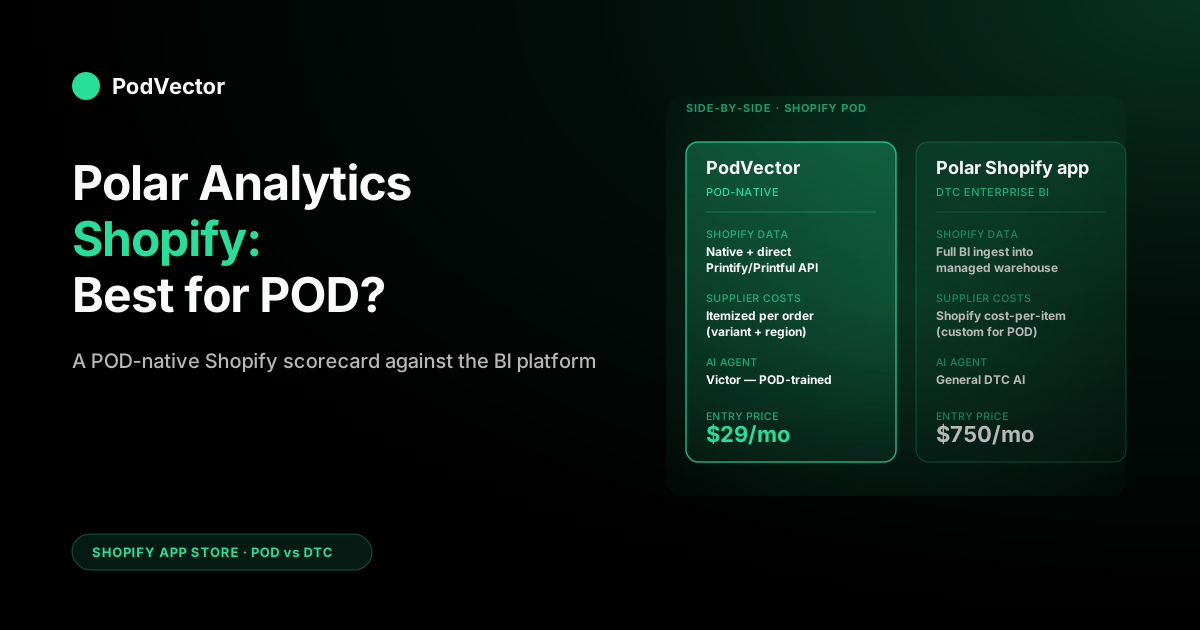
Quick Answer: The Polar Analytics Shopify app — now listed as "Polar: AI‑Analytics Platform" — is a serious BI platform that pulls Shopify orders, ad spend, email, and 45+ other sources into a managed Snowflake warehouse, then layers a suite of AI agents on top. The Shopify App Store now lists a single Core plan starting at $750/month, with pricing scaling by your online GMV above that.
For POD sellers running Shopify with Printify or Printful, the Shopify integration itself is solid — but Polar pulls supplier costs through Shopify's order line items, which means flat or category-level COGS by default. Per-order Printify and Printful supplier pricing doesn't load that cleanly, and the entry price overshoots most POD operators below seven figures.
If you want a POD-native alternative, PodVector AI is built around itemized Printify/Printful supplier costs — and Victor, an AI employee that runs your Meta and Google ads and updates Shopify listings with your approval, not just a dashboard you read. Below is the side-by-side: where Polar's Shopify app wins, where it loses for POD, and how to decide.
What the Polar Analytics Shopify app is
The Polar Analytics Shopify app is the Shopify App Store distribution of Polar's broader business intelligence platform. Install it from the Shopify app marketplace, authorize Shopify access, and Polar starts ingesting your store's orders, customers, products, and refunds into its managed data warehouse.
That warehouse — built on Snowflake — becomes the single source of truth Polar layers everything else on. You connect ad accounts (Meta, Google, TikTok, Amazon), email/SMS tools (Klaviyo, Postscript), 3PLs, and dozens of other sources alongside Shopify, and Polar reconciles them into a unified set of dashboards.
The Shopify App Store listing — now titled "Polar: AI‑Analytics Platform" — carries a 4.9 average rating across 101 reviews and is part of a customer base Polar now markets as 4,000+ ecommerce brands and agencies. Most reviews praise the consolidation — one dashboard instead of twelve — the multi-touch attribution, and the responsive support. The complaints, when they exist, are usually about price.
It's worth being clear about the framing. Polar's Shopify app is not a "Shopify report enhancer" the way a lot of cheaper apps are. It's a full BI stack that happens to plug into Shopify as one of many data sources — which is why it's powerful and why it's expensive. Polar now markets the whole thing as "the all-in-one data stack for insights, activations, and AI agent foundations," which tells you where the roadmap is pointed: the warehouse is the base layer, and the agents that read and act on it are the product it's selling forward.
How Polar's Shopify integration works under the hood
Understanding the Shopify integration matters for POD sellers, because that's where the supplier-cost question gets decided.
What Polar pulls from Shopify
The Shopify connector ingests orders, line items, customers, products, refunds, taxes, shipping charges, payment processor fees, and discount data. It refreshes on a near-real-time basis and back-fills your historical Shopify data on first install.
For most metrics — revenue, orders, average order value, repeat purchase rate, sessions-to-conversion — that pull is everything you need. Polar can rebuild Shopify's reporting set and then go further, with cohort analysis and cross-channel attribution layered on top.
What Polar does not pull from Shopify
Per-order supplier costs from Printify, Printful, Gelato, or Gooten do not flow into Shopify orders by default. Shopify has a "cost per item" field on each product, but that field is a single static number — not the variant-by-variant, region-by-region pricing your POD supplier actually charges.
So when Polar calculates gross margin, it uses whatever value sits in Shopify's "cost per item" field. If you've set that field manually based on a Printify base price, it's directionally right but stale. If you haven't set it, Polar reports zero COGS and your gross margin looks like 100%.
Why this matters for POD
POD margin is where everything matters. A Printify hoodie costs differently than a Printify tee, and both vary by garment type, print method, color, size, and ship-to country. Polar pulls clean Shopify data, but the Shopify data Polar pulls doesn't carry the per-line-item supplier truth.
You can fix this with custom warehouse modeling — pull Printify and Printful API data into Polar's warehouse separately, join on order ID, recompute margin. That's engineering work, not a built-in feature. POD-native tools handle it out of the box.
Polar Analytics Shopify vs alternatives for POD
| Tool | Shopify integration | POD supplier accuracy | Shopify App Store entry price | AI agent |
|---|---|---|---|---|
| Polar Analytics | Full BI ingest into managed warehouse | Flat / category COGS via Shopify field; itemized requires custom modeling | $750/mo | Yes (Polar agent suite + MCP) |
| PodVector AI | Native Shopify + direct Printify/Printful API | Itemized supplier line items per order | $29/mo | Yes (Victor — POD-trained) |
| Triple Whale | Full BI ingest, ad-spend-first | Itemized but DTC-modeled; POD via custom mapping | $129/mo | Yes (Moby) |
| Lifetimely (by AMP) | Native Shopify, LTV-focused | Supplier costs via Shopify cost-per-item field | $34/mo | No |
| BeProfit | Native Shopify, lightweight | Manual COGS mapping; no native POD integrations | $25/mo | No |
| TrueProfit | Native Shopify with Printify/Printful (since 2024) | Itemized supplier costs | $35/mo | Limited |
The full apples-to-apples scoring across all eight major Shopify profit tools lives in the PodVector AI vs competitors complete POD comparison, and the broader POD profit tool comparison hub covers adjacent picks. The summary above is the slice that matters when you're specifically weighing Polar's Shopify app.
Where Polar's Shopify app is strong
For the right kind of Shopify brand, Polar is genuinely one of the best tools in the category. Three things stand out.
Multi-channel attribution on top of Shopify orders
Polar's first-party pixel and incrementality testing module — branded "Causal Lift" — sit above your Shopify order data. The blended-CAC and MER views reconcile ad-reported spend against actual platform charges and surface the gap.
That gap is where most generic Shopify dashboards quietly mislead you. For a brand spending $200K/month across Meta + Google + TikTok + Amazon, that consolidation is worth the price tag on its own.
LTV and cohort analysis Shopify can't do
Shopify's native customer reports show you basic repeat-purchase rates, but they don't let you slice by acquisition channel, cohort month, or product mix. Polar's lifetime ID and cross-device tracking enable proper cohort views.
You can answer questions like "what's the 90-day LTV of customers acquired from TikTok prospecting in March?" without exporting CSVs. For brands with repeat-purchase economics, this is genuinely differentiated.
A real warehouse you can extend
Every Polar customer gets a dedicated managed data warehouse — meaning clean, queryable data you actually own. If your team has SQL skills (or hires an agency that does), you can extend Polar with custom models and reports. That's a real architectural advantage over closed-box Shopify profit apps.
The warehouse also underpins Polar's multi-store Shopify support — if you run several Shopify stores (or a store plus wholesale and marketplace channels), Polar rolls them into one consolidated view rather than forcing you to switch dashboards per store. That's a genuine draw for portfolio brands, though it's rarely the deciding factor for a single-store POD operator.
This is also the lever for fixing POD supplier costs inside Polar — but it's lever-pulling, not point-and-click.
AI agent suite on Shopify data
Polar has moved from a single AI assistant to a named agent suite: a Data Analyst agent ("Ask Polar") that takes natural-language questions ("what was my MER last week?") and returns visualized answers across your Shopify and ad data, plus a Media Buyer agent, an Email Marketer agent, and an Inventory Planner agent. They've also shipped Polar MCP, which exposes your real-time commerce data to Claude and other AI tools.
The whole suite sits on what Polar now markets as an "e-commerce semantic layer" — a pre-built library of metrics and dimensions (CAC, MER, LTV, contribution margin, cohort definitions) that the agents reason over so they answer in commerce vocabulary rather than raw SQL columns. That semantic layer is the real engine, and it's also exactly where POD diverges: it's modeled for general DTC, so it has no concept of a per-variant Printify base cost or a Printful membership discount unless you build those metrics in yourself.
The category direction here is right — analytics is moving from "dashboards you read" to "agents that act" — and Polar is investing seriously in it. The broader landscape is covered in our AI agents for ecommerce analytics guide.
Polar has also leaned into data activations — sending the warehouse data back out to act. Klaviyo Audiences pushes lost or high-LTV cohorts back into Klaviyo for retargeting, a "missed revenue" recovery flow re-engages abandoners automatically, and Advertising Signals feeds server-side conversion data to Meta and Google to sharpen targeting. For a Shopify brand already living in Klaviyo and Meta, those write-back loops are a genuine reason to centralize on Polar — and they're the closest Polar gets to acting on your behalf rather than just reporting.
Where it falls short for POD on Shopify
Now the honest part. Polar is a great Shopify BI tool, but POD has structural quirks the platform wasn't designed around. Three gaps matter most.
1. Shopify's cost-per-item field doesn't carry POD reality
POD supplier costs vary by variant — print method, color, size, ship-to country, and any premium-tier discounts (Printify Premium, Printful Membership). Shopify's cost-per-item field is one number per product or variant, set manually. It can't carry that variance.
Polar pulls that one number and uses it to compute gross margin. The result is consistently 8–22% off any given day on a Printify-heavy store. Most POD brands either eat the inaccuracy or pay an analyst to fix it inside the warehouse.
2. Shipping treated as separate cost
In standard DTC Shopify (Shopify + 3PL), shipping is something you charge customers and pay your 3PL or carrier separately. In POD, the supplier (Printify, Printful, Gelato, Gooten) charges shipping as part of the per-order fulfillment line — bundled with the garment cost on the same API call.
Polar's fulfillment cost modeling separates shipping by default. That's correct for a Shopify-plus-3PL setup and structurally wrong for POD, where the "shipping cost" line and the "supplier cost" line come from the same Printify or Printful invoice. Without a custom transform, Polar's POD gross margin is consistently optimistic.
3. The Shopify App Store price tag
The Shopify App Store entry plan for Polar is $750/month — a clean signal of who the platform is built for. Polar's "Customize" plans start at the same $750 floor and scale up with modular add-ons.
That's an easy buy for a Shopify brand doing $300K/month in revenue. It's a hard buy for a POD operator on Shopify doing $20K/month with a 25% contribution margin — that's $5K of margin a month, of which Polar would consume 15%. The platform isn't priced wrong; it's priced for a different customer.
4. The AI agents don't know POD
Polar's Data Analyst, Media Buyer, and Inventory Planner agents are competent at general DTC Shopify questions because they're built on the platform's general ecommerce metric library. Ask them POD-specific questions — "is my Printify Premium subscription paying for itself on the SKUs I shipped this month?" — and they don't have the model context, because the underlying Shopify data never carried the per-line-item supplier truth in the first place.
An agent's quality is a function of the data it sees and the metrics it's been taught. Because Polar's agents reason over a general-DTC semantic layer, they've been taught the wrong vocabulary for a POD margin conversation — there's no "supplier line cost" or "Premium discount" dimension for them to reach for.
Shopify native reports vs Polar — what you actually gain
A useful framing: what does Polar give you on top of Shopify's built-in analytics?
| Capability | Shopify native | Polar Analytics |
|---|---|---|
| Orders, AOV, conversion rate | Yes | Yes (richer slicing) |
| Cross-channel ad spend reconciliation | No | Yes (Meta, Google, TikTok, Amazon) |
| Multi-touch attribution | Last-click only | 10 models, including time-decay and U-shaped |
| LTV and cohort analysis | Basic repeat-rate | Full cohort by channel/month/product |
| Per-order POD supplier costs | No (cost-per-item field only) | No by default (custom modeling required) |
| Custom SQL on raw data | No | Yes (managed warehouse) |
| AI assistant for natural-language queries | Sidekick (limited) | Polar agent suite (Ask Polar) + MCP |
The honest read: Polar's Shopify gain is mostly on the marketing-attribution side. On the POD-margin-truth side, both Shopify native and Polar leave the same gap — and that gap is the entire reason POD-native tools exist.
Pricing on the Shopify App Store
As of mid-2026, Polar's Shopify App Store listing shows a single entry plan, priced by online GMV:
- Core plan — from $750/month. The entry tier, billed monthly with annual discounts available and pricing that scales with your store's online GMV. Includes the managed warehouse, the standard Shopify connector, unlimited users and historical data, and access to the 45+ source connectors.
- Modular add-ons. Beyond the base, Polar layers on the Business Intelligence module, Incrementality Testing, the Email Marketer AI Agent, and Advertising Signals (the conversion-API enhancement layer that pushes purchase data back to Meta and Google) — quoted on top of the GMV-based Core price.
Real-world implementation cost for a typical mid-market customer lands somewhere between $9K and $20K/year, depending on connector count, GMV tier, and team seats. That's competitive against hiring a fractional analytics consultant — and structurally above what most sub-$1M POD stores on Shopify can justify.
For the deeper tier-by-tier math, our Polar Analytics pricing breakdown for POD sellers walks through the GMV thresholds against a Printify-heavy store, and the broader Polar Analytics comparison for POD sellers covers the platform-level pros and cons.
Why POD sellers on Shopify pick PodVector AI instead
PodVector AI was built specifically for Shopify POD sellers running Printify and Printful. The architectural choices reflect that focus.
Direct Printify and Printful API integration, not Shopify-field reads
PodVector AI pulls supplier cost data directly from the Printify and Printful APIs and joins it to your Shopify orders by order ID. Every order line carries the actual supplier-charged base cost, shipping, and any premium-tier discounts applied.
No flat COGS, no Shopify cost-per-item maintenance, no spreadsheet reconciliation. The difference is between a P&L that says "42% gross margin" and one that says "42% gross margin — calculated from your actual 1,247 Printify line items this month, with $312 in Printify Premium savings already netted out."
Operating profit, not just Shopify gross
Most Shopify profit dashboards stop at gross. PodVector AI includes ad spend (Meta, Google), Shopify payment processing, app subscriptions, refunds, and chargebacks in the operating P&L by default.
That matters in POD because contribution margin is thin. A 25% gross margin shrinks to a 6% operating margin once you net out ads and fees — and 6% is the number you actually need to see when deciding whether to scale a campaign. (For the full mechanics, see gross profit vs operating profit in print-on-demand.)
Victor: POD-trained AI employee
Victor is the AI employee built into PodVector AI. Today, you can ask Victor questions in plain English — "which Printify SKUs lost money last week after ad spend?" — and get a real answer pulled from your live data warehouse.
Victor is an AI employee: he answers your business questions and acts on them with your approval. That means catching a Printify supplier price change at 3 a.m., cross-checking it against your average Meta CPA on that SKU, and surfacing which three listings to pause before the morning. We're not all the way there yet — but the architecture is built for it from day one.
POD-priced for the Shopify App Store
PodVector AI starts at $29/month. That's designed for a $20K/month POD operator on Shopify with a thin contribution margin, not a $3M brand with a dedicated analytics budget.
The live data warehouse that powers Victor is the same architecture pattern Polar uses — just sized and priced for POD economics rather than enterprise DTC.
How to decide: a stage-based recommendation
The right Shopify analytics stack depends less on your absolute revenue and more on what your bottleneck is. A practical framework:
Under $50K/month: skip Polar's Shopify app
At this stage, Polar's $750/month entry is hard to justify against the margin it would consume. PodVector AI or BeProfit cover the profit-visibility need at a fraction of the cost.
You don't need cross-channel attribution yet — your ad spend is concentrated on one or two platforms, and platform-reported ROAS plus a POD-aware P&L gets you most of the way to the right scaling decisions.
$50K–$300K/month, single-channel POD on Shopify: PodVector AI
This is the sweet spot for POD-native tools. You need accurate per-order supplier costs, operating profit (not just gross), and ad-spend integration with Meta or Google.
You don't yet need the multi-channel attribution layer Polar specializes in. PodVector AI's $29–$129 tiers cover the work without forcing an enterprise procurement conversation.
$300K–$1M/month, multi-channel: evaluate both
Here it gets interesting. If your POD business is spending across Meta + Google + TikTok + email/SMS and your supplier mix is concentrated (mostly Printify or mostly Printful), Polar starts to earn its price tag on the attribution side.
The supplier-cost gap remains. The honest answer for many brands at this stage is "PodVector AI for the POD margin truth, plus a lighter-weight tool for cross-channel attribution" rather than one platform that does both well.
$1M+/month, multi-channel, multi-region: Polar (with a POD layer)
At this scale, the warehouse-native architecture starts to matter independently. You'll likely want a managed warehouse you can extend with custom models — which Polar provides — and you'll have the engineering or agency budget to fix the POD supplier-cost gap inside that warehouse.
Even at this stage, many POD-focused brands keep PodVector AI running alongside Polar specifically for the daily POD margin view, because the cost of building and maintaining the POD line-item model on top of Polar isn't trivial. Our PodVector AI resource hub collects the deeper writeups on each of these stages.
FAQs
Is the Polar Analytics Shopify app good for print-on-demand?
It's good for general Shopify analytics, less specialized for POD. The Shopify integration ingests orders cleanly, and the multi-channel attribution and LTV layers are solid. The supplier-cost side is the gap — Polar reads from Shopify's static cost-per-item field, which doesn't reflect Printify or Printful's per-variant, per-region pricing without custom modeling.
How much does the Polar Analytics Shopify app cost?
The Shopify App Store entry tier is $750/month for the Core plan, with pricing that scales by your online GMV and annual discounts available. Modular add-ons (BI module, incrementality testing, the Email Marketer AI agent, Advertising Signals) are quoted on top. Real-world annual cost typically lands between $9K and $20K for a mid-market Shopify customer.
What's the best alternative to Polar Analytics on the Shopify App Store for POD?
For Shopify POD sellers running Printify or Printful, PodVector AI is the most direct alternative — built around itemized supplier costs and POD operating margin, priced from $29/month. Triple Whale and Lifetimely are reasonable picks if you have specific multi-channel attribution or LTV needs.
Does the Polar Analytics Shopify app support Printify and Printful?
It can ingest Printify and Printful orders through Shopify (since both POD platforms sync orders into Shopify), but it doesn't model supplier line items as a first-class POD cost. You'd typically need a custom warehouse transformation to get accurate per-order POD margin inside Polar.
What does Polar give me that Shopify analytics doesn't?
Mainly cross-channel ad spend reconciliation, multi-touch attribution beyond last-click, proper LTV and cohort analysis, and a queryable warehouse you can extend with custom SQL. On the POD-margin side, both Shopify native and Polar leave the same gap — which is the entire reason POD-native profit tools exist.
How does Polar's Shopify integration compare to a native Shopify profit app?
Native Shopify profit apps (BeProfit, Lifetimely, PodVector AI) read directly from Shopify and present a profit P&L within minutes of install. Polar is a full BI platform that pulls Shopify into a managed warehouse — heavier, more powerful, and considerably more expensive. The right pick depends on whether your bottleneck is "I need profit visibility today" (native app) or "I need a unified data layer across 12 sources" (Polar).
Is Polar's Shopify app warehouse-native?
Yes. Each Polar customer gets a dedicated managed data warehouse, which is genuinely valuable — you own the data and can extend it with custom queries. The same architecture pattern (live data warehouse under an AI employee layer) is what powers PodVector AI and most modern Shopify intelligence tools.
POD margin truth for Shopify, without the enterprise price tag
Polar's Shopify app is a great BI platform. PodVector AI is a POD-native one. If you sell on Shopify with Printify or Printful and you want an AI employee (Victor) that reconciles itemized supplier costs, runs your Meta and Google ads, and updates listings with your approval — start free.
Try Victor free