
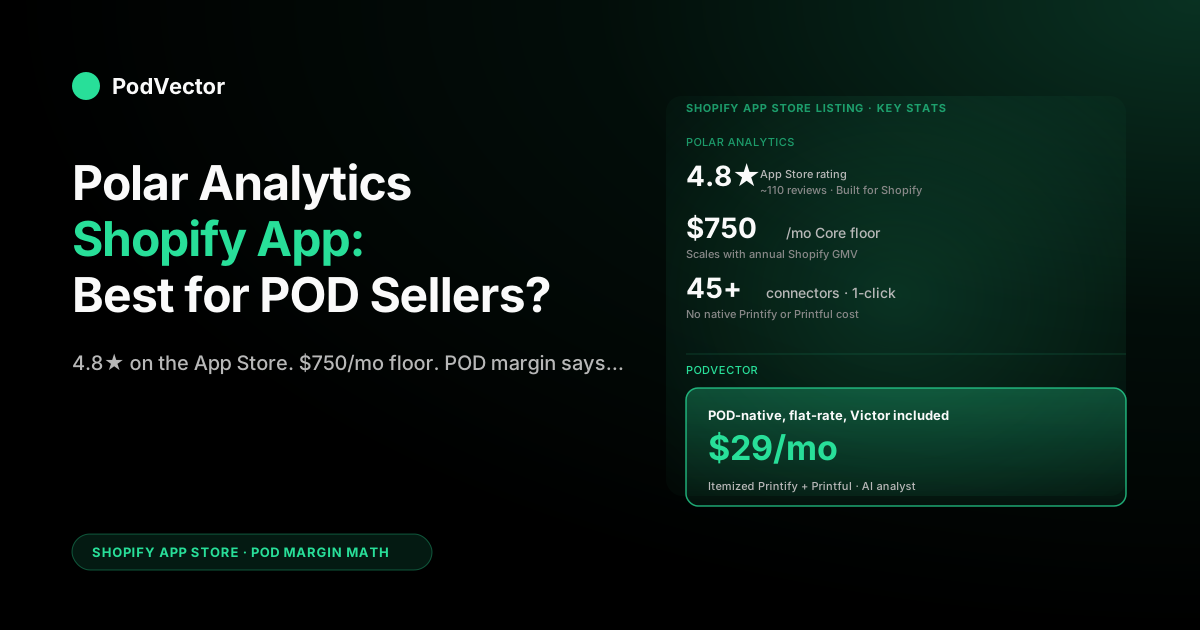
Quick Answer: The Polar Analytics Shopify App is a multichannel AI analytics platform that connects Shopify to 45+ data sources, tracks LTV and cohorts, runs server-side attribution, and powers BI dashboards. It's rated 4.9/5 across 101 reviews, with the Core plan starting at $750/month and scaling by Shopify GMV.
Is it the best Shopify analytics app for you? For general DTC stores at $3M+ GMV, yes — Polar is a strong pick, and its 2026 AI-agent suite (Data Analyst, Media Buyer, Email Marketer, Inventory Planner, AI Data Engineer, plus Polar MCP) is now bundled into the Core plan rather than sold as add-ons. For Print-on-Demand operators on Printify or Printful, no — entry pricing consumes a large share of operating profit, and the supplier-cost layer that POD margin depends on isn't built in, so even the agents optimize against margin numbers that haven't been charged real supplier cost.
If you want a Shopify-native option sized for POD economics, PodVector AI starts at $29/month with itemized Printify and Printful supplier costs and Victor — your AI employee — included on every tier. Below is the full Polar Analytics Shopify App walkthrough, who it fits, and a POD-specific decision matrix.
What's on the Polar Analytics Shopify App listing
Pull up the Polar Analytics listing on the Shopify App Store and the app name is "Polar: AI‑Analytics Platform," with the tagline "Analytics that unify your data, track LTV, and grow revenue." That's the framing — note the 2026 listing now leads with LTV tracking, not just attribution.
The listing positions Polar as a single platform that pulls Shopify data together with your ad accounts, email tool, and other sources, then layers BI dashboards, attribution, and AI on top. Think of it as a managed analytics stack rather than a single-purpose app.
Above the install button you'll see a 4.9/5 rating across 101 reviews (97% of them 5-star). The listing has been live since October 2020, and Polar says 4,000+ brands and agencies run on the platform — a real track record, but one built almost entirely on general DTC stores, so don't treat the rating as a POD buying signal on its own.
The top of the page now leads with five headline capabilities: 1-click integrations (Shopify, Amazon, Google, Meta, TikTok, Klaviyo, and more); custom reports and KPIs (spend, CAC, LTV, ROAS, CVR, cohorts, inventory); missed-revenue detection that recovers Klaviyo's lost abandoners automatically; attribution accuracy via Polar's server-side pixel; and omnichannel reporting — one view across brands, stores, markets, and channels. That's the marketing surface.
What happens when you install the app
Installation through Shopify is straightforward. You hit Install, approve the standard scopes (read orders, products, customers, marketing, inventory), and Polar provisions a workspace tied to your Shopify store.
The first-run setup
Once installed, you're prompted to connect additional data sources — Meta, Google Ads, TikTok, Klaviyo, Amazon, and so on. Each runs through a standard OAuth flow. The first sync takes a few hours to a day depending on your historical volume.
Polar then provisions a dedicated Snowflake database for your store — a managed data warehouse Polar runs on your behalf. This is where the data lands, and it's the layer your dashboards and AI queries run against. You can query it with SQL if you want, which is unusual for a Shopify app at this category.
The Polar Pixel install
If you're on a paid plan with the pixel module, Polar's first-party tracking pixel installs into your Shopify theme and checkout via Shopify's pixel framework. It captures checkout events server-side and ships them through Polar's attribution engine.
For Shopify stores running paid ads, this is the headline upgrade vs. relying on third-party browser pixels alone. The pixel surfaces in your Shopify admin under Settings → Customer events, alongside any other pixels you've configured.
Onboarding and CSM contact
Every paid plan includes a dedicated customer success manager and a private Slack channel. Onboarding is hands-on rather than self-serve — there's a kickoff call, dashboard configuration session, and ongoing check-ins.
That makes sense for the price point. It also means the app's "time to value" is measured in days, not minutes — you don't open it on Monday and have a useful dashboard on Tuesday without help.
Polar Analytics Shopify App features at a glance
The Shopify App Store listing groups features into four areas. Here's what each one actually does.
Customer behavior
Tracks every visit, click, add-to-cart, and order across your Shopify store, with individual user lifetime IDs. You get cohort views, retention curves, segmentation by behavior, and product-level affinity analysis.
This is the LTV and retention foundation. For a Shopify DTC brand running re-engagement flows, it's the reason most operators install the app. For a deeper feature breakdown, the dedicated Polar Analytics features walkthrough covers each module.
Marketing and sales
Pre-built dashboards covering CAC, LTV, ROAS, MER (marketing efficiency ratio), CVR, blended cost-of-acquisition, and ad-platform spend. The numbers are unified — meaning Meta spend is sitting next to Shopify revenue is sitting next to Klaviyo revenue, all in the same view.
The custom-metric layer lets you define KPIs that don't exist out of the box: profit-per-customer, post-discount margin, contribution-per-channel. SQL is available if you need to write something the no-code builder can't express.
The listing's "missed-revenue detection" module also lives here — it watches for Klaviyo abandoners that flows failed to recover and surfaces them automatically, so you can re-target the spend you already paid to acquire. Useful for an email-heavy DTC brand; for a POD store the recovered carts are still priced at POD margins, so the absolute dollar recovery is smaller than the listing's general-DTC framing implies.
Visuals and reports
Drag-and-drop dashboard builder with pre-built templates for finance, marketing, retention, and product analytics. Reports schedule into email or Slack. Alerts fire on thresholds you set — for example, "ping me if ROAS drops below 1.5 on any campaign."
Mobile reporting is functional but limited. The desktop experience is where the app actually lives.
Ads and attribution
Multi-touch attribution across 10 models (last-click, first-click, linear, time-decay, position-based, plus a few proprietary variants). Conversion API enhancement for Meta sends server-side events back to ad platforms, which Polar claims drives roughly a 20% ROAS lift on average.
Higher tiers add geo-based incrementality testing — splitting markets into treatment and holdout groups to measure true causal impact of channels. That's the gold-standard measurement, and it's the reason large Shopify brands accept the price tag.
AI agents and the assistant layer
Polar's 2026 positioning leans hard on AI — its site now headlines "grow resilient brands on a strong data foundation" and describes the platform as "the all-in-one data stack for insights, activations, and AI agent foundations," with the agent suite "powered by a unique e-commerce semantic layer." Beyond the in-dashboard assistant ("Ask Polar" — a question in plain English, an answer back), Polar now ships a suite of role-specific agents bundled into the Core plan: a Data Analyst agent for instant answers, a Media Buyer agent that flags wasted ad spend against your ROAS targets, an Email Marketer agent for Klaviyo revenue-per-subscriber, an Inventory Planner agent for stockout and margin risk, and — newest on Polar's 2026 lineup — an AI Data Engineer agent that promises to connect "any data source, just by asking." Polar MCP (sold as "Polar Headless MCP") exposes your cleaned warehouse to outside tools — Claude, Slack, Gmail, n8n — so you can query Polar data from wherever you already work.
It's a real step up from static dashboards, and it's now the front door of Polar's marketing. The catch for POD is the same as the rest of the platform: that semantic layer is built on Shopify-level COGS, the whole agent suite still sits behind the $750/month floor, and a Media Buyer agent optimizing to "ROAS" or an Inventory Planner protecting "margin" is working off revenue that was never charged the real Printify or Printful supplier cost. Even the new AI Data Engineer agent's "any data source, just by asking" pitch doesn't close this for POD — Printify and Printful aren't native connectors, so per-order supplier cost is still something you load by hand. The agent is only as right as the cost data underneath it.
Connectors and integrations included
Polar's listing claims 45+ data sources. The ones that matter for most Shopify stores are these.
| Category | Connectors |
|---|---|
| Storefront | Shopify, Amazon, Etsy |
| Paid ads | Meta, Google Ads, TikTok, Pinterest, Snapchat, Microsoft Ads |
| Email and SMS | Klaviyo, Postscript, Attentive, Mailchimp |
| Subscriptions | Recharge, Skio, Bold |
| Reviews and CX | Yotpo, Okendo, Gorgias |
| Warehouse and 3PL | ShipBob, ShipStation, custom warehouse exports |
Notably absent from the headline list: Printify and Printful. The Polar Analytics Shopify App reads your Shopify orders (which include the line item that came from Printify or Printful), but the supplier-side cost data — what each Printify order actually cost you in base price plus shipping plus mockup-specific variants — isn't pulled directly from the POD providers.
You can load that data manually via SQL or a custom upload, but it's not a 1-click connector. For POD operators, this is the gap that determines whether the app fits.
Pricing on the Shopify App Store
The App Store listing shows one visible plan — Core, from $750/month — but Polar's own pricing page now splits the offer into a bundled Core plan, a modular Custom plan, and à-la-carte individual products, all scaled by your annual Shopify GMV.
| Plan / layer | Starting price | What's included |
|---|---|---|
| Core (listed plan) | $750/month | Full BI platform, the AI agent suite (Data Analyst, Media Buyer, Email Marketer, Inventory Planner, AI Data Engineer), Polar MCP, Klaviyo Audiences, first-party Pixel, dedicated Snowflake database, unlimited users, unlimited historical data, dedicated CSM, Slack support |
| Custom plan / individual products | Contact sales | Pick modules à la carte — Business Intelligence, Incrementality Testing, Advertising Signals, Klaviyo Audiences, Polar Headless MCP — priced per product; Polar says the Core bundle saves ~20% vs. buying individually |
That $750/month is the floor — it's what shows on the listing regardless of your store size. The actual bill scales with your annual Shopify GMV, often landing well above the headline number, and Incrementality Testing still bills separately per test.
Annual contracts run roughly 20% off the monthly rate. There's no public free trial — Polar runs guided demos and pilots through their sales team rather than self-serve sign-ups.
For the full GMV-tiered breakdown and what shifts at each band, the dedicated Polar Analytics pricing walkthrough has the math. If you want the Shopify-billing-specific view (recurring vs. external charges, multi-store math), the Polar Analytics Shopify pricing breakdown covers it.
Polar Analytics App Store reviews and ratings
The 4.9/5 rating across 101 reviews — 97% of them 5-star — is high for a tool at this price point. Reading through the actual reviews surfaces a fairly consistent set of themes.
What positive reviewers consistently call out
- Customer support quality. Mentioned in the majority of 5-star reviews. The dedicated CSM and Slack channel show up as concrete differentiators rather than abstract benefits.
- Setup speed. Despite the app's depth, most reviewers describe the initial configuration as faster than expected — typically a few hours for the basic dashboards, then a kickoff call for the deeper work.
- Data unification. The "everything in one view" framing actually delivers — most operators are coming from a stack of three to five separate tools and welcome the consolidation.
- Custom metric flexibility. The ability to define metrics in SQL when the no-code builder hits its ceiling shows up repeatedly as a power-user feature that earns its keep.
What negative reviewers consistently call out
- Price. Almost every 1-star and 2-star review names the price as the breaking point. Operators who installed at the entry tier and then discovered the GMV-based scaling.
- Mobile experience. The desktop dashboards don't all translate cleanly to a phone screen — operators who do most of their reviewing on mobile push back on this.
- Speed in dashboards. A subset of reviewers note that switching between heavily-filtered views can feel slow, especially with deep historical ranges loaded.
For POD operators specifically, none of the reviews call out the supplier-cost gap — but most of the reviewers visible in the listing are general DTC brands rather than Printify or Printful operators, so absence of that feedback isn't surprising.
Polar Analytics Shopify App pros and cons
Honest summary based on the listing, the install behavior, and a year of customer reviews.
Pros
- Comprehensive integration coverage. 45+ connectors with 1-click setup covers the vast majority of the Shopify ecommerce stack.
- Server-side attribution that genuinely works. Polar Pixel + Conversion API enhancement is best-in-class for Shopify stores running paid ads at scale.
- Managed warehouse with SQL access. You don't have to manage Snowflake yourself, but you get the power of a real warehouse if you want it.
- Unlimited users. Adding agency partners, contractors, or your full team doesn't increase the bill.
- Strong customer success layer. Dedicated CSM and Slack channel raise the floor on support quality.
- Multi-store consolidation. If you run several Shopify stores, the cross-store reporting is genuinely useful.
Cons
- Entry price. $750/month floor prices out the long tail of Shopify stores under $1M GMV.
- GMV-tiered pricing scales fast. Above $5M GMV the monthly bill climbs steeply, which can outpace the operating margin gains.
- No native Printify or Printful supplier cost connector. POD-specific cost data has to be loaded by hand or via custom SQL.
- No self-serve free trial. Demo and pilot run through sales rather than a click-to-try experience.
- Mobile UX is limited. Most workflows assume desktop.
- Onboarding-heavy. Time to first useful dashboard is days, not minutes.
Where the app misfits POD economics
Polar Analytics is built for general Shopify DTC. POD differs from general DTC in three ways that change the install math.
POD margin is roughly half of typical DTC margin
A typical Shopify DTC apparel brand runs 60–70% gross margin. Printify and Printful POD stores run 40–50%, sometimes lower on lower-priced products like t-shirts and mugs.
That matters because Polar's pricing is keyed off GMV, not gross profit. A $5M Shopify DTC brand at 65% gross margin generates $3.25M gross profit. A $5M Shopify POD store at 45% generates $2.25M, and after ad spend is netted out, the operating profit gap is wider still. Same Polar bill, different ability to pay.
The supplier cost layer is custom work
Polar gives you a managed warehouse — but loading per-order Printify and Printful supplier costs into it (vs. flat or category-level COGS pulled through Shopify) is custom work. You either build that yourself in SQL, hire it out, or live with approximate margin numbers.
For a $5M Shopify brand with a finance hire, that's a project. For a solo POD founder, it's the entire month — and the answer Polar gives you in the meantime is wrong by 5–15% on margin, which is often the difference between a profitable campaign and an unprofitable one.
POD's ad-attribution wins are real but smaller
Polar Pixel's headline value is precision attribution between Meta, Google, TikTok, and other channels. For a $200 AOV cosmetics brand, a small attribution improvement compounds into real money. For a $35 AOV t-shirt store, the absolute dollar gain is much smaller.
That's not a knock on the technology — it's a comment on which problem dominates POD economics. For most POD operators, the question that drives decisions is "what did this campaign actually net after Printify costs?" not "which model assigned the conversion." Both matter; one matters more.
POD-aware alternatives to the Polar Shopify App
Three alternatives actually built around POD-shaped data, ordered roughly by entry price.
PodVector AI — POD-native at $29/month
PodVector AI is built for Print-on-Demand sellers running Shopify. The installation is similar in shape to Polar — Shopify OAuth, ad-platform OAuth — but supplier integration with Printify and Printful is direct and on by default.
Every order line item is enriched with the actual Printify or Printful supplier cost, so margin math is right by default rather than approximate. Pricing is flat-rate ($29 / $79 / $129 monthly tiers), not GMV-tiered.
Victor, the included AI employee, runs on a unified data warehouse purpose-built for POD. You ask Victor in plain English what a campaign netted after supplier costs, and the answer comes from your data — not a static dashboard. Victor answers questions and acts on those answers without leaving the chat — with your approval. Where Polar's agent suite is a set of analyst and advisor modules gated behind the $750/month floor, Victor is an employee that takes the next step — and it's included on every PodVector tier from $29, reasoning off itemized Printify and Printful costs rather than Shopify-level COGS.
Lifetimely (by AMP) — POD-adjacent at $34/month
Lifetimely is a Shopify-first profit and LTV tool. It's not POD-specific, but the entry price is reasonable and the LTV reporting is solid. POD supplier costs need to be uploaded as a flat COGS rate per product, which is workable for stores with stable supplier rates but less precise than line-item ingestion.
Triple Whale — multichannel at $129+/month
Triple Whale's Shopify App Store entry tier starts around $129/month and scales with order volume. The feature set is closer to Polar's than Lifetimely's — multi-touch attribution, server-side pixel, AI dashboards — but priced as a step down from Polar.
For POD specifically, Triple Whale handles supplier costs more flexibly than Polar but less precisely than PodVector AI or Lifetimely.
For a wider category sweep, the complete POD margin-tool comparison walks through the broader landscape, and the Polar Analytics overview for POD sellers goes deeper on the head-to-head.
How to decide for your POD store
The right answer depends on stage, ad spend complexity, and operating margin headroom. Five buckets.
Under $50K/month Shopify GMV: PodVector AI Starter
The Polar Analytics Shopify App's $750/month floor consumes most of your operating profit at this stage. PodVector AI at $29/month gives you accurate Printify and Printful supplier costs plus Victor, who runs your ads and store ops with your approval. Pick PodVector AI.
$50K–$300K/month Shopify GMV, single-channel POD: PodVector AI Growth or Scale
You're running ads, you have multi-channel data, you need an AI-driven view of where the money's actually going. PodVector AI Growth ($79/month) or Scale ($129/month) fits. The Polar Analytics Shopify App still doesn't, unless you have very specific multi-platform attribution problems.
$300K–$1M/month Shopify GMV, multi-channel: evaluate both
At this scale the Polar Pixel and multi-touch attribution start paying back, and the operating profit can absorb the bill. But Printify and Printful complexity still matters, and Polar's supplier-cost gap is real.
The honest call: PodVector AI for the POD-cost layer plus Polar (or a Polar-class tool) for cross-channel attribution. Or pick one and accept the gap. Worth modeling what each path actually unlocks.
$1M+/month Shopify GMV, multi-channel DTC: Polar fits
At $12M+ annual Shopify GMV, Polar genuinely becomes the right tool for the attribution and BI layer. The pricing fits, the attribution stack is best-in-class, and the dedicated CSM pays for itself.
Bolt on a POD-aware supplier cost layer for any Printify or Printful volume. PodVector AI at the Scale tier complements Polar at this stage rather than replacing it.
If you're agency or multi-store: weight unlimited users heavily
Polar's "unlimited users" pricing is genuinely valuable when you're adding agency partners, contractors, or a five-person ops team. PodVector AI does the same on every tier. Either way, don't pick a per-seat tool here.
For a deeper view of how AI-native analytics plays out in this category specifically, the complete guide to AI analytics for Print-on-Demand covers the broader picture beyond a single vendor.
FAQs
What is the Polar Analytics Shopify App?
It's a multichannel AI analytics platform that connects to Shopify, pulls in 45+ data sources (Meta, Google, Klaviyo, TikTok, Amazon, etc.), and provides BI dashboards, attribution, a managed warehouse, and a suite of AI agents. It's listed on the Shopify App Store and starts at $750/month for the Core plan.
Is the Polar Analytics Shopify App free?
No. The starting price on the Shopify App Store is $750/month for the Core plan, billed every 30 days. There's no documented free tier or self-serve free trial — Polar runs guided demos and pilots through their sales team.
How is the Polar Analytics App rated on the Shopify App Store?
4.9 out of 5 stars across 101 reviews (97% 5-star), on a listing that's been live since October 2020. Positive reviews consistently call out customer support and data unification; negative reviews most often cite price and mobile UX limitations.
Does the Polar Analytics Shopify App support Printify and Printful?
Indirectly. The app reads your Shopify orders, which include line items fulfilled by Printify or Printful — but the supplier-side cost data (what each order actually cost in base price plus shipping) isn't pulled via a native connector. You can load it manually with SQL or a custom upload, but it's not 1-click.
Can I install the Polar Analytics App on multiple Shopify stores?
Yes. Polar supports multi-store reporting with per-store breakouts and consolidated dashboards. Pricing aggregates GMV across stores — two $3M Shopify stores get priced as one $6M brand for tier purposes.
How does the Polar Analytics Shopify App compare to Triple Whale?
Triple Whale's Shopify App Store entry tier starts around $129/month and scales with order volume. Triple Whale tends to win on entry price; Polar tends to win on warehouse depth, multi-touch attribution flexibility, and managed Snowflake access at higher GMV. For POD specifically, neither tool offers itemized Printify or Printful supplier cost ingestion out of the box.
What's the cheapest POD-aware alternative to the Polar Shopify App?
PodVector AI at $29/month is the lowest-priced POD-specific alternative on Shopify, with itemized Printify and Printful supplier costs included on every tier. Lifetimely (by AMP) at $34/month is the closest POD-adjacent general-purpose alternative.
Does the Polar Analytics Shopify App have AI agents?
Yes. As of 2026 Polar bundles a suite of role-specific AI agents into the Core plan — a Data Analyst agent, a Media Buyer agent, an Email Marketer agent, an Inventory Planner agent, and a newer AI Data Engineer agent — plus Polar MCP, which exposes your warehouse to Claude, Slack, Gmail, and n8n. All of it sits behind the $750/month Core floor. For POD specifically, the agents reason off Shopify-level COGS rather than itemized Printify or Printful supplier costs, so margin-driven recommendations carry the same cost-data gap as the rest of the platform.
Will installing the Polar App slow down my Shopify store?
The Polar Pixel runs server-side rather than as a heavy browser script, so its frontend impact is minimal compared to traditional client-side pixels. It installs through Shopify's own customer-events pixel framework rather than injecting theme code, which keeps storefront load impact low.
Do I need a Shopify Plus plan to install the Polar Analytics App?
No. The app is available across Shopify plans, including standard Shopify and Shopify Advanced. Multi-store features and some attribution capabilities are easier to extract value from on Shopify Plus, but the app installs and runs on standard Shopify.
Want a Shopify analytics app sized for POD margins?
The Polar Analytics Shopify App is built for $5M+ general DTC. PodVector AI starts at $29/month, plugs into Shopify, Printify, and Printful directly, and includes Victor — your AI employee — on every tier. Victor doesn't stop at telling you what a campaign netted after supplier costs. He reallocates the ad spend, updates the Shopify listing, and manages the Printify or Printful side — asking for your approval before each move.
Try Victor free