
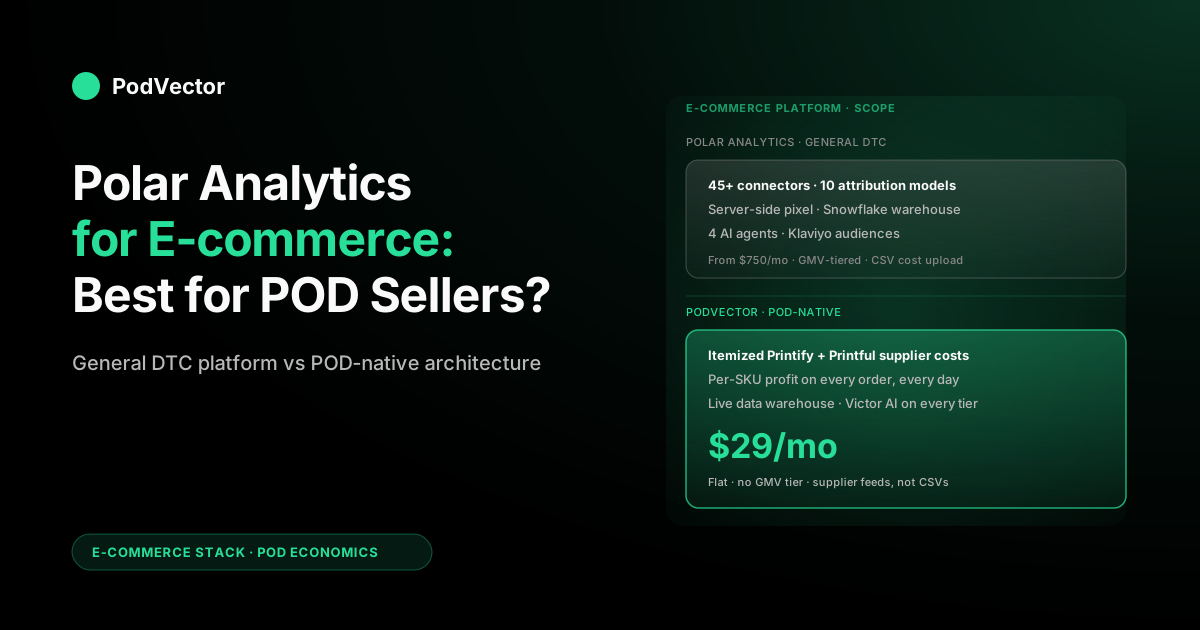
Quick Answer: Polar Analytics is one of the strongest e-commerce analytics platforms on the Shopify App Store — according to Polar's own MCP documentation, it ingests 45+ native data sources into a dedicated Snowflake warehouse with metrics refreshed every 15 minutes, plus five purpose-built AI agents. For a large DTC operator running cross-channel paid, it's a credible top-tier pick.
For Print-on-Demand sellers, the e-commerce framing is the issue. Polar is built for general DTC economics, where cost of goods is one number you upload as a CSV. POD economics break that model — Printify and Printful invoice line by line, prices shift frequently, and per-SKU profit is the actual metric you need. Polar doesn't ingest those feeds natively. And as TestFeed's 2026 review notes, Polar has repositioned toward brands with real budgets — some older affordable tiers are gone.
If you want an analytics stack that itemizes Printify and Printful supplier costs and ships Victor, an AI employee, on every plan — PodVector AI starts at $29/month flat. Below: what Polar covers as an e-commerce platform, where it earns its price, where it breaks for POD, and how the alternatives stack up.
What "Polar Analytics for e-commerce" actually means
Polar Analytics positions itself as the unified analytics platform for Shopify e-commerce brands. The pitch is one workspace where Shopify orders, ad spend across Meta and Google, email metrics from Klaviyo, and fulfillment data all sit in the same data layer — backed by a dedicated Snowflake warehouse Polar provisions for each customer.
That positioning has sharpened in 2026. According to TestFeed's 2026 review, Polar "no longer describes itself as a dashboard" — it now calls itself an AI analytics platform that grows revenue, with the product expanding to match: server-side pixel attribution, incrementality testing, AI agents, and a headless MCP layer for teams that want to pipe Polar into their own tools.
What it isn't is a general business intelligence tool. You wouldn't deploy Polar for a B2B SaaS company or a service business. According to Softwares.com (last reviewed July 2026), Polar is "BI purpose-built for ecommerce" — the semantic layer, the pre-built metric definitions for CAC, LTV, ROAS, and MER, are wired specifically to direct-to-consumer commerce. The focus is also the limit.
For the broad evaluation across all of Polar's offering, the Polar Analytics overview for POD sellers covers the whole platform. This article zooms specifically into the "for e-commerce" framing — what it means in practice, and how POD's economics test that frame.
What Polar covers as an e-commerce platform
The platform splits into four practical surfaces that an e-commerce operator actually uses day to day.
Data centralization
According to Polar's MCP documentation, the platform ingests 45+ native sources blended into 400+ deterministic metrics in a dedicated Snowflake warehouse, with data refreshed every 15 minutes. Connectors span Shopify, Klaviyo, Google Ads, Meta, TikTok, Amazon, and more.
The semantic layer applies pre-built calculations on top — so when you ask for "blended CAC," the platform knows the formula, the inputs, and the time window. You're not writing the math yourself. According to Conjura, Polar has expanded from a reporting layer into a flexible, self-serve analytics solution that supports rapid insight generation with the help of AI.
Multi-store and multi-brand support means a brand running US/UK/EU storefronts can roll them into one workspace — useful at higher GMV tiers where multi-region complexity becomes real.
Attribution
The Polar Pixel is a first-party server-side tracking layer that captures conversion events independently of the ad platforms, with a lifetime ID that stitches sessions across devices. Multiple attribution models — First Click, Last Click, Linear, U-Shaped, Time Decay, plus paid-focused models — let you compare credit allocation side by side.
The Conversion API (CAPI) Enhancer pushes enriched conversion signals back to Meta and Google, recovering attribution accuracy lost to iOS 14+ App Tracking Transparency. According to Polar's own comparison page, the CAPI Enhancer "pushes enriched data to Meta and Google."
For the deep walk on each attribution model and where each one fits, the Polar Analytics attribution capabilities breakdown goes model by model.
Dashboards and reporting
Out-of-the-box e-commerce dashboards cover the standard families: profit and loss, acquisition, retention, and merchandising. Each one has filtering by channel, campaign, product, customer cohort, and date range.
According to Conjura, fully customizable reporting with drag-and-drop UI and SQL access against the warehouse are included — uncommon for a Shopify-app-class tool, and the feature that makes the "platform" framing fair rather than marketing copy. According to AI Systems Commerce's 2026 review, all plans include unlimited users and unlimited historical data with no per-seat fees.
AI agents and MCP
According to Let's Talk Shop (2026), Polar ships five purpose-built AI agents: Media Buyer, Email Marketer, Inventory Planner, Data Analyst (Ask Polar), and an MCP agent for external tools. The agents query the same warehouse the dashboards use, so the answers are computed against current data rather than a stale weekly export.
The Polar MCP (Model Context Protocol) surface is a notable 2026 addition. According to Polar's own documentation, the open MCP lets you build custom AI agents on top of your Snowflake data and query your data in plain English — and Polar is listed as an official Claude connector. That's the architectural unlock for teams that want to integrate their analytics into a broader AI workflow.
Incrementality testing
Polar's incrementality and causal-lift testing measures what spend actually drove versus what attribution merely credited — a step beyond standard multi-touch attribution models. According to Let's Talk Shop (2026), Polar's Causal Lift feature is a separate add-on, with the first test priced around $4,000/month. For a large DTC brand auditing whether Meta spend is additive or just harvesting existing demand, it's a genuine differentiator — but the add-on pricing puts it firmly in enterprise territory.
Where Polar earns its price for DTC
For the right brand profile, Polar is one of the best e-commerce analytics tools on the market. Three places it pays back hardest:
Cross-channel attribution at serious ad spend levels. Once you're spending real money across Meta and Google, the double-counting problem becomes a real cost. Polar's server-side pixel and multiple attribution models give you the math to subtract overlap and see what each channel actually drove — independently of what each platform self-reports.
Multi-channel cohort and LTV analysis. Polar's retention dashboards stitch first purchase to repeat purchase across Shopify, Amazon, and subscription tools. For a brand thinking about LTV by acquisition channel, that join is what you're paying for. According to Conjura, Polar can also enrich Klaviyo customer profiles with purchase data and insights, allowing brands to build smarter segments and trigger more targeted email and SMS campaigns. Want to understand how an email flow like browse abandonment fits into that picture? See Klaviyo browse abandonment flow setup for POD sellers.
The data analyst replacement. Brands that would otherwise hire a dedicated data analyst plus a BI seat often find Polar pays back quickly. According to Softwares.com, Polar "ships pre-built ecommerce metrics, connects Shopify and ad platforms out of the box … so marketers get answers without a data team." The Ask Polar agent answers ad-hoc questions; the warehouse holds the same data the analyst would query.
For the depth on Polar's e-commerce feature breadth specifically, the Polar Analytics features comparison for POD sellers walks the full surface area.
The POD gap: why e-commerce ≠ Print-on-Demand
Polar is built for e-commerce. Print-on-Demand is a subset of e-commerce — but it's the subset where the standard playbook breaks.
The break point is cost of goods. In a typical DTC brand, COGS is a relatively stable number per SKU. You order inventory in batches, the unit cost is set at the PO, and you maintain a cost CSV that updates quarterly.
POD doesn't work that way. Each Printify or Printful order generates a line-item invoice — base cost, print cost, shipping cost, fulfillment fee — and those numbers shift as the supplier reprices. Multiplied across hundreds or thousands of SKU/variant/print-provider combinations, the cost CSV becomes a full-time job to maintain.
Polar accepts a manual cost-of-goods upload, same as every other DTC analytics tool. What it doesn't do is read Printify or Printful's actual invoice feeds. So the per-SKU profit you see in Polar is only as accurate as the spreadsheet you uploaded last week. For a grounded view of how Printify's cost itemization actually works — and why a manual CSV goes stale quickly — see net profit margin benchmarks for POD stores.
The pricing structure compounds the issue. According to MerchantFlow (verified June 2026), Polar's Core plan started at $750/mo, and the bill climbs as your store grows. According to TestFeed's 2026 review, some older affordable tiers have been removed as Polar has repositioned toward larger brands — "the entry point has roughly doubled" and the product has been repackaged into separate modules. POD margins typically run thinner than DTC margins on owned inventory — meaning a GMV-keyed pricing model takes a proportionally bigger share of POD profit than it does from a standard inventory brand at the same revenue level.
For the deeper version of this trade-off across the full pricing ladder, the Polar Analytics pricing breakdown for POD sellers walks tier by tier. And for a grounded view of what real contribution margin looks like at checkout, average checkout completion rate benchmarks for e-commerce covers where conversion losses hit margin first.
The e-commerce analytics landscape
Polar isn't the only player in this category. Five tools show up in the same buying conversations, each with a different shape.
Triple Whale. The closest direct competitor. Similar feature surface — first-party pixel, multi-channel attribution, AI assistant (Moby), cohort dashboards. According to Let's Talk Shop (2026), Triple Whale's Moby focuses on ad performance and creative recommendations and bundles incrementality, media mix modeling, and multi-touch attribution into its Enterprise plan. Polar is more open (MCP protocol); Triple Whale is more autonomous. Both treat supplier cost as a CSV-upload problem. According to Let's Talk Shop, Triple Whale's entry paid tier (Foundation) starts around $219/month.
Lifetimely. Strong on profit P&L and LTV cohorts, weaker on cross-channel attribution. Often used as a profit-focused complement to a separate attribution tool. The Lifetimely comparison for POD sellers covers where it fits and where it leaves gaps.
Shopify Analytics (native). Bundled with your Shopify plan. Covers the basics — sessions, sales by product, conversion rate, returning customer rate — but stops well short of cross-channel attribution and warehouse-scale analysis.
Northbeam / Hyros. Higher-end attribution-focused platforms. Heavy on machine-learning attribution models. Often deployed at very high GMV where the marginal accuracy gain justifies the price.
PodVector AI. POD-native. Starts at $29/month flat, no GMV ladder. Itemized Printify and Printful supplier costs at the SKU level. Live data warehouse, Victor (the AI employee) on every plan. Smaller feature set than Polar at the high end — it's not trying to replace an enterprise BI deployment — but built around the cost-modeling gap none of the DTC tools fill. For a look at how AOV optimization plays into that margin picture, see how to increase AOV with AI for POD sellers.
Side-by-side: Polar vs the alternatives
| Tool | Starting price | Attribution depth | POD supplier costs | AI employee included |
|---|---|---|---|---|
| Polar Analytics | ~$750/mo GMV-tiered (per MerchantFlow, Jun 2026) | Multi-model, server-side pixel, MCP | Manual CSV upload | Yes (5 AI agents) |
| Triple Whale | ~$219/mo entry tier (per Let's Talk Shop, 2026) | Multi-touch + Moby AI + MMM (Enterprise) | Manual CSV upload | Yes (Moby) |
| Lifetimely | Order-tiered | Basic last-click | Manual CSV upload | No |
| Shopify Analytics | Bundled | Last-click only | None | Sidekick (admin only) |
| Northbeam / Hyros | High-end, custom | ML-driven, deepest | Manual CSV upload | Yes (varies) |
| PodVector AI | $29/mo flat | Cross-channel read (Meta, Google) | Native Printify/Printful integration | Yes (Victor, every tier) |
The structural pattern: every DTC-built tool treats supplier cost as a CSV problem. PodVector AI treats it as a supplier-integration problem. That's the architectural difference that decides whether per-SKU profit is a column on every order or a maintenance burden you carry. For a deeper look at the data reconciliation angle, see data reconciliation for POD sellers moving between platforms.
Three POD-stage scenarios
Three POD profiles a typical operator might run in 2026 — costs and trade-offs made qualitative to avoid carrying unverified numbers.
Scenario A: Side-hustle store, early-stage GMV
Polar's entry price (around $750/month per MerchantFlow, Jun 2026) represents a significant share of operating profit for a store with thin POD margins. On a low-GMV store, the features don't pay back at this scale, and a high fraction of each sale already goes to the print supplier. As TestFeed (2026) notes, if you remembered Polar as the affordable dashboard, that version is gone.
Most relevant alternatives: Shopify Analytics for the basics + a POD-native cost tracker for the supplier-cost layer. PodVector AI at $29/month fills the latter without breaking the budget.
Verdict: Polar isn't the right fit. Stack a free profit dashboard with a POD-native tracker.
Scenario B: Growing store, meaningful GMV
At a mid-range GMV, Polar's monthly cost as a share of revenue becomes more defensible — especially if you're running cross-channel paid at meaningful spend levels and the attribution is changing media-buying decisions.
This is the tipping point. If your bottleneck is "I'm spending money on Meta and Google and don't know which dollar is working," Polar earns the price. If your bottleneck is "I can't trust my margin numbers per design," Polar leaves that one open. For CRO techniques that feed into the margin math at this stage, see CRO techniques for POD sellers.
Verdict: Polar makes sense for the attribution problem. Pair it with a POD-native cost tracker for the margin problem — or skip Polar and use the budget on a POD-native stack that handles both.
Scenario C: Established brand, high GMV
At scale, Polar's cost as a fraction of GMV is small. If you're running large ad budgets across multiple channels, the cross-channel attribution, AI agents, and MCP integration absolutely justify the price. The incrementality (Causal Lift) add-on becomes meaningful here too — though at the pricing Let's Talk Shop (2026) cites, it requires a deliberate budget decision.
The supplier-cost gap still hurts — Printify/Printful invoicing detail still has to be modeled by hand — but the attribution gain dominates. Many brands at this scale run Polar for attribution and a POD-native tool for cost modeling, side by side. For Google Ads attribution specifically, Google Ads data-driven attribution explained for POD sellers walks the nuances worth layering on top of Polar's channel-level data.
Verdict: Polar earns its place in the stack. Pair with a POD-native cost tracker for the supplier-cost layer.
Where PodVector AI fits the picture
PodVector AI isn't trying to replace Polar at the enterprise tier. It's built for the gap that opens when "e-commerce analytics" gets aimed at POD economics.
The architecture difference: instead of accepting a cost-of-goods CSV upload, PodVector AI ingests Printify and Printful supplier invoices directly. Each order writes through to a live data warehouse joined to Shopify orders at the SKU level. Per-SKU profit isn't a spreadsheet you maintain — it's a column on every order, every day.
That means questions like "what was my Printify margin by design last week, net of Meta ad spend" return live answers, not stale weekly exports. Victor — the AI employee included on every tier — reads that live warehouse (ingesting Shopify, Meta Ads, Google Ads, Printify, Printful, and Klaviyo), proposes typed actions with rationale, and the merchant approves or rejects before anything executes.
Victor can execute Shopify-side writes with your approval: repricing products to a target margin, bulk repricing across your store, creating buy-one-get-one or free-shipping discounts, raising your free-shipping threshold, creating customer-specific discounts, organizing products into a collection, and reverting price changes. He reads Meta Ads and Google Ads data and proposes moves — the ad-platform writes stay with you. For a look at how this fits the broader POD strategy, see how PodVector AI works for POD sellers.
The trade-off, said plainly: PodVector AI doesn't ship Polar's depth in features like the Email Marketer Agent, Klaviyo Audiences activation, incrementality and causal-lift testing, or the full multi-model attribution suite with MCP integration. If those are core to your stack, Polar wins on capability.
For the deeper PodVector AI vs Polar walk, the PodVector AI vs competitors comparison covers the full surface area, and the alternative to Polar Analytics for Print-on-Demand sellers framing covers when to swap, not just stack.
Decision matrix: which e-commerce stack fits
Three questions answer this in under a minute.
| Your situation | Best fit | Why |
|---|---|---|
| POD store under $1M GMV, 1–2 ad channels | Shopify Analytics + PodVector AI | Polar's entry price eats too much profit on thin POD margins; POD-native cost tracking matters more than attribution depth at this scale |
| POD store at mid-range GMV, cross-channel paid | Polar OR PodVector AI (or both) | Tipping point — Polar earns price on attribution, PodVector AI on supplier costs; pair if budget allows |
| POD brand at high GMV, complex stack with Klaviyo/Meta/Google | Polar + PodVector AI | Polar's feature breadth and MCP integration pay back at scale; PodVector AI fills the supplier-cost gap Polar leaves open |
| POD store of any size where margin clarity is the bottleneck | PodVector AI | Itemized Printify/Printful integration is the architectural difference; not a feature toggle elsewhere |
The shortest read: Polar is excellent e-commerce analytics for general DTC. POD economics need either a complement or a replacement that handles supplier costs natively.
FAQs
Is Polar Analytics good for e-commerce?
Yes, for general DTC e-commerce on Shopify, Polar is one of the strongest analytics platforms in the category. According to Conjura, Polar consolidates data from your sales, marketing, and customer tools into one dashboard — designed for teams that want analytics power without the need for in-house data engineering. Where it's a less natural fit is verticals with non-standard cost structures, like Print-on-Demand. As Softwares.com notes (July 2026), the e-commerce focus "is also the limit."
What size e-commerce brand is Polar Analytics built for?
Polar's pricing and feature design target larger DTC brands running cross-channel paid traffic. According to MerchantFlow (Jun 2026), Polar's Core plan started at $750/mo when last verified, and the bill climbs as your store grows. According to AI Systems Commerce's 2026 review, individual modules such as Business Intelligence alone begin at $510/month, with incrementality testing priced separately and enterprise configurations requiring a custom quote.
Does Polar Analytics work for Print-on-Demand stores?
Polar works in the sense that the connectors will pull your Shopify, Meta, and Google data the same as any DTC brand. Where it doesn't work is the Printify/Printful supplier-cost layer — Polar accepts manual CSV uploads but doesn't ingest the line-item invoice feeds that POD sellers actually need to track margin accurately.
What's the cheapest e-commerce analytics stack for POD?
Shopify's built-in analytics (bundled with your Shopify plan) for the dashboards plus PodVector AI ($29/month) for itemized supplier costs and Victor as the AI employee. Combined cost: under $70/month, with per-SKU profit accuracy that DTC-built tools at far higher price points still don't deliver.
Can I run Polar Analytics and PodVector AI together?
Yes. Many brands at higher GMV run Polar for cross-channel attribution and a POD-native tracker for the supplier-cost layer. The data layers don't conflict — Polar reads from Shopify and ad platforms, PodVector AI reads from Shopify, Meta Ads, Google Ads, Printify, and Printful.
What's the difference between Polar Analytics and Triple Whale for e-commerce?
According to Let's Talk Shop (2026), Triple Whale is "more autonomous; Polar is more open." Triple Whale's Moby 2 focuses on autonomous campaign management and creative recommendations, while Polar's open MCP protocol lets you build custom AI agents on your own Snowflake data. Both treat supplier cost as a CSV-upload problem, so neither fills the POD gap natively.
How does Polar's pricing compare to PodVector AI for a POD seller?
According to MerchantFlow (verified Jun 2026), Polar's Core plan started at $750/mo. PodVector AI is flat at $29/month regardless of GMV. For a POD seller where the supplier captures a large portion of each sale, a GMV-keyed bill takes a proportionally larger share of actual profit than it would for a standard inventory brand. For context on what healthy net margins look like at different POD revenue tiers, see net profit margin benchmarks for POD stores.
Try Victor — the AI employee built for POD margin reality
Polar Analytics is built for general Shopify e-commerce. Triple Whale is built for ad attribution. Lifetimely is built for profit P&L. None are built for Printify and Printful supplier-cost reality at the SKU level.
PodVector AI is. Itemized supplier costs, live data warehouse, Victor included on every plan — proposing and executing approved actions so you stay in control. Starts at $29/month, flat — no GMV ladder.
Try Victor free