
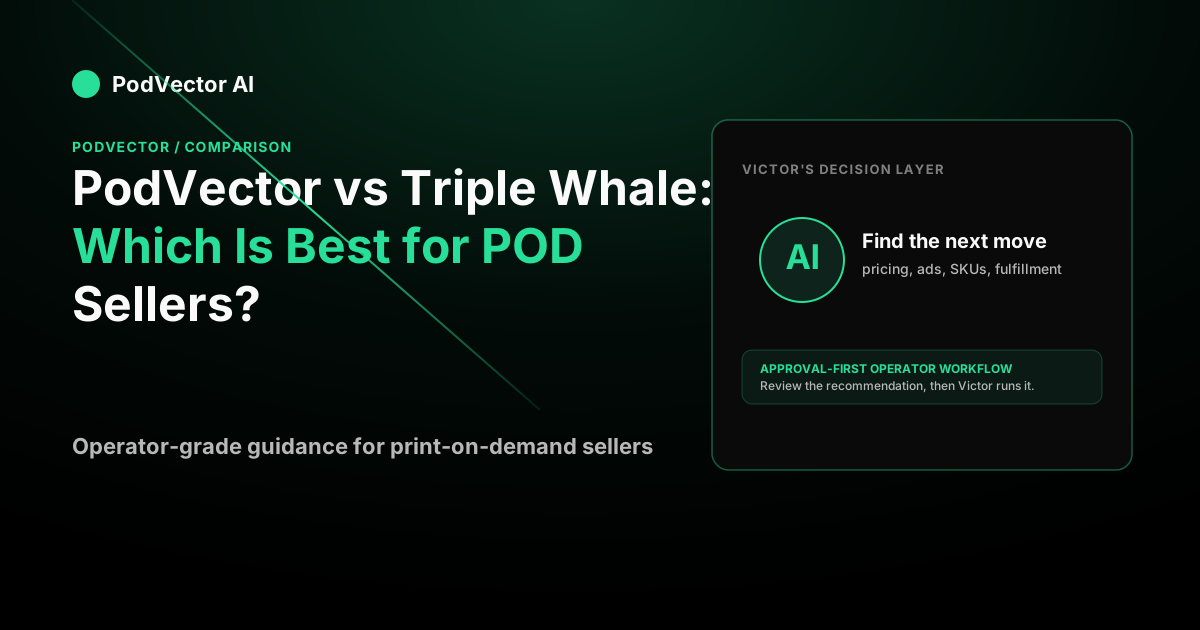
Quick Answer: PodVector AI is the better choice for most print-on-demand (POD) sellers. Triple Whale is a powerful analytics platform, but it shows you charts and leaves the work to you. PodVector AI gives you Victor, an AI employee that reads your Meta and Google ads, updates your Shopify listings, and watches Printify and Printful costs—asking for your approval before each Shopify-side move, and proposing the ad-side moves for you to make.
Triple Whale still wins if you run a large multi-brand store and want deep attribution dashboards with a team to act on them. It starts around $129–$149/month, which is steep at POD's thin margins.
For a solo or small POD operator who wants the work done, not just measured, PodVector AI is the stronger pick. See full features at podvector.ai.
PodVector AI vs Triple Whale at a Glance
Both tools connect to your Shopify store and your ad accounts. From there, they take very different paths.
Triple Whale is an analytics and attribution platform built for direct-to-consumer brands. It pulls your data into one place and shows you dashboards for revenue, ROAS, and customer journeys.
PodVector AI is built around Victor, an AI employee for POD sellers. He reads the same data across Shopify, Meta, Google, Printify, and Printful—then acts on it with your approval.
The short version: Triple Whale tells you what happened. Victor does something about it. You can dig deeper in our PodVector AI vs competitors comparison.
The Core Difference: Operator vs Dashboard
This is the whole decision in one line. Triple Whale is a place to look. PodVector AI is something that works.
With Triple Whale, you open a dashboard, read the numbers, and then go do the work yourself. You pause the losing ad set. You change the price. You update the listing.
With PodVector AI, Victor watches every order, ad dollar, and fulfillment cost in real time. When a campaign starts bleeding margin, he flags it and proposes a fix.
You stay in control. Victor asks before he acts, so nothing changes your store or your spend without a yes from you.
Today, Victor's live write actions are Shopify-side: price changes, discounts, and collection updates. His read and analysis span Meta, Google, Printify, and Printful, and his action coverage is expanding from there.
Feature Comparison
| Feature | PodVector AI | Triple Whale |
|---|---|---|
| Primary role | AI employee that runs your ops | Analytics & attribution dashboard |
| Best for | Solo & small Shopify POD sellers | Larger multi-channel DTC brands |
| Takes action for you | Yes—with approval gates | No—you act on the data |
| Printify + Printful costs | Native, itemized per order | Via generic Shopify cost fields |
| Ad platforms read | Meta, Google (more added over time) | Meta, Google, TikTok, and more |
| Attribution modeling | Operating-profit focused | Deep multi-touch attribution |
| Interface | Chat with an operator | Dashboards & reports |
| Entry price | $29/month | ~$129–$149/month |
Why POD Costs Break Generic Analytics
Most ecommerce analytics tools assume Shopify knows your cost of goods. For a POD store, that assumption is wrong.
Your real cost of goods is your supplier invoice from Printify or Printful, and Shopify never sees it. So a generic dashboard fills the gap with a flat percentage or a number you typed in once.
Here's what that hides. A $24.99 shirt with an $11.42 Printify base cost, $4.50 in ad spend, and $1.50 in Shopify fees can look like a 60% margin in a generic view. The real operating margin is closer to 18%.
PodVector AI pulls the itemized supplier cost for each order from Printify and Printful directly. That means Victor acts on your true margin, not an estimate. We unpack this further in the PodVector AI vs TrueProfit comparison.
Triple Whale can track costs too, but it leans on the same Shopify-side data unless you type in supplier numbers by hand. PodVector AI pulls your Printify, Printful and Gelato costs automatically, before you even make a sale. For POD, that's the same flat-COGS trap.
Pricing Comparison
PodVector AI starts at $29/month for the Starter plan, with full Shopify, Printify, and Printful connectivity plus Meta and Google ad-spend reading. Higher tiers add more ad channels and proactive alerts as you grow.
Triple Whale typically starts around $129–$149/month and climbs past $500/month as order volume rises. That pricing is aimed at brands with bigger budgets and dedicated marketing teams.
At POD's thin unit economics, a $129+ monthly bill eats a real slice of contribution margin. For a store doing a few thousand dollars a month, that math rarely works.
When PodVector AI Wins
Pick PodVector AI if you're a solo or small POD seller who wants the work handled, not just charted.
You'll get an operator that flags losing ad sets, suggests price changes when margins dip, and keeps an eye on every Printify and Printful cost. You approve each material move.
It's also the better fit if you're price-sensitive. At $29/month, it fits a POD budget far more comfortably than a $129+ analytics platform.
For more head-to-head breakdowns, browse our POD tool comparison hub or the full PodVector AI guide library.
When Triple Whale Wins
Triple Whale is the stronger choice for larger, multi-channel brands that live in their data.
If you run real ad budgets across Meta, Google, TikTok, and more, and you have a team to act on insights, its deep attribution modeling is genuinely good. You can read more in this roundup of Triple Whale alternatives.
It's built for brands where the bottleneck is understanding the data, not executing on it. If you already have people to run the ads and update the store, Triple Whale gives them a sharp view.
Switching From Triple Whale
Moving to PodVector AI is straightforward because both tools connect the same way.
You authorize Shopify, your ad accounts, and your POD suppliers once. Victor starts reading your live data and surfacing the first actions within minutes.
You don't lose your numbers—you gain an operator who works them. Instead of opening a dashboard each morning, you get proposed moves you can approve or skip.
FAQs
Is PodVector AI a Triple Whale alternative for print on demand?
Yes. PodVector AI is a strong Triple Whale alternative for POD sellers, especially solo and small Shopify stores. The big difference is that Victor acts on your data with approval, while Triple Whale shows you dashboards to act on yourself.
Does Triple Whale work for POD sellers?
It can, but it's built for larger DTC brands. Its POD supplier costs usually flow through generic Shopify cost fields, so margins can look better than they are unless you add supplier numbers by hand.
Which is cheaper, PodVector AI or Triple Whale?
PodVector AI is cheaper, starting at $29/month versus roughly $129–$149/month for Triple Whale. For thin POD margins, that gap matters.
Can PodVector AI actually change my store or ads?
Victor takes action with your approval. Today his live write actions are Shopify-side—price, discount, and collection updates—while his read and analysis cover Meta, Google, Printify, and Printful. Action coverage is expanding over time.
Do I lose my analytics if I switch?
No. PodVector AI still reads the same Shopify, ad, and supplier data. You just get an operator proposing moves instead of only charts to interpret.
Let Victor Run Your POD Ops—With Your Approval
Triple Whale shows you the chart. Victor does the work. Hand off Meta, Google, and Shopify ops to an AI employee built for POD.
He flags the losing ad set. He proposes the price change. You say yes.
Try Victor free