
Quick Answer: Printful does not publish a public, always-on "free shipping code" for sellers. The codes you see on coupon aggregators are mostly expired, affiliate-padded, or tied to one-off campaigns that lapsed before you searched.
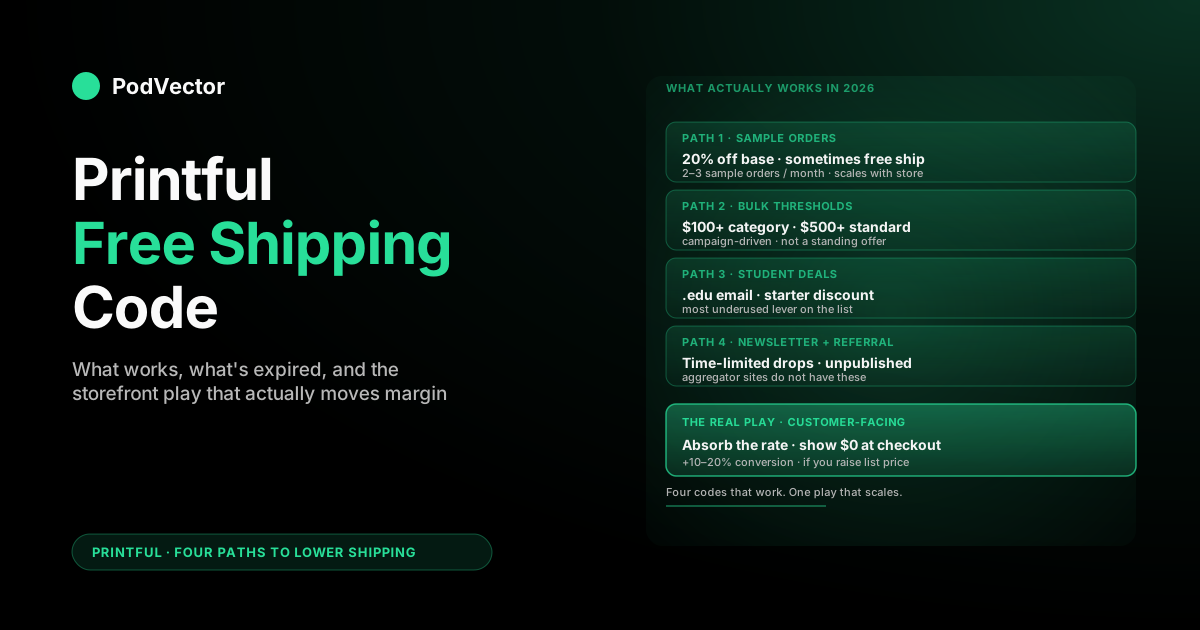
There are four legitimate ways to lower or remove Printful shipping cost on an order: sample orders, occasional bulk thresholds, student deals via .edu emails, and newsletter or referral one-offs. None of them is a stable margin lever you can plan around.
The real "free shipping" play for a POD seller is the one you offer your own customer — you bake the Printful shipping rate into product price and present $0 at checkout. This guide breaks down both sides: the codes that work for your Printful invoice, and the storefront play that actually moves your margin.
What a "Printful free shipping code" actually means
The phrase covers two different searches with two different answers. Most sellers conflate them, and that is why aggregator pages feel useless.
The first search is "give me a code so my Printful invoice has $0 shipping on this order." That code rarely exists in 2026, and when it does it is narrow — tied to a sample order, a specific campaign window, or a bulk threshold most sellers will never hit on a single order.
The second search is "how do I offer free shipping to my customer on a Printful-fulfilled store." That is a storefront and margin question, not a coupon question. The answer is to bake the Printful shipping rate into your product price and display $0 at checkout. It is the move 80% of profitable POD stores already run.
This article covers both. Start with the codes that actually exist, then move to the storefront play that is the real lever. For the underlying cost structure those rates ride on, see Printful pricing: full breakdown for POD sellers.
The four legitimate paths to lower Printful shipping
These are the only paths Printful currently runs that meaningfully reduce or remove shipping cost on the seller side. Anything else you see on a coupon site is noise.
1. Sample orders
Sample orders are Printful's biggest lever for sellers. The program lets you order your own products at a discount to test print quality, color, and fit before listing them. Historically the discount included free shipping and 20% off the base cost on monthly sample orders.
Recent operator reports suggest the free-shipping component on samples is no longer guaranteed in every region. Verify in your dashboard before you assume it. The 20% off base cost is still consistent.
The cap scales with your store. A connected store at any revenue gets two sample orders monthly; stores doing $300+/month get three sample orders monthly with up to four items each. Use them. Sample cost is the cheapest insurance against a refund tidal wave on a new SKU.
2. Bulk-order thresholds
Printful runs occasional free-shipping promos tied to order totals. The two thresholds you will see surface are $100+ on tailor-made or specific categories, and $500+ on standard shipping. Both are campaign-driven, not standing offers.
The realistic use case is bulk production for a flash drop or a wholesale fulfillment run. If you are placing a single order on behalf of a customer who pre-paid for ten units, the $100 threshold can swing into reach and the per-unit shipping math improves materially.
The trap is treating these thresholds as planning anchors. They expire mid-campaign, the eligibility rules shift by region, and a code that worked last week may return "promotion not valid" at checkout today. Check the official Printful deals page before you assume one is live.
3. Student deals via .edu emails
Printful runs a student program for accounts registered with a verified .edu address or a European university email. The program bundles a starter discount and historically included free shipping on the first sample order.
This is the most underused lever on the list. If you have a current student email — yours or a co-founder's — register the Printful account under it. The savings compound across the first 6–12 months of testing, which is exactly when margin is thinnest.
For the broader picture of what you can run on a free Printful account before you start paying for anything, see Printful pricing free account: full breakdown.
4. Newsletter and referral one-offs
Printful periodically drops free-shipping or percentage-off codes through its newsletter and referral program. The newsletter is worth subscribing to because the codes are time-limited and unpublished — aggregator sites will not have them.
Referral codes are the next tier. Existing sellers can refer a new account and both sides receive a one-time credit or shipping discount. The mechanics shift each year. Check the current referral terms in your dashboard before assuming a referral path is live.
None of these four paths gives you predictable free shipping on every order. They reduce specific invoices. The recurring monthly cost line still exists, and ignoring it is what kills margin.
Why coupon aggregators are a waste of time
Search "printful free shipping code" and the first page is a wall of aggregator sites — WorthEPenny, SimplyCodes, ValueCom, DontPayFull, and a dozen clones. They all show 30+ codes. Almost none of those codes work.
The economics explain it. These sites monetize via affiliate clicks, not code validity. They scrape every code Printful or its partners ever published, keep the listings up forever, and rank for the search regardless of whether the codes still redeem. A 65%-off code from 2022 still pulls clicks in 2026.
There are three tells that a listed code is dead. The "verified" badge is purely cosmetic — almost every aggregator marks every code "verified" by default. The "X people used today" counter is a randomized number from the templating engine. And the success-rate percentage refreshes hourly without any human verifying anything.
The safer path is to skip aggregators entirely and check three direct sources. The Printful deals page at printful.com/deals lists current campaigns. Your dashboard surfaces personal codes (sample order, student, referral). The Printful newsletter drops time-limited codes nobody else has.
If you still want to try an aggregator code, the test costs nothing — drop it into checkout, watch the line item. If shipping zeroes out, great. If it does not, you wasted 30 seconds. Just do not build a margin plan around that lottery.
The real free-shipping play: offer it to your customer
This is where most POD sellers stop searching for codes and start running the actual lever. "Free shipping" as a customer-facing offer is not Printful giving you a discount — it is you absorbing the standard Printful shipping rate into product price and showing $0 at checkout.
The psychology is well-established. Customers convert at materially higher rates when shipping is presented as free, even when the total price is identical to a version with itemized shipping. The conversion lift is real on impulse buys and apparel under $40.
Two flavors exist. Unconditional free shipping bakes the rate into every product price, every time. Threshold-based free shipping (free over $X) lifts average order value by pushing customers to add a second item to clear the bar.
Printful's own playbook on this is solid — see their guide on using free shipping to increase average order value. The framing is the same one we recommend: shipping is a marketing decision, not a logistics line item.
The trap is doing this without knowing your per-SKU shipping cost. A $4.39 US-domestic rate on a $24 t-shirt with $7 base cost leaves you a $4.61 gross margin if you absorb shipping at $24 list. That is a thin line and the moment Printful raises rates by $0.50 you are eating it. The reframe in our honest Printful print on demand services review walks through the same trap from the platform-evaluation angle.
Setting up free shipping in Shopify with Printful fulfillment
The setup is straightforward but most sellers get the rate-table piece wrong and end up with phantom shipping charges on checkout.
The flow in plain English:
- Step 1. In Shopify admin, open Settings → Shipping and delivery → Shipping. Find the shipping profile your Printful products use.
- Step 2. In each shipping zone you serve (US, EU, UK, ROW), add a rate called "Free shipping" with a price of $0. Set the condition to "Based on order price" with a minimum of $0 if unconditional, or your threshold if threshold-based.
- Step 3. Disable any inherited Printful "Flat rate" or "Calculated" shipping options on the same zone. Two visible options at checkout = a confused customer.
- Step 4. Raise product prices to absorb the Printful shipping rate. For a $4.39 US-domestic tee rate, add roughly $5 to the list price as a buffer for rate variance.
- Step 5. Place a test order from an unrelated IP. Confirm checkout shows $0 shipping and the Printful order in your dashboard charges you the standard rate.
The phantom-charge bug usually traces to either a leftover Printful "calculated" rate that returns a $4 fee alongside your $0 rate, or a shipping profile mismatch where some products are on the Printful profile and some on the default. Audit both before you ship the change.
For the broader plan-tier context — what features Shopify expects to be on the Printful side versus yours — see Printful pricing free plan: full breakdown.
Margin math: what free shipping actually costs you
Free shipping is never free. Either you absorb the rate into price (margin hit), or you eat it on top of the existing margin (worse margin hit). The question is which of the two costs you less.
Run the math on a single SKU. A unisex t-shirt with $7 base cost, $4.39 US-domestic shipping, sold for $24 retail. Itemized shipping at checkout: $24 list - $7 base = $17 contribution before fees, customer pays the $4.39 themselves. Absorbed into price: $29 list - $7 base - $4.39 shipping = $17.61 contribution.
The two options come out roughly the same on margin if you price them correctly. The difference shows up in conversion. The $29 absorbed version typically converts 10–20% better than the $24+$4.39 itemized version because the customer reads "free shipping" before they read the price.
The trap is the seller who absorbs without raising prices. $24 list - $7 base - $4.39 shipping = $12.61 contribution. That is a 24% margin hit on every order, and most sellers do not realize they are running it until the monthly P&L lands.
The other trap is international. A US-fulfilled order shipped standard to Germany can cost $9–$14. Absorbing that into a US-priced $24 tee means international orders are net losses. The fix is geographic price differentiation or excluding international from the free-shipping offer.
For the per-SKU cost lines that drive this math, see the Printful costs and charges cluster hub. The piece-by-piece breakdown is what tells you which SKUs can carry free shipping and which cannot.
Tracking shipping cost per order so it does not eat margin
Most POD sellers run free shipping for six months, then discover they are net negative on apparel because Printful raised standard rates by $0.40 across the catalog and nobody updated the absorbed buffer.
The fix is itemized tracking. Every Printful invoice line breaks out base product, shipping, fulfillment, and any add-ons separately. The data is there — the question is whether you are reading it.
The dataset you actually want, per order: order_id, product_sku, base_cost, shipping_cost, route, sale_price, displayed_shipping_to_customer (0 if free), realized_margin. Six fields. With them you can compute per-SKU and per-route contribution margin, then alert when Printful rate changes push a SKU below your target.
The tracking does not have to be fancy. A weekly CSV export from Printful into a spreadsheet, joined to your Shopify order export, gives you the baseline. The risk with a spreadsheet is staleness — by the time you notice a margin drift, you have shipped 200 orders at the new bad rate.
Live tracking is the upgrade. Webhook ingestion of every Printful invoice and Shopify order into a unified data warehouse means margin drift triggers an alert the same day Printful changes a rate, not at month-end close.
For the comparison angle on how Printful's shipping itemization stacks up across the platform, see our Printful print on demand service review. The full Printful topic hub indexes the rest of the cost and operations deep-dives.
FAQs
Is there a working Printful free shipping code right now?
Not as a general standing offer. Sample orders, occasional bulk thresholds, student deals, and newsletter drops are the four paths that can produce free shipping on a specific Printful invoice. Check the Printful deals page and your dashboard for any campaign currently live.
Why don't the coupon aggregator codes work?
Most are expired. Aggregator sites monetize via affiliate clicks and keep dead codes listed indefinitely. The "verified" and "X people used today" labels are template defaults, not real validation. Test directly at checkout if you want to try one — it costs nothing — but do not plan around any of them.
Does Printful give free shipping on sample orders?
Historically yes, paired with 20% off base cost. Recent operator reports suggest free shipping on samples is no longer guaranteed in every region. The 20% off is still consistent. Verify in your dashboard before placing the order.
What is the bulk threshold for free shipping on Printful?
Printful runs occasional promos at $100+ on specific categories and $500+ on standard shipping. Neither is a standing offer. The promos appear on the deals page during active campaigns and disappear when the campaign ends.
Should I offer free shipping to my customers on Shopify?
Usually yes, if your product margins support absorbing the Printful shipping rate into price. Customers convert at materially higher rates when shipping reads as $0 at checkout. The trap is forgetting to raise list price to cover the absorbed rate.
How do I avoid losing money on international free shipping?
Either exclude international from the free-shipping offer entirely, or differentiate prices by geographic zone. A US-fulfilled tee shipped standard to Germany can cost $9–$14, which a $24 US-priced absorbed-shipping SKU cannot carry.
Do student deals still include free shipping?
The student program bundles a starter discount, and historically the first sample order included free shipping. Coverage varies by region. Register the account with the .edu email and check the dashboard for current terms before assuming.
What's the safe way to test a free shipping code I found online?
Add an item to cart, enter the code at checkout, watch the shipping line. If it zeroes out, the code is live. If it errors or does nothing, move on. You are not committing to the order until you confirm payment, so the test is risk-free.
Stop guessing whether free shipping is actually working for your margin
Most POD sellers absorb the Printful shipping rate into product price and never look again. Then Printful raises standard rates by $0.40 across the catalog, and the seller ships 200 orders at the new bad margin before noticing.
Victor is an AI business operator for your POD store. He reads your live Shopify and Printful data, computes per-SKU contribution margin including shipping absorption, flags which products dropped below your target after the last rate change, and proposes the exact price adjustment to restore margin. Once you approve, he can update Shopify prices and discounts directly.
It is the three legs together — a POD playbook baked into the agent, a live connection to your store data, and the ability to act on it — that turns "free shipping" from a guess into a tracked margin lever.
Try Victor free