
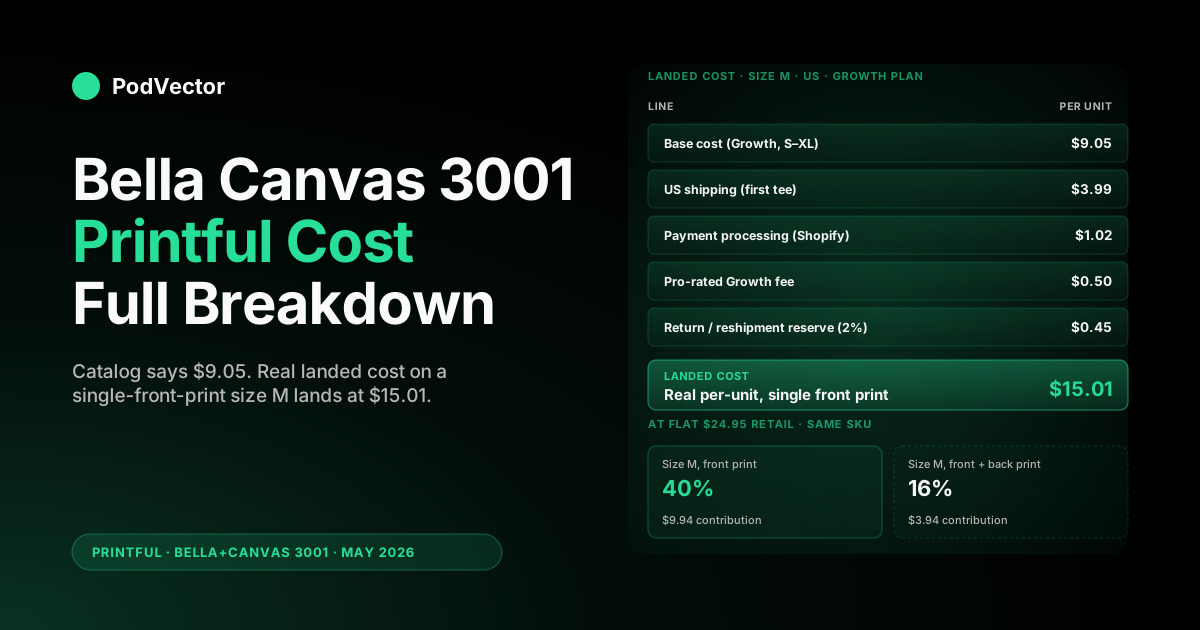
Quick Answer: According to Printful's published catalog, a Bella+Canvas 3001 on Printful costs $11.50 (size M, one front DTG print) on the free plan, with the Growth plan cutting production costs by up to 33%. That headline base doesn't include shipping (domestic US starts at $4.75 for shirts per Printful), 2XL+ size upcharges, or extra placements like a back print (+$5.95) or sleeve (+$2.95). Real landed cost after shipping, payment processing, and plan fees is materially higher than the catalog number.
This breakdown walks every line on a 3001 invoice, the plan-tier math, and the retail price you actually need to charge in 2026 ad-cost reality.
You picked the 3001 — here's what Printful will charge
If you're building a POD store and you've landed on the Bella+Canvas 3001 as your hero tee, you've already made the right call for most US lifestyle and streetwear niches. The 3001 is the most-printed POD blank in the Bella+Canvas catalog for a reason.
What's harder is pinning down what the tee actually costs you per order. Printful's product page shows one number. Printify shows a different one. Your invoice shows a third, with extra lines you didn't budget for.
This guide builds the real per-3001 cost from the ground up. Every line that hits an invoice — base, size, placement, shipping, plan tier — broken down with the 2026 numbers and the margin math each line drives.
Headline base price vs real invoice line
The single most common pricing mistake on the 3001 is anchoring on the catalog's base price and ignoring everything else. Three sample 3001 orders, same SKU, same plan tier, same retail tag — and the real per-unit cost can swing significantly depending on how the order falls.
Here's why the spread is so wide:
- Catalog base covers the blank, one front print, and Printful's handling. According to Printful's published catalog (as cited on Printful's blog), a size M Bella+Canvas 3001 with one front DTG print runs $11.50 before any plan discount.
- Size upcharges kick in at 2XL and climb through 5XL. If your audience skews large, your average unit cost is structurally higher than the catalog implies.
- Print placements beyond the front print are itemized. A back print adds $5.95, each sleeve adds $2.95, and label prints add further cost on top.
- Shipping is a separate line — domestic US shipping for shirts starts at $4.75 per Printful, climbing for international destinations.
- Plan tier changes the base itself. Printful's Growth plan cuts production costs by up to 33% according to Printful's own published guidance.
The "real" 3001 cost lives at the intersection of all five. We work each line below, then put them together into landed-cost scenarios.
Free vs Growth vs Business: the only number that matters
Printful's plan tier sets your 3001 base price for every order. According to Printful's published catalog (as cited on Printful's blog), the base cost for a size M Bella+Canvas 3001 with one front DTG print is $11.50 before plan discounts. Printful states the Growth plan cuts production costs by up to 33%, putting a Growth-plan 3001 in the range of approximately $7.71–$7.85 on that same M size. The Business plan layers an additional discount on top of Growth for stores at qualifying sales thresholds.
| Plan | Monthly fee | Production cost discount | Free at trailing annual sales |
|---|---|---|---|
| Free | $0 | None | — |
| Growth | $24.99 | Up to 33% off production (per Printful) | $12,000 |
| Business | $49.99 | Additional % on top of Growth | $150,000 |
The Growth tier is the inflection point for most active stores. At a $24.99 monthly fee and a per-unit discount of several dollars on every 3001 shipped, the plan pays for itself quickly once any meaningful order volume flows through the account. Growth also unlocks discounts on every other blank in the catalog, not just the 3001.
The Business plan ($49.99/mo) layers another discount tier on top of Growth, plus design transfer storage and sample credits. Stores doing $150k+ trailing annual sales get Business free, and the per-unit gap compounds fast at six-figure volume.
For the full plan-cost picture across all Printful tiers and what each unlocks, see our Printful Plus membership price and benefits breakdown.
2XL through 5XL upcharges
Catalog base covers XS–XL. Sizes above XL carry a flat per-unit upcharge that scales with the size. The upcharge structure below reflects Printful's published catalog tiers; verify current amounts in your Printful dashboard before finalizing pricing:
| Size | Upcharge (above XL base) | Notes |
|---|---|---|
| XS–XL | Base price | No upcharge |
| 2XL | +$2.50 | Most common extended-size order |
| 3XL | +$3.50 | |
| 4XL | +$5.50 | |
| 5XL | +$6.50 |
If you're selling the 3001 at a single flat retail price across all sizes — Shopify's default behavior — every 2XL+ order is partially subsidized by the S–XL pool. When a significant share of your orders skew large, this materially compresses average margin on the SKU.
The fix is straightforward: set per-variant retail pricing that mirrors the upcharge. Printful's Shopify sync supports per-variant pricing natively, but you have to enable it in the integration — it's not on by default.
Most POD stores never set this up. The result is a quiet margin leak on the volume SKU that only shows up when you look at per-variant contribution data.
Back, sleeve, and label print costs
The 3001 base buys one front DTG print. Every extra placement is itemized on top, identical across plan tiers. According to Printful's catalog, embroidery on the 3001 runs $14.50 plus a $6.50 digitization fee; DTG placements beyond the front are priced as follows:
| Placement | Add-on cost | Running total (on top of base) |
|---|---|---|
| Front print (included) | $0 | Base only |
| + Back print | $5.95 | Base + $5.95 |
| + Left sleeve | $2.95 | Base + $8.90 |
| + Right sleeve | $2.95 | Base + $11.85 |
| + Outside label (neck) | $2.49 | Base + $14.34 |
| + Inside label | $0.99 | Base + $15.33 |
The single highest-impact margin decision on the 3001 is whether to add a back print. A back print "to look more premium" costs $5.95 of contribution margin per unit, every order, forever. At a sub-$30 retail, that can convert a healthy contribution margin into a thin one — and the situation worsens once ad spend layers in.
The working rule: any placement beyond the front print needs a retail bump of at least 1.5× the placement cost to recover the margin loss plus the extra payment processing fee on the higher revenue.
Sleeve prints are smaller but compound the same way. A front + back + dual-sleeve design eats $11.85 of contribution before shipping. That design needs a materially higher retail to keep a workable margin in any ad-driven niche.
Embroidery is a separate pricing track entirely: according to Printful's blog, embroidery on the 3001 costs $14.50 for one area plus a one-time $6.50 digitization fee, or $18.25 for unlimited-color embroidery plus the same digitization charge. If you're running embroidered 3001s as a premium line, verify current embroidery pricing in your Printful dashboard — these rates update periodically.
Shipping cost by region
Shipping is a separate line on every Printful invoice. Domestic US shipping for shirts starts at $4.75 per Printful. International shipping has different price points by delivery zone. Printful's 3001 shipping is structured as a first-tee fee plus a smaller add-on per additional tee in the same order. The regional tiers below reflect Printful's published rates — always confirm in your dashboard, as these update periodically:
| Destination | First tee (approx.) | Each additional |
|---|---|---|
| US (domestic) | $4.75+ | $1.25–$1.75 |
| Canada | $5.99+ | $1.75+ |
| UK | $3.99+ | $1.25+ |
| EU (most countries) | $4.99+ | $1.50+ |
| Australia / NZ | $8.99+ | $2.50+ |
| Rest of world | $10.99–$14.99 | $3.00–$4.00 |
The structural consequence of zone-flat shipping: single-tee international orders are brutal on margin. A high shipping line on an international single-tee order can nearly equal the unit cost of the tee itself. International AOV needs to clear multiple units to keep contribution positive on most rest-of-world corridors.
The fix isn't blocking international orders — it's setting a country-level shipping surcharge in Shopify (or a free-shipping threshold that pushes international buyers toward multi-unit orders) so the per-order shipping line doesn't quietly compress contribution.
US fulfillment routes from California or North Carolina based on the destination zip, but the price is identical from either center. For the full picture on how hidden cost lines beyond shipping kill POD profits, see our guide on the hidden costs that kill POD profits.
Three landed-cost scenarios
Catalog math is one number. Landed cost is the number that determines whether the SKU clears profit. Three real scenarios on a US-fulfilled 3001, using Printful's published base of $11.50 for a size-M one-front-print tee (free plan; Growth plan applies a discount of up to 33% per Printful's guidance):
Scenario A: single-front-print, size M, US destination, Growth plan
- Base cost (Growth plan, up to 33% off $11.50 per Printful): approximately $7.71
- Shipping (US domestic, per Printful): starting at $4.75
- Payment processing (Shopify, standard rate on ~$27.95 retail): approximately $1.11
- Pro-rated Growth fee (estimate, active store): approximately $0.50
- Return / reshipment reserve: approximately $0.50
- Estimated landed cost: ~$14.57
- Contribution at $27.95 retail: ~$13.38 (~48%)
Scenario B: size 2XL, flat retail same as size M
- Base cost (Growth plan, size 2XL = base + $2.50 upcharge): approximately $10.21
- Shipping: approximately $4.75
- Payment processing: approximately $1.11
- Pro-rated Growth fee: approximately $0.50
- Return reserve: approximately $0.50
- Estimated landed cost: ~$17.07
- Contribution at flat $27.95: ~$10.88 (~39%) — margin compression vs. size M is visible
Scenario C: front + back print, size M, US, Growth plan
- Base cost (Growth plan, size M): approximately $7.71
- Back print add-on: $5.95
- Shipping: approximately $4.75
- Payment processing: approximately $1.11
- Pro-rated Growth fee: approximately $0.50
- Return reserve: approximately $0.50
- Estimated landed cost: ~$20.52
- Contribution at flat $27.95: ~$7.43 (~27%)
Same SKU, same plan, same retail tag — and contribution swings substantially depending on size and placements. That spread is invisible from the catalog view. It only surfaces when you look at invoice-level data per order.
Scenario C becomes structurally thin once ad spend layers in. A contribution margin in the high-20s needs a very low cost-per-acquisition to break even, which is unrealistic in most competitive Meta or Google audiences. The fix is either raising retail on back-print designs or stripping the back print entirely.
3001 vs cheaper alternatives in the Printful catalog
According to Seller Mockups' 2026 3001 guide, the Printful price for the 3001 is approximately $11.50, versus approximately $6.95 for the Gildan 5000, approximately $14.00 for the Comfort Colors 1717, and approximately $10.00 for the Next Level 3600. According to Printful's own blog, the Next Level 3600 runs $16.25 on Printful — confirm your dashboard for the current figure, as Printful's blog posts may reflect pricing at the time of publication.
| SKU | Tier | Approx. base (size M) | Source |
|---|---|---|---|
| Gildan 5000 Heavy Cotton | Budget | ~$6.95 | Seller Mockups 2026 |
| Bella+Canvas 3001 | Mid / premium staple | ~$11.50 | Printful / Seller Mockups 2026 |
| Comfort Colors 1717 | Premium / pigment-dyed | ~$14.00 | Seller Mockups 2026 |
| Next Level 3600 | Premium alternative | ~$10.00–$16.25 | Seller Mockups 2026 / Printful blog |
The 3001's premium over the Gildan 5000 is the most-debated line in POD tee modeling. According to Seller Mockups, the 3001 costs more but delivers a better customer experience — softer fabric, better fit, and sharper prints — and if you're selling premium designs, "the 3001 pays for itself in fewer returns." Lifestyle, streetwear, gift, and design-led niches generally perform better on the 3001. Workwear and price-led utility niches often do better on the Gildan 5000. Run a 14-day split test on the same design in your niche to find your store's actual number.
According to Seller Mockups' 2026 guide, the 3001 is available in 100+ colors versus 60+ for the Gildan 5000, 70+ for the Comfort Colors 1717, and 40+ for the Next Level 3600 — color breadth that matters when you're building a multi-SKU catalog.
If you're still deciding between Printful and Printify for the 3001, see our Printify Premium subscription price breakdown and our Printify Premium promo code guide for the cost side of the equation on the Printify platform.
For a direct Printful-side cost reference, see our Printful Bella+Canvas 3001 price and base cost breakdown.
The 2026 retail price the 3001 actually needs
Using the Growth-plan landed cost scenarios above, here is how different retail price points map to contribution margin on a single-front-print size-M 3001 shipping domestically in the US:
| Retail price | Est. contribution $ | Est. contribution % | Best fit |
|---|---|---|---|
| $19.95 | ~$5.38 | ~27% | Aggressive organic-only niches |
| $24.95 | ~$10.38 | ~42% | Standard POD anchor price |
| $27.95 | ~$13.38 | ~48% | Defensible 2026 ad-driven floor |
| $29.95 | ~$15.38 | ~51% | Lifestyle and design-led brands |
| $34.95 | ~$20.38 | ~58% | Premium positioning, licensed designs |
Many POD pricing articles still anchor at $24.95 because that was the workable retail floor in 2021–2022. Ad costs have climbed since then. A $24.95 retail on a 3001 produces a contribution margin that needs to absorb a competitive cost-per-acquisition on Meta or Google — and the math gets tight fast.
According to Seller Mockups' 2026 guide, a common retail range for the 3001 runs $22–$32 depending on niche, design complexity, and brand positioning. The honest 2026 floor for an ad-driven 3001 store is closer to $27.95. Lifestyle and design-led stores can often push higher — the 3001's perceived quality supports a price band well above budget blanks. If you anchor at $24.95 because "that's the POD price," your margin is doing older math against today's ad costs.
For context on how Google Ads campaign structure interacts with POD margin on Shopify, see our Shopify Performance Max campaigns guide for print-on-demand.
Tracking real per-order 3001 cost
Knowing one 3001's catalog cost is the easy half. The harder half is keeping that cost current as the Printful catalog adjusts, and tying it to the actual orders flowing through your store.
Three structural problems with the spreadsheet approach:
- Printful adjusts apparel base prices periodically. Older quotes go stale, and updated bases need to flow into your margin model without manual re-entry.
- Real per-unit cost depends on the size mix, the placement mix, and the destination mix of your actual orders. The "average 3001 cost" in a spreadsheet rarely matches the per-invoice cost on shipped orders.
- Hidden lines (address-correction fees, reprint reserves, return shipping) add cost per order on top of the modeled figure. Operators usually discover these in arrears, after the margin has already slipped.
The fix is to keep landed cost in one live system, tied to the actual invoice and order stream — not a snapshot in a sheet. PodVector's AI employee, Victor, reads your Shopify orders, Printful invoice data, and payment processor fees into a live data warehouse for your store.
You can ask Victor "what was my real per-unit contribution on Bella+Canvas 3001 orders last month, broken out by size and placement?" and get a live answer built from the current period's invoice data — not a static dashboard frozen at month-end. Victor can also propose specific Shopify actions in response: per-variant retail pricing on 2XL+ to recover the upcharge, a free-shipping threshold to drive bundling, or a price bump on the back-print designs that drifted below your margin floor. Each proposal waits on your approval — Victor never acts without it.
For the broader picture on how AI can surface these moves faster, see our POD seller's guide to AI automation for ecommerce. And for a full view of the hidden cost lines that erode POD profits beyond the Printful base, see our guide on the hidden costs that kill POD profits — shipping, ads, refunds, and fees.
FAQs
How much does a Bella Canvas 3001 cost on Printful in 2026?
According to Printful's published catalog (as cited on Printful's blog), a size M Bella+Canvas 3001 with one front DTG print costs $11.50 on the free plan. The Growth plan cuts production costs by up to 33% per Printful's guidance. None of those figures include shipping (domestic US starts at $4.75 for shirts per Printful), 2XL+ size upcharges, or extra placements.
What's the real landed cost of a 3001 after fees?
A size-M, single-front-print 3001 on the Growth plan shipping in the US lands at roughly $14–15 per unit after shipping, payment processing, pro-rated plan fee, and a return reserve. At a $27.95 retail that leaves approximately 48% contribution margin before ad spend — check your own invoice data for the precise figure, since size and destination mix shifts the number.
Should I pay $24.99/month for the Growth plan just for the 3001 discount?
Yes, for most active stores. Printful states the Growth plan cuts production costs by up to 33%. That per-unit saving stacks across every blank in the catalog, not just the 3001 — so the $24.99 monthly fee pays for itself quickly once any meaningful order volume flows. Growth also discounts every other blank in your catalog simultaneously. See our Printful Plus membership breakdown for the full plan comparison.
What's the size upcharge on a 2XL Bella+Canvas 3001 at Printful?
+$2.50 on top of the S–XL base. 3XL is +$3.50, 4XL is +$5.50, 5XL is +$6.50. If large sizes make up a meaningful share of your orders, set per-variant retail pricing in Shopify to recover the upcharge and prevent margin compression on your highest-volume SKU.
How much does adding a back print to the 3001 cost?
+$5.95 on top of the base, identical across plan tiers. A front + back 3001 on the Growth plan runs meaningfully higher than a front-only tee once shipping and fees are added. At a moderate retail price, the margin on a front + back design gets thin fast once ad spend layers in. Consider raising retail on back-print designs or stripping the back print entirely if margin is tight.
Does Printful charge extra for dark colors on the 3001?
No. According to Printful's catalog, all stocked 3001 colors — including dark colorways — hit the same base production price. The only practical consideration is print quality: white ink on dark garments requires a DTG under-base process, which can affect vibrancy. Budget a slightly higher reprint reserve on dark 3001 orders versus white or light garments.
How does the 3001 compare to the Next Level 3600 on Printful?
According to Printful's blog, the Bella+Canvas 3001 is priced at $11.50 versus $16.25 for the Next Level 3600 — a meaningful gap that makes the 3001 the default choice for margin-conscious POD stores. The Next Level 3600 offers a similarly modern fit and soft hand, but at a higher base that compresses contribution on any retail price below $32. Unless your brand positioning explicitly commands a premium, the 3001 is the stronger unit-economics choice.
What retail price should I charge for a Bella Canvas 3001 in 2026?
The defensible 2026 floor for ad-driven stores is around $27.95. According to Seller Mockups' 2026 guide, a typical retail range runs $22–$32 depending on niche and brand positioning. Lifestyle or design-led brands can typically push toward the upper end of that band — the 3001's perceived quality relative to budget blanks supports a wider price spread. The $24.95 anchor that circulates in older POD guides was built for an earlier ad-cost environment; your margin needs to cover today's CPMs, not 2021's.
Is the Bella Canvas 3001 worth the extra cost vs. the Gildan 5000?
Niche-dependent. According to Seller Mockups' 2026 guide, the Gildan 5000 runs approximately $6.95 versus approximately $11.50 for the 3001 on Printful — a difference of roughly $4.55 per unit. Lifestyle, streetwear, and gift niches generally perform better on the 3001 due to its softer hand and modern fit. Price-led utility niches (workwear, basic logos) often do better on the Gildan 5000. Run a split test on the same design in your niche to know your store's actual conversion difference. For a deeper look at how PodVector surfaces per-SKU margin data to guide decisions like this, see our PodVector strategy overview.
Know your real 3001 cost — not the catalog one
Catalog shows one number. Your invoice shows another after size upcharges, placements, shipping, and the address-correction fees nobody warned you about.
PodVector's AI employee Victor reads your Shopify orders, Printful invoices, and payment fees into a live data warehouse, then surfaces which 3001 variants dropped below margin and proposes Shopify actions to fix it — per-variant retail pricing, free-shipping thresholds, buy-one-get-one discounts — all executable on your approval.
Try Victor free