
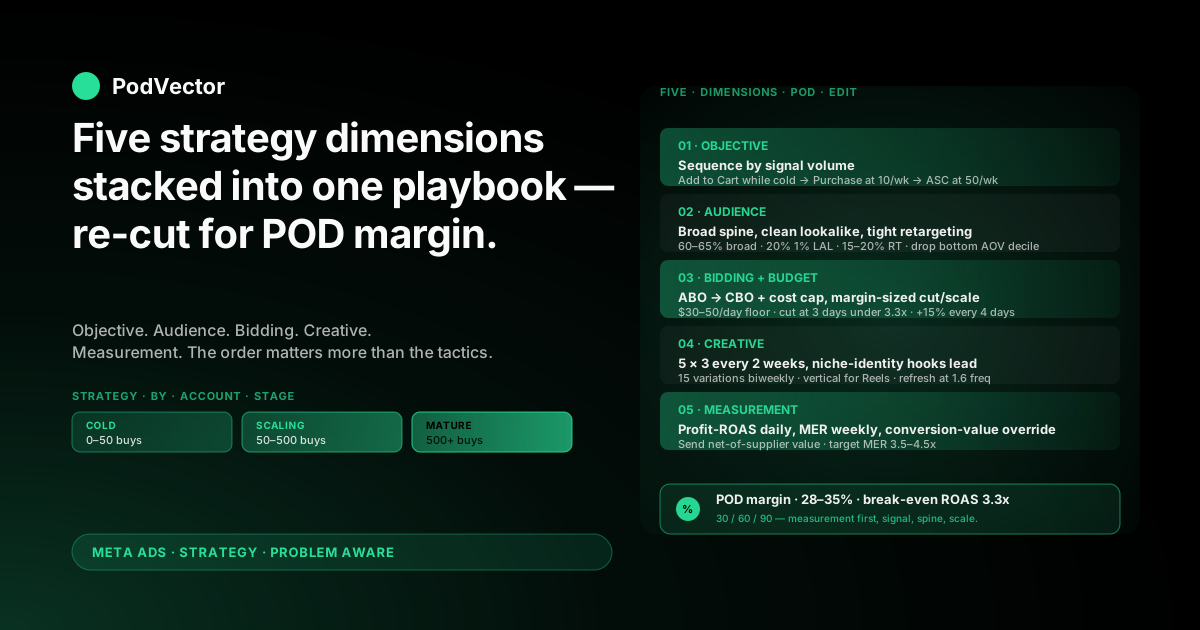
Quick Answer: A Shopify Facebook Ads strategy is five strategy decisions stacked on top of each other — objective, audience, bidding, creative, measurement. For owned-inventory stores at 50–60% gross margin, defaults on each one work fine.
Print-on-demand sits at 28–35% contribution margin after Printify or Printful supplier cost. Each of the five strategy layers needs a POD-specific edit, or the account quietly burns budget against signal that doesn't reflect your P&L.
This playbook walks each strategy dimension in order, names the POD edit, then assembles the five into an account roadmap by maturity stage (cold → scaling → mature). Skip to strategy by account stage if you already have a working account.
Why "strategy" matters more on POD than owned inventory
The top-ranking 2026 strategy guides — Shopify's Facebook Advertising overview, AdRoll's scaling playbook, and JoinBrands' 16-step guide — converge on a similar shape. Install the Pixel. Layer Conversions API. Build a funnel. Use lookalikes. Test creative. Set a 2.5x–3x ROAS target.
That shape is correct for owned-inventory Shopify stores. The numbers underneath assume 50–60% gross margin, which makes most strategic choices tolerant. A mediocre audience segment at 55% margin still profits if your creative is decent.
Print-on-demand removes that tolerance. Contribution margin sits at 28–35% after Printify or Printful supplier cost (base garment + decoration + shipping). Each strategic layer that works "well enough" on owned inventory becomes the line between profit and loss on POD.
The five dimensions below are not a list of tactics. They are the five places where one decision compounds into months of account behaviour — and where the generic Shopify-Facebook playbook's defaults quietly lose POD operators money.
Dimension 1: Objective strategy
Meta gives you eleven campaign objectives. The strategic question is which to optimise against, in what order, as the account matures.
The default playbook
Most Shopify Facebook Ads guides recommend going straight to a Sales objective with Purchase optimisation. For a brand-new account with zero conversion history, that's a strategic mistake — Meta needs roughly 50 Purchase events per ad set per week to escape the learning phase. A new POD account on $40/day spend won't hit that floor for a month.
The POD strategy
Sequence objectives by signal volume. Two patterns work in practice:
- 0–10 purchases/week: Optimise for Add to Cart on a Sales campaign, with broad targeting. Add to Cart fires 4–6x more often than Purchase, so Meta gets enough events to learn against. You're trading off some attribution accuracy for learning speed.
- 10–50 purchases/week: Switch to Purchase optimisation on the same Sales campaign. Keep targeting broad. Don't change creative concurrently — change one variable at a time so you can attribute the lift.
- 50+ purchases/week: Add an Advantage+ Shopping Campaign in parallel to manual prospecting. ASC needs the conversion volume to work; before then it just spends money in a black box.
The objective nobody recommends but should
Engagement objective on a Reels-format video, capped at $5–$10/day, run alongside your Sales campaign. Reels CPM is 40–60% lower than feed CPM in 2026, and you're seeding the algorithm with audience signal cheaply. Reels engagement converts to Purchase audiences at roughly 8–12% rate — enough to materially compound a lookalike build.
Dimension 2: Audience strategy
Audience strategy on Meta has shifted significantly since 2023. Targeting precision matters less; signal quality matters more.
The default playbook
Stack 5–10 interest groups (e.g. "dog owners" + "Etsy shoppers" + "Shopify users") into one ad set with a 200,000–2M-person audience. This was the right move pre-Advantage+. It's no longer competitive in 2026.
The POD strategy
Three audience tiers, ordered by leverage:
- Broad (60–65% of spend): No targeting except country and age. Meta's algorithm is better at finding niche-design buyers than your interest stack is. The 2026 SERP top three all confirm broad is the new default for prospecting.
- 1% Purchase Lookalike (20% of spend): Built on a cleaned customer list — drop the bottom AOV decile (often coupon-stack one-and-done buyers) before uploading. A lookalike trained on coupon buyers scales to more coupon buyers, which is the worst kind of growth on a margin-constrained POD account.
- Retargeting (15–20% of spend): View Content (3 days), Add to Cart (3 days), Initiate Checkout (1 day). Cap frequency at 1.5–2.0 impressions per week. POD audiences saturate faster than owned-inventory audiences because design-led niches are smaller.
The audience strategy nobody talks about
Build a "buyers of design X" custom audience for every breakthrough design in your catalog. When you launch a thematically adjacent design (same niche, same colour palette, same cohort identity), seed it against that custom audience for the first 3 days before going broad. Cold-start CPA drops 30–40%.
Dimension 3: Bidding and budget strategy
Most published guides hand-wave this dimension as "set it and forget it with Advantage+ Budget." That works for owned inventory. POD margin sensitivity demands more deliberate choices.
The default playbook
Use Campaign Budget Optimisation (CBO — Meta lets the algorithm distribute spend across ad sets). Set a daily budget at the campaign level. Let Meta decide which ad set wins.
The POD strategy
Mixed CBO/ABO based on what you're trying to learn. Ad Set Budget Optimisation (ABO — manual budget per ad set) for the first 14 days, so you can read clean per-audience signal. Then CBO once you have at least one ad set proven above 4.0x profit-ROAS.
Budget floor for a POD account: $30–$50/day per active ad set. Lower than $30 and Meta can't gather enough signal in a 7-day window to optimise meaningfully. Higher than $50 in week one risks overspending on un-validated creative.
The bid strategy that actually matters
Cost cap. Most guides recommend Lowest Cost (the default). Lowest Cost asks Meta to spend the budget at any cost-per-result. Cost cap sets a ceiling on what you're willing to pay per Purchase.
For a POD store at 30% margin and a $30 AOV, your break-even cost-per-purchase is roughly $9. Set a cost cap at $7 once you have 30+ Purchase events of training data. It will spend less budget some days, but the budget it spends will be profitable.
Scale and cut rules
| Decision | Owned-inventory rule | POD rule |
|---|---|---|
| Scale ad set | +20% every 3 days when above 2.5x ROAS | +15% every 4 days when above 4.0x profit-ROAS |
| Cut ad set | 7 days under 1.8x ROAS | 3 days under 3.3x profit-ROAS, $30 spend floor |
| Pause creative | 1.6+ frequency or 14 days | 1.6+ frequency or 10 days |
Tighter cut windows on POD. Margin doesn't tolerate the 7-day generic Shopify cadence — you bleed 30–40% more on losing ad sets than the rule allows.
Dimension 4: Creative strategy
The single biggest strategic edge POD has over owned inventory is creative velocity. You can ship a new design in an hour. You can ship a new hook on the same design in fifteen minutes. The strategy is to lean on it hard.
The default playbook
One brand video per quarter. Two static product shots. Maybe a UGC video if you find an influencer.
The POD strategy: 5×3 every two weeks
Five product concepts × three opening hooks each = 15 creative variations every two weeks. Run them as Advantage+ Creative tests so Meta auto-allocates budget toward winners.
Hook taxonomy that works on POD:
- Niche-identity hook: "If you've ever pulled a 14-hour shift at the bedside, this one's yours." Speaks directly to the cohort the design serves. Out-performs price-led hooks by 30–50% on hook rate.
- Social-proof hook: "3,400 nurses already wear this." Works once you have enough volume to credibly cite numbers.
- Design-detail hook: "Look at the embroidery on this — it's not a print." Useful for premium-positioned product lines (embroidered hoodies, all-over-print sublimation).
Discount-led hooks ("20% off this weekend") attract coupon-stack buyers — the same audience pattern that wrecks lookalike builds. Use them sparingly and only in retargeting, never in cold prospecting.
Format strategy
Vertical video (9:16) for Reels and Stories placements; square (1:1) for Feed. Static images still convert at acceptable hook rates on Feed but lose 40–60% of CTR on Reels — Reels demands motion, even if it's a 3-second mockup spin. Carousel format works for product family ads (one ad showing 5 niche designs in the same theme).
For the deeper creative-architecture piece, see our complete guide to Meta ad types for POD sellers.
Dimension 5: Measurement strategy
This is the dimension where almost every Shopify Facebook Ads guide we've audited fails for POD. They optimise on Meta-reported ROAS, which is the wrong number once supplier cost enters the picture.
The default playbook
Watch Meta-reported ROAS daily. Scale ad sets above target. Cut ad sets below target. Trust Ads Manager.
The POD strategy
Three metrics, each watched on its own cadence:
- Profit-ROAS, per ad set, daily: (Attributed revenue − supplier cost − ad spend) / ad spend. This is the cut/scale signal. Most guides skip it because it requires joining Shopify orders, Printify/Printful costs, and Meta spend in one place.
- MER (Marketing Efficiency Ratio), weekly: Total Shopify revenue / total ad spend across all channels. The number your bank account agrees with. Smooth over four-week windows.
- Hook rate, per creative, every refresh cycle: 3-second video views / impressions. Below 25% on cold prospecting = creative is failing before targeting. Above 40% = the creative is doing the work; tune budget and cut rules.
The conversion-value override
By default, your Shopify Facebook channel app sends order subtotal as the Purchase event value. Meta's algorithm scales the ads delivering the largest receipts. On POD, the largest-receipt SKUs are usually the lowest-margin ones (oversized hoodies, full-print all-overs).
Override the value field to send net of supplier cost instead of subtotal. Shopify metafields can store supplier cost per variant; the CAPI payload reads from them. This single change retrains Meta to scale your highest-margin SKUs, not your largest-receipt ones. It's the highest-leverage one-time strategic decision in the entire playbook.
Where the data layer lives
Some POD operators run profit-ROAS in a weekly spreadsheet rebuild. Some pipe Shopify orders, Printify/Printful supplier exports, and Meta ad spend into a live data warehouse — Snowflake, Redshift, Databricks, or equivalent — and query it ad-hoc. Either works. The wrong choice is having no data layer at all and trusting Meta's reported ROAS.
This is the gap PodVector AI's AI employee Victor was built around — joining your Shopify, Printify or Printful, and Meta data in one live data warehouse so questions like "what's my profit-ROAS on this Advantage+ Shopping campaign?" or "which 5 designs in my catalog actually earn at scale?" get a real answer in seconds, not after a Sunday-night reconciliation. Victor answers those questions and acts on them under operator approval — pausing losers, raising budgets on winners.
For the broader measurement frame, see our complete guide to Meta Ads ROAS and attribution for POD in the ROAS & Attribution cluster.
Strategy by account stage
The same five dimensions don't apply uniformly. Strategy depends on where the account is in its lifecycle. Three stages, with the strategic priorities at each.
Stage 1: Cold (0–50 lifetime Purchases)
Strategic priority: signal accumulation, not scale. Run one broad prospecting ad set with Add to Cart optimisation, $30–$50/day, 5×3 creative test running. Don't touch Advantage+ Shopping. Don't build lookalikes — there's no source data.
Measurement: ignore daily ROAS. Watch hook rate (creative quality) and Add to Cart cost (audience-creative fit). Strategic mistake to avoid: cutting ad sets in week one because reported ROAS looks bad — attribution lag means the number isn't real yet.
Stage 2: Scaling (50–500 lifetime Purchases)
Strategic priority: prove and protect profit-ROAS while expanding spend. Switch to Purchase optimisation. Build the 1% Purchase lookalike. Add a tight retargeting layer. Layer Advantage+ Shopping at 30–40% of spend cap.
Measurement: profit-ROAS per ad set daily, MER weekly. The conversion-value override should be live by now if it isn't already. Strategic mistake to avoid: scaling too fast — +15% every 4 days, not +50% on a good day.
Stage 3: Mature (500+ lifetime Purchases)
Strategic priority: defend efficiency, increase creative velocity, expand catalog cohorts. The five dimensions all matter equally now. Cost cap bidding becomes possible. Custom audiences from breakthrough designs become powerful. ASC can absorb 50%+ of spend.
Measurement: profit-ROAS, MER, hook rate, plus cohort-level LTV (which 90-day-old buyer cohorts repurchase, and from which design families). For the LTV side, see CAC vs LTV modelling for Shopify Facebook Ads in the comparison cluster.
Five anti-patterns the SERP doesn't warn you about
Each of these shows up monthly in POD account audits. None get flagged by the top-ranking generic Shopify-Facebook strategy guides because they're invisible at owned-inventory margins.
1. Optimising for Purchase before you have Purchase volume
Generic advice: pick Sales objective + Purchase optimisation from day one. POD reality: at $40/day on a cold account, you'll get 3–8 Purchases per week. Meta can't learn against that signal. Fix: Add to Cart optimisation until 10+ Purchases/week.
2. Pushing the entire 200-SKU catalog into Advantage+ Shopping
Generic advice: sync your full catalog and let Meta find the winners. POD reality: half your catalog is low-margin or low-converting designs that drain budget. Fix: curate to 8–15 SKUs in a dedicated product set; refresh monthly based on profit-per-SKU.
3. Building lookalikes on the full customer list
Generic advice: upload your customer list and build a 1% lookalike. POD reality: includes coupon-stack and one-and-done buyers; lookalike scales the wrong audience. Fix: drop the bottom AOV decile before uploading.
4. Trusting Meta-reported ROAS as the cut/scale signal
Generic advice: scale above 2.5x, cut below. POD reality: 2.5x Meta-reported is roughly 0.8x profit-ROAS once you net out supplier cost. You're scaling losers and cutting winners. Fix: profit-ROAS as the line, weekly MER as the sanity check.
5. Treating creative as a quarterly project
Generic advice: refresh the brand video each quarter. POD reality: creative is your single biggest strategic edge — POD lets you ship 15 new variations every two weeks at near-zero cost. Fix: 5×3 cadence as the default cadence, not the heroic one.
First 90 days: a sequenced rollout
Strategy without sequence is a shopping list. Here's the order most POD-Shopify accounts should adopt the five dimensions.
Days 0–30: install + signal
Lock measurement strategy first (dimension 5). Verify Pixel + Conversions API deduplication. Set the conversion-value override to send net-of-supplier order value. Build the profit-ROAS source of truth — spreadsheet is fine to start.
Launch one broad prospecting ad set with Add to Cart optimisation. Spend $30–$80/day. Run 5×3 creative test from day one. The goal of month one is signal, not scale.
Days 31–60: spine
Switch to Purchase optimisation if you crossed 10 Purchases/week. Build the 1% Purchase lookalike from the cleaned customer list. Add a retargeting layer with capped frequency (3-day View Content, 3-day Add to Cart, 1-day Initiate Checkout).
Apply the cut/scale rules from day 31, not day 1. Applying them with no signal just shuffles randomness.
Days 61–90: scale
Add Advantage+ Shopping at 30–40% of spend cap if month two delivered >3.5x profit-ROAS on prospecting. Push manual prospecting +15% every 4 days only on ad sets above 4.0x profit-ROAS. Refresh creative every 10 days. Watch MER weekly.
By day 90, a healthy POD account is running 3–5 prospecting ad sets, 2 retargeting ad sets, 1 ASC, and a creative pipeline shipping 15 new variations every two weeks.
For the strategic frame above this article, see our complete Meta Ads playbook for POD sellers. The decision-frame companion to this strategy article is our Shopify Facebook Ads strategy walkthrough, and scaling Facebook ads on Shopify picks up after day 90. The Meta Ads strategy cluster hub indexes the full set; the Meta Ads topic hub points across to ad types, integrations, and ROAS & attribution.
FAQs
What is the best Facebook ads strategy for a Shopify print-on-demand store?
Five strategy dimensions in this order: measurement (set conversion value to net-of-supplier-cost first), then objective (Add to Cart while cold, Purchase once volume crosses 10/week), then audience (broad + 1% Purchase lookalike + tight retargeting), then bidding (ABO for first 14 days then CBO; cost cap once you have 30+ Purchases of data), then creative (5×3 every two weeks). The order matters more than the tactics.
How is Shopify Facebook Ads strategy different for POD vs owned inventory?
POD margin (28–35% contribution) is roughly half owned-inventory margin (50–60% gross). That changes break-even ROAS from ~1.8x to ~3.3x, makes the conversion-value override mandatory rather than optional, and tightens cut windows from 7 days to 3. The strategic shape is the same; the numerical thresholds underneath are not.
What ROAS target should a Shopify POD store aim for on Facebook ads?
Break-even sits around 3.3x at 30% contribution margin. Healthy is 4.0x–4.5x blended (MER), with profit-ROAS per ad set above 4.0x as the cut/scale line. Anything Meta-reported under 3.0x is a loser by the time you net out supplier cost, processing, and Shopify fees.
Should I use Advantage+ Shopping Campaigns as the centrepiece of my Shopify FB ads strategy?
Not at first. ASC needs ~50 Purchase events per ad set per week to escape the learning phase. A new POD account at $40/day won't reach that for a month. Run manual prospecting until you cross 50 Purchases/week, then layer ASC at 30–40% of spend cap. Cap stays there until ASC beats manual on profit-ROAS for four straight weeks.
How much should I budget for Shopify Facebook Ads on a print-on-demand store?
$30–$80/day for the first 30 days while you build signal. Scale only after profit-ROAS sits above 4.0x for two consecutive 14-day windows. Most POD accounts that fail at scale failed at signal first and didn't notice for six weeks because they were watching Meta-reported ROAS instead of profit-ROAS.
What's the right audience strategy for a POD Shopify store on Facebook?
Broad takes 60–65% of spend, 1% Purchase lookalike (built on a cleaned customer list with the bottom AOV decile dropped) takes 20%, retargeting takes 15–20%. Stacked-interest audiences underperform broad in roughly 70% of POD accounts we audit. The exception is brand-new accounts with no Purchase signal — there a single tight interest stack can give Meta something to learn against until the lookalike is buildable.
How do I measure profit on a Facebook ad set when supplier costs vary by SKU?
Capture supplier cost per variant (Printify or Printful base + decoration + shipping) in Shopify metafields or a dedicated app. Join Shopify orders to Meta ad-set attribution. Subtract supplier cost from each attributed order. The output is profit-per-ad-set per day, which is what you cut and scale against. Some teams build this in a spreadsheet refreshed weekly; some pipe it into a live data warehouse.
How often should I refresh creative as part of a Shopify Facebook ads strategy?
Every 10 days, or once frequency hits 1.6, whichever comes first. POD audiences saturate faster than owned-inventory audiences because design-led niches are smaller. The supporting creative pipeline is 5 concepts × 3 hooks every two weeks — 15 new variations, run as Advantage+ Creative tests so Meta auto-allocates budget toward winners.
Want a strategy that optimises on profit-ROAS, not Meta-reported ROAS?
Meta will happily report a 3.0x ROAS on a Shopify POD account that's actually running at break-even. The strategic decisions in this playbook only compound when the measurement layer underneath them is right.
Victor is the AI employee PodVector AI built for that. Ask "what's my profit-ROAS on this prospecting ad set?" or "which 8 designs in my catalog actually earn at scale?" and get an answer pulled from your live store data, not last week's spreadsheet.
Try Victor free