
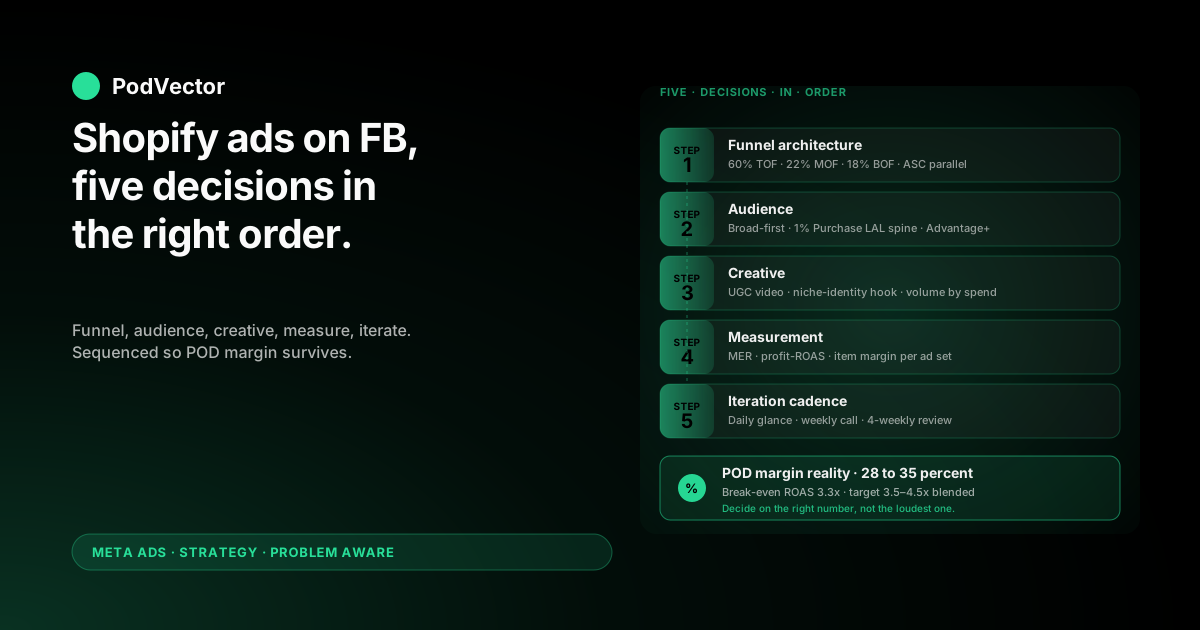
Quick Answer: A Shopify-on-Facebook ad strategy for print-on-demand isn't a setup checklist. It's five sequenced decisions — funnel architecture, audience, creative, measurement, iteration cadence — each tuned to the 28–35% contribution margin POD leaves on the table after Printify or Printful supplier cost.
The generic 2026 playbook says broad-first targeting, Advantage+ Shopping for the bottom funnel, UGC video on top, and Marketing Efficiency Ratio (MER) as the north star. That's directionally right. The POD edit is brutal: every one of those defaults assumes a 50–60% margin store underneath, so the ROAS bars, the budget pacing, and the cut rules all need to move.
This article walks the five decisions in the order an operator should make them, the numbers each decision lands on for a POD store, and the Shopify-side levers most Meta strategies skip.
Why "Shopify ads on Facebook" needs a POD-specific strategy
Search "Shopify ads on Facebook strategy" and the top results converge on the same shape: install Pixel and the Conversions API (CAPI — Meta's server-side event channel), build a TOF/MOF/BOF funnel, layer Advantage+ Shopping Campaigns (ASC), feed broad and lookalike audiences, run UGC video creative, scale on Marketing Efficiency Ratio. OptiMonk's beginner guide, EasyApps' 2026 guide, and AdCreate's complete guide all land in roughly the same neighbourhood, and the framework is sound.
The framework also assumes you keep most of the revenue. POD doesn't.
After Printify or Printful supplier cost, your contribution margin lives between 28% and 35%. That single number rewires every default in the strategy.
Break-even ROAS roughly doubles
An owned-inventory Shopify store at 55% gross margin breaks even around a 1.8x ROAS. A POD store at 30% margin breaks even around 3.3x.
So the "healthy 2.5x" in a generic Shopify guide is, for POD, the platform charging you to manufacture a loss. The strategy has to encode this — every ROAS bar, every scaling rule, every cut threshold sits 2x further up the chart than what most articles publish.
Meta's purchase optimisation reads the wrong number
Meta optimises toward the order subtotal it sees inside Pixel and CAPI events. For POD, that subtotal includes the supplier cost — so the algorithm pushes traffic toward orders with the largest receipts, not the largest contribution margin.
A high-ticket Printify hoodie at $48 with $26 supplier cost looks like a $48 win to Meta and a $22 win to your P&L. A $24 mug with $7 supplier cost looks like a $24 win to Meta and a $17 win to your P&L. Meta will scale the hoodie. You make more money on the mug.
Strategy has to correct for this drift, or you scale the wrong winners.
Variance flips winners to losers at smaller swings
At 55% margin, a 10% ROAS dip still leaves a profitable ad set. At 30% margin, that same dip pushes the ad set under break-even. The cut decision in POD has to be more sensitive than the raise decision — and most operators do it the other way around, raising fast and letting losers ride.
The five strategic decisions, in order
A working Shopify-on-Facebook strategy for POD is not a list of tactics. It's five decisions, made in this order, that each constrain the next.
| Order | Decision | Outcome it controls |
|---|---|---|
| 1 | Funnel architecture | Where prospecting spend goes vs. retargeting; whether ASC sits under or beside manual |
| 2 | Audience | Cold pool selection, lookalike ladder, broad-first vs. interest stack |
| 3 | Creative | Concept volume, hook strategy, format mix (video / carousel / static) |
| 4 | Measurement | What you trust as the profit signal — MER, profit-ROAS, item-level margin |
| 5 | Iteration cadence | Weekly review, scale/cut triggers, creative refresh frequency |
Skipping or reversing the order produces predictable failures. Decide creative before audience and you build assets the audience won't engage with. Decide measurement last and you've already spent three months on the wrong number.
Decision 1 — Funnel architecture: where ASC fits and where it doesn't
The 2026 default for Shopify is a three-tier funnel — top-of-funnel (TOF) prospecting at 60–70% of budget, middle-of-funnel (MOF) retargeting at 20–25%, bottom-of-funnel (BOF) catalog/cart-abandoner at 10–15%. Layered with Advantage+ Shopping Campaigns absorbing some or all of the top end as Meta's algorithm matures.
The POD-specific allocation
POD shifts the mix slightly because the audience pool is huge (your designs target niches Meta knows well) but the margin is thin (you can't waste prospecting spend on cold traffic that bounces).
A working POD allocation lands closer to:
- 55–65% TOF prospecting — broad-first ad sets, 1% lookalike, Advantage+ Audience
- 20–25% MOF — viewers, add-to-cart, 30-day site visitors
- 15–20% BOF — Advantage+ Catalog Ads (formerly Dynamic Product Ads), cart abandoners (7–14 day window), recent purchasers excluded
That extra 5% on retargeting matters because POD's design-led model means a single visitor who saw a niche design once is more recoverable than a generic apparel visitor — they self-selected by clicking a niche-specific creative.
Where Advantage+ Shopping Campaigns belong
ASC is Meta's automated campaign type that optimises across audience, placement, and creative simultaneously. The Shopify SERP says ASC delivers 15–30% lower customer acquisition cost (CAC) than manual structures. For most stores, true. For POD, conditional.
ASC will scan your Shopify catalog and pick whichever SKUs it sees as biggest. Without curation, that's the ones with the largest supplier cost — which Meta sees as biggest receipts and you see as smallest margin.
The strategy fix: curate the catalog feed to a hand-picked 8–15 SKU shortlist of your highest-margin, best-converting designs before turning ASC on. Then ASC's optimisation pressure is concentrated where margin actually lives.
Run ASC alongside manual prospecting, not instead of it, until ASC has cleared 30 days at or above your blended target. The Meta Ads + Shopify integration guide walks the catalog-feed setup in detail.
Decision 2 — Audience: broad-first, but with a lookalike spine
Interest-based targeting collapsed after iOS 14. Meta's behavioural data thinned out and broad audiences started outperforming narrowly-targeted ones. The 2026 SERP unanimously says: go broad and let the algorithm find buyers.
Mostly correct. The POD-specific edit is that "broad" without a customer-list lookalike spine costs you the design-niche advantage you actually have.
The audience ladder for POD
Build the ladder from narrowest to widest, run all rungs concurrently, and let CPA arbitrate budget:
- 1% Purchase Lookalike — built off your top-decile customer list (filtered to highest-LTV buyers, not just any purchaser). For POD this often outperforms broad on prospecting CPA by 20–35%.
- 1% Add-to-Cart Lookalike — wider behavioural pool, useful when purchase volume is too low to seed a stable purchase lookalike (under ~500 customers).
- 3–5% Purchase Lookalike — used as a scaling rung once 1% saturates.
- Advantage+ Audience — Meta's auto-expanding audience seeded with your customer list; treat as a parallel ad set, not a replacement.
- Pure broad — no targeting input. Often the highest-volume rung at scale, but the noisiest on quality.
For stores doing under 500 customers, the spine collapses to broad + 1% ATC lookalike. The customer-list rungs unlock once data exists.
The interest layer is not dead, just demoted
Interest stacks (e.g., "people interested in Etsy + dog owners + 35–55") still produce stable performance for niche POD designs where the niche is small enough that broad won't reliably find it.
If you're running designs for "left-handed bass guitarists" or "Cavalier King Charles Spaniel owners," interest targeting still earns its slot at maybe 10–15% of TOF spend. For broad-niche designs (parents, teachers, generic fitness), kill the interest layer — it just adds fragmentation.
Decision 3 — Creative: hooks, volume, and the POD differentiator
Creative is the only lever that breaks ad-account ceilings. Targeting compresses, bidding compresses, placements compress — creative is the open variable. The 2026 SERP consensus is UGC video at the top, carousel and collection at the middle, dynamic catalog at the bottom.
Format mix for POD
- UGC video (15–30s) — the workhorse. POD wins on niche-specificity, and a creator who actually owns the niche identity (a teacher, a nurse, a horse owner) outperforms generic UGC by 1.5–3x click-through rate. 60–70% of TOF spend.
- Static design-on-product — strong for top-of-funnel design discovery; cheap to produce. 15–20% of TOF.
- Carousel — best for design-collection retargeting. Show 5–10 designs from one niche to MOF visitors who only saw one.
- Advantage+ Catalog Ads — bottom-of-funnel only, fed by the curated catalog from Decision 1.
The hook is most of the work
Meta gives you ~1.7 seconds of attention before the scroll. The first frame and the first three words of the caption decide whether the ad gets to deliver its content. Hook strategy that travels well in POD:
- Niche-identity hook — "If you've ever taught third grade, you'll get this." Lets the viewer self-identify in frame one.
- Design-in-context hook — the design shown on a real person, in a real environment, not on a flat product mockup.
- Pattern-interrupt hook — text-on-screen that contradicts expectation in the first half-second. Risky; works when it lands.
Avoid generic "10% off" hooks at TOF. Discount-led hooks burn through the audience without building niche-design recognition, and POD's repeat-purchase rate depends on that recognition.
Volume scales with spend
Creative fatigue (frequency above 3.0 on a single concept) is the largest single cause of account decline. The volume floor by spend tier:
| Daily spend | New concepts per month | Active concepts at any time |
|---|---|---|
| $50–$200 | 4–6 | 6–10 |
| $200–$800 | 8–12 | 10–18 |
| $800–$2,000 | 15–20 | 20–30 |
| $2,000+ | 20–30 | 30+ |
The scaling playbook walks how to push concept volume without inflating production cost.
Decision 4 — Measurement: MER, profit-ROAS, and what Meta hides
This is the decision most strategies treat as a side note. For POD it's the one that decides whether the other four work.
Why Meta-reported ROAS is not your profit signal
Meta-reported ROAS is the platform's attribution model's estimate of revenue it thinks it caused, divided by spend. It includes view-through windows, default 7-day click attribution, and the iOS-driven modelled gap. It also includes the supplier cost portion of every order.
None of that is wrong, exactly. It's just not the number that decides whether you have a business.
The three numbers that actually decide
- MER (Marketing Efficiency Ratio) — total Shopify revenue ÷ total ad spend across all platforms. The blended truth. POD's MER target lands at 3.5–5x depending on margin and AOV. Below 3.3x and you're losing money in aggregate, regardless of what Meta shows.
- Profit-ROAS — (Shopify revenue − Printify/Printful supplier cost − Shopify fees − payment processor) ÷ ad spend. The number Meta will never show you, because it doesn't have the supplier-cost data. The break-even line for profit-ROAS is 1.0x. Most POD operators discover their "4x ROAS" winner is a 0.9x profit-ROAS loser.
- Item-level margin per ad set — which SKUs each ad set is actually selling. ASC and broad-targeted ad sets often drift toward high-supplier-cost SKUs because Meta scales receipt size. Catching this needs SKU-level tagging on every order, joined back to ad-set ID.
Where the profit signal has to live
None of these three numbers exists inside Meta Ads Manager. They live across Shopify orders, Printify/Printful supplier exports, Meta spend reports, and your payment processor — and the join requires connecting them in a single source of truth.
Most stores attempt this in spreadsheets and it works until the store crosses ~$30k/month, at which point the manual reconciliation breaks. The pattern that survives is a live data warehouse that reads from each source on a schedule, joins on order ID, and exposes profit-ROAS and item-level margin per ad set in something an operator can query in the moment.
Snowflake, Redshift, Databricks, or equivalent all work. The principle is the same: ad-set-to-margin has to be queryable in seconds, not assembled in CSVs once a week. The ROAS & attribution guide covers the join pattern in depth.
Decision 5 — Iteration cadence: the weekly and 4-week rhythm
Strategy without cadence is theatre. The cadence below is what separates accounts that compound from accounts that drift.
Daily (5 minutes)
- Spend pacing vs. budget — anything off by more than 25% gets a glance
- Frequency check on flagged ad sets (anything above 3.0)
- No decisions taken on daily numbers — POD ROAS variance can hit 40% day-on-day on noise alone
Weekly (45 minutes)
- Rolling 7-day MER vs. target — the call on whether last week was actually profitable
- Profit-ROAS by ad set — winners get +20% budget, losers get killed
- Creative concept rotation — anything at 2.5+ frequency goes into refresh queue
- Audience saturation check — CPM drift on lookalike rungs is the early warning
4-weekly (2–3 hours)
- Funnel allocation review — has the TOF/MOF/BOF mix drifted from target?
- ASC catalog re-curation — drop SKUs that ran below margin, add new winners
- Lookalike rebuild — refresh the 1% Purchase LAL with the latest 6 months of high-LTV customers
- Creative concept post-mortem — which hook formats won, which didn't, what to commission next
Operators who run this cadence week after week beat operators with better single-week tactics. The step-by-step setup guide covers what has to be in place before the cadence is worth running, and the Meta Ads strategy cluster covers the wider stack.
Shopify-side levers most Meta strategies skip
The five decisions above all live inside Meta. Three more levers live inside Shopify and move the same numbers further than another round of audience tuning will.
Product page conversion rate
A 0.5-point lift in product-page conversion rate (e.g., 2.0% → 2.5%) drops effective CAC by 25%. That's bigger than most audience changes will produce. The mechanics: trust badges, design-detail close-ups, sizing chart, real-customer review imagery, and a fast mobile load (under 2.5s LCP).
Post-purchase upsell
POD's repeat-purchase rate inside 30 days hovers around 8–12% for design-led stores. A one-click post-purchase upsell ("Same design, also on a hoodie?") can add 15–25% to AOV at near-zero ad cost. That delta widens MER directly.
Cart-abandonment recovery beyond Meta retargeting
Meta retargeting handles cart abandoners on-platform. Email and SMS recover the rest at much lower variable cost. A POD store with no email recovery flow is leaving margin on the table that no Meta change will replace.
Five strategy mistakes that cost POD margin
1. Treating ASC as a replacement instead of a parallel
Turning off all manual prospecting once ASC starts working is the single largest unforced error in 2026 POD accounts. ASC needs the manual layer alongside it for two reasons: it gives Meta clean separation between curated-catalog-only spend and full-catalog spend, and it preserves the ad-set-level data you need to know which audiences/creatives are actually doing the work.
2. Scaling on Meta-reported ROAS, ignoring profit-ROAS
Already covered, but worth repeating because it's the most common margin-leak in POD Meta accounts. Meta-reported 4x with profit-ROAS at 0.9x means you're growing revenue and shrinking profit at the same time — exactly the trap a thin-margin model punishes hardest.
3. One creative, three formats, called "creative volume"
Cropping the same UGC clip into 1:1, 4:5, and 9:16 doesn't add concept volume. Meta's algorithm treats them as variants of the same creative for fatigue purposes. Concept volume = different hook, different angle, different creator, different design — not different aspect ratios.
4. Choosing the funnel architecture before doing the customer-list lookalike
If you have 1,000+ customers and you're running broad-only TOF, you're leaving Meta's strongest signal unused. Build the 1% Purchase LAL first, run it as the spine of TOF, and let broad fill in around it. Reverse the order and broad will look better than it actually is, because LAL hasn't been given a chance.
5. Treating the strategy as set-and-forget
The Meta auction shifts. iOS shifts. Audience pools saturate. Creator preferences shift. A strategy decided in Q1 and never re-decided is a Q3 loss. The 4-weekly review exists for this reason — not to second-guess every week, but to catch the drift before it compounds.
FAQs
What's a working blended ROAS target for a Shopify POD store on Facebook?
3.5–4.5x blended (across all Meta spend) is the workable band, with 5x+ on retargeting and 3.0x+ on cold prospecting. POD's 28–35% margin makes 3.3x literal break-even, so the buffer above that absorbs supplier price changes, refunds, and seasonality. Stores running at "industry-standard" 2.5–3x targets are scaling losses without realising it.
Do you still need a Pixel if you have CAPI?
Yes — run both with deduplication. The Pixel handles browser-side events (still useful for fast in-session signal); CAPI handles server-side events (resilient to ad blockers and iOS opt-outs). Most working 2026 setups have CAPI as the primary signal and Pixel as the backup, with event_id deduplication so Meta doesn't double-count. Shopify's Facebook & Instagram channel app handles the dedup automatically.
How much should a POD store spend on Facebook ads to start?
$30–$50/day is the floor that produces enough conversion signal in 7 days for an ad set to clear learning. Below that, Meta's algorithm doesn't have enough data to optimise and the account looks broken when it's actually just under-fed. Plan for $1,500–$2,500 minimum across the first month — split between media and 4–8 creative concepts.
Should you use Advantage+ Audience or build manual lookalikes?
Both, in parallel. Advantage+ Audience is Meta's auto-expanding pool seeded by your customer list; manual lookalikes give you a controlled spine. Run them as separate ad sets so CPA arbitrates between them. Most POD accounts find Advantage+ wins on volume and 1% Purchase LAL wins on quality — the budget split lands around 60/40 once both have stabilised.
How do you handle creative for a multi-niche POD store?
One ad set per niche, not one ad set per design. Mixing niches inside an ad set forces Meta to pick which niche it likes; the loser niche's designs never get fair delivery. The cleanest pattern: each niche gets its own TOF ad set, its own lookalike spine (built from past purchasers in that niche), and its own creative pipeline. Cross-niche bestsellers can sit in a "house champions" ad set on top.
How does this strategy connect to Google Shopping for the same POD store?
Meta drives demand creation; Google Shopping captures the bottom-of-funnel intent Meta created. Most working POD stores run both — Meta at 60–70% of total ad spend, Google at 30–40%. The two complement: Meta tells someone the design exists, Google's there when they search for it the next day. Shared MER target across both keeps the apples-to-apples comparison honest.
When does it make sense to outsource Meta Ads vs. run them in-house?
Below $1k/day spend, in-house almost always wins — the operator has tighter feedback loops on what their designs are doing. Above $5k/day, a specialist agency or freelance media buyer earns their fee in the creative pipeline alone. The middle band ($1k–$5k/day) is where most disasters happen, because it's the band where founders try to scale without yet having the time. The agencies and learning guide covers what to look for in a POD-specialist agency.
What's the relationship between this strategy and the wider Meta Ads picture?
This article is the strategy layer. The setup mechanics, ad-type playbooks, and ROAS/attribution detail sit beside it across the Meta Ads topic hub. If your foundation isn't in place — Pixel + CAPI clean, Shopify catalog feed live, baseline conversion tracking matching within 10% — none of the strategic decisions above will hold. The fix is upstream.
Strategy on the right number, not the loudest one
Meta-reported ROAS is one number. Shopify revenue is another. Printify or Printful's supplier cost is the one Meta will never see. Profit-ROAS is the one that decides whether the strategy actually works.
PodVector AI's AI employee Victor connects all three. You ask "is this Facebook ad set actually profitable after Printify cost?" and Victor answers with live numbers from your unified data warehouse — not a delayed export, not a yesterday-end snapshot. Victor answers and acts on what he sees — with your approval.
Try Victor free