
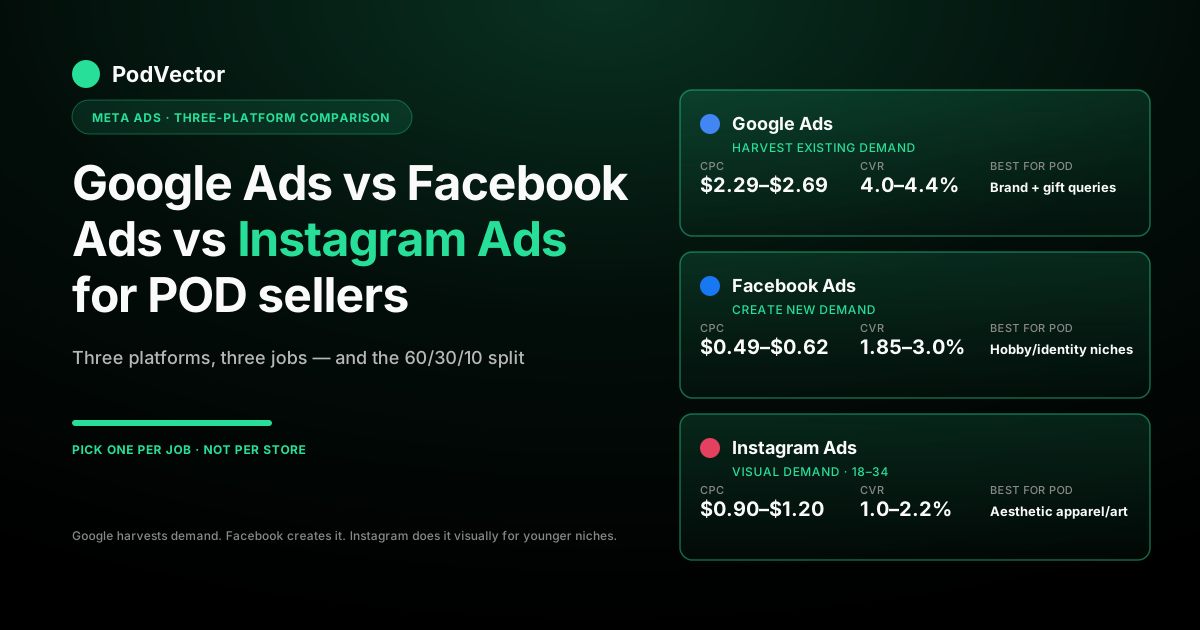
Quick Answer: Three platforms, three jobs. Google Ads captures buyers who already know what they want. Facebook Ads finds prospects who don't. Instagram Ads (which runs inside the Meta system as a placement, not a separate ad account) wins on visual-first creative for younger, niche audiences.
For most POD operators, the right answer is not "pick one." It's a 60/30/10 split — Meta (Facebook + Instagram) for prospecting, Google Search and Shopping for harvesting branded and product-name searches, Instagram-specific creative for the niches where the audience lives there.
This guide breaks down cost, intent, targeting, creative, and POD-specific economics for each platform — then shows the budget-allocation rule that decides which platform should get your next dollar.
Three platforms, three jobs
The first thing to clear up: Instagram Ads is not a separate platform you buy from a different vendor. It's a placement inside Meta Ads Manager. The same campaign, same audience, same pixel, same billing.
What makes Instagram worth treating as its own thing is creative. The format, the audience age skew, and the way the ad sits next to organic content are different enough from Facebook that the same creative can produce wildly different results across the two surfaces.
So the real comparison is two systems — Google and Meta — with Meta containing two creative environments (Facebook and Instagram) that you should think of separately even though you buy them together.
Each platform does one job better than the other two:
- Google Ads: harvests existing demand. The buyer already typed "graphic tee for cat lovers." You show up.
- Facebook Ads: creates new demand. The scroller wasn't shopping. Your ad makes them want the shirt.
- Instagram Ads: creates demand specifically in younger, more visual, niche-driven audiences who live in the feed.
If you understand that split, the rest of the decision is mostly arithmetic.
Headline comparison: cost, intent, format
The 2026 benchmarks below blend public sources (WordStream, Meta Business reports, agency benchmarks) with the POD operator cohort we work with. Treat them as the orientation table, not the final answer for your store.
| Axis | Google Ads | Facebook Ads | Instagram Ads |
|---|---|---|---|
| Median CPC (all industries) | $2.29–$2.69 | $0.49–$0.62 | $0.90–$1.20 (≈ 2x Facebook) |
| Median CPM | $3.12 (Display) | $11.54 | $14–$18 |
| Average CTR | 4.26% | 1.81% | 0.9–1.5% (Feed) / 0.4–0.8% (Stories) |
| Average ecommerce conversion rate | 4.0–4.4% | 1.85–3.0% | 1.0–2.2% |
| Buyer intent | High (active search) | Low (passive scroll) | Low (passive scroll, visual) |
| Audience age skew | All ages | 25–54 strongest | 18–34 strongest |
| Best for POD when | Brand searches, product names, gift queries | Broad-niche prospecting, retargeting at scale | Visual-first niches (apparel, art, design-led) |
Two things jump out. Facebook is the cheapest on a per-click basis, but Google has a 2–3x higher conversion rate. Instagram costs roughly twice as much per click as Facebook for a younger, more design-receptive audience. We'll unpack what each of those means for POD margins below.
How Google Ads works for POD
Google Ads runs four main campaign types relevant to POD: Search, Shopping, Performance Max (PMax — Google's all-in-one auto-targeted campaign type), and Display. For most POD stores, only the first two matter.
Search ads show up when someone types a query. For POD, the queries that convert are usually long-tail: "funny nurse mug for night shift," "gift for retired firefighter," "matching family christmas pajamas dachshund." High-intent, low competition, low CPC.
Shopping ads show product images and prices in the search results and the Shopping tab. They're fed by a Google Merchant Center product feed (which Shopify can push directly with the right app or a feed manager).
Shopping is usually where POD finds its Google traction. The image and price do most of the selling. CPCs in apparel land at $0.45–$1.20, conversion rates at 1.5–3.0%, and the audience is already in shopping mode.
Where Google struggles for POD: cold prospecting. If nobody is searching for your specific design, Google has nothing to show. Search-only operators in saturated niches (general "graphic t-shirt") get crushed by big brands paying $3+ per click on broad terms.
For the deeper Google playbook see our Google Ads vs Facebook Ads breakdown and the ecommerce-specific cost comparison.
How Facebook Ads works for POD
Facebook Ads (the campaign engine inside Meta Ads Manager) is built for demand creation. The buyer wasn't looking for your shirt. Your creative, placed in their feed between a friend's birthday post and a news article, makes them stop and want it.
The mechanism that makes Facebook work for POD is creative volume. Meta's algorithm needs 8–12 creative variants per campaign to find the angle that converts in a given niche. With unlimited POD designs, the supply side is easy. The hard part is producing 8 different ad creatives per design without burning out.
Facebook's audience targeting weakened after the iOS 14.5 privacy changes, but its automated optimization (Advantage+ Shopping, the auto-budget-allocation campaign type) recovered most of the gap. Today the algorithm wants broad audiences, lots of creative, and a clean conversion event coming back via the Conversions API.
Facebook CPCs at $0.49–$0.62 look incredible until you realize the conversion rate is one-third of Google's. On a $26 hoodie with $6 of contribution margin, you need a 1.85% conversion rate at a $0.62 CPC to break even. That's tight.
For the structural Meta playbook see our complete Meta Ads playbook for print-on-demand sellers.
How Instagram Ads works for POD
Instagram is a Meta placement, not a standalone ad account. You buy it inside Ads Manager, often as part of a campaign that also runs on Facebook. The differences are the formats, the audience, and the cultural context of the surface.
Instagram's strongest formats for POD are Feed image ads, Reels (the short-form vertical video format), and Stories. Reels in particular have become the cheapest scaled prospecting placement in the Meta system in 2026, with CPMs running 30–40% below Feed in most niches.
The audience skew matters. Instagram users skew 18–34, more female, more design-aware, more fashion- and home-decor-receptive. POD verticals that hit hard on Instagram: graphic apparel, art prints, home goods, jewelry, kids' merch, hobby-niche tees (especially fitness, dog breeds, hobbies with strong visual identity).
Instagram CPMs run higher than Facebook ($14–$18 vs. $11–$13) because the inventory is more constrained. But the engagement is better, the creative bar rewards POD designs that look good as a still image, and the Shopping integration (Instagram Shop, product tags in feed posts) closes the loop without making the buyer leave the app.
Where Instagram struggles for POD: text-heavy creative, older audiences (45+ engagement is weak), and any niche where the design itself isn't aesthetically strong.
Cost reality: CPC, CPM, and CAC for POD margins
Here's the math nobody else in the SERP runs. POD has a unique cost structure: low AOV, thin contribution margin per unit, and a base cost (Printify, Printful, or equivalent) that scales linearly with sales.
Take a typical $26 hoodie. Printify base: $14. Shipping: $5.50 average (often passed to customer but rarely fully recovered). Platform/processing fees: $1.20. Contribution margin before ads: about $5.30.
That $5.30 is your CAC budget per first sale. Repeat purchases extend it, but you can't spend $50 to acquire a buyer who returns $5.30 today and probably never comes back.
Now run each platform against that:
| Platform | POD CPC | POD CVR | Implied CAC | vs. $5.30 margin |
|---|---|---|---|---|
| Google Search (long-tail) | $0.55–$1.40 | 3.0–5.5% | $10–$47 | Often profitable on long-tail |
| Google Shopping (apparel) | $0.45–$1.20 | 1.5–3.0% | $15–$80 | Mixed; design-led wins |
| Facebook Feed | $0.45–$0.85 | 1.85–3.0% | $15–$46 | Profitable with strong creative |
| Instagram Feed | $0.85–$1.40 | 1.0–2.2% | $38–$140 | Niche-dependent; younger only |
| Instagram Reels | $0.30–$0.65 | 0.8–1.8% | $17–$81 | Cheapest if creative is strong |
The verdict: every platform can be profitable for POD, and every platform can destroy margin. The factor that decides which one is which is creative and conversion rate, not the headline CPC.
Intent and funnel coverage
Each platform sits at a different point in the buying funnel. Trying to use one platform for the whole funnel is the most common mistake POD operators make.
Top of funnel (cold prospecting): Facebook and Instagram own this. Google can't show you to people who aren't searching. Meta can put you in front of 10 million graphic-apparel browsers in a week.
Middle of funnel (consideration, retargeting): All three work. Google's retargeting is RLSA (remarketing lists for search ads) and Display retargeting. Meta's retargeting via the pixel + CAPI is the workhorse for most POD stores.
Bottom of funnel (high-intent, ready to buy): Google wins decisively. Someone searching "[your brand] hoodie" or "matching dad-and-son fishing shirts" has already decided. Google Search and Shopping convert these at 4–8%.
The right way to think about it: Meta builds the audience, Google harvests them. A buyer who saw your Instagram Reel three times this month, then googled your brand name on payday — that's the conversion path that drives most of POD's profitable scaling. The Reel cost $0.40. The branded Google click cost $0.25 and converted at 9%.
Targeting options compared
Targeting is where the platforms diverge most.
Google Search: the buyer's keyword is the target. You bid on terms; the algorithm matches their query against your bid. Demographic targeting exists but is secondary.
Google Shopping: targeting is automatic from the product feed. Your titles, descriptions, and images are the targeting signals.
Facebook: after the iOS 14.5 changes, Meta moved most ecommerce stores to Advantage+ Shopping (broad targeting + AI optimization). Detailed-interest targeting still exists but performs worse than broad in most POD niches.
Instagram: same Meta system. The only Instagram-specific lever is placement (Feed, Reels, Stories, Explore) — but the audience and interest layers are shared with Facebook.
The practical implication for POD: you don't pick "interests" anymore. You pick a strong creative, a broad audience, and a conversion event, and let the algorithm find the buyers. The leverage moved from targeting to creative and to the conversion-event quality flowing back via the Conversions API.
Creative format requirements
Creative is the make-or-break input on Meta. On Google, it matters less because the search query already pre-filters intent.
Google Search: headlines and descriptions, all text. Responsive Search Ads now want 12+ headlines and 4+ descriptions per ad, with the algorithm assembling combinations.
Google Shopping: the product image and price are the ad. Optimization happens in the feed (titles, attributes, GTINs).
Facebook Feed: tolerates longer text and informational creative. Static images, carousels, and 1:1 video all work. UGC-style (user-generated content — looks unpolished, like a friend posted it) consistently outperforms branded production.
Instagram Feed: visual-first. The product or design has to look good as a still. Polished aesthetics convert; ugly creative is hidden by the algorithm fast.
Instagram Reels and Stories: 9:16 vertical video, sound-on-friendly, hook in the first 1–2 seconds. POD wins here with try-on videos, design-process clips, and "POV: you wear this" creative.
The minimum creative pack for a POD store running all three: 4 Google Search ads (text), 1 Shopping feed (full catalog), 8 Facebook Feed creatives per ad set, 4 Instagram Feed creatives, 6 Reels-format vertical videos. Yes, it's a lot. The shops that scale built a creative production cadence to match.
For the format-specific tactics see our complete guide to Meta ad types for POD sellers.
Best platform by POD niche shape
The niche shape — design type, audience age, AOV, search volume — decides which platform produces the cheapest CAC. Not the platform's average benchmarks.
| POD niche shape | Best primary | Best secondary | Why |
|---|---|---|---|
| Gift / occasion ("for grandma's 80th") | Google Search | High-intent search volume; Facebook for retargeting | |
| Hobby/identity ("nurses, dachshund moms") | Interest-clustered audiences scroll Meta | ||
| Fashion/aesthetic apparel | Visual-first; younger audience lives in IG | ||
| Home decor / wall art | Google Shopping | Aesthetic browse + price-comparison closer | |
| Branded merch (existing audience) | Facebook (retargeting) | Google Search (branded) | Audience already exists; harvest demand |
| Funny/political/topical tees | Instagram Reels | Virality + share mechanics |
The 60/30/10 budget split (and when to break it)
Most profitable multi-channel POD stores we work with run a budget split that looks like this:
- 60% Meta (Facebook + Instagram combined) — the demand-creation engine. Roughly 40% Facebook, 20% Instagram inside that.
- 30% Google (Search + Shopping) — the demand-harvesting engine. Roughly 10% Search (long-tail and brand), 20% Shopping.
- 10% experimentation — Reels-only campaigns, new creative angles, new product launches.
Break the rule when:
- Your niche has high search volume but no virality. Push to 50/50 Google/Meta.
- You sell to under-25s in a visual category. Push Instagram to 30%+.
- You're a branded merch shop with an existing audience. Push branded Google Search up; cold Meta down.
- You're under $5K/month total spend. Pick one platform and master it before splitting. Most operators should start on Meta.
The split is not the destination. It's the starting point for measurement. The platform that produces the cheapest CAC for your store after 60 days of clean attribution data is the one you scale.
Tracking the truth across all three
The hardest part of running three platforms is not running them. It's knowing which one is actually working. Each platform's dashboard reports its own attribution claims, and the three dashboards together always claim 130–160% of your real revenue.
Meta's pixel + Conversions API claims credit for any view-through within 7 days. Google Ads claims credit on any click within 30 days. Both are right by their own rules. Together they double-count anything in the overlap.
Three options for handling this, in order of how much it costs you in margin to ignore the problem:
- Spreadsheet de-duplication: pull each platform's report weekly, compare to Shopify revenue, allocate the gap by some rule. Works for stores under $20K/month.
- UTM-based last-click model: route Shopify orders to the platform whose UTM was the last touch. Underweights Meta's view-through prospecting; overweights Google's branded-search harvesting. Simple, defensible.
- Unified data warehouse with full path tracking: push every ad-platform spend record, every Shopify order, and every customer touchpoint into a single warehouse (Snowflake, BigQuery, Databricks, or equivalent). Run a multi-touch attribution model on the unified data. This is what scaled POD brands and agencies do.
The third option is what Victor — PodVector AI's AI employee for POD sellers — does for solo merchants who don't have a data team. Victor pulls Meta, Google, Shopify, and Printify into a single live data warehouse, deduplicates the conversion claims, and answers "which platform delivered my last $1,000 of profit?" against your actual margin numbers, not the platform's claims.
For the deeper attribution treatment see our complete guide to Meta Ads ROAS and attribution for POD and the Meta Ads comparison hub for sibling platform breakdowns. The Meta Ads topic hub indexes everything we've published.
Independent industry views worth reading: WSI's Facebook & Instagram vs Google breakdown, the GoDaddy small-business comparison, and the long-form AgencyAnalytics agency playbook.
FAQs
Are Facebook Ads and Instagram Ads the same thing?
No. They're managed in the same place (Meta Ads Manager) and share the same audience and pixel system, but they're separate placements with different formats, audience skews, and creative requirements. Treat them as one buying system, two creative environments.
Which platform is cheapest for POD sellers?
On a per-click basis, Facebook Feed at $0.45–$0.85 and Instagram Reels at $0.30–$0.65 are usually cheapest. On a cost-per-acquisition basis, the answer depends entirely on your conversion rate, which depends on your creative, niche, and design quality. Google Shopping for branded or long-tail searches is often the cheapest CAC despite the higher CPC.
Should a brand-new POD store run all three at once?
No. Pick Meta first, master one platform's creative cadence and attribution, get to a stable CAC. Add Google Shopping when you have 30+ SKUs in a clean feed. Add Instagram Reels-specific creative when you can produce 4–6 vertical videos a month without burnout. Splitting too early dilutes learning at the platform level.
Do I need a separate budget for Instagram if I'm running Facebook Ads?
Not strictly. You can let Meta's Advantage+ placements auto-allocate between Facebook and Instagram. But running an Instagram-only campaign (and the Reels-only sub-placement) gives you cleaner data on which surface is actually working for your niche, which is worth the management overhead once you're past $10K/month spend.
What's the best ratio of Google to Meta spend for POD?
The default we recommend is 30% Google / 60% Meta / 10% experimentation. Push toward 50/50 if your niche has high search volume (gift, occasion, very specific product names). Push toward 70%+ Meta if your niche is purely visual or trend-driven and search volume is thin.
Can Instagram Shopping replace a Shopify storefront?
It augments, not replaces. Instagram Shop and product tags shorten the path from ad to product page, which lifts conversion rate on Instagram traffic. But you still need Shopify (or equivalent) for checkout, customer accounts, post-purchase, and the conversion data that flows back to the platforms. Instagram Shop is a better landing page, not a full storefront.
How long until I know which platform is winning?
Plan for 30 days minimum at $30+/day per ad set to clear Meta's learning phase. Google Shopping needs about 50 conversions per campaign to optimize properly. Instagram Reels-specific creative needs 8–12 variants tested to find the winning angle. So roughly 6–8 weeks of clean spend before you have data worth acting on.
Stop guessing which platform actually paid back
Three platforms. Three dashboards. Three competing claims about who drove your last sale.
Victor unifies Meta, Google, Shopify, and Printify into one live data warehouse, deduplicates the attribution claims, and tells you — in plain English, against your actual margins — which platform deserves the next dollar.
Try Victor free