
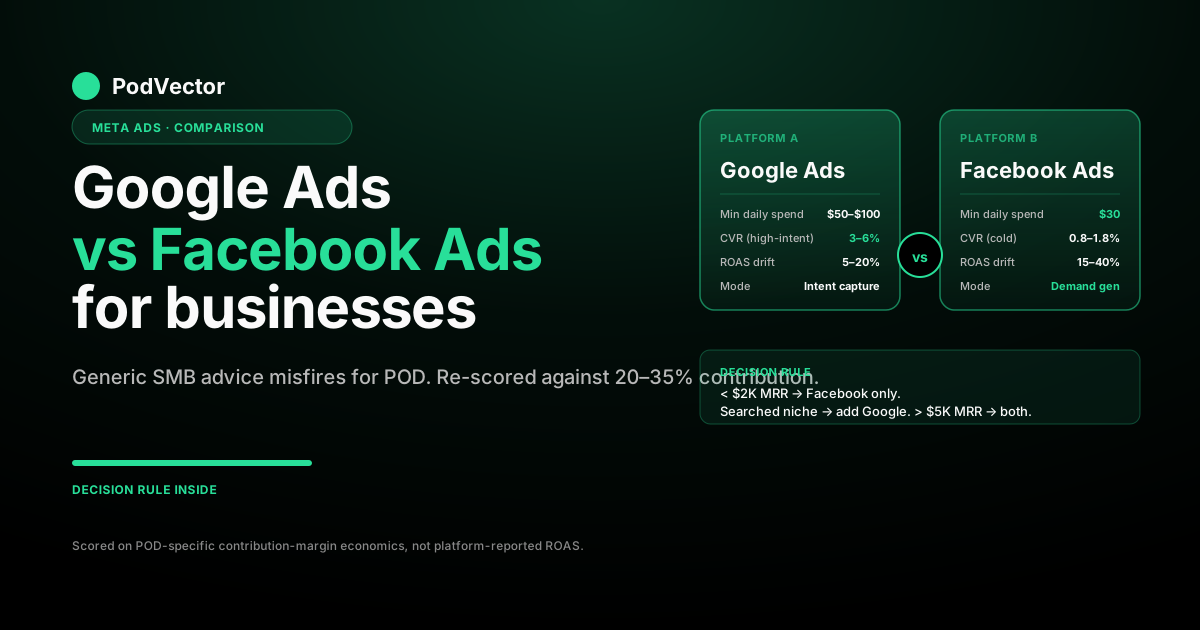
Quick Answer: Most "Google Ads vs Facebook Ads for businesses" guides assume a normal SMB shape — fixed COGS, 60–80% gross margin, a tight SKU lineup, predictable supplier costs. Print-on-demand businesses break every one of those assumptions, so the standard advice misfires hard.
For a typical POD store in 2026, Facebook Ads is usually the right starting platform: lower minimum efficient spend (~$30/day), a creative-driven discovery loop that surfaces winning designs faster, and audience targeting that reaches niche buyers who never search by keyword. Google Ads — specifically Google Shopping and high-intent search — earns its place once you have proven SKUs and your niche has measurable search volume.
The decision rule isn't "which platform is better in the abstract." It's "what does my contribution margin per unit allow, and which platform's strongest signal matches the shape of my designs' demand?" This guide answers that against POD-specific economics.
Why generic business advice misfires for POD
Most well-circulated comparisons — like the AdsGo 2026 comparison, the Swydo agency playbook, and the Boulder Decisions overview — assume a standard small-business shape. Fixed cost of goods sold. Healthy 60–80% gross margins. A tight SKU lineup. Predictable supplier costs.
Print on demand inverts every one of those assumptions. Your supplier cost varies by garment, supplier, color, size, and shipping country. Your contribution margin after the Printify or Printful base price, shipping, payment processing, and platform fees usually lands between 20% and 35%.
You launch new designs faster than any platform's algorithm can fully learn them. Your SKU count is in the hundreds, often thousands. The standard "Google for high intent, Facebook for awareness" framing is correct as far as it goes, but it doesn't survive contact with POD economics.
That structural mismatch matters because each platform breaks in a different place when forced through POD numbers. Google Ads breaks at the feed and at SKU bidding: Printify and Printful default exports trip Google Merchant Center disapprovals about half the time, and high-CPC search keywords ("custom t-shirt for dad") burn budget against your 25%-margin contribution before retargeting can recover it.
Facebook breaks at margin math: a 1.8% cold conversion rate against a $1.10 CPC needs roughly 60 clicks per sale. On a $5.30 contribution-per-unit POD product, that math is structurally underwater before retargeting kicks in. Both platforms work for POD businesses — but only if you size them against actual unit economics, not against generic SMB benchmarks.
The third reason POD is different is signal latency. A jewelry brand spending $5,000 on the wrong channel has burned a test budget against fat margins. A POD seller burning $5,000 without a baseline of true contribution margin can finish the month with negative contribution and no diagnostic clarity on why.
Head-to-head: the comparison table
Here is the side-by-side scored against POD's specific structural needs. Numbers are 2026 ranges from public benchmark data and our own client cohort. The verdict column is the POD-specific call.
| Factor | Google Ads (Search + Shopping) | Facebook Ads | POD verdict |
|---|---|---|---|
| Avg CPC (apparel/accessories) | $0.65–$2.69 (Search), $0.55–$1.20 (Shopping) | $0.55–$1.45 | Facebook cheaper raw; Google often cheaper per sale in searched niches |
| Min efficient daily spend | ~$50–$100/day | ~$30/day | Facebook for stores under $2K MRR |
| Cold conversion rate (POD) | 2.8%–5% | 0.8%–1.8% | Google wins when niche has search demand |
| Time to launch first campaign | 4–10 hours (feed + keywords) | 30–90 minutes | Facebook lower friction |
| Time to competence | 2–3 months | 3–6 weeks | Facebook faster, lower ceiling |
| Best for niche-design discovery | Weak | Strong | Facebook for finding winners |
| Best for branded/category capture | Strong | Weak | Google to defend demand Facebook creates |
| Reported-vs-real ROAS drift | 5–20% overstated | 15–40% overstated | Google more honest; both need reconciliation |
| Creative-volume burden | Low (text + product feed) | High (8–15 fresh creatives/week) | Google lower ongoing labor cost |
| iOS attribution impact | Mild | Significant | Google more resilient post-iOS 14 |
The headline takeaway: neither platform "wins" in the abstract. Google Ads costs more per click but converts higher in searched niches and reports more honestly. Facebook Ads costs less per click but needs more creative work, drifts further from real ROAS, and needs your niche to be discoverable rather than searched.
Cost: CPC, CPM, and what they mean at thin margin
The full POD-specific cost breakdown covers the math in detail. Here's the short version for a typical POD t-shirt: Printify base $9.50, retail $24.99, shipping subsidized $4, payment processing $1.10, platform fees $0.45 — leaving roughly $9.94 contribution margin, or 40% on a clean SKU. After returns and average-order-value drag, real contribution typically lands at $5.30–$7.50.
Against $5.30 contribution per unit, here's what each platform's CPC math implies:
- Google Search at $2.69 CPC: needs a 5%+ conversion rate to break even. Achievable in tight bottom-of-funnel keywords ("german shepherd dad shirt"); not achievable in broad terms ("funny t-shirts").
- Google Shopping at $0.85 CPC: needs 16% conversion to break even, which is unrealistic — but its actual 3–6% conversion against the cheaper CPC plus higher AOV from cross-sells often clears the bar.
- Facebook prospecting at $1.10 CPC: needs ~21% conversion to break even on the click. Facebook's actual 0.8–1.8% cold conversion means prospecting alone almost never pays — retargeting at 4.5–8x reported ROAS is what carries the math.
The cost lesson for POD businesses: raw CPC comparison is misleading. The honest comparison is "cost per acquisition divided by true contribution margin per unit." Most POD sellers running both platforms have never run that math at the channel level, which is the gap any unified data layer closes first.
Targeting: search intent vs interest graphs
Google Ads captures existing demand. Someone typing "personalized dog mom mug" already knows what they want and is shopping. Your job is to be in the auction and have a product page that converts.
Facebook Ads creates demand. Someone scrolling Instagram who happens to belong to a "Golden Retriever Mom" interest cluster doesn't know your mug exists yet. Your creative makes them want it. The buying decision happens against zero search history.
For POD, this distinction is decisive. Most successful POD designs are niches Google search volume can't reach: regional micro-fandoms, occupation-specific inside jokes, hobby tribes too small for keyword tools to register. Facebook's interest graph reaches these audiences. Google's keyword auction does not.
Conversely, when your design hits a niche with real search volume — "veterinarian gifts," "math teacher mug," "jeep accessories" — Google captures buyers Facebook never had a creative angle to interrupt. The two platforms reach structurally different demand, which is why mature POD operators run both rather than picking one.
Creative: keyword leverage vs creative volume
Google Ads' creative load for POD is low. A clean product feed (title, description, image, attributes), a text-search ad set with negative keywords, and you're shipping. Optimization is about feed quality, bidding, and search-term hygiene — not about cranking out new creative weekly.
Facebook Ads' creative load is high. Meta's algorithm rewards fresh creative, audiences fatigue in 7–14 days, and a typical POD store running Facebook profitably is producing 8–15 new creatives per week. That's labor (or paid creatives) most generic-business comparisons leave out of the cost column.
For POD businesses comparing platforms on dollars-in-dollars-out, that creative labor matters. A store grinding 12 creatives a week to keep Facebook profitable is paying $200–$600/week in production cost (or 8–15 hours of founder time). Folded back into per-design profitability, Google often wins outright in any niche with measurable search volume.
Tracking and attribution: which platform is more honest with POD
iOS 14's privacy changes hurt Meta meaningfully more than Google. Meta's attribution model relied heavily on third-party-cookie-equivalent event signals; Google's relies more on first-party search-and-click data. Properly configured server-side conversion tracking recovers a meaningful portion of Meta's loss, but reported ROAS still drifts more than Google's.
Concrete numbers from our client cohort: Meta reports overstated ROAS by 15–40% against bank-deposit revenue reconciliation. Google reports overstated by 5–20%. Both need weekly reconciliation; Meta needs it more.
For thin-margin POD businesses, that drift gap is a strong practical reason to lean Google when the niche permits. A 3.0x reported on Meta might be 2.1x real. A 3.0x on Google is more likely 2.6x. Same headline number, very different real margin.
The fix isn't "trust Google, distrust Meta." It's "reconcile both against your real bank-deposit revenue weekly, and treat platform-reported numbers as estimates, not ground truth." The Meta Ads ROAS and attribution guide covers the reconciliation workflow in detail.
Learning curve and time investment
Google Ads has a steeper learning curve. Keyword research, match types, Quality Score optimization, negative keyword management, bid adjustments, ad extensions, feed cleanup, Merchant Center policy, and Performance Max guardrails all require deliberate study. Most POD operators need 2–3 months to be competent and 6+ months to optimize well.
Facebook Ads is easier to start. The interface is more intuitive, launching a basic campaign takes 30–90 minutes, and the first profitable retargeting campaign is achievable inside a month. The catch is that Facebook is harder to scale: past $5K MRR, the creative treadmill, audience-fatigue management, and CBO-versus-ABO tuning compound complexity.
For a solo POD operator with 5–10 hours a week to spend on ads, Facebook is the lower-friction starting point. For an operation with a part-time PPC contractor, Google's higher learning curve pays back faster because the platform rewards optimization more directly than Meta does.
Three POD business scenarios and which wins
Generic comparisons stop at "depends on your business." Here are three concrete POD scenarios with the actual call.
Scenario 1: New POD store, $0–$2K MRR, evergreen apparel niches. Start with Facebook. Lower minimum efficient spend ($30/day vs Google Shopping's $50–$100/day floor). Creative-driven discovery surfaces winning designs faster than waiting for keyword data to accumulate. Add Google Shopping once you have 5–10 proven SKUs and a niche with measurable search volume.
Scenario 2: Established POD store, $5K–$25K MRR, mixed evergreen and seasonal. Run both. Facebook for prospecting and creative discovery on new design drops; Google Shopping defending the branded and category demand Facebook prospecting creates; Google Search on tight bottom-of-funnel keywords for top-10-revenue SKUs. Budget split typically 60/40 Meta-to-Google in growth months, 50/50 in maturity.
Scenario 3: Niche POD store with strong search demand (occupation, hobby, fandom). Lead with Google. If your niche has search volume — "ICU nurse gifts," "pickleball dad shirt" — Google's higher-intent traffic converts at 3–6% against Facebook's 0.8–1.8% cold. Add Facebook later for awareness on new design drops, but Google does the heavy lifting.
The decision rule by stage and niche
Five concrete decision rules POD operators can apply this week.
- If MRR is under $2K and budget is under $1K/month: Facebook only. Splitting too thin under-funds both into noise.
- If your niche has measurable search volume (50+ searches/month on the core query in any keyword tool): Google Shopping is non-optional past $2K MRR.
- If your niche has no search volume but a clear interest cluster (Facebook group sizes 10K+): Facebook is non-optional. Google won't reach those buyers.
- If reported Meta ROAS is dropping below 2.5x for two consecutive weeks: shift 30% of Meta budget to Google Shopping on your top 10 SKUs before increasing total spend. Meta-only operations frequently chase fading ROAS by adding budget; the platform shift is usually the right move.
- If you can't see contribution margin per channel weekly: stop the platform debate and fix the data layer first. Every other decision compounds on getting that one number right.
For the head-to-head decision framework matched against MRR stage, the when to use Google Ads vs Facebook Ads guide goes deeper. For the small-business-specific cut, the small business comparison covers budget-constrained scenarios.
Running both: the integrated POD playbook
Past $5K MRR, the question stops being "which one" and becomes "how do they work together." The integrated POD playbook has four moves.
Move 1 — Facebook prospecting feeds Google branded search. Facebook prospecting introduces buyers to your store and your designs. A meaningful share of those buyers later search "[your store name]" or "[your design phrase]" on Google. If you don't run Google branded search, competitors will bid on those terms and intercept the conversion you paid Facebook to create.
Move 2 — Google Shopping captures the long tail of your top SKUs. Once a design proves out on Facebook, list it cleanly in Google Shopping with optimized title and description. Google's intent capture closes the buyers who saw the Facebook ad, didn't click, and later searched the product category.
Move 3 — Retargeting runs on both, deduplicated by attribution window. Don't double-pay for the same conversion. Set Meta retargeting to a 7-day click window, Google remarketing to a 30-day click window, and reconcile against bank revenue weekly to confirm you're not over-counting.
Move 4 — Budget reallocation runs on contribution margin, not platform-reported ROAS. Each Monday, look at last week's true contribution by channel (reported revenue minus drift, minus itemized supplier cost). Shift 10–20% of budget from the lower-contributing channel to the higher one. Compounded over 12 weeks, this discipline outperforms any single-platform optimization.
For the deeper Meta-specific structure, the complete Meta Ads playbook for POD covers campaign architecture across MRR stages.
Five mistakes POD businesses make in this comparison
Across hundreds of POD sellers we've reviewed, five mistakes show up repeatedly when picking between these platforms.
- Assuming generic SMB advice applies. Standard "Google for B2B, Facebook for B2C ecommerce" frameworks assume 60%+ gross margin. POD operates at 20–35% contribution. Every recommendation has to be re-tested against that thinner margin.
- Comparing reported ROAS as if both numbers mean the same thing. A 3.0x on Meta and a 3.0x on Google are not equivalent. Meta drifts 15–40%; Google drifts 5–20%. Reconcile against bank revenue weekly before comparing.
- Excluding creative labor from Facebook's cost. A POD store grinding 12 creatives a week is paying $200–$600 in labor or 8–15 hours of founder time. Fold that back in before declaring Facebook "cheaper."
- Picking one and refusing to add the second. Past $5K MRR, the platforms cover different parts of the funnel. Refusing to add the complement leaves money on the table competitors who run both will capture.
- Not pricing in true contribution margin per channel. A 2.5x reported ROAS on a 25%-margin POD product needs roughly 4.0x reported to break even after itemized Printify or Printful supplier cost. Most POD sellers who think they're profitable on either platform haven't run that math.
For the cluster overview of every comparison angle in this series, the Meta Ads comparison cluster indexes the platform-by-platform deep dives. The Meta Ads topic hub covers the broader strategy, attribution, and ad-types ecosystem.
FAQs
Is Google Ads or Facebook Ads better for a small POD business?
For a POD business under $2K MRR, Facebook Ads is the better starting platform. The minimum efficient daily spend is lower (~$30 vs Google Shopping's ~$50–$100), the creative-discovery loop helps you find winning designs faster, and you avoid the 4–8 hours of feed cleanup that derails most POD sellers' first Google Shopping attempt. Add Google once you have proven SKUs and a niche with measurable search volume.
How much should a POD business budget to test both platforms?
A practical $1,500/month starting split is roughly $900 on Facebook (one prospecting ad set + one retargeting ad set, $30/day combined) and $600 on Google Shopping ($20/day on top 3 SKUs). Below this combined budget, focus on a single platform — splitting too thin under-funds both into noise. The cost comparison guide covers budget tiers in more detail.
Why does Google Ads convert better than Facebook for some POD niches?
Google Ads captures existing demand — buyers who already typed "math teacher mug" are mid-purchase, not browsing. Conversion rates of 3–6% are normal in those niches. Facebook creates demand against scrolling, interest-based audiences who weren't shopping. Cold conversion of 0.8–1.8% reflects that intent gap. The right platform is the one whose strongest signal matches your design's demand shape.
Does Performance Max work for POD businesses?
Not yet for most POD stores under $20K MRR. Performance Max became legitimately workable for POD in 2025 with brand exclusions and audience signals, but it over-rotates into branded search if you don't fence it, and its placement opacity makes diagnosing what's working harder. We recommend starting with standard Google Shopping for diagnostic clarity, then evaluating Performance Max once you have a baseline ROAS to compare against.
How does iOS attribution change the Google Ads vs Facebook Ads decision for POD?
iOS 14 hurt Meta meaningfully more than Google. Meta's reported ROAS now drifts 15–40% from real; Google's drifts 5–20%. For thin-margin POD, that gap is a strong practical reason to lean Google when the niche permits. Server-side conversion tracking on Meta recovers part of the loss, but the gap doesn't fully close.
What's a realistic ROAS for each platform on a POD business?
For POD apparel and accessories in 2026, prospecting Meta campaigns typically report 1.6x–2.4x ROAS, retargeting reports 4.5x–8x, and Google Shopping in proven niches reports 2.8x–4.2x. Reported numbers overstate true ROAS by 15–40% on Meta and 5–20% on Google. The only number that matters for thin-margin POD is contribution-margin ROAS — reported numbers minus drift, divided by your true CAC.
Should POD businesses run both platforms or pick one?
Under $5K MRR, pick one (almost always Facebook). Past $5K MRR, run both. The platforms cover different parts of the funnel — Facebook prospects and discovers; Google captures the searched demand Facebook prospecting creates. Refusing to add the complement past $5K MRR leaves money on the table that competitors who run both will capture.
How does Google Shopping handle POD's high SKU count?
Standard Google Shopping campaigns scale fine to thousands of SKUs once the feed is clean — Google's bidding model treats each product line as a separate auction unit. The practical limit isn't SKU count; it's how many SKUs have meaningful search volume. A POD store with 800 designs typically finds that 30–60 SKUs do 80% of Shopping revenue, which is also the SKU set worth optimizing product titles and descriptions for.
Stop guessing which platform earned the dollar. See it.
Every POD business arguing Google Ads vs Facebook Ads is arguing platform-reported numbers. The number that actually matters — true contribution margin per channel after itemized Printify or Printful supplier cost — almost nobody tracks live. Victor connects directly to your Shopify, Printify, Printful, Meta, and Google ad accounts, runs the reconciliation in a unified live data warehouse, and answers "which platform earned me a dollar today?" instead of "which platform claimed it earned me a dollar." and see your real channel-level profit before your next ad-budget reallocation.
Try Victor free