
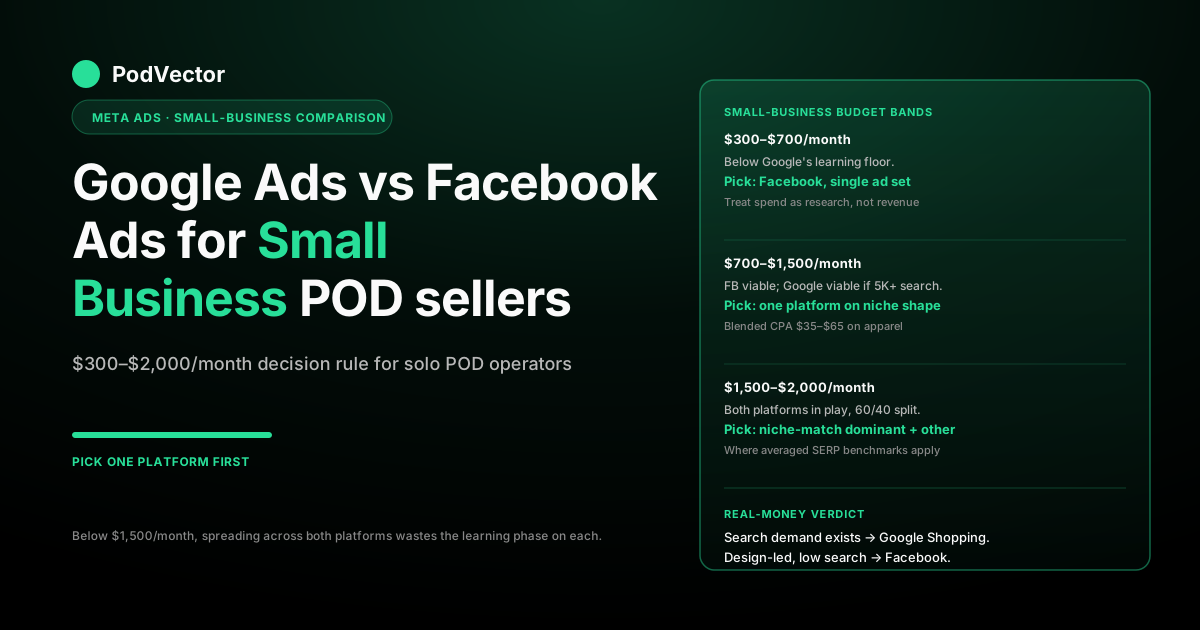
Quick Answer: For a small-business print on demand seller spending $300–$2,000 a month, the right platform is decided in minutes, not by averaged industry CPCs. If your niche has measurable search demand and you can shoot product photos but not video, start on Google Shopping. If your niche is design-led with low search volume and you can ship 3–5 creatives a week, start on Facebook.
The cheap-clicks framing the rest of the SERP repeats — "Facebook is $0.85, Google is $1.95" — is a trap for small POD operators. Click cost doesn't pay your Printify supplier bill. Cost per purchase against the $5–$7 of contribution margin you keep on a $26 hoodie is the only number that matters, and at small-business spend levels each platform has a different floor below which it cannot learn.
Below: the side-by-side small-business comparison, the $500/month decision rule, the realistic time cost of running each, and a four-week ramp plan you can start tomorrow.
What "small business POD" actually means for ad strategy
The phrase "small business" gets used loosely. For a print on demand seller making the Google-versus-Facebook decision, the practical definition has three parts: a monthly ad budget under $2,000, a one- or two-person team where the founder also makes the creative, and monthly recurring revenue under $25,000.
That definition matters because the SERP's most-cited cost benchmarks — including the AdsGo head-to-head and the LeadsBridge small-business guide — quote averages drawn from advertisers spending five and six figures a month. At those budgets, the platforms behave very differently than they do at $500 or $1,500.
Three constraints separate the small-business POD case from the averaged numbers. Each one shifts the right answer.
Budget floor. Google Shopping needs roughly $50–$100 per day to exit its learning phase reliably on apparel. Below that, the algorithm doesn't see enough conversions to optimize and either burns budget on the wrong queries or stalls.
Facebook's floor is roughly $30 per day per ad set, but the campaign-level total to learn well is closer to $40–$60. A $500/month budget is $16/day. That is below both floors, but Facebook is closer to viable.
Creative cost. Google Shopping uses your existing product photos and the title/description from your Shopify or Etsy listing. Setup is data work, not video work.
Facebook needs new creatives weekly to outrun ad fatigue — typically 3–5 fresh assets to test against winners. For a solo POD seller without a video editor, that's the binding constraint, not the click cost.
Margin density. A $26 hoodie sold through Shopify with a Printify base costs about $14 to fulfill, $5.50 to ship, and $1.20 in payment fees. That leaves $5.30 of contribution before any ad cost. A $4 cost per purchase eats 75% of that margin, not the 15% the platform's revenue-based ROAS would suggest.
POD operators have to defend pennies, not percentages. The platform that wastes less of the $5.30 wins, regardless of which one looks cheaper in the ads dashboard.
Google Ads vs Facebook Ads for small business: side by side
The table below is the 2026 view scaled to small-business POD reality — apparel and accessories at sub-$2,000 monthly spend. Numbers come from public benchmark reports cross-checked against operator data inside the PodVector AI cohort.
| Axis | Google Ads (Shopping/Search) | Facebook Ads (Meta) | Small-business POD verdict |
|---|---|---|---|
| Minimum viable monthly budget | $1,500 ($50/day Shopping) | $900 ($30/day per ad set) | Facebook accessible at lower MRR |
| Average CPC (apparel) | $0.95–$2.80 | $0.55–$1.45 | Facebook 40–55% cheaper per click |
| Conversion rate (cold) | 2.5–5.5% (Shopping/Search) | 0.8–1.8% (cold prospecting) | Google compresses CPA where search exists |
| Realistic CPA (apparel) | $25–$60 prospecting | $35–$75 cold | Google when niche has search volume |
| Setup time (first launch) | 4–8 hours (feed + Merchant Center + campaign) | 2–4 hours (pixel + 3 creatives + audiences) | Facebook faster for solo founders |
| Weekly maintenance | 1–2 hours (negative keywords, bids) | 3–5 hours (creative refresh, fatigue) | Google lower ongoing time |
| Time to first signal | 3–7 days (Shopping) | 5–10 days (pixel volume dependent) | Google faster on tight queries |
| Best for design-led products | Weak — text-driven surface | Strong — visual feed | Facebook for niche apparel and gifts |
| Best for keyword-shaped demand | Strong — captures intent | Weak — interest proxies only | Google when long-tail search exists |
| Attribution honesty (default) | Over-reports 5–20% | Over-reports 20–40% (CAPI helps) | Both inflate; Facebook more so |
Two rows decide the small-business call: minimum viable monthly budget and weekly maintenance time. If your budget is below $1,500 a month or your free hours are under three a week, the table picks the platform for you before you ever look at CPC.
Cost reality at $300–$2,000/month
Cost averages from the SERP describe what advertisers spending $20K/month pay. Small-business POD operators spend in three discrete bands, and each band behaves differently.
$300–$700/month
This is below Google Shopping's learning floor on apparel. Running it here usually produces one of two outcomes — the algorithm fails to find buyers and you burn the budget, or it finds the cheapest two queries and ignores the rest of your catalog.
Facebook can technically run at $10–$23/day, but you'll see real fatigue inside two weeks because the audience pool burns through fast at low impression caps. The realistic answer at this band: pick one platform, run a single tightly-targeted ad set, and treat the spend as research budget, not revenue budget.
Expected outcome: 3–8 conversions a month if the design-niche fit is strong, zero to two if it isn't. CPA will look high relative to platform averages because you're running below efficient scale on purpose.
$700–$1,500/month
This is the band where Facebook becomes properly viable for POD and Google Shopping starts to work for niches with search demand above 5,000 monthly long-tail queries. At $30–$50/day, Facebook can sustain one prospecting ad set plus one retargeting ad set with weekly creative refresh.
Google Shopping at the high end of this band ($50/day) hits its minimum viable spend. Below $1,200/month, expect Shopping to feel uneven — strong weeks alternating with stalled weeks.
Expected blended CPA: $35–$65 for apparel, depending on niche and creative quality. That's $5–$15 of margin per sale on the $5.30 hoodie example before you factor in repeat-purchase tail.
$1,500–$2,000/month
This band lets you run both platforms, with allocation tilted to whichever matches your demand shape. A reasonable split is 60/40 — 60% on the platform that matches your niche, 40% on the other for top-of-funnel coverage.
Above $2,000/month is where the SERP's averaged benchmarks start to apply. Below it, the floors and creative-cost realities matter more than the per-click numbers.
For a deeper cost breakdown across all spend levels, our Google Ads vs Facebook Ads cost analysis walks the full P&L against POD's contribution margin.
The $500/month decision rule
Most small-business POD operators arrive at this question with a budget closer to $500 than to $5,000. The decision rule below collapses 4,500 words of SERP comparison into four checks. If you answer "yes" to all four under one platform, that's where you start.
Pick Google Ads (Shopping or Search) if
- Your products map to specific search queries with at least 1,000 monthly volume across long-tail variants. Use Google Keyword Planner or Ahrefs to verify, not gut feel.
- You have product photos with white or simple backgrounds suitable for Shopping listings.
- Your Shopify or Etsy store is set up with structured product titles, descriptions, and an active Google Merchant Center feed (or you can build one in a weekend).
- You can spend $50/day on Shopping for at least 21 days continuously to clear the learning phase.
Pick Facebook Ads if
- Your niche is design-led — t-shirts, hoodies, mugs, posters with original art — where the search volume on the exact concept is under 1,000/month.
- You can produce 3–5 fresh creative assets per week (static images count; short video helps).
- Your Shopify pixel is installed and has fired at least 50 view-content events in the last 30 days.
- You can sustain $30/day for at least 14 days through the Facebook learning phase.
Pick neither yet if
- Total monthly budget is under $300. Build organic Etsy traffic or Pinterest first; ad spend below this floor produces noise, not data.
- Your store has converted fewer than 10 organic orders in the last 60 days. Work on the offer, photography, and pricing first.
This rule isn't original to PodVector AI — variants appear across LyfeMarketing's five questions and similar starter guides. What's specific to POD is the search-volume threshold (1,000 long-tail variants, not 5,000 head terms) and the creative-asset count, both calibrated to print on demand's actual cost structure.
The hidden time cost neither platform reports
Click costs are public. The hours you spend running each platform are not, and for a solo POD founder they're often the binding constraint.
Google Shopping's setup is front-loaded. Building a clean Merchant Center feed, mapping product attributes, fixing disapprovals, and structuring campaigns takes 4–8 hours the first time. After launch, weekly maintenance averages 1–2 hours — checking search-term reports, adding negative keywords, adjusting bids on top SKUs.
Facebook's setup is faster. Pixel install, audience creation, and uploading three creatives takes 2–4 hours. Maintenance is the inverse of Google's — weekly creative production is 3–5 hours minimum because static and video assets fatigue inside 7–14 days at small-business impression volumes.
Translated to a 40-hour-a-week founder running everything else (product, fulfillment, customer support):
- Google Shopping costs roughly 6 hours up front and 6 hours/month ongoing.
- Facebook Ads costs roughly 3 hours up front and 16 hours/month ongoing.
If you have a designer or video tool that lets you batch a month of Facebook creative in one Sunday, the gap closes. If you're cutting clips in Canva between order-fulfillment runs, the Facebook time tax is real and it's why founders sometimes pick the wrong platform on cost grounds and burn out by month two.
Five questions to pick the right platform
Run these in order. The first one that produces a clear answer is your platform.
1. Does Keyword Planner show 1,000+ monthly volume on long-tail queries that match your products?
If yes, Google Shopping is in play. If under 500, Google can't spend efficiently no matter how good your products are. Search demand is a structural feature of the niche, not something you can grow with creative work.
2. How many fresh creatives can you produce per week?
Three or more (static counts), Facebook is viable. One or none, Facebook will fatigue you out by week three. Hiring a creative on Fiverr or Contra closes the gap, but that's $300–$600/month of overhead the SERP rarely surfaces.
3. What's your monthly ad budget?
Under $700, pick one platform — Facebook unless your niche has heavy search demand. $700–$1,500, still pick one but you have room to ramp. $1,500–$2,000, run both with a 60/40 split.
4. How much time can you spend on ads weekly?
Under 3 hours, pick Google. Three to ten hours, either works. More than ten hours, the time isn't the constraint — pick on demand shape.
5. Are you measuring profit per order or just revenue?
This isn't strictly a platform question, but it changes the answer. If you're optimizing on Shopify-reported revenue, both platforms will lie to you in the same direction — overcounting attributed sales. If you're tracking contribution margin per order against ad spend, Facebook's higher over-reporting (20–40% versus Google's 5–20%) skews the comparison and tilts the call slightly toward Google for any given CPA.
For deeper measurement honesty, our guide to Meta Ads ROAS and attribution for POD walks the full reconciliation.
The four-week ramp plan
Picking the platform is the easy half. The harder half is not stopping at week two when results look messy. Here is the four-week plan that gets a small-business POD operator from launch to clean signal on either platform.
Week 1 — Setup
Google Shopping: build the feed in Google Merchant Center, fix disapprovals, structure one Standard Shopping campaign with priority="medium" on your top 20 SKUs. Set the daily budget at $50.
Facebook: install the pixel, set up the conversions API (CAPI) connection, build one prospecting ad set targeting a tight interest stack relevant to your design niche. Upload three creatives (one image carousel, two static), each with a different hook. Set the daily budget at $30.
Week 2 — Don't touch it
Resist the urge to optimize. Both platforms are in learning. Pausing or recutting the campaign restarts the clock.
What to track: cost per click, cost per add-to-cart, cost per purchase. Do not track ROAS yet — the sample is too small.
Week 3 — First adjustments
Google: pull the search-term report. Add negative keywords for queries that aren't your buyers. Lower bids on SKUs producing clicks but no purchases; raise bids on SKUs converting above niche average.
Facebook: rotate one new creative against the worst-performing of the original three. Keep the audience untouched.
Week 4 — Decision
If CPA is within 1.5x of your contribution margin and the trend is downward, scale spend by 20%. If CPA is more than 2x your contribution margin and flat or rising, pause and audit — the issue is usually offer, not platform. If results are mixed, run another two weeks before scaling or killing.
The mistake most small-business POD operators make in week 4 is killing the platform when the killer was the offer or the creative. Run a campaign post-mortem before changing the channel.
When to add the second platform
Adding the second platform is a graduation, not a default. The threshold most POD operators hit successfully is roughly $5,000 MRR with a stable single-platform CPA at or below 1.5x contribution margin for at least 60 days.
The most common upgrade path is Facebook prospecting plus Google branded search. After a Facebook prospecting campaign starts producing brand searches at scale, those searches show up in Google Search Console. Capturing them with a low-budget branded campaign — typically $5–$10/day — protects them from competitor bidding and converts at 6–12% rather than the 1–2% prospecting rate.
The reverse path is Google Shopping plus Facebook retargeting. Once Shopping pushes consistent traffic, the pixel sees enough visits to build a meaningful retargeting audience. A small Facebook retargeting ad set ($15–$20/day) recaptures abandoned carts at $10–$28 CPA — substantially below the prospecting rate.
Either path is cleaner than spinning up two prospecting engines simultaneously, which doubles the time cost and halves the per-platform learning rate.
Five mistakes small POD sellers make on both platforms
1. Treating CPC as the success metric. A $0.85 click that doesn't convert is more expensive than a $2.80 click that does. The metric that matters is cost per purchase against your contribution margin, not click cost in isolation.
2. Pausing campaigns inside the learning phase. Google Shopping needs 21 days, Facebook needs 14. Pausing on day 9 to "fix" a high CPA resets the algorithm and wastes the spend that came before.
3. Running too many ad sets at small budgets. Three ad sets at $10/day each will all underperform one ad set at $30/day. Concentrate spend below $1,500/month.
4. Not reconciling platform-reported sales against Shopify. Both platforms inflate. The honest CPA usually sits 15–25% above what the dashboard shows. Reconcile weekly during the first 60 days so your scale-up decisions are based on real numbers.
5. Forgetting Printify or Printful supplier cost in the math. A 4x Shopify ROAS isn't 4x against POD margin — it's roughly 0.7x of contribution. Build the supplier cost into your CPA target before you scale, not after.
For sellers running Facebook specifically, our complete Meta Ads playbook for POD goes deeper on creative strategy and audience structure. For the broader comparison, see Google Ads vs Facebook Ads: which is best for POD sellers and the full Meta Ads comparison cluster.
FAQs
What is the smallest budget that works for Google Ads or Facebook Ads as a POD small business?
Facebook can produce signal at $30/day ($900/month). Google Shopping needs $50/day ($1,500/month) on apparel. Below those floors, both platforms produce noise rather than learnings. Under $300/month, neither platform is the right move — invest in organic Etsy or Pinterest traffic first.
Is Facebook Ads cheaper than Google Ads for small business?
Facebook is cheaper per click and per thousand impressions, but Google Shopping converts at roughly 3x the rate on apparel. Cost per purchase — the number that determines profitability — is usually lower on Google when your niche has 1,000+ monthly long-tail searches, and lower on Facebook when it doesn't. Cheap clicks aren't cheap customers.
Can a print on demand small business survive on just Facebook Ads?
Yes, especially in design-led niches where Google's search demand is too thin to support Shopping. Many seven-figure POD businesses run Facebook prospecting and add Google only for branded search defense once a recognizable brand emerges. The single-platform path is viable; the dual-platform path is faster but more expensive.
Can a print on demand small business survive on just Google Ads?
For niches with measurable search demand — registered nurse gifts, breed-specific dog merchandise, hobby-specific apparel — yes. Google Shopping converts efficiently and requires far less weekly creative work. The trade-off is ceiling: Google's spend is bounded by the search volume of your niche. Once you saturate the available queries, scaling requires Facebook or another platform that creates demand rather than capturing it.
How long until small business POD ads become profitable?
Realistic timeline: 30–60 days to first stable signal, 90–120 days to a CPA reliably below 1.5x contribution margin. Anyone promising profitability inside two weeks is selling a course. The variable that compresses this most is offer quality, not platform choice — a $26 hoodie with a generic design will struggle on either platform; a niche-specific design with a strong hook can hit profitability in week three.
Do I need a Shopify store to run Google Ads or Facebook Ads for POD?
For Google Shopping, yes — or an equivalent platform with a structured product feed (BigCommerce, WooCommerce, Etsy via specific integrations). For Facebook, you can technically run traffic to Etsy listings or even a landing page, but conversion tracking and dynamic retargeting both work substantially better on Shopify. The infrastructure investment pays itself back within the first profitable month.
Should I hire an agency to run small business POD ads?
Below $3,000/month in ad spend, agency fees usually consume the margin you'd otherwise scale on. Most quality agencies have minimum retainers of $1,500–$3,000/month, which is more than your ad budget. Self-manage until $5,000 MRR with one platform working, then evaluate. Until then, lean on platform documentation, free Skillshop courses for Google, and Meta Blueprint for Facebook.
How does Victor decide between Google and Facebook for small business POD?
Victor is PodVector AI's AI employee. It pulls live data from your Shopify store, your Printify or Printful supplier, your ad accounts, and your search-volume data into a single source of truth, then answers questions like "where should my next $500 in ad spend go this month?" with itemized math against POD's actual contribution margin — not platform-reported ROAS. For small-business operators making the Google-versus-Facebook call, the answer changes weekly as inventory, demand, and creative fatigue shift, and Victor recomputes it every time you ask. Victor answers and acts on those answers directly inside the ad platforms — with your approval.
Stop guessing which platform deserves your next $500
Google says one CPA. Facebook says another. Shopify shows a third. Printify and Printful subtract their cost off-ledger.
Victor pulls every channel's data into one live source of truth and answers "where does my next ad dollar earn the most contribution margin?" with itemized math your dashboards never produce. And stop optimizing on revenue while losing on profit.
Try Victor free