
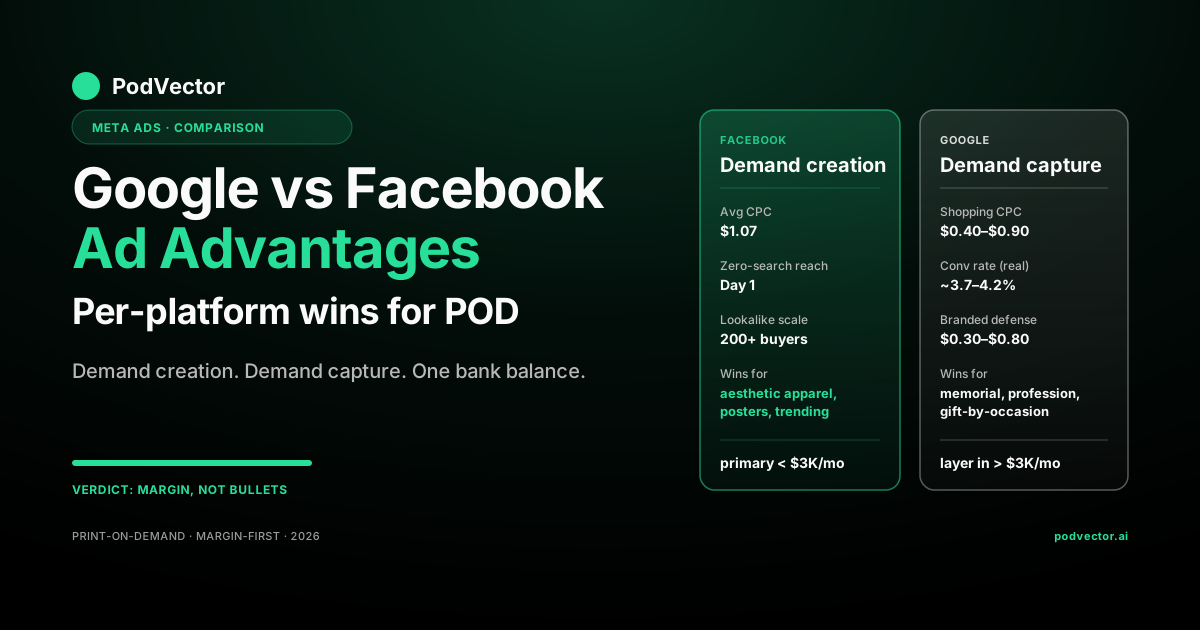
Quick Answer: Most "advantages" lists you'll find are written for B2B SaaS and e-commerce in general — not for the print-on-demand reality of $3–$8 contribution margin per order on a $24.99 t-shirt. The advantages that matter for POD are different.
Google Ads' real POD advantages: high-intent capture for niches with actual search demand (memorial, profession, breed, gift-by-occasion), Shopping campaigns that surface variants directly in results, and a 4.40% average conversion rate that holds up after de-duplicating attribution. Facebook Ads' real POD advantages: $1.07 average CPC, demand creation for designs with zero search volume, lookalike audiences trained on actual buyers, and a learning phase that stabilizes in 7–14 days at sub-$1K spend.
For most POD apparel and home-decor catalogs under $3K/month spend, Facebook's advantages outweigh Google's because there's no demand to capture yet. For POD niches with intent-driven keywords, Google wins on margin per order. Above $4K/month, you want both — but only if a layer above the ad managers is reconciling them against your real Shopify margin.
Why generic "advantages" lists mislead POD operators
Search "Google Ads vs Facebook Ads advantages" and you'll get the same six bullet points on every blog. Higher intent on Google. Lower CPC on Facebook. Better visual storytelling on Meta. More precise demographic targeting on Meta. Stronger conversion rate on Search. Faster results on Google.
All of those are technically true. None of them tell a print-on-demand seller what to do.
The reason: those lists are written for an imagined "average e-commerce business" with a $60–$120 average order value, fixed cost of goods, and at least some search demand for what they sell. POD has none of those properties. Average order value sits closer to $24.99. Cost of goods is variable per provider, per product, per region — Printify and Printful charge differently for the same blank. And most POD designs have zero monthly searches on day one.
So when an "advantages" article says Google has higher conversion rates, the unspoken assumption is that you have keywords worth bidding on. POD apparel mostly doesn't. When the same article says Facebook is cheaper per click, the unspoken assumption is that low CPC translates to low CPA. POD's narrow margin breaks that math.
The only useful way to read advantages is per-channel against the catalog you actually have. The rest of this article does that.
Google Ads' real advantages for POD
Stripped of generic claims, here are Google's advantages that actually move the bank balance for a POD operator.
1. Intent capture for niches that already have search demand
Google's defining advantage is capturing buyers at the moment they tell the search box what they want. For POD, that advantage is real but narrow — it only kicks in for niches where buyers actually type queries.
Examples that work well: memorial gifts, breed-specific apparel ("border collie mom shirt"), profession humor ("nurse mug funny"), and gift-by-occasion phrases ("retirement gift for teacher"). Examples that don't work: pure aesthetic apparel, abstract designs, or trending micro-niches where the audience hasn't started searching yet.
If your top-selling SKUs map to phrases people search 100+ times a month, Google captures that demand more cheaply than any other channel. If they don't, Google has nothing to bid against and Facebook's discovery model wins by default.
2. Shopping campaigns that show variants and prices in the result
Google Shopping (the product-image listings at the top of search results) is the most underused Google format for POD. A clean Shopping feed surfaces your t-shirt variants with the design preview, the price, and the size in the result itself — buyers click already pre-qualified on look and budget.
Shopping CPCs run $0.40–$0.90 for POD apparel, well below Search's $2.10–$3.20 range. The catch is the feed: variants need accurate titles, GTIN-or-MPN data, and consistent design preview images. POD operators with thin product metadata get worse Shopping performance than they'd get from manual Search campaigns. Fix the feed before you fight the ad manager.
3. A 4.40% average conversion rate that holds up under attribution
The headline 4.40% conversion rate vs Facebook's 1.85% is overstated by both platforms — but Google's number holds up better when you de-duplicate. Google attributes mostly on last-click; if a buyer searched, clicked your ad, and bought, that's a real attributable order.
Facebook's higher view-through window (1-day post-view) inflates its numbers more aggressively. So when you reconcile both platforms against actual Shopify orders, Google's reported conversion rate shrinks ~5–15%, while Facebook's shrinks ~25–45%. Google's "true" advantage on conversion is smaller than the dashboard suggests but still real.
4. Branded search defense
If your POD store has any organic traffic — even a few hundred orders a month — competitors and arbitrage sellers will eventually bid on your store name. Branded search defense (a tightly-themed campaign on your own brand terms) costs $0.30–$0.80 per click and protects orders that would otherwise leak.
This is a cheap, high-ROAS advantage Facebook can't replicate. Most POD operators ignore it until they notice an arbitrage seller bidding on their name. Set it up early; it pays for itself the first month a competitor shows up.
5. YouTube reach without the YouTube studio
Google's display network (the partner sites and YouTube placements where Google ads also appear) lets you push static and short-video ads to YouTube and the broader Google content network without producing a dedicated YouTube channel. For POD apparel, this advantage is modest — display performance lags Search and Shopping — but it's a way to spend incremental budget once Search and Shopping are saturated.
Facebook Ads' real advantages for POD
Facebook's advantages cluster around demand creation, audience modeling, and creative iteration speed. For POD specifically, these matter more than the cost-per-click difference suggests.
1. Demand creation for designs with zero search volume
Most POD designs have zero monthly Google searches when they launch. Facebook doesn't care — its targeting fires on demographics, interests, behaviors, and lookalike modeling, none of which need a buyer to have typed your phrase before.
This is Facebook's single biggest advantage for POD. A new aesthetic apparel drop, a new home-decor SKU, or a new niche test gets reach on day one without waiting for organic search to build. Google has no equivalent for that — display targeting on Google can serve impressions, but it can't generate qualified buyers without intent signal.
2. $1.07 average CPC and sub-$1K stable spend floor
Facebook's $1.07 average CPC is roughly 2.5x cheaper than Google's $2.69. For POD, that gap matters because the contribution margin per order is small enough that CPC differences eat measurable percentage points of margin.
The corollary advantage: Facebook's learning phase stabilizes faster and at lower spend. Advantage+ Shopping (Meta's auto-targeted commerce campaign) typically exits learning in 7–14 days at $30–$60/day. Google's Performance Max (Google's all-in-one auto-distributed campaign) usually wants $3K/month and 14–28 days. For a POD operator under $1K/month total ad spend, Facebook is the only viable platform that produces stable signal.
3. Lookalike audiences trained on real buyers
Once you've shipped 200+ orders, Facebook's lookalike model can target users similar to your actual buyers — not similar to a generic interest cluster, but similar to the people who specifically bought your designs.
This advantage compounds. A 1,000-buyer seed produces sharper lookalikes than a 200-buyer seed. By the time a POD store hits 5,000 lifetime orders, lookalikes typically outperform interest targeting by 30–60% on cold conversion. Google has no real equivalent — its similar-audiences feature was deprecated in 2023 and the Customer Match alternative depends on email-list size most POD stores don't have.
4. Creative iteration speed and visual-first format
POD lives or dies on the design. Facebook's feed format puts the design front and center — full-bleed image or video, design plus context (model wearing the shirt, mug on a desk, poster on a wall), and the option to test 5–10 variants per ad set in days.
Google's Search format is text-first. You can't show the design in a Search ad's headline. Shopping helps, but the product image is small and surrounded by competitors. For visual-discovery categories — apparel, posters, wall art, accessories — Facebook's creative format is structurally better at converting cold traffic.
5. Retargeting that catches abandoned carts at scale
Facebook's retargeting is less novel than it used to be — every platform has it now — but Meta's pixel still produces the highest-volume retargetable audience for POD because most buyers spend more time on Instagram and Facebook than on properties Google can re-serve to. Retargeting CPMs on Meta run $8–$15 for warm audiences vs $25–$45 on Google Display. The math works better.
The advantages neither platform talks about
The articles in the top three SERP results for this comparison list advantages on both sides. None of them list the structural disadvantages that bite POD operators specifically.
Google's hidden disadvantage: for POD apparel without sharp search demand, you're bidding against Amazon, Etsy, and large brand stores on broad keywords. Quality scores on POD landing pages — usually a single design preview with thin copy — drive auction prices 40–80% above the cross-industry $2.69 average. Google's "advantage" of high-intent capture only exists if you can afford the auction.
Facebook's hidden disadvantage: the iOS 14.5+ privacy changes shrunk Meta's signal pipeline. Conversion APIs (Meta's server-side data feed, called CAPI) plug some of the gap, but POD stores on Shopify with default app-pixel-only setups still lose 15–25% of attributable orders. The advantages of cheap CPC and good lookalikes only land if your pixel is feeding back a complete picture — and most POD operators haven't audited theirs in years.
Reading either platform's advantages without these caveats is how operators end up scaling spend on a channel that's silently leaking margin.
Which set of advantages matters more by POD niche
The advantages of each platform align differently against the actual structure of your catalog. A rough mapping:
| POD niche | Primary platform | Why its advantages dominate |
|---|---|---|
| Memorial / sympathy | High-intent search ("memorial gift for grandma loss"); buyers Google specific phrases the same week of need | |
| Profession humor / nurse / teacher | Google + Facebook | Google captures gift-buyers searching; Facebook scales bulk awareness in profession Facebook groups |
| Breed / pet-specific apparel | Google + Facebook | "Border collie mom shirt" gets searched; Facebook's pet-interest segments scale once a winner is found |
| Aesthetic / abstract apparel | Zero search volume; design itself does the converting in feed | |
| Trending / micro-niche | Speed of demand creation matters more than search capture during the trend window | |
| Wall art / posters / home decor | Visual-first format converts cold; Google's text-first Search underperforms | |
| Mugs / drinkware (gift-occasion) | "Funny coffee mug for boss" gets searched at scale; gift intent is high | |
| Personalized / custom name | Facebook + Google | Facebook's targeting nails the persona; Google captures the few who search by occasion |
The pattern: when buyer intent expresses itself as a search phrase, Google's advantages dominate. When the design is the demand signal, Facebook's advantages dominate. Many POD niches sit in the middle and benefit from both.
Which advantages matter at each budget tier
Budget changes which advantages are accessible. Below certain spend floors, some platform features simply don't work well enough to be called advantages.
Under $1K/month: Facebook's advantages dominate. You can't generate enough conversions on Google to escape Performance Max's learning phase, and Search at $2.10–$3.20 CPC eats your daily budget in 30 clicks. One Facebook creative-testing campaign plus one retargeting campaign uses the budget more efficiently than any Google build.
$1K–$3K/month: Facebook still primary, but Google Shopping with a clean feed becomes worth testing — Shopping CPCs are low enough that $300–$500/month produces real signal. Skip Performance Max at this tier; manual Shopping is more controllable.
$3K–$8K/month: Both platforms' advantages are accessible. Typical split: 65–75% Facebook, 25–35% Google (Search + Shopping mix). At this tier, the advantage neither platform offers — unified margin attribution across both — becomes the bottleneck.
$8K+/month: Performance Max becomes viable. Lookalike audiences hit their compounding zone. Branded search defense pays for itself. The advantages of running both platforms compound, but only if the operator has stopped reading platform-reported ROAS and started measuring contribution margin per channel from the order data itself.
Combining advantages: how POD operators actually run both
The "use both" recommendation is correct but lazy unless it specifies the role of each platform. Here's the working POD split:
Facebook does the demand creation. Cold prospecting at the top of the funnel, Advantage+ Shopping for catalog-wide testing, lookalike scaling once a creative wins, retargeting for cart abandoners.
Google does the demand capture. Search on the 20–40 keywords your top sellers actually rank for, Shopping for the full catalog, branded defense on your store name, and Performance Max only above $3K/month with a clean feed.
Budget allocation isn't a fixed ratio — it's whichever platform's marginal CAC is lower this week. If Facebook's marginal CAC for the next $500 is $18 and Google's is $34, the next $500 goes to Facebook regardless of what last quarter's split looked like.
That decision requires daily-fresh per-platform CAC measured against actual Shopify margin, not platform-reported CAC. Which is the advantage neither platform offers and most POD operators don't build.
The advantage you build yourself: unified margin attribution
Every advantage above sits inside a single platform's dashboard. The advantage that compounds across both is the one that lives outside both: a single source of truth that answers what's my actual margin per channel this week?
Building it requires three pieces. A live data warehouse — Snowflake, Redshift, Databricks, or equivalent — that holds Shopify orders, Printify and Printful cost line items, Meta spend and conversions, and Google spend and conversions in one schema. An ETL pipeline that refreshes the warehouse hourly or daily so yesterday's data is available before today's budget decision. And a query layer that joins those tables to compute contribution margin per order, then rolls up to channel-level CAC and ROAS using your own attribution rules — not Meta's or Google's.
For a solo POD operator, that's typically 4–8 weeks of build plus ongoing maintenance. For an agency-managed account, it's a six-figure infrastructure project. Most POD operators never build it and end up making budget decisions on platform-reported numbers that overstate channel ROAS by 30–60% combined.
The alternative is an AI employee that already pulls Shopify, Printify, Printful, Meta, and Google into one live warehouse and answers margin questions in plain English. That's what Victor by PodVector AI does. Victor answers "what's my actual blended CAC across Meta and Google this week, net of Printify costs?" in chat. Victor can also pause campaigns whose marginal CAC has crossed your threshold — with your approval — rather than just flagging them.
For wider context, our Meta Ads vs alternatives hub frames the whole channel landscape, the effectiveness comparison drills into which channel actually delivers margin, and the cost comparison handles the per-click economics. The ROAS and attribution guide for POD explains why the dashboard numbers lie. The complete Meta Ads playbook covers the Meta side end to end. The full Meta vs alternatives cluster and Meta Ads topic hub hold the rest. For an outside agency view of the same comparison, the AdsGo 2026 guide is a solid non-POD reference.
FAQs
What's Google Ads' single biggest advantage over Facebook for POD?
Capturing buyers who already typed a buying-intent phrase. For POD niches where that intent exists — memorial, profession, breed, gift-by-occasion — Google produces orders at higher contribution margin than Facebook because the buyer arrived already pre-qualified. For niches without that intent, this advantage doesn't materialize.
What's Facebook Ads' single biggest advantage over Google for POD?
Generating demand for designs with zero search volume. Most POD designs have no Google search demand on day one; Facebook's targeting fires on demographics, interests, and lookalikes, none of which need prior search behavior. This makes Facebook the only viable cold-acquisition channel for aesthetic, abstract, and trending POD catalogs.
Are Facebook's advantages still real after iOS 14.5 privacy changes?
Yes, but smaller than 2020. Conversion APIs (Meta's server-side feed, called CAPI) recovered most signal for stores that set them up properly. POD stores on default Shopify pixel-only setups still leak 15–25% of attributable orders to attribution gaps. The advantages of cheap CPC and good lookalikes still apply; the disadvantage of partial signal needs an explicit fix.
Does Google Shopping have an advantage over Facebook's Advantage+ Shopping?
For catalogs with intent-driven keywords and a clean feed, yes — Shopping CPCs run $0.40–$0.90 vs Facebook's broader $0.90–$1.40 range, and the buyer arrived searching. For catalogs without that intent, no — Advantage+ Shopping (Meta's commerce campaign type) outperforms Google Shopping because the underlying demand is interest-based, not query-based.
Which platform has more advantages for a $500/month POD budget?
Facebook, by a wide margin. Below $1K/month, Google can't generate enough conversion volume to escape Performance Max's learning phase, and Search burns through a daily budget in 30 clicks. Use the entire $500 on one Facebook creative-testing campaign and one retargeting campaign. Layer Google in only after monthly spend reliably crosses $3K.
Do Google's advantages on conversion rate hold up after attribution reconciliation?
Mostly yes. Google attributes primarily on last-click, so its reported conversion rate shrinks roughly 5–15% when reconciled against Shopify orders. Facebook's view-through-heavy attribution shrinks 25–45% in the same reconciliation. Google's conversion-rate advantage is smaller than the headline 4.40% vs 1.85% gap suggests but still real.
Should I split my POD ad budget evenly between Google and Facebook to capture both sets of advantages?
Almost never. Even-split logic ignores marginal CAC, which is the only number that matters. Most POD accounts under $5K/month run 65–75% Facebook, 25–35% Google. Above $8K, the split should float weekly based on which platform's marginal CAC is lower — measured against your actual Shopify margin, not the ad managers' self-reported numbers.
What's the advantage of running both platforms if I can only afford one?
None — split-budget testing under $1K/month produces unreliable signal on both. Pick one (Facebook for almost every POD catalog under $1K) and run it cleanly. Adding the second platform is only an advantage once you have enough spend to escape both platforms' learning phases simultaneously, which usually means $3K+/month total.
Advantages live in margin per order, not bullet-point lists
Every "advantages" article ends with "use both." Few of them tell you which advantage is producing margin this week. Victor by PodVector AI pulls Shopify, Printify, Printful, Meta, and Google into one live warehouse and answers "which platform's advantage actually delivered margin in the last 7 days?" in plain English — so you stop reading two sales pitches and start spending against the only number that compounds.
Try Victor free