
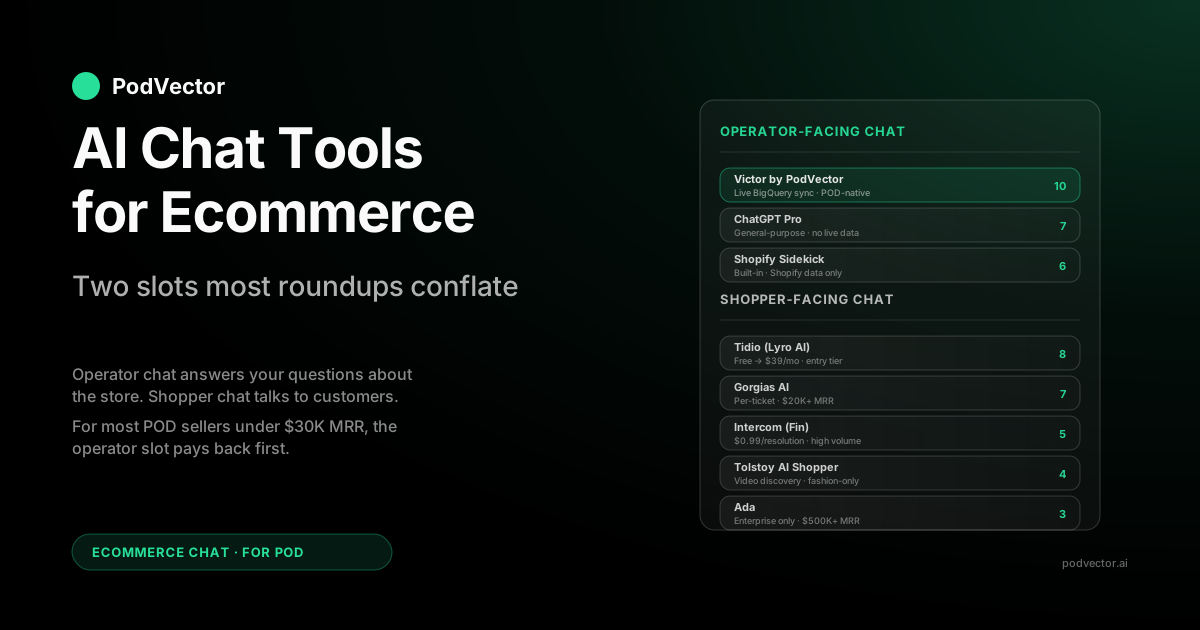
Quick Answer: The AI chat tools for ecommerce that survive a POD-operator's margin filter in 2026 split into two slots most generic roundups conflate. Shopper-facing bots — Tidio Lyro, Gorgias AI, Intercom Fin, Tolstoy AI Shopper, Ada — handle support and product-recommendation conversations on your storefront. Operator-facing chat — Victor by PodVector AI, ChatGPT with custom GPTs, long-context LLMs, Shopify Sidekick — answers your own questions about the store. The 2026 shift is that the shopper bots no longer just answer — they take actions (cancel an order, edit an address, process a refund) and pitch products, while the operator tools start to do the same on your side. For most POD sellers under $30K MRR, the AI-employee slot pays back faster than the shopper slot, and Tidio's free tier is the right starting point if you do install a shopper bot.
The five top-ranking "AI chat tools for ecommerce" articles list 5–25 tools each but never separate these two jobs, which makes the comparison nonsense for a print-on-demand operator.
A graphic-tee store doing $8K/month with 40 tickets/week has different chat needs than a 60%-margin DTC brand doing $200K/month with 800 tickets/week. This guide picks one tool per slot per revenue stage and names the ticket volume and AOV at which each one starts paying back.
Why Generic Roundups Mislead POD Operators
Search "AI chat tools for ecommerce" and you get listicles ranking Tidio, Tolstoy, Intercom, Ada, Gorgias, and a dozen others against each other. Tolstoy's "10 Best AI Chatbots" roundup and DigitalApplied's "Best Recommendation Platforms" guide both follow the same template: feature comparison, integration notes, pricing tiers, conversion-lift case studies. The conclusions are vendor-agnostic but operator-blind — they assume any ecommerce store benefits from any of these tools, when the reality is that the stage and the unit economics decide whether the install is free money or a $200/month leak.
The first thing a POD operator needs to do with the entire category is split it in two. Shopper-facing chat is the bot on your storefront that answers customer questions, recommends products, and recovers carts.
Operator-facing chat is the assistant you open in a tab to ask questions about your store: which design is bleeding margin, which Printify base is selling above its supplier price, which ad set is producing returns at sub-$5 CAC. Both jobs are real. The roundups conflate them because they're written for an audience that, by default, runs a high-margin DTC brand with enough ticket volume to justify a support bot regardless of stage.
Print-on-demand inverts that default. A typical Printify-supplied tee retails at $24, costs $11 from the supplier, and clears about $13 of gross before any tool subscription touches it.
A $200/month chat tool needs to drive 15+ incremental orders every month just to pay its own bill — which is plausible for the AI-employee slot at any revenue stage but only plausible for the shopper slot once your support volume is high enough that automated deflection saves real human hours. For most graphic-tee stores under $30K MRR, the AI-employee slot pays back first.
For the broader category, the complete guide to AI tools for POD sellers is the pillar. The closely-related conversational AI platform comparison goes deeper on the shopper-facing platform layer. The tools cluster hub indexes every comparison in this series, and the AI analytics topic hub is where the operator-chat-as-analytics-interface question lives.
The Scorecard: One Pick Per Slot
Scores out of 10 on POD-specific criteria — payback against a $13/unit gross margin, depth of integration with the store data and supplier costs, and whether the tool's output is usable at the per-design level rather than only at the per-store level. Starting cost is the all-in monthly including AI usage fees, not the headline plan price.
| Slot | Top pick for POD | Starting all-in cost | POD payback | Setup time |
|---|---|---|---|---|
| Operator chat — live data | Victor by PodVector AI | Free trial | 10 | 15 min (warehouse sync) |
| Operator chat — general | ChatGPT (Plus plan) | $20/mo | 7 | 0 min (no integration) |
| Operator chat — Shopify-native | Shopify Sidekick | Free | 6 | 0 min (built in) |
| Shopper chat — entry tier | Tidio (Lyro AI) | Free → $39/mo | 8 | One-click app |
| Shopper chat — support volume | Gorgias AI | $10/mo + per-ticket | 7 | One-click app |
| Shopper chat — enterprise | Intercom (Fin) | $0.99 per resolution | 5 | One-click app |
| Shopper chat — discovery + conversion | Tolstoy AI Shopper | $99/mo | 4 | One-click app |
| Shopper chat — large catalog | Ada | Custom (enterprise) | 3 | Multi-week onboarding |
The "POD payback" column is what the SERP roundups don't have. It's not a feature score — most of these tools are well-built. It's a payback score against the print-on-demand unit economic profile, which is the actual question every POD operator is asking when they evaluate chat software.
Operator-Facing Chat: Victor vs ChatGPT vs Long-Context LLMs vs Sidekick
The AI-employee slot is the chat tool you open to ask questions about your own store. "Which design lost the most margin to discounts last week?" "What's the average reorder rate on the unisex hoodie versus the comfort-color tee?" "Why did my Printify cost on SKU 4471 jump $0.40?" These are questions a human analyst could answer in a SQL session, but a POD operator at 1–10 employees doesn't have a SQL session — they have a store, an inbox, and forty tabs open.
Victor by PodVector AI — the live-data pick
Victor is purpose-built for the POD AI-employee slot. The architecture is three tools backed by a live warehouse sync of your Shopify, Printify, Printful, and ad-platform (Meta and Google) data.
You ask a question in plain English, and Victor looks at your real numbers to answer it, also in plain English, with the data to back it up. Today the answers are read-only — Victor reports, doesn't act.
The roadmap is to add execution: pause the losing ad set, regenerate the listing copy, push the supplier-cost-aware reprice. For the AI-employee slot specifically, the live data access is the differentiator — every other AI chat option either doesn't have your numbers (ChatGPT and other general-purpose LLMs) or has them at the storefront level only (Sidekick).
The payback math is direct. If Victor surfaces one losing design per month that you would have kept funding for another four weeks, the saved ad spend pays back the subscription several times over. Most POD operators have at least one of these in their store at any given time, which is why the AI-employee slot tends to pay back first regardless of revenue stage.
ChatGPT — the general-purpose default
ChatGPT Plus at $20/month is the entry point most POD operators reach for first. It writes listing copy, suggests niche angles, drafts customer-service replies, and (with the Code Interpreter / Advanced Data Analysis feature) can analyze a CSV of your Printify orders if you export and paste.
It does not have live access to your store. Every analytical question requires an export-paste loop, which works for a one-off question and breaks for a weekly margin review. Pair it with a custom GPT trained on your brand voice for the copywriting tasks and treat it as a complement to a live-data tool, not a replacement.
Long-context LLMs — the deep-document pick
A long-context general-purpose assistant (typically $20/month) is the alternative to ChatGPT for operators who do a lot of long-document work — analyzing supplier contracts, reviewing six months of customer reviews, drafting a brand voice guide. A 200K-token context window means you can paste an entire Printify product export plus a year of customer reviews and ask the model to find the design themes that correlate with five-star reviews.
Like ChatGPT, no live store access; same export-paste loop applies. For operators who write a lot, a long-context model's prose can read more naturally than ChatGPT's defaults, which matters for listing copy.
Shopify Sidekick — the built-in baseline
Sidekick (free, included with every Shopify plan) lives in your admin and answers questions about your store data — "show me my best-selling product this week" or "create a discount for everyone who's bought a hoodie in the last 90 days." It's the lowest-friction option because there's nothing to install. The depth is shallow versus Victor — Sidekick doesn't see your Printify supplier costs, doesn't reconcile across platforms, and can't answer cross-channel questions like "what's my Etsy versus Shopify margin on the same SKU." Use it for one-off Shopify-only questions; reach for a deeper tool for actual margin analysis. The full breakdown is in the POD seller's guide to Shopify Sidekick.
What to install for the AI-employee slot
Under $5K MRR: ChatGPT Pro alone for copy and ad-hoc questions, plus Sidekick for storefront questions. $5K–$30K MRR: add Victor for the margin-and-reorder questions Sidekick can't answer. Past $30K MRR: Victor is the daily driver, a long-context LLM for the long-document work, ChatGPT for the team's collaborative documents and image generation.
Shopper-Facing Chat: Tidio vs Gorgias vs Intercom vs Tolstoy vs Ada
The shopper slot is the bot on your storefront that talks to customers. Sizing questions, shipping ETAs, order status, return policy, the inevitable "is this design available in a hoodie." The 2026 versions of these tools are "AI agents," not scripted chatbots — they resolve a ticket end-to-end (cancel the order, edit the shipping address, kick off the return) instead of just answering and handing off. They also differ in which model powers them, and that's worth knowing: Tidio's Lyro runs on Anthropic's Claude, Gorgias's AI Agent on a direct OpenAI partnership. For POD specifically, the support-volume math matters more than the model — most graphic-tee stores under $20K MRR don't have enough tickets per week to justify the higher tiers, and the wrong install just adds a monthly bill without saving meaningful human hours.
Tidio (Lyro AI) — the entry tier
Tidio's free plan covers 50 conversations per month, with the Lyro AI add-on starting at $39/month for 50 AI-handled conversations and scaling from there. The Shopify integration is one-click and the bot pulls product data, order data, and your help-doc content into its context automatically.
For POD stores under $20K MRR, Tidio is the lowest-friction install — you'll know within a week of going live whether the AI is deflecting enough tickets to justify the upgrade past the free tier. Most POD operators report 30–50% deflection on simple status and sizing questions, which is the bar at which the math works.
Gorgias AI — the support-volume pick
Gorgias starts at $10/month and prices most of its value on per-ticket fees, which inverts the question — instead of paying a flat subscription for AI capacity you might not use, you pay only when the bot or your team actually handles a ticket. For POD stores past $20K MRR with 100+ tickets/week, the Gorgias model usually beats Tidio because it scales with actual support load. The AI Agent (Gorgias's autonomous tier) handles full ticket resolution including refund processing, order edits, and returns initiation — which matters for POD because returns logistics on Printify-supplied items are particular and the bot needs to know not to promise free returns on items the supplier won't accept.
Intercom (Fin) — the per-resolution pick
Intercom's Fin AI Agent prices at $0.99 per AI resolution on top of the Intercom platform plans (starting around $74/month). The economics are straightforward: every ticket Fin handles end-to-end costs you a dollar, every ticket it can't escalates to your inbox at zero AI cost.
For POD stores doing 200+ tickets/week with a high mix of repeat questions (where's my order, what's your return policy, do you have this in 2XL), Fin's resolution rate clears the bill easily. Below that volume, the platform fee starts to look heavy versus Tidio's free tier and Gorgias's pay-per-ticket.
Tolstoy AI Shopper — the discovery-and-conversion pick
Tolstoy ($99/month starting) has repositioned in 2026 from a video tool to a full "AI sales agent" — it pairs shoppable video with AI Search, virtual try-on, product recommendations, and in-chat add-to-cart, so the bot can recommend a hoodie, play a 15-second video of the design in motion, and close the sale without the shopper leaving the conversation. For POD stores in fashion-adjacent niches (streetwear, athleisure, art-print apparel) where the design itself is the product, the discovery-led experience converts better than a text-only bot recommending products by SKU. For pure niche-graphic stores where the design is the entire pitch and a static product shot does the job, Tolstoy's premium over Tidio doesn't pay back.
Ada — the enterprise tier
Ada is custom-priced and enterprise-onboarded — you'll talk to a salesperson, scope a multi-week implementation, and pay annually. It's the right pick for POD operations past $500K MRR with multi-language storefronts and dedicated CX teams. For everyone else in this category, Ada is the wrong tier — you'll pay six figures for capabilities a $39/month Tidio install covers at your support volume.
What to install for the shopper slot
Under $20K MRR: Tidio free, upgrade to Lyro paid only after you measure actual deflection. $20K–$100K MRR: Gorgias AI, especially if your team is already using Gorgias for the human ticket queue. $100K+ MRR: Intercom Fin for the per-resolution economics, or Gorgias if you want a single tool for human and AI tickets. The complete shopper-side ranking is in the best AI chatbot for ecommerce comparison.
Features That Matter for POD (and the Ones That Don't)
Every chat tool in the category lists the same dozen features on its pricing page — sentiment analysis, multilingual support, brand-voice training, integration with N apps. For a POD operator, four of those features actually move the needle and the rest are noise. The four:
- Order-status lookup that reads your supplier's data, not just Shopify's. If a customer asks "where's my order," the true answer comes from Printify's or Printful's tracking info, not Shopify's. A bot that only sees Shopify will tell the customer "fulfilled" while the package is still sitting in a Printful queue. Tidio, Gorgias, and Intercom all support Printify/Printful order data through their app integrations; the smaller bots don't.
- Returns logic that knows your supplier policy. Printify's standard policy on misprints versus customer-fault returns is different from a Printful merchant store's, and both differ from a brand running its own warehouse. The bot needs to know not to promise refunds your supplier won't process. This is usually a custom-flow build, not a feature you can install.
- Sizing-chart specificity per base product. POD bases (Bella+Canvas 3001, Gildan 18000, Comfort Colors 1717) all run different. The bot's sizing recommendation needs to map to the actual base you're selling, not to a generic "Men's M = 38–40 chest" table. Most bots support uploading per-product sizing charts; check that the upload is per-variant, not per-product.
- Design-specific FAQ handling. Customers ask design-specific questions ("is this glow-in-the-dark?" "is this puff print?") that a generic bot trained on your help docs can't answer unless you've documented every design's print method. For POD stores with hundreds of designs, the realistic answer is that the bot escalates these to a human; trying to train them out is more work than the deflection saves.
The features that don't matter at the POD scale: real-time sentiment analysis (your ticket volume is too low for the data to be statistically meaningful), multi-language NLU (most POD stores serve English-speaking buyers exclusively), brand-voice training (the bot's voice is fine; what matters is whether it answers correctly), CRM-grade contact enrichment (you have a Shopify customer record, that's the CRM).
Three Chat Stacks by MRR Stage
The right chat stack changes with revenue. The three stages below are where most POD operators land; the transition between them is usually the moment the support inbox starts taking more than five hours a week.
Stage 1 — Under $10K MRR: operator-only
Skip the shopper bot entirely. Your ticket volume is low enough that a human (you) handling them in batches twice a day is cheaper than any bot subscription — and the bot's mistakes will cost you more in customer goodwill than the saved time is worth.
Install Victor for the AI-employee slot to surface the margin-bleeding designs you don't have time to find manually, and use ChatGPT Pro for the listing copy and ad creative briefs. Total stack cost: ~$60/month.
Stage 2 — $10K–$50K MRR: operator + entry shopper bot
This is where the shopper slot starts paying back. Install Tidio on the storefront and let the free tier deflect the easy questions while you measure the real deflection rate.
Keep Victor as the operator daily driver. Add a long-context LLM if you do a lot of long-document analysis (six-month review summaries, supplier contract reviews). Total stack cost: ~$100–$150/month.
Stage 3 — Past $50K MRR: full chat stack
Move the shopper bot to Gorgias AI or Intercom Fin for the per-ticket economics; the team is large enough that AI deflection saves real headcount. Keep Victor as the operator daily driver and the entire team's analytical interface to the store data. Total stack cost: $400–$1,500/month depending on ticket volume, against support savings that should run 3–10× that.
The Payback Math at $13/Unit Gross Margin
The single number that decides every install in this category for a POD store is gross profit per unit. At a $24 Printify-supplied tee with $11 supplier cost, you have roughly $13 of gross before fees, ad spend, or any tool subscription touches the unit. The arithmetic for the shopper slot is direct:
- A $39/month chat bill needs to drive or save 3 incremental units per month.
- A $200/month chat bill needs to drive or save 15 units per month.
- A $1,200/month chat bill needs to drive or save 92 units per month.
For shopper-facing chat, "save" means tickets the bot deflects from a human handler at $20/hour blended cost. A 5-minute average ticket means each deflected ticket saves $1.67 — so a $200/month bot needs to deflect 120 tickets per month to break even on labor savings alone, before counting any incremental sales from cart recovery or product recommendation.
For operator-facing chat, the payback is different and usually faster. A single losing-design discovery — say, a design you're spending $80/week on Meta ads to push at a $4 CAC against a unit that's clearing $3 of contribution — is worth roughly $300/month in saved ad spend.
Most POD stores have at least one of these at any time, which is why the AI-employee slot tends to pay back regardless of stage. The deeper margin walkthrough lives in the POD seller's guide to AI chat for ecommerce.
Tools POD Operators Can Skip
Three categories of "AI chat for ecommerce" that show up in every roundup but rarely pay back at POD scale:
- Standalone "AI sales assistant" platforms in the $300–$500/month range. ManyChat, Drift, LivePerson, and several others target the SaaS or B2B audience where average deal size is $1,000+. The conversational lift they're priced for assumes high AOV and long sales cycles — neither of which describes a $24 graphic tee.
- AI-only platforms with no human handover path. Some bots position the AI as the only support channel. POD support has too many edge cases (custom design requests, lost-in-mail claims, supplier-side misprints) for an AI-only flow to work; you need handover to a human inbox, and the bots that deprecate this slot end up generating angry customers.
- "AI shopping concierge" platforms aimed at luxury or curated catalogs. These are well-built for $300+ AOV stores where a human-feeling conversation is part of the brand experience. For a $24 graphic tee where the buyer's mental model is "click, pay, get it in 7 days," concierge interactions add friction without lifting conversion.
If your store is under $30K MRR and you're being pitched any of these by a sales rep, the right answer is "not yet." Revisit at $200K+ MRR if the brand positioning ever justifies the spend.
FAQs
Do I really need an AI chatbot if I'm doing under $10K MRR?
For shopper-facing chat, no — your ticket volume is low enough that a human handling tickets in batches twice a day is cheaper than any subscription. For operator-facing chat (asking questions about your own store data), yes — even at $5K MRR, the right operator chat surfaces margin-bleeding designs that pay back the subscription in saved ad spend within the first week.
Will an AI chatbot replace my customer service?
No, and any vendor pitching that as the goal is misaligned with how POD support actually works. The realistic deflection rate on a well-tuned bot is 30–50% of incoming tickets — the easy ones (where's my order, sizing, return policy).
The remaining 50–70% (custom design requests, supplier-side misprints, lost-in-mail claims, refund disputes) need a human. The bot is leverage on the easy half, not a replacement for the hard half.
What's the difference between AI chat and a regular chatbot?
A traditional chatbot follows a scripted decision tree — "click here if your question is about shipping" — and breaks the moment a customer asks something the script doesn't cover. AI chat (Tidio Lyro, Gorgias AI, Intercom Fin) uses a large language model that can answer questions in natural language by reading your help docs, order data, and product catalog. The 2026 versions go a step further — they're "AI agents" that take the action, not just describe it: editing an order, processing a refund, or kicking off a return inside the conversation.
The deflection rate is dramatically higher because customers don't have to phrase their question to match a script, and resolution is higher because the bot can finish the task instead of escalating it. The full architecture comparison is in the POD seller's guide to conversational AI for ecommerce.
Can I use ChatGPT as my customer chat bot?
You can, but it's the wrong slot for it. ChatGPT (or any general-purpose LLM) doesn't have live access to your Shopify orders or Printify fulfillment status, so it can't answer the most common questions a customer actually asks ("where's my order"). Use ChatGPT for the AI-employee slot — your own questions about your store — and use a Shopify-integrated bot like Tidio or Gorgias for the shopper slot.
Which AI chat tool is best for Printify-supplied stores specifically?
For shopper-facing: Tidio at the entry tier, Gorgias past $20K MRR. Both have native Printify app integrations that pull live order tracking. For operator-facing: Victor is the only tool in the category that reads your Printify supplier costs alongside your Shopify revenue at the per-design level, which is the data you need to answer the margin questions Printify-supplied stores constantly run into.
How much should I budget for AI chat tools as a POD seller?
Under $10K MRR: $20–$60/month (operator chat only). $10K–$50K MRR: $80–$200/month (operator + entry shopper bot). $50K–$200K MRR: $300–$1,200/month (full stack). Past $200K MRR: $1,500+/month, scaling with ticket volume. The rule is that combined chat spend should be under 1% of revenue at every stage; if it's pushing past 2%, you're either over-tooled or your support workflow has a problem the bot can't fix.
Where does Victor fit if I already use ChatGPT?
Different slots. ChatGPT is general-purpose and has no live access to your store data — every analytical question requires an export-paste loop that breaks for weekly reviews.
Victor is purpose-built for POD operators with live warehouse sync to your Shopify, Printify, Printful, and ad-platform (Meta and Google) data, so you can ask "which design lost the most margin to discounts last week" and get the answer with the supporting table in 10 seconds. Most POD operators run both — ChatGPT for copy and brainstorming, Victor for margin and reorder questions.
Add the operator chat slot first
Most POD chat decisions start with the shopper bot and skip the AI-employee slot — which is backwards if you're under $30K MRR. Victor reads your live Shopify, Printify, Printful, and ad-platform (Meta and Google) data and answers margin and reorder questions in plain English, so the losing designs surface before next week's ad spend. And see your real numbers before deciding which shopper bot to install on top.
Try Victor free