
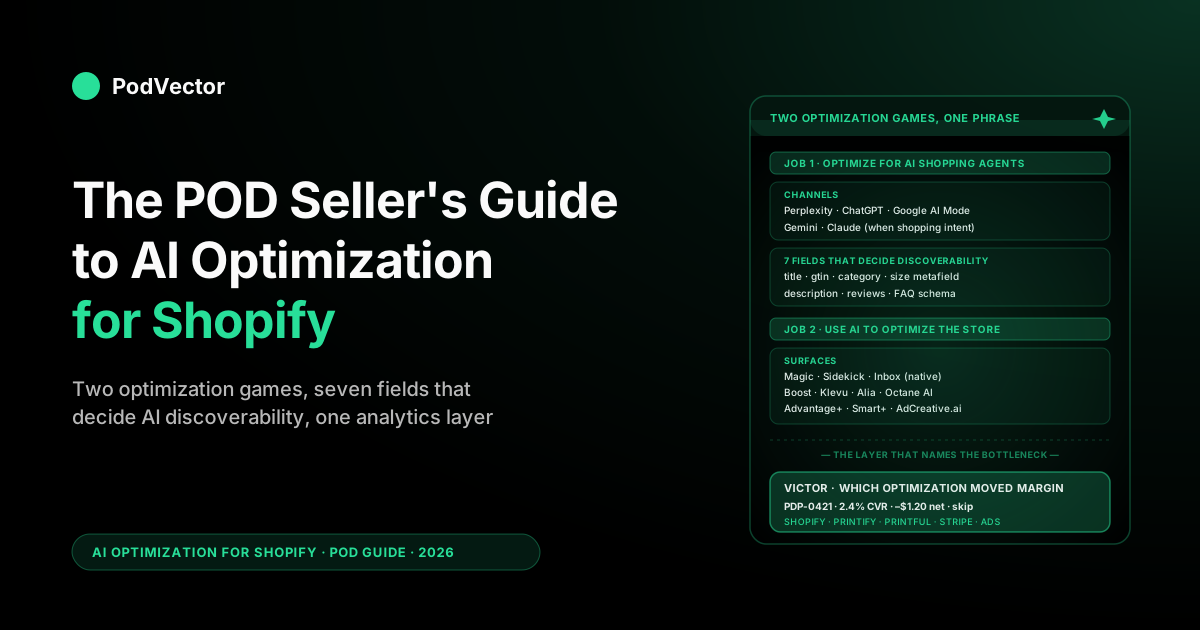
Quick Answer: "AI optimization for Shopify" in 2026 means two different jobs, and most operator confusion comes from collapsing them. The first is optimizing FOR AI — what's now called Generative Engine Optimization (GEO): making sure your product feed, structured data, reviews, metafields, and crawler access are clean enough that AI shopping surfaces (ChatGPT Shopping, Google AI Mode, Google AI Overviews, Perplexity, Microsoft Copilot) can surface your products when a shopper asks the agent to "find me a funny dad-bod Father's Day mug." The second is using AI TO optimize — wiring AI into the conversion path, the merchandising path, the support path, and the decision layer so the store earns more per visit.
For print-on-demand sellers, both jobs are harder than the generic Shopify guides admit: the Printify and Printful product feeds rarely arrive AI-ready (missing GTINs, weak Google taxonomy mapping, sizing in the wrong field), and the conversion-side AI tools that work for stocked DTC brands either ignore item-level cost or ignore supplier latency. This guide covers what's actually working in mid-2026, what to skip, and where the analytics layer fits.
Two jobs hiding inside one phrase
"AI optimization for Shopify" reads like one workstream. It's two.
The first is the discovery game — the work the industry now files under Generative Engine Optimization (GEO): making sure that when a shopper opens ChatGPT, Perplexity, Microsoft Copilot, Google AI Overviews, or Google's AI Mode and asks for "a funny Father's Day mug under twenty bucks that ships before June 14," the agent finds your Shopify product, not a competitor's. The second is the conversion game — using AI to get more revenue per visit out of the traffic you already have. The tools, the metrics, and the failure modes are completely different across the two.
The reason this matters more for POD than for stocked DTC is that POD operators don't own their product data. Printify and Printful sync product attributes into Shopify on a schedule, and the schema they push doesn't map cleanly into the Google Merchant taxonomy that AI shopping agents read.
The default Printify sync, for example, leaves gtin empty, leaves google_product_category unset, and dumps the variant size into the title rather than the size metafield. To a ChatGPT shopping agent reading the feed, the listing is invisible — not because the product is wrong, but because the data is.
Stocked DTC operators publishing to Shopify don't have this problem because their PIM controls the schema. POD operators inherit it.
The conversion-side gap is similar but inverted. Most "AI tools for Shopify" roundups (the Ringly listicle, the PageFly Shopify Magic guide, the Toolpeak optimization guide) optimize for stocked-margin economics — a 40-60% gross margin, a single supplier, low refund variance.
POD operations run at 5-15% net per order with a high refund variance, so a $79/month AI conversion tool either has to lift CVR by 0.5+ points or it eats the margin from two or three orders every month. The math is unforgiving and most generic-DTC AI tools don't survive it.
This guide treats the two jobs separately, then maps both back to the analytics layer that tells you which one is bottlenecking your store. We've covered adjacent ground in the POD seller's guide to AI optimization for ecommerce (the broader category) and the POD seller's guide to Shopify AI (the platform's own AI surfaces) — this piece zooms specifically into the optimization workflow.
Job 1 — Optimize your POD store FOR AI shopping agents
Orders flowing to Shopify stores from AI search grew roughly 11× between January 2025 and January 2026, and AI-referred shoppers convert 31% better than the average source — ChatGPT traffic converts at 1.81% versus 1.39% for non-branded organic search — per Shopify's own published numbers. That's why Shopify now ships two dedicated playbooks: one on optimizing your store for AI and a newer one on optimizing your products for AI platforms. That's the data that ended the "is AI search a real channel" debate. The follow-on question — the one most POD operators haven't answered — is whether their store is even visible to that channel.
The mental model worth carrying: AI shopping agents are not crawling your storefront the way a Googlebot crawls a page. They're querying structured product feeds and indexed catalog data, then synthesizing a recommendation in natural language.
The feed is the product to them. A Shopify storefront with a beautiful PDP and a half-empty product feed is invisible to ChatGPT Shopping in the same way a beautiful storefront with no Google Shopping submission was invisible to Google Shopping in 2018. The optimization is at the data layer.
The five AI shopping surfaces a POD store should be visible to
As of mid-2026, the five channels worth optimizing for in priority order:
- ChatGPT Shopping — the most mature AI shopping surface, with deepening Shopify integration via the Catalog and Agentic Commerce APIs after the 2025 merchant pilot. It pulls from your Google Merchant Center feed plus Shopify's published catalog metadata, so visibility here means feed completeness plus structured data plus authentic reviews.
- Google AI Mode — Google's conversational AI search agent leans heavily on Merchant Center feed data, structured review markup, and the same product schema Google Shopping has used for years.
- Google AI Overviews — the AI answers that now sit above standard Search results increasingly cite specific products, reading the same Merchant Center feed and structured schema. The good news: if your Google Merchant Center feed is healthy, you're 80% of the way there for both Google surfaces.
- Perplexity — its shopping answers pull from product schema, structured reviews, and content its crawler (PerplexityBot) can actually reach. Increasingly cited in "best [product] for [use case]" queries that map perfectly onto POD gift niches.
- Microsoft Copilot (when shopping is the intent) — Copilot's shopping answers increasingly surface products. The signal it reads is structured product schema plus authoritative review aggregation, not feed APIs (yet).
The pattern across all five: a POD store optimized for the discovery game looks the same regardless of which agent is asking. Get the feed clean, get the schema markup right, get the review density up, and the agents do the rest.
Don't block the AI crawlers — the silent visibility killer
Before any of the field-level work matters, the agents have to be allowed in. Several of these surfaces (Perplexity, Copilot, ChatGPT's browse mode, Google's AI features) read your live storefront through named crawlers, and a default robots.txt or an over-eager security app can quietly block them.
The bots to explicitly allow: OAI-SearchBot (OpenAI), PerplexityBot, ClaudeBot, Google-Extended, and Bingbot. Blocking any of them makes your store invisible to that surface no matter how clean the feed is — a 30-second robots.txt check that POD operators almost never run.
The seven product-data fields that decide AI discoverability
Every AI shopping audit we've run on a POD-on-Shopify store ends with the same seven fields driving the visibility delta. The defaults from a fresh Printify or Printful sync get four or five of them right; the remaining two or three are where every operator loses surfacing.
1. title — agent-readable, not just shopper-readable
POD titles default to the design name plus the variant noun ("Calmly Competitive Dad Tee"). For a human browsing your storefront that's fine.
For an AI agent searching "Father's Day t-shirt for a quiet dad," the absence of the gift occasion, the audience, and the fit type means the agent never matches the query to your listing. The fix: a templated title structure that includes design intent + audience + product noun + variant attribute ("Calmly Competitive Dad — Funny Father's Day Unisex T-Shirt — Soft Cotton, Adult Sizes"). Long titles read clunky to humans but they're the literal text the agent matches on.
2. google_product_category — almost never set by default
The Google taxonomy code that tells Merchant Center (and downstream AI agents) what kind of product this is. Printify and Printful both leave this field empty by default, and Shopify's auto-categorization is right maybe 60% of the time for POD novelty products.
A "Calmly Competitive Dad" mug with no category code surfaces to "general drinkware" queries but not to "novelty mug" or "father's day gift mug" queries. Set it manually per product type (the codes are public: 2918 for mugs, 1604 for shirts, 211 for posters) or use a metafield template that maps your Printify base products to Google codes once.
3. gtin / mpn — the field POD operators are told to ignore
POD bases don't have manufacturer GTINs in the way stocked products do — Bella+Canvas doesn't print a UPC into your product feed. The instinct is to leave the field blank.
The cost: AI shopping agents that require GTIN as a verification signal (Google's strict catalog quality scoring, certain ChatGPT Shopping queries) deprioritize listings without one. The fix isn't to fake a GTIN; it's to use identifier_exists: false as an explicit signal that the product is custom/POD, paired with a strong MPN constructed from your Shopify SKU. The agents handle the absence cleanly when it's declared; they penalize when it's silent.
4. Variant size + color + material as structured metafields, not just title text
The single most common Printify sync failure: variant size lives in the variant title ("Calmly Competitive Dad Tee — L"), not in a structured size metafield. AI agents querying "Father's Day shirt in size 2XL" parse the structured metafield, not the title string.
The fix is a Shopify metafield mapping per supplier — Printify's variant data flows through their bulk product API and you can map variant.option_value: "L" into variant.metafield.size: "L" on import. Most operators discover they need this only after their Google Merchant feed gets disapproved for missing required attributes; it's worth doing before the disapproval.
5. description — written for the agent's summarization layer
AI shopping agents don't paste your product description verbatim into their answer; they summarize it. That summarization is more accurate when the description leads with the concrete attributes the agent will be asked about (occasion, audience, fit, fabric, sizing, ship window) and saves the brand storytelling for paragraph two.
POD descriptions written for emotional resonance ("celebrate the dad who always shows up...") read beautifully to humans and yield generic, low-confidence summaries from agents. The fix is the same templating logic from the POD seller's guide to AI writer for ecommerce — start with the structured attributes, layer the brand voice on top.
6. Authentic reviews — the trust signal AI agents weight heaviest
Across every AI shopping surface we've audited, review density and freshness rank above price and above brand familiarity in the recommendation logic. A POD listing with 14 verified Judge.me or Yotpo reviews surfaces ahead of a competitor with two reviews even when the competitor has a lower price and a better-known brand.
The mechanism is straightforward: the agent treats reviews as the primary trust signal because the agent itself can't physically inspect the product. For POD operators, the implication is to install a post-purchase review-request flow (Judge.me free tier handles this; Yotpo's paid tier adds incentivized review collection) the day the store opens, not the day the AI traffic plateau hits.
7. Structured FAQ markup on PDPs
Two- to four-question FAQ blocks marked up as FAQPage schema on every PDP. These get parsed directly into AI shopping answers — when a shopper asks "does this Father's Day mug ship before June 14," the agent reads the structured FAQ before falling back to the description.
POD operators with strong FAQ blocks routinely get cited in AI shopping answers ahead of competitors with thin or unstructured FAQ content. Shopify's free schema apps (and templates from the Presta guide to the Shopify AI Toolkit) get this set up in an afternoon.
New in 2026: the free first-party Shopify Knowledge Base app (included on every plan) lets you view and edit the exact FAQs AI shopping agents pull when answering questions about your store. For POD operators it's the cleanest place to pin the answers that drive refunds when wrong — sizing, ship windows, and fabric — so the agent quotes your truth instead of guessing.
Job 2 — Use AI to optimize your Shopify store
The discovery game above gets your products in front of AI-referred traffic. The conversion game is what happens after the click. The Shopify AI ecosystem in 2026 splits into roughly five surfaces worth knowing for POD:
Native Shopify AI — Magic, Sidekick, and Inbox
Free with every Shopify plan, and the surface most POD operators underuse. Shopify Magic handles draft generation for product copy, blog posts, email campaigns, and FAQ blocks (covered in detail in the POD seller's guide to Shopify Magic AI features). Sidekick is the conversational admin assistant — "show me my worst-converting PDPs from the Father's Day collection" works as a query (covered in the POD seller's guide to Shopify Sidekick AI). Shopify Inbox handles AI-suggested replies in the chat and email channels. Together they cover the basics without subscription overhead. The catch for POD: none of them know about your Printify or Printful margin layer, so they'll cheerfully recommend "boost the discount on this product" without seeing that the discount cuts your net per order to negative.
Behavioral conversion AI — pop-ups, quizzes, on-site personalization
The category that drove most of the "Shopify AI lift" stats in 2025-2026: tools like Alia (popup intelligence), Octane AI (personalization quizzes), and the personalization layer in Klaviyo. These detect visitor behavior in real time and adapt the surface — a returning visitor who looked at three Father's Day designs gets a different popup than a first-time visitor.
For POD specifically, these tools earn their keep when the catalog is large enough that personalization actually matters (300+ designs, multiple gift occasions). Below that, a well-built static popup performs nearly as well at a tenth of the cost.
AI search and merchandising on the storefront
Replacing Shopify's default search with an AI-powered semantic search (Boost AI Search, Searchanise, Klevu). The lift here is real for POD stores with a high "intent vocabulary mismatch" — a shopper searches "fishing dad" and your store has "Reel Cool Dad," "Hooked on Daddy," and "Best Catch Dad" but no listing called "fishing dad." Semantic search bridges the gap. ROI threshold for POD: usually worth it once the catalog passes 200 SKUs and search-led sessions are 15%+ of total.
AI-assisted ad creative and copy
Meta Advantage+, TikTok Smart+, and the third-party platforms (AdCreative.ai, Pencil) that auto-generate variant creative for high-volume creative testing. The conversion lift comes from running 30-100 creative variants per design instead of 4-8, with the ad platform's own ML deciding which to scale.
For POD operators running paid acquisition, this is now a baseline expectation, not a competitive advantage. The differentiation has moved upstream into which designs get the creative-test budget.
AI analytics — the layer that decides what to optimize
The piece that makes all the above coherent. Without a margin-aware analytics layer telling you "the Father's Day Funny Dad design is converting at 2.4% but losing $1.20 net per order to high-cost variants" or "the Quiet Dad design is converting at 0.8% but should be at 1.7% based on category benchmark," every other AI tool is optimizing in the dark.
This is where Victor comes in. He's your AI employee, and he sees your Shopify, Printify, Printful, and ad accounts together, live. He decides where your ad spend should go, then acts on it with your approval: fixing the product listing problems that get your feed rejected, keeping your product details correct, and moving ad spend to the designs that actually make you money. We've laid out the analytics architecture in the complete guide to AI analytics for print-on-demand and the employee roadmap in the complete guide to AI agents for ecommerce analytics.
A POD-specific AI conversion stack
The tools above are a menu, not a checklist. Most POD operators we work with run something like this:
| Layer | Solo / <100 SKUs | Growing / 100-500 SKUs | Mid-market / 500+ SKUs |
|---|---|---|---|
| Native AI | Shopify Magic + Inbox (free) | Shopify Magic + Sidekick + Inbox | Magic + Sidekick + Inbox + Shopify Flow automations |
| Search / merchandising | Default Shopify search | Boost AI Search ($29/mo) | Klevu or Searchanise ($199+/mo) |
| Conversion AI (popups, quiz) | Skip — static popup is enough | Alia or Octane AI ($49-149/mo) | Klaviyo personalization + Octane AI |
| Ad creative AI | Meta Advantage+ (free in ads) | Advantage+ + AdCreative.ai ($29/mo) | Advantage+ + Pencil + in-house creative team |
| Analytics / decision layer | PodVector AI Victor (live warehouse) | PodVector AI Victor + Klaviyo segment AI | Victor + Klaviyo + dashboard layer |
| Total monthly | ~$0-50/mo | ~$100-300/mo | ~$500-1,500/mo |
The single most expensive mistake we see at every tier: skipping the analytics layer and buying tools further down the menu. A $149/month personalization quiz that fires on every visitor optimizes a number that may or may not matter; the analytics layer tells you whether quiz interactions are correlated with margin-positive purchases or with refund-prone purchases. Without that signal, the quiz is theater.
Five POD-specific pitfalls in AI optimization
Five mistakes we see repeatedly. Avoiding them is worth more than picking the "best" tool from each category.
1. Optimizing CVR without optimizing item-level margin
The single most expensive mistake in POD AI optimization. A tool that lifts CVR from 1.8% to 2.4% on a product whose net margin is negative makes the operator lose money faster, not slower.
POD margins are computed at the item level (base cost from Printify or Printful, print cost, shipping, payment fee, refund accrual) — and a CVR lift on a $1.20-loss item is worth less than a 0.2% CVR drop on a $4.80-margin item. Every AI optimization decision needs the item-level cost data sitting underneath it. We covered the cost-tracking architecture in the best Shopify apps to track profitability in print-on-demand and the warehouse-powered solve in the Printify-Shopify profit tracking guide.
2. Ignoring the Printify or Printful sync schema
POD operators who never look at their own Google Merchant Center feed are routinely sitting on 30-40% of their products being silently disapproved or downgraded for "missing required attributes." The fix takes one afternoon: open Merchant Center, filter to disapproved products, identify the missing fields (usually GTIN handling, size metafield, Google category), then build a one-time mapping from your Printify or Printful base products into the correct fields. The lift on AI-channel visibility post-fix is typically 2-4× because the catalog goes from 60% indexed to 95% indexed.
3. Letting AI tools rewrite supplier-truth fields
This is the discovery-game corollary of the writing-side pitfall covered in the POD seller's guide to AI writer for ecommerce. An AI optimization tool that rewrites your sizing chart, fabric content, or shipping window in pursuit of "better" copy can manufacture chargebacks. Every supplier-truth field has to stay templated from the live Printify or Printful feed; the AI gets the rest of the description but never the spec layer.
4. Buying conversion tools before the catalog is AI-discoverable
The order matters. Spending $200/month on a personalization quiz when the underlying product feed is 40% disapproved means you're optimizing the conversion rate of a traffic stream that isn't arriving.
Job 1 (discovery optimization) precedes Job 2 (conversion optimization) in priority for any POD store with weak feed health. Most operators discover this in reverse — they buy the conversion tools, see flat results, then run the feed audit and realize the visibility floor was the actual constraint.
5. Optimizing for the wrong AI channel
A POD store selling $18 funny dad mugs gets traffic from a different mix of AI surfaces than one selling $90 personalized wedding posters. The mug store skews heavily toward ChatGPT Shopping and Microsoft Copilot (high-volume, low-consideration buyers using AI for novelty discovery); the poster store skews toward Google AI Mode and brand-named search (high-consideration buyers using AI to disambiguate options).
Optimizing the mug store for premium-product schema, or the poster store for high-velocity feed APIs, wastes effort. The first move is figuring out which AI channel your specific products are actually being asked about — which is, again, an analytics question.
How to measure which optimization actually moved margin
The hardest part of AI optimization for Shopify isn't picking the tools; it's attributing the lift. Every AI tool's dashboard claims credit for every conversion that touched it, and the totals across all the dashboards usually add up to 200-300% of actual revenue. The measurement framework that works for POD:
- Per-PDP CVR tracking pre/post optimization — the cleanest signal for the discovery and conversion games. Tag the optimization date and compare 14-day pre vs. 14-day post for the same product.
- Item-level net margin pre/post — the signal that matters most. CVR lift means nothing if margin per order dropped to compensate. Pull from your Printify/Printful cost feed plus Shopify revenue plus Stripe fees.
- AI-channel attribution — Shopify's source tracking now includes the major AI shopping surfaces as distinct sources (ChatGPT, Google AI Mode, etc.), and Google Search Console exposes AI Overview impressions separately. Pull both into a single dashboard so you can see whether the discovery work actually drove referral lift.
- Refund-rate watch — the canary for AI optimizations that cheat. A CVR lift paired with a 2-point refund rate increase usually means the AI surface is over-promising on the product (sizing, ship window, fabric) and the chargebacks are absorbing the lift.
This is where Victor pays back. Before you wire up a $149/month conversion tool, Victor can tell you which PDPs are CVR-bottlenecked vs. margin-bottlenecked vs. discovery-bottlenecked — so the spend goes to the bottleneck that actually exists, not the one a tool's marketing page assumes you have.
After the change is live, Victor can confirm whether the per-PDP lift translated into per-order margin lift or whether it was washed out by refunds and ad costs — and roll back the ones that didn't pay, with your approval. We covered the operator-loop architecture in the POD seller's guide to AI for Shopify and the agent roadmap in agentic AI for ecommerce: what it looks like for POD sellers.
The employee roadmap is worth naming explicitly. Victor answers the optimization questions an employee would otherwise put to an analyst and acts on those answers with your approval — which products to rewrite, which feeds to fix, which conversion tools to roll back.
On the roadmap, Victor coordinates with the optimization stack to execute the changes: pushing the corrected metafield through the Printify-to-Shopify sync, reordering the popup priority in Alia, swapping the underperforming ad creative — all gated behind operator approval, all measured against margin. The tools above become execution surfaces; the AI employee layer decides what to push.
A stack recommendation by POD store size
The right AI optimization stack scales with the catalog and the cadence, not with the budget. Three tiers:
Solo, <100 SKUs, 1-2 drops/month
Discovery side: Manual Google Merchant Center feed audit (one afternoon), Shopify Magic for FAQ blocks, free Judge.me for reviews.
Conversion side: Native Shopify Magic, Inbox, default search.
Analytics: PodVector AI Victor for the margin-aware view of which products to optimize first.
Why: At this scale the bottleneck is almost always feed health and review density, not conversion-rate sophistication. Spending on conversion tools before fixing the feed is wasted budget.
Growing, 100-500 SKUs, weekly drops
Discovery side: Templated metafield mapping for all Printify/Printful base products, structured FAQ markup, paid Yotpo or Judge.me Awesome plan for review velocity.
Conversion side: Boost AI Search, Alia or Octane AI for visitor personalization, Meta Advantage+ for ad creative.
Analytics: Victor + Klaviyo segment AI.
Why: The catalog crosses the threshold where semantic search and personalization stop being optional. The analytics layer becomes load-bearing because the variant explosion makes manual prioritization impossible.
Mid-market, 500+ SKUs, multi-channel
Discovery side: Full Merchant Center optimization plus dedicated PIM-style metafield governance, agentic storefront integration with ChatGPT and Microsoft Copilot shopping where eligible.
Conversion side: Klevu or Searchanise enterprise search, Klaviyo personalization, Octane AI quizzes, Pencil or AdCreative.ai for creative volume.
Analytics: Victor + dashboard layer + dedicated weekly margin-attribution review.
Why: At this scale every percentage point of CVR is a five-figure monthly delta and every basis point of margin is a four-figure delta — the tooling spend pays back in weeks if the analytics layer is in place to confirm it.
FAQs
What does "AI optimization for Shopify" actually mean for a POD store?
Two things, usually conflated. The first is optimizing your store FOR AI shopping agents (ChatGPT, Google AI Mode, Google AI Overviews, Microsoft Copilot) so they surface your products when shoppers ask.
The second is using AI to optimize the store itself — search, popups, personalization, ad creative, copy. POD operators usually need to start with the first because their Printify or Printful product feeds default to a state that AI agents can't read well.
Will AI shopping channels really drive POD revenue?
Yes, and the curve is steep. Shopify's published numbers show roughly 11× growth in AI-search-driven orders between January 2025 and January 2026, with AI-referred shoppers converting 31% better (ChatGPT at 1.81% vs. 1.39% for non-branded organic) and bouncing 33% less than other sources. POD novelty products (gifts, occasion-based designs, custom apparel) are an unusually strong fit for AI shopping because the queries — "find me a Father's Day mug for a quiet dad who likes fishing" — are exactly the kind of natural-language, attribute-rich queries the agents handle well.
Do I need to pay Shopify Plus to get the AI optimization features?
No. Shopify Magic, Sidekick, and Inbox are included in every plan. The AI shopping surfaces (ChatGPT, Google AI Mode, Microsoft Copilot) read from your standard Google Merchant Center feed and Shopify catalog metadata, not from a Plus-only API. Plus adds Shopify Flow for AI-triggered automations and a few more advanced governance features, but the discovery-side optimization works on every Shopify plan.
How do I check whether my POD store is visible to AI shopping agents?
Four quick tests, in order. (1) Open your robots.txt and confirm you're not blocking OAI-SearchBot, PerplexityBot, ClaudeBot, Google-Extended, or Bingbot — a block here makes every other test moot. (2) Open Google Merchant Center and check the disapproval rate on your product feed — anything over 10% is a feed-health problem. (3) Open ChatGPT, Perplexity, and Microsoft Copilot, ask each "find me a [your category] under [your price point]" and see whether your products appear. (4) Open Google Search Console, filter by AI Overview appearances, and see which queries your store is being cited on. The combination tells you which channel is bottlenecking which products.
What's the single highest-ROI AI optimization for a POD Shopify store?
For most stores: cleaning the product feed so the catalog is fully discoverable to AI shopping agents. The lift on AI-channel impressions and conversions is typically 2-4× post-cleanup, the work is one to two afternoons of metafield mapping per supplier, and the ongoing maintenance is near zero. Conversion-side tools come second because they only matter once the discovery side is delivering traffic.
How does Shopify Magic compare to a third-party AI optimization tool?
Magic is broader and cheaper (free) but shallower. It handles draft generation across copy, FAQs, and emails competently — but it doesn't know about your Printify or Printful margin layer, doesn't run multi-variant ad creative testing, and doesn't do semantic search. The pattern that works: use Magic for the breadth (every store should turn it on), layer specialized third-party tools on top of the specific bottlenecks Magic doesn't cover, and run the analytics layer underneath both.
Will AI optimizations cause refunds or chargebacks?
Only if you let the AI rewrite supplier-truth fields (sizing, fabric, shipping windows) in pursuit of more compelling copy. The fix is templating: keep the spec layer pulled from the live Printify or Printful feed, and let the AI handle everything else.
POD operators who maintain that discipline don't see refund or chargeback spikes from AI work. Operators who let the LLM hallucinate sizing details typically see refund rates climb 1-3 points within a quarter.
How do AI shopping agents differ from Google Shopping?
Mechanically similar (both read structured product feeds), but the trust signals differ. Google Shopping weights price competitiveness and brand familiarity heavily.
AI shopping agents weight review density and freshness, schema completeness, and FAQ markup more heavily — because the agent is synthesizing a recommendation in natural language and needs more raw signal per product than Google's ranked results page. The practical implication: a POD store with thin reviews can rank fine on Google Shopping but never get cited by ChatGPT Shopping.
How does this connect to Shopify's broader AI roadmap?
Shopify's 2026 roadmap is steadily moving toward agentic commerce — storefronts that AI agents can both shop and transact through, with the merchant approving the agent integrations. The optimization work above (clean feed, structured schema, dense reviews) is the prerequisite for any of that to work. We've covered the broader platform direction in the POD seller's guide to Shopify and AI and the cluster's other angles at the AI overview cluster hub and the AI analytics topic hub.
Optimize the bottleneck that actually exists — not the one a tool's marketing page assumes
Every AI optimization tool in this guide earns its seat only when the bottleneck it solves is the one your POD store is actually hitting. PodVector AI's Victor is the agentic AI employee that sits on top of your live Shopify, Printify, Printful, and ad-platform data and tells you which products to rewrite, which feeds to fix, which conversion tools to roll back, and which AI channels are actually driving margin-positive revenue — so the optimization spend goes to the work that moves the next dollar.
Try Victor free