
Quick Answer: An AI writer for ecommerce in 2026 is one of three things — a general-purpose model (ChatGPT, Claude) wired into your prompt library, an ecommerce-specialized writer (Describely, Cuppa.ai, Hypotenuse, Talkoot) that knows product-feed schemas, or a marketing-copy platform (Copy.ai, Jasper, Writer) tuned for ad and email work. For print-on-demand sellers, the right shortlist depends on the copy job: bulk product descriptions across a 50-variant drop favor Describely, Cuppa.ai, or Hypotenuse (or Shopify Magic for a free, native-in-admin first pass); ad and email variants favor Copy.ai, Jasper, or ChatGPT with a strong prompt; long-form SEO articles favor Frase or Claude.
The category every general guide skips for POD is supplier-aware copy — sizing, fabric, and shipping claims that have to template from your live Printify or Printful feed, not get hallucinated by an LLM. That's where most POD operators discover their AI writer needs an employee layer underneath it — one that knows which listings are actually losing money and which to rewrite first — not just a better prompt.
Why "AI writer for ecommerce" reads differently for POD
Most "best AI writer for ecommerce" roundups in 2026 — the DTCskills list, the SEO.ai list, the Describely comparison post — assume a generic DTC operator running a 200-SKU stocked catalog with one supplier and 40–60% gross margins. That operator can buy a writing tool, get back four hours a week, and pay it off in the first invoice.
Print-on-demand operates on different math. A POD store running on Printify or Printful through a Shopify front end nets a thin margin per order after the base cost, the print fee, the shipping, the payment fee, the ad cost, and the refund slippage. A monthly writing-tool subscription needs to either save real time on a high-cadence workflow or unlock a sales channel that's currently dark — otherwise it eats multiple orders' worth of margin every month with nothing to show. See our Printful base-cost breakdown and Printify discount breakdown if you need a clearer picture of your actual per-order economics before committing to a tool stack.
The second reason is the variant explosion. A "calmly competitive dad" Father's Day design isn't one product to write copy for — it's the same design on a unisex tee, a women's relaxed tee, a youth tee, a hoodie, a sweatshirt, and a mug. Each variant has a different gift-occasion fit, a different sizing chart, a different audience, and a different optimal angle. Generic AI writers built for a "give me a product description for this URL" workflow choke on the variant explosion: they either rewrite the same body copy six times with cosmetic changes, or they hallucinate sizing details that don't match your supplier's chart. The AI writers that work for POD either accept structured product-feed input (so the variant data drives the copy) or they accept a prompt template the operator can fan out across variants in bulk.
The third difference is supplier truth. A stocked DTC brand owns its product data — fabric, weight, country of manufacture, sizing — and can let an AI writer paraphrase it freely. POD operators rent that data from Printify or Printful, and it changes when a supplier swaps base products, updates a print process, or revises a sizing chart. AI-written copy that hallucinated "100% organic ringspun cotton" when the supplier shipped a 50/50 blend will surface as a chargeback, a refund, or a one-star review — and the operator absorbs the cost. The operators who scale POD copy with AI all build the same guardrail: a templated layer that pulls supplier truth (sizing, fabric, shipping windows) directly from the feed, and a generative layer that writes everything else.
A fourth difference, sharpened since mid-2025, is the agentic turn. As Shopify has expanded its MCP and Agentic Commerce Protocol, tools that purely generate text are being outflanked by tools that generate text and act on the store. That shift matters for how you pick a writing tool today: a tool that integrates tightly with Shopify's admin surfaces (Shopify Magic, Describely, Cuppa.ai) will benefit from that expanding protocol in ways a standalone copy tool won't.
The five copy jobs that actually move POD revenue
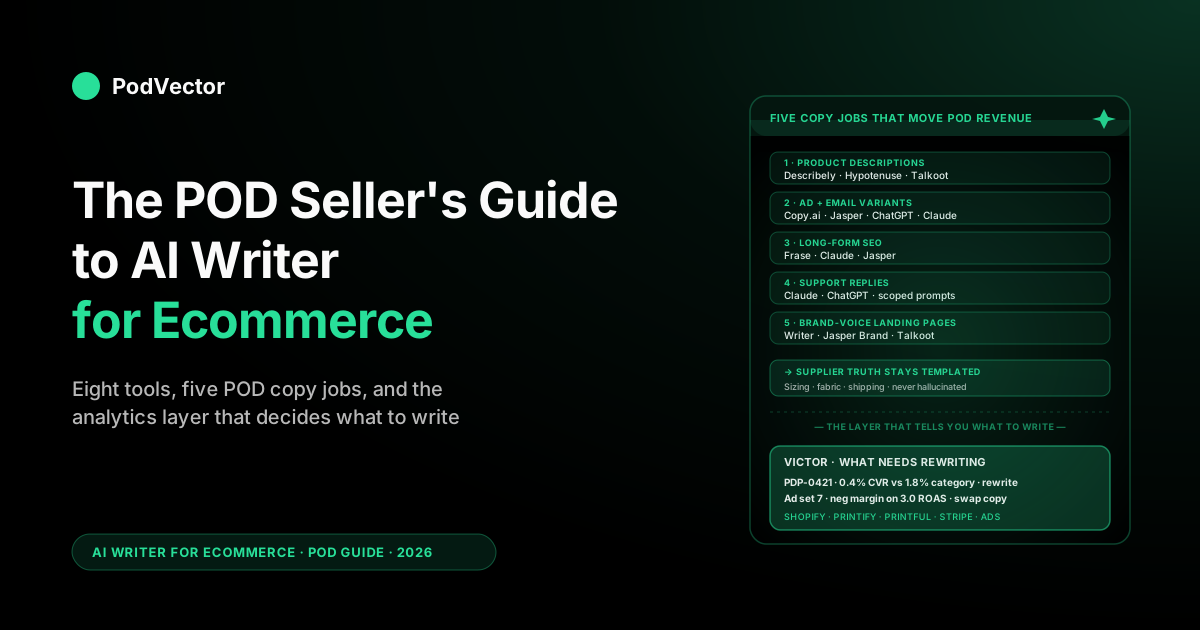
Before shopping for a tool, name the job. Most POD operators discover their stack mismatch when they buy a tool optimized for one job and try to do all five with it. The five copy jobs that actually move POD revenue, in rough order of payback speed:
1. Product descriptions and titles (high cadence, high variance)
Every drop is a fresh batch of 10–50 variants needing titles, bullet copy, descriptions, and metafields. The work is bounded but the cadence is brutal — a POD operator running multiple drops a month is writing hundreds of product blurbs, plus the variant-aware metafields. AI writers shine here because the work is templatable, the brand voice is portable, and the variant explosion maps cleanly to "give me 12 variations on this base description."
This is the job where ecommerce-specialized writers earn their seat — they accept feed input, they batch, and they output to your store via integration rather than copy-paste. Per the DTCskills 2026 roundup, the standouts for catalog-heavy Shopify stores are Describely, Hypotenuse, and Cuppa.ai. If you want a zero-cost starting point, Shopify Magic generates SEO-flavored product descriptions and headlines natively in the Shopify admin — fine for a first pass on a new product, though it doesn't batch across a full drop or enforce supplier-truth fields. As the DTCskills reviewer notes, if every product page on your store sounds the same, Shopify Magic is probably why.
2. Ad copy and email subject lines (high variance, high test volume)
Meta ad accounts running modern creative-rotation surfaces chew through ad variants per design looking for the winning combination. Email is similar — a flow with eight subject-line variants outperforms one with two, and the marginal cost of generating more is negligible. This job favors marketing-copy platforms (Copy.ai, Jasper) tuned for short-form variant generation, or a general model like ChatGPT or Claude with a strong prompt library. The ecommerce-specialized writers can do this job but it's not where they're optimized.
3. Long-form SEO articles and cluster pages (low cadence, compounding payback)
The SEO content layer that compounds discoverability over months — pillar pages, cluster articles, gift guides, design-trend explainers. AI here lets a single operator publish at a significantly higher cadence than before, but the editorial bar is higher (Google rewards expertise signals and penalizes thin AI content). This is Frase, Claude, or Jasper territory, plus a structured SERP-and-outline workflow. We've covered the SEO mechanics in the POD seller's guide to AI SEO for ecommerce and the prompt patterns in the POD seller's guide to ChatGPT prompts for Shopify.
4. Customer support replies and macros (medium cadence, brand-voice critical)
The DM, email, and live-chat replies that POD operators answer many times a day. AI writers slot in either as a draft assistant (operator picks the best of three drafts) or as an autonomous responder for the straightforward share of tickets. The brand-voice fidelity bar is high here, and the cost of a wrong answer is a refund or a chargeback. Most operators use Claude or ChatGPT with a tightly scoped prompt and a templated reference doc for sizing, shipping, and returns.
5. Personalized landing pages and segment-aware on-site copy (low cadence, high leverage)
The work that didn't really exist as a discipline before 2024 — generating segment-aware hero copy, gift-occasion-specific landing pages, and dynamic on-site copy blocks. The cadence is low (a handful of pages per quarter for most POD stores) but the leverage on conversion rate is high. This is Writer, Jasper Brand Voice, or Claude with the brand kit attached. We unpack the personalization angle in the POD seller's guide to AI writing for ecommerce.
The nine AI writers worth shortlisting in 2026
The nine tools below cover the five jobs above without overlap so heavy that a POD operator needs more than three of them. Pricing reflects publicly listed plans as of mid-2026; treat the dollar figures as directional, not authoritative — confirm current pricing on each vendor's site before buying.
1. ChatGPT (OpenAI) — the universal default
The default starter, and the tool most POD operators are already paying for through a Plus or Team subscription. ChatGPT's strength for POD is breadth: with a well-built prompt library, it handles all five jobs above credibly. Its weakness for POD is the same as its strength — nothing about it is ecommerce-specific. You bring the structure (variant templates, brand voice doc, sizing reference), it brings the writing.
For operators with under 100 SKUs and bandwidth to maintain a prompt library, ChatGPT plus a structured workflow is often enough. Once the catalog crosses 200 SKUs and drops are coming weekly, the copy-paste tax starts to matter and an integrated writer earns its keep. We've covered the prompt patterns in detail in the POD seller's guide to ChatGPT for Shopify stores.
2. Claude (Anthropic) — best-in-class long-form and brand voice
Claude's long context window and strong instruction-following make it the preferred general model for long-form SEO drafts, support-macro libraries, and brand-voice landing pages. Like ChatGPT, it brings no ecommerce-native schema awareness — you supply the structure. For POD operators who already have a tight prompt library and need a second general model to A/B against ChatGPT, Claude is the natural choice. Entry price is comparable to ChatGPT Plus.
3. Describely — the POD-friendly bulk product copy specialist
One of the very few ecommerce-specialized writers with a Shopify integration that actually understands variants. Describely accepts a product-feed input, generates titles, descriptions, bullet points, and metafields in bulk, and pushes them back to the store. The DTCskills 2026 roundup rates it best for catalog-heavy Shopify stores specifically because the Shopify integration lets you pull products, generate descriptions, and push updates back to your store without leaving the app.
For POD operators running high-cadence drops, the time savings versus a general model are real. The catch for POD specifically is that Describely is built around the assumption that your supplier is your truth source; you have to map Printify or Printful's feed correctly into the tool's expected schema, or the generated copy drifts from your actual product.
4. Cuppa.ai — bulk SKU-scale copy with direct Shopify publish
A strong contender for the POD bulk-copy job. Cuppa.ai is built to generate product descriptions, category pages, and collection copy at SKU scale, with a "Brand DNA" voice profile, bulk CSV workflows, and direct publish to Shopify and WordPress. For POD operators the draw is the same as Describely's — select a batch, generate, review, publish without copy-paste — plus native category- and collection-page copy, which most product-description tools skip. The same supplier-truth caveat applies: map your Printify or Printful feed correctly and keep sizing, fabric, and shipping-window fields templated rather than letting the model invent them.
5. Talkoot — ecommerce product-storytelling at brand-voice fidelity
Positioned as an AI writer built specifically for ecommerce (Talkoot's product page), Talkoot's bet is that brand voice and product storytelling are the differentiators ecommerce writers should optimize for. The brand-voice training is unusually rigorous. For POD operators with a strong distinct brand identity — a niche store with a clear voice, not a "designs for everyone" generalist — Talkoot's output reads less generic than the alternatives. The trade-off is a heavier setup: operators have to feed in voice samples and approved copy before the output is usable. Pricing is mid-market enterprise territory.
6. Hypotenuse — product data enrichment plus copy in one workflow
Hypotenuse leans further into the data side: it's positioned as a product-data enrichment platform that also writes descriptions, with image editing and brand-voice generation as adjacent surfaces. The DTCskills 2026 roundup rates it best for bulk product content at scale — "if you need 200 product descriptions written and published in an afternoon, this is the tool designed for that job." For POD operators who have product-data hygiene problems (missing attributes, inconsistent variant naming, gaps in the metafield set), Hypotenuse can do the cleanup and the writing in one pass.
7. Copy.ai — short-form marketing variants at speed
The strongest of the marketing-copy platforms for ad headlines, email subject lines, social captions, and product-launch copy. Copy.ai's free product-description generator (copy.ai/tools/product-description-generator) is a useful baseline for solo POD operators. The paid tiers add workflow templates, brand-voice memory, and team collaboration. Where Copy.ai earns its seat for POD is high-test-volume ad and email work — generating a large batch of subject-line variants in minutes versus doing it by hand.
8. Jasper — brand voice plus marketing campaigns
The mid-market workhorse for marketing teams. Jasper's Brand Voice feature is among the more polished in the category, and the campaign-orchestration surface (planning a launch with consistent copy across email, ads, blog, and social) has matured significantly through 2025–2026. The DTCskills 2026 roundup rates Jasper best for multi-format content teams. The 2026 Jasper update added structured-output mode that produces bulleted feature lists, sizing tables, and FAQ sections in one pass — a genuine time-saver for POD product pages. For solo POD operators, Jasper can be overpowered; for POD brands with an in-house marketer or an agency, the brand-voice consistency across channels can justify the spend.
9. Writer — enterprise governance and on-site personalization
The enterprise option, with strong governance, brand-voice enforcement, and a bench of pre-built agents — the Ecommerce PDP Copy agent specifically targets product detail page generation, per Writer's product page. For POD operators at this scale, Writer's value is less about per-asset cost savings and more about consistency-at-scale and compliance — making sure contributors writing copy across email, ads, social, and the storefront all sound like one brand. Pricing is enterprise-tier on the entry plan.
Notable mention: Anyword (data-driven copy scoring, strong for ad-copy testing) and Writesonic (SEO-focused product content) came up in several 2026 roundups. Neither is POD-specific, but both are worth a trial if your primary bottleneck is ad-copy performance scoring or SEO-structured product pages.
Comparison table: which writer for which POD job
The shortlist mapped to the five copy jobs. ★★★ means best-in-class for the job; ★★ means competent; ★ means usable but not the right primary tool.
| Tool | Product copy (bulk) | Ad & email variants | Long-form SEO | Support replies | Brand-voice landing pages |
|---|---|---|---|---|---|
| ChatGPT | ★★ | ★★★ | ★★ | ★★★ | ★★ |
| Claude | ★★ | ★★★ | ★★★ | ★★★ | ★★★ |
| Shopify Magic | ★★ | ★★ | ★ | ★ | ★ |
| Describely | ★★★ | ★ | ★ | ★ | ★ |
| Cuppa.ai | ★★★ | ★ | ★★ | ★ | ★★ |
| Talkoot | ★★★ | ★★ | ★★ | ★ | ★★★ |
| Hypotenuse | ★★★ | ★★ | ★★ | ★ | ★★ |
| Copy.ai | ★★ | ★★★ | ★★ | ★★ | ★★ |
| Jasper | ★★ | ★★★ | ★★ | ★★ | ★★★ |
| Frase | ★ | ★ | ★★★ | ★ | ★ |
| Writer | ★★★ | ★★★ | ★★ | ★★ | ★★★ |
The reading: no single tool wins all five jobs, and most POD operators end up running two or three. The common stacks we see are ChatGPT or Claude + Describely or Cuppa.ai + Frase for solo and small operators, and Jasper or Writer + Talkoot or Hypotenuse + Frase for brand-led mid-market POD businesses.
POD-specific pitfalls in AI writing
Five mistakes we see POD operators make over and over with AI writing tools. Avoiding them is worth more than picking the "best" tool from the shortlist above.
1. Letting the LLM hallucinate sizing, fabric, or shipping
The single most expensive mistake. An AI writer that generates "ultra-soft 100% combed cotton, ships in 2–3 business days" when the actual supplier base is a 50/50 blend on a longer production window will manufacture chargebacks and refund disputes that wipe out months of margin gains. Every POD copy workflow needs a templated layer that injects supplier-truth fields (fabric, weight, sizing chart, production window, shipping window by region) from the live feed, with the LLM's free-form generation explicitly told not to override those fields. Review our Printify Express Delivery guide for the shipping-window figures you should be templating for Printify orders.
2. Treating variants as duplicates
An AI writer fed "shirt, hoodie, mug, ceramic ornament" of the same design and asked to "rewrite for each variant" will produce four near-identical descriptions with the variant noun swapped in. The variants are different products with different gift fits, different audience demographics, and different price-anchor expectations. The prompt has to specify the audience and gift occasion per variant — "this is a unisex tee for an adult dad" vs. "this is a coffee mug for a teacher" — or the copy reads generic and the conversion rate drops.
3. Skipping the SERP for SEO content
POD operators publishing AI-drafted blog content without first analyzing the top SERP results consistently underperform. Google's ranking algorithm has gotten very good at detecting content that doesn't match the search intent's expected format (a roundup query getting a how-to article, a how-to query getting a thought-leadership piece). The SERP is the spec; the AI writes against the spec. Tools like Frase or a manual top-3 audit before drafting solve this.
4. Buying a tool without a writing workflow
The most common reason a writing-tool subscription gets cancelled at the three-month mark is that the operator never built a workflow around it. The tool sits unused except for the occasional one-off generation. The operators who get value out of these tools all have the same pattern: a checklist or SOP for each copy job (drop-launch checklist, ad-test checklist, blog-publish checklist) with the tool wired into a specific step. No checklist, no value.
5. Optimizing the writer before you've named the bottleneck
The deeper failure mode. A POD operator who's losing conversions to a slow page-load doesn't have a copy problem; they have a performance problem. An operator whose ROAS dropped because the ad auction got more competitive doesn't have an ad-copy problem; they have a margin-attribution problem. AI writing tools earn their keep when the bottleneck is genuinely writing speed or writing quality. Naming the actual bottleneck before shopping for a tool is the underrated skill, and it usually requires looking at the analytics — which is the next section.
A stack recommendation by POD store size
The right writing stack scales with the cadence of the operation, not the size of the budget. Three rough tiers:
Solo operator, <100 SKUs, 1–2 drops/month
Stack: ChatGPT Plus or Claude Pro + a personal prompt library in Notion or a markdown doc, with Shopify Magic free in the admin for native first drafts. Optional: Frase when starting an SEO content cadence.
Why: The catalog is small enough that copy-pasting descriptions per drop is faster than learning a new tool. The ROI on an integrated writer doesn't show up until the catalog or drop cadence forces a workflow change.
Growing operator, 100–500 SKUs, weekly drops
Stack: ChatGPT or Claude + Describely, Cuppa.ai, or Hypotenuse + Frase for SEO.
Why: Catalog volume and drop cadence push past the point where copy-paste workflows scale. The integrated writer pays back in time savings and (more importantly) consistency across SKUs and channels. The general model handles the long tail of one-off jobs the integrated writer doesn't. If you're also running Printify and Printful side by side, check the Printful vs. Printify comparison to confirm which supplier's feed you should prioritize mapping into your writing tool first.
Brand-led mid-market POD, 500+ SKUs, multi-channel
Stack: Jasper or Writer for brand-voice campaigns + Talkoot or Hypotenuse for product copy + Frase for SEO + ChatGPT or Claude for utility tasks.
Why: Brand consistency across email, ads, social, blog, and storefront becomes the constraint, not raw writing speed. Enterprise-tier tools earn the premium through governance, brand-voice enforcement, and integration depth — not through better individual outputs. If your Shopify admin automation is still manual at this scale, see our guide to Shopify Admin API store modifications and automation for the infrastructure layer that makes a high-cadence writing workflow actually executable.
Where AI writing slots into your POD analytics loop
The pattern that separates POD operators who scale from POD operators who churn through tool subscriptions: AI writing is the second move, not the first. The first move is naming what the writing is supposed to do — lift conversion on a specific PDP, reduce CPA on a specific ad set, surface a specific design in a specific search query — and that naming requires looking at the live data.
This is where PodVector AI's Victor pays for itself before the writer does. Victor sees your live Shopify, Printify, Printful, Meta Ads, and Google Ads data together, so he knows the real story behind every product and every ad. Before you write a new product description, Victor can tell you which existing listing is converting below the category baseline — so the AI writer's effort goes into the descriptions that actually need lifting. Before you generate a batch of ad-copy variants, Victor can tell you which existing variants are losing money on margin even when they look profitable on revenue — so the writer's work is targeted at the variants worth replacing.
Victor is an AI employee: he reads and analyzes the connected platforms, shows you the action he wants to take and why, and only runs it once you approve. On the Shopify side, he can reprice a product to a target margin, bulk reprice across the store, set up a BOGO or free-shipping discount, raise the free-shipping threshold, create a customer-specific discount, organize products into a collection, and revert a price change. He also reads your Meta Ads, Google Ads, Printify, and Printful accounts live, and with your approval he can act there too — pausing or turning on campaigns, adjusting budgets and targeting, rewriting ad copy, and acting on your Printify and Printful orders and products. We've laid out the analytics architecture in the complete guide to AI analytics for print-on-demand and the agent roadmap in the complete guide to AI agents for ecommerce analytics.
The agentic framing is worth naming. Today Victor answers questions an employee would otherwise outsource to an analyst — which products to rewrite, which ads to swap, which segments to target. The AI writer becomes one of several execution surfaces in the loop, with the AI employee layer deciding what gets written and the merchant deciding what gets shipped. We've gone deeper on this in agentic AI for ecommerce: what it looks like for POD sellers and surveyed the broader landscape in the POD seller's guide to AI for ecommerce.
For broader category context across other AI surfaces a POD operator should be paying attention to, the AI overview cluster hub collects the cluster's other guides, and the AI analytics topic hub ties writing back into the analytics layer that decides what to write.
FAQs
What is the best AI writer for ecommerce in 2026?
There isn't a single "best" — there's a best for each of the five copy jobs. For bulk product descriptions across a high-cadence catalog, Describely, Cuppa.ai, or Hypotenuse. For ad and email variants, Copy.ai or ChatGPT with a strong prompt library. For long-form SEO content, Frase or Claude. For brand-voice consistency at scale, Jasper or Writer. Most POD operators end up running two or three tools, not one.
Is an AI writer worth it for a small POD store?
For under 100 SKUs and 1–2 drops per month, a ChatGPT Plus or Claude Pro subscription plus a personal prompt library is usually enough. The integrated ecommerce writers (Describely, Hypotenuse, Talkoot) start to earn their seat once you're past 100 SKUs or running weekly drops, where the time savings versus copy-paste workflows compound.
Can an AI writer handle Printify or Printful product feeds directly?
Some can, with caveats. Describely, Cuppa.ai, and Hypotenuse all integrate with Shopify and can read your product feed (which includes the Printify or Printful product data after sync). The catch is that you have to map the supplier's variant schema correctly into the tool's expected fields, and you have to keep the supplier-truth fields (fabric, sizing, shipping window) templated rather than letting the LLM rewrite them freely. That's the difference between AI writing that scales and AI writing that triggers chargebacks. For POD operators selling on Etsy through Printify, see the Printify-to-Etsy setup guide — the feed mapping principles are similar but the metafield schema differs from Shopify's.
Will Google penalize AI-generated product descriptions?
Google's published guidance is that content quality matters more than how it was produced — AI-generated content that's helpful, accurate, and matches the search intent ranks fine. Where AI-generated copy gets penalized is when it's thin, hallucinated, or duplicates content already on the web. POD operators who run AI-drafted descriptions through editorial review and inject real supplier truth into the templated fields don't see a penalty. Operators who publish raw LLM output across thousands of SKUs without an editorial pass do.
How does an AI writer for ecommerce differ from a general-purpose AI writer?
The differences are integration, schema awareness, and bulk workflow. A general-purpose writer like ChatGPT takes free-form prompts and outputs free-form text — you bring the workflow. An ecommerce-specialized writer like Describely accepts product-feed input, knows what a SKU, a variant, and a metafield are, batches across hundreds of products, and pushes output back to your store. The general model is more flexible; the specialized tool saves more time per drop. POD operators usually need both.
What's the cheapest way to get started with AI writing for a POD store?
A ChatGPT Plus or Claude Pro subscription plus a one-page prompt library covering your three or four most-used copy jobs (product descriptions, ad headlines, email subject lines, blog drafts). This is enough to handle most solo-operator workflows; upgrade to an integrated writer when the copy-paste tax actually starts to bite.
How do AI writers handle brand voice across a POD catalog?
The mid-tier and enterprise tools (Jasper, Talkoot, Writer) all have brand-voice training surfaces — you upload approved copy samples, the tool extracts a voice profile, and subsequent generations adhere to it. The general models (ChatGPT, Claude) handle this through prompt engineering — you maintain a brand-voice doc and inject it into every prompt. Both approaches work; the integrated tools save the per-prompt overhead in exchange for higher monthly cost.
Should I use an AI writer or hire a human copywriter?
The honest answer in 2026 is that the question is becoming the wrong question. The POD operations scaling fastest use AI writers as the draft layer and a human (the operator or a part-time editor) as the editorial layer. The AI handles the bulk volume and the variant explosion; the human handles the brand voice, the editorial judgment, and the supplier-truth verification. Replacing the human entirely either burns brand equity or generates legal exposure. Replacing the bulk-drafting work with AI saves real hours every week.
Which Printify or Printful plan makes sense if I'm scaling AI-generated copy?
Scaling copy volume means scaling listing volume, which changes your per-order economics. Before committing to a writing tool that accelerates your catalog growth, sanity-check your supplier costs: see our Printful Premium membership breakdown and the comparison of Printify alternatives to make sure the supplier you're writing copy for is still the right supplier at your new scale.
Pick the writer that fits the bottleneck — let Victor name the bottleneck
Every AI writer in the shortlist above earns its seat only if the writing is what's holding back the next dollar of POD revenue. PodVector AI's Victor is the AI employee that connects to your live Shopify, Printify, Printful, Meta Ads, and Google Ads data — reads what's actually happening across your business, proposes the moves that protect your margin, and executes approved Shopify actions so the writing work goes into the listings that actually need it.
Try Victor free