
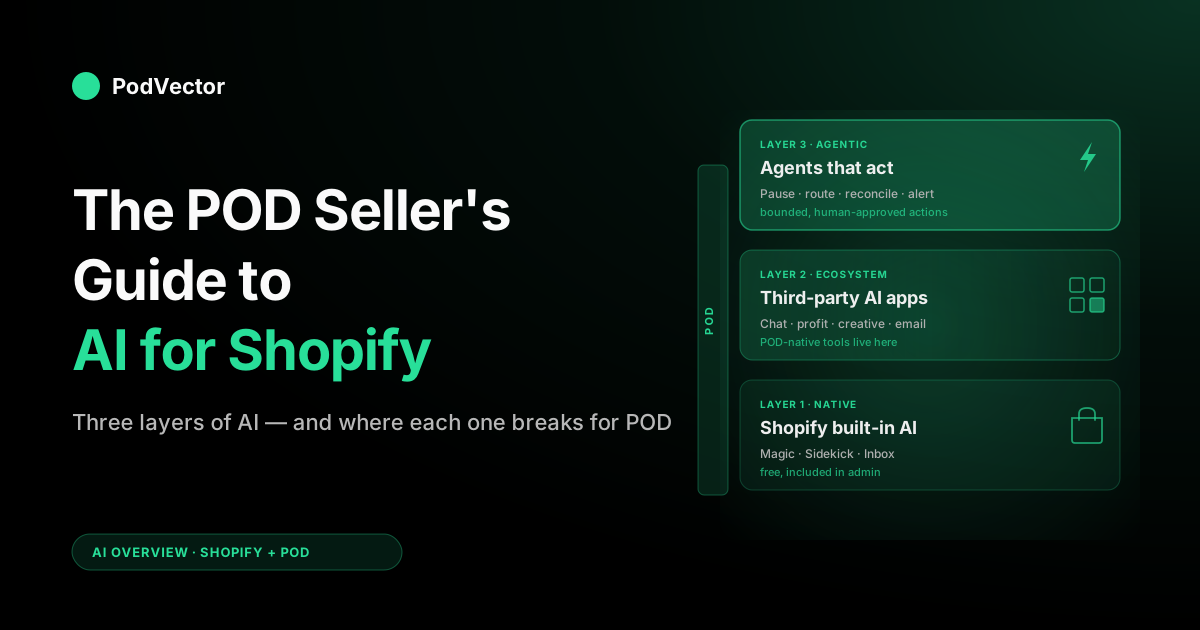
Quick Answer: "AI for Shopify" in 2026 is three stacked layers: Shopify's native AI (Magic, Sidekick, Inbox, and the AI store builder that spins up a storefront from a prompt), a crowded third-party app ecosystem for chat / creative / analytics, and an emerging agentic layer where AI takes bounded actions on the store's behalf. Sidekick itself crossed that line in early 2026 — it now creates customer records and writes payments queries, not just answers questions. Most AI-for-Shopify guides are written for wholesale brands that type a COGS number into a settings field.
Print-on-demand breaks that assumption — per-order supplier costs, design-as-SKU catalogs, and Printify/Printful routing turn the same feature list into a very different ROI map. This guide walks through what each layer does, which tools actually move POD numbers on Shopify, and where the agentic shift changes what one seller can run.
What "AI for Shopify" means in 2026
"AI for Shopify" used to mean a product-recommendation widget and a chat bubble. In 2026 it means something much bigger.
It means Shopify's own Magic and Sidekick assistants writing copy and answering merchant questions from inside the admin. It means a few hundred AI-labeled apps in the Shopify App Store for chat, search, creative, analytics, email, ads, and reviews.
It means AI agents that read your store data and take bounded actions without a human clicking through. And it means a growing share of shoppers arriving through AI-generated answers instead of traditional search, which changes how Shopify product pages need to be structured in the first place.
Third-party estimates put the share of top-performing Shopify stores using at least one AI tool above 70%, and AI now handles roughly a third of customer interactions across the ecosystem. Those numbers are real but they flatten an important distinction: a tool being installed is not the same as a tool earning its subscription back.
For a POD operator with thin margins and a variable per-order cost structure, that distinction is the whole game. The job of this guide is to separate the AI features that move your numbers on Shopify from the ones that just look good in a feature list. For broader context, the AI overview cluster covers the category-level picture and the wider AI analytics topic hub walks through adjacent tooling.
What changed between Shopify 2022 and Shopify 2026
Four shifts matter:
- Shopify shipped first-party AI. Magic (content generation), Sidekick (a conversational commerce assistant that reads your store data), and an AI store builder (a full storefront generated from a short description) are now free inside every plan. They absorbed a chunk of what third-party apps used to charge for — and as of early 2026, Sidekick stopped only answering and started acting, creating customer and company records and writing ShopifyQL queries against payments and web-performance data.
- Large language models hardened into workflows. Product description generators, customer-service copilots, SEO writing pipelines, and ad-creative variations moved from novelty to routine. What used to take a freelancer a week takes a prompt template and a human review pass.
- Agentic commerce arrived on both sides. Shoppers increasingly delegate research and purchase to AI agents (ChatGPT, Copilot, and other AI assistants). Merchants are starting to deploy agents that take bounded actions on the store — pause a campaign, flag a margin anomaly, route to a cheaper supplier. Shopify built its Universal Commerce Platform and related primitives to ride this shift rather than fight it.
- The data layer got serious. Every "Shopify AI" feature is only as good as the data it reads. For a POD store that means itemized supplier costs, not a manual COGS average — which is exactly where most generic Shopify AI tools fall down.
Why Shopify-for-POD is a different map from Shopify-in-general
Most "AI for Shopify" guides are written with DTC wholesale brands in mind: companies that buy inventory, hold it, and ship it from a warehouse. Print-on-demand inverts almost every assumption in that model. Apply a generic Shopify AI playbook to a POD business and you'll either over-invest in tools that don't move your numbers, or miss the one change that would have.
Your COGS is computed per order, not per SKU
A wholesale brand sets a unit cost when it buys inventory. A POD seller doesn't find out what an order cost until the supplier invoice prints, and the number varies by product, print method, garment color, shipping destination, and which supplier fulfilled it.
A Printify hoodie shipped from the Midwest to the East Coast doesn't cost the same as the identical hoodie shipped to Oregon. This single difference breaks every generic Shopify analytics app that assumes COGS is a number you type in a settings field. For the full walkthrough of how this rewrites profit math on Shopify, see the complete guide to Shopify COGS tracking for POD.
Design is the SKU, and there are thousands of them
A wholesale brand has maybe 50 SKUs. A working Shopify POD store has hundreds or thousands of designs, each applied across a handful of product types and color options.
Shopify's native reports and most third-party AI analytics apps reason at the store or product level, not the design level. "Which design is eating my ad spend without returning orders" is a question you literally cannot answer without an analytics layer that handles that granularity. This is where most of the AI-for-Shopify conversation misses POD entirely.
Two suppliers, different pricing, different strengths
Most Shopify POD stores run Printify, Printful, or both. Printful tends to win on quality and customer experience; Printify tends to win on cost and catalog breadth.
Routing products between them by geography, product type, or margin target is a real optimization lever. A generic AI tool doesn't know either supplier exists.
A POD-native tool reads both via their APIs and reconciles the costs back to the Shopify order. Background context: Printify alternatives comparison and the complete Printful review.
Ad attribution matters more, not less
POD margins are tight enough that a 4x ROAS campaign on Shopify can still be unprofitable if fulfillment costs are high. Generic Shopify AI reports compute ROAS as revenue divided by ad spend.
POD-appropriate analytics compute contribution margin: revenue minus ad spend minus itemized fulfillment cost minus Shopify fees minus payment processing. If your AI tool isn't reconciling those four data sources, it's showing you a vanity number. The Meta Ads / Shopify integration guide for POD walks through the math and the setup.
Layer 1: Shopify's native AI (Magic, Sidekick, Inbox)
Before you buy a third-party AI app for your Shopify POD store, know what Shopify already ships for free. The native AI layer has matured enough in 2026 to cover most of the low-hanging content and support tasks — but it stops well short of the operations and profit-intelligence layer where POD sellers win or lose.
Shopify Magic
Magic is Shopify's built-in generative-AI assistant for content. It writes product descriptions, email subject lines and body copy, blog posts, and FAQ answers.
It rewrites product copy in different tones, expands bullet lists, and generates meta descriptions. For a POD operator pushing out hundreds of new designs, Magic's product-description generator is the single most valuable native feature — not because it writes brilliant copy (it doesn't), but because it writes adequate copy fast, and you can human-review a sample from each batch. Treat it as a first draft at scale, not a final draft for scale of one.
Shopify's AI store builder
The newest native feature, and the one most "AI for Shopify" searches now surface first: you describe the store you want, and Shopify generates a themed storefront with copy and starter products in seconds.
For a POD seller it's a fast way to stand up a niche store or a seasonal microsite without a designer. Third-party builders like BuildYourStore.AI, Framer, and PagePilot chase the same job from outside the admin — useful, but a roundup like this comparison of the best AI Shopify store builders won't tell you whether the store you spin up actually makes money. The builder gets you a storefront; the profit question starts the moment the first order ships.
Sidekick
Sidekick is Shopify's conversational admin assistant. You ask it questions in plain language ("which products had the highest return rate last month?", "show me customers who bought twice in the last 90 days"), and it queries your store data and surfaces the answer.
As of early 2026 it does more than answer. It now creates customer and company records from a plain-language description, writes ShopifyQL queries against payments and web-performance data, and helps with fulfillments and payouts — alongside the older tricks of setting up discount codes, drafting shipping rules, and suggesting conversion improvements.
The useful frame: Sidekick is a conversational interface — increasingly an acting one — on top of Shopify's native reports and admin.
For merchants whose analytics needs live entirely inside Shopify's data model, it's excellent. For POD sellers whose margin number requires itemized Printify/Printful costs that Shopify doesn't natively ingest, Sidekick's profit answers are only as good as the COGS data you feed it — which is usually a manual field.
That gap is why POD-native analytics tools exist. See AI analytics platforms for Shopify: what it looks like for POD for the specifics.
Shopify Inbox
Shopify Inbox is the built-in customer chat widget with AI auto-replies. It handles the common ("where is my order?", "what's your return policy?") without human intervention and escalates the rest.
For a POD store with standard policies, Inbox covers most ticket volume under a few thousand orders per month. Once volume crosses a threshold or you need deep catalog-aware answers ("do you have this design in youth sizes?"), a specialized chatbot does better — see best AI chatbot for Shopify compared.
What Shopify native AI does not do well
Three gaps, all of which matter for POD:
- Per-order itemized fulfillment cost. Shopify's profit reports compute margin using a COGS field. That field is a single number per variant. POD per-order costs don't fit that model, so the native profit numbers are approximate at best and wrong at worst.
- Design-level reasoning. Shopify segments by product, variant, collection, customer — not by design. For a POD store, that's often the dimension that matters most.
- Cross-platform reconciliation. Meta spend, Google spend, TikTok spend, Printify cost, Printful cost, Shopify revenue — Shopify's native AI sees only the Shopify half of that picture.
Layer 2: the third-party AI app ecosystem
Above the native layer sits a crowded marketplace of AI-labeled apps. It helps to group them by the value lever they pull, because each group has a different ROI curve for a POD store.
Customer-facing AI (chat, search, recommendations)
Apps like Tidio, Gorgias, and a long tail of Shopify-native chatbots add conversational search and support. Personalization and product-recommendation engines (Rebuy, LimeSpot, etc.) push related products and bundles.
The value lever is conversion rate and AOV. For POD stores, these features are useful but rarely the biggest win — conversion on a well-designed POD storefront is usually set by traffic quality and creative, not by recommendation logic.
If you have traffic volume to justify it, pick one chatbot and one recommendation engine. Don't stack five.
Operations AI (profit tracking, analytics, inventory)
This is the layer most POD-relevant to Shopify. Tools like Triple Whale, Lifetimely, and BeProfit bring blended margin and attribution; Victor brings POD-native per-order supplier cost reconciliation and a conversational interface over live data.
The value lever is margin — finding money that would otherwise have leaked. For POD stores specifically, this is where the needle moves.
If you pick one category to invest in first, this is it. Comparison: best AI tools for ecommerce data analysis compared.
Creative AI (design, copy, ads, video)
Design generators (Midjourney, DALL-E, Firefly), LLMs for copy (ChatGPT, Shopify Magic itself, and other general-purpose models), ad creative generators, short-form video tools. The value lever is speed — more creative variants for less cost. POD is uniquely well-positioned here because the product is the creative. Faster, cheaper designs mean more SKUs, which means more tests, which means more winners.
Email and retention AI
Klaviyo's AI handles send-time optimization, subject-line testing, and predictive segments. For a POD store with a few thousand customers, this layer starts paying back fast — especially on seasonal or niche-moment designs where timing matters. Shopify Email has caught up for the low end.
SEO and content AI
Surfer SEO, Clearscope, SEMrush, and the new wave of "generative engine optimization" tools. The generative-search share of product discovery is rising, and your Shopify product pages and collection pages need to be legible to LLMs, not just crawlers. Worth the investment if organic is a meaningful channel for your niche.
Reviews and social proof AI
Yotpo, Judge.me, and others use AI to solicit, summarize, and surface reviews. For Shopify POD stores where product quality varies across designs, review automation is mid-priority but cumulative: more reviews compound into better conversion over months.
For an external perspective on the full landscape, Shopify's own roundup of AI tools for business covers the generic picture well — the POD-specific operations layer is where this guide adds value beyond that starting point.
The 9 AI-for-Shopify use cases that earn their keep for POD
Narrowing the landscape: these are the nine AI-powered capabilities that routinely pay for themselves on a Shopify POD store. Everything else is either nice-to-have or not yet mature enough for most sellers.
1. Profit intelligence per order, per design, per campaign
An AI analytics layer that reads your Shopify orders, Printify or Printful cost lines, and Meta or Google ad spend, then answers questions like "what was my margin on Design X in April after fulfillment and ads" in real time. This is the single highest-leverage AI feature for POD sellers on Shopify, because it unlocks the decisions you otherwise can't make: which designs to scale, which to kill, which campaigns to turn off. The complete guide to profit tracking for Shopify POD stores walks through the setup.
2. Anomaly detection on margin and ROAS
When true ROAS drops 20% in two days, or a design's return rate spikes, or supplier costs jump on a routing lane, you want to know within hours — not next week when you happen to open the Shopify analytics tab. AI monitoring watches the metrics that matter and surfaces anomalies proactively.
In a dashboard-only world, you catch these when you happen to look at the right chart. In an AI-monitored world, you get a message.
3. Natural-language queries against live Shopify data
Instead of building dashboards for every question, you just ask. "Which hoodie designs had a positive contribution margin in Q1?" "Compare Printify vs Printful shipping cost on small orders to California." "What's my repeat-purchase rate on customers who first ordered a holiday design?" An LLM that translates those questions against a tenant-isolated warehouse, then answers in plain English, is the single most productive analytics upgrade most Shopify POD stores can make.
4. AI-generated product descriptions and metadata at scale
A Shopify POD store with a thousand designs needs a thousand product descriptions, meta titles, and meta descriptions, each with enough keyword specificity to rank. Done by hand, that's a quarter of work.
Done with Shopify Magic plus a prompt template that reads your design metadata, it's an afternoon. The tradeoff is quality control: sample-review each batch, tighten the prompt, re-run.
5. AI-driven ad creative generation
Static image ads, lifestyle mockups, short vertical video for TikTok and Reels — all are dramatically cheaper in 2026 than they were two years ago. For POD specifically, the ability to spin up ten variants per design without a photographer or designer tightens the feedback loop between "launched a design" and "know if it sells."
6. Conversational search and catalog-aware chat
Shoppers increasingly use chat interfaces to find and evaluate products instead of scrolling collection pages. A Shopify chatbot that can answer "do you have this design in youth sizes?" or "what shirts have this color palette?" raises conversion rate for shoppers who engage. Less transformational than operations AI for most POD stores, but worth setting up once traffic volume justifies it.
7. Fraud detection tuned for POD-specific risk signals
Chargebacks on POD are particularly painful: you already paid the supplier, you can't restock the item, and the customer keeps the shirt. AI fraud tools that catch risky orders before supplier fulfillment prevent real losses. Shopify's built-in fraud analysis handles the basics; specialized tools add value once order volume crosses a threshold where the false-positive / false-negative tradeoff starts mattering.
8. Email timing, segmentation, and subject-line testing
Klaviyo AI (or Shopify Email's AI features at the low end) handles send-time optimization, predictive segments for churn and repeat-purchase, and subject-line testing. For a POD store with seasonal or fandom-driven design launches, well-timed flows move meaningful revenue on the retention side.
9. Generative-engine-ready product content
A rising share of Shopify product discovery comes through AI shopping agents (ChatGPT, Copilot, and similar assistants) that read structured product data and surface matches. Optimizing Shopify product titles, descriptions, structured data, and schema markup for those agents — "generative engine optimization" — is now a line item. For long-tail POD niches, GEO often outperforms traditional SEO on cost-per-click even in year one.
Layer 3: the agentic shift on Shopify
The defining shift in Shopify AI for 2026 isn't smarter chatbots. It's agents — AI systems that don't just answer questions but take actions on behalf of a user or a business. The trajectory has two sides: shopper-side agents and merchant-side agents, and both matter for POD.
Shopper-side: agentic commerce on Shopify
Shoppers are beginning to delegate purchase research to AI agents. "Find me a custom t-shirt for a friend who loves trail running, under $30, delivered by Thursday." The agent searches, compares, and presents options — and in some cases completes checkout directly. Shopify has leaned into this with a Universal Commerce Platform designed to let third-party AI agents read and transact against a Shopify store's catalog.
For POD sellers that means your product data — titles, descriptions, variant metadata, structured attributes — is now being read by LLMs, not only by human shoppers. Optimizing for that readership is real work and pays.
Merchant-side: agentic operations on Shopify
On the merchant side, agents are beginning to act on your store's behalf: pausing a Meta campaign that's burning through spend at a terrible true ROAS, flagging a supplier cost spike, drafting the weekly summary, responding to routine customer service tickets, re-routing a product between Printify and Printful when the margin math flips. The common pattern is "read live data, reason, take a bounded action, report back." This is where Victor is built to go.
Victor can answer your questions using live data. He pulls together your Printify and Printful costs, your Shopify orders, your ad spend, and your fees, so you get a real answer, not a guess. Victor is also built to take action for you, like pausing a Meta Ads campaign or changing a product price in Shopify, always with your approval first. For the broader category and where it's heading, see the complete guide to AI agents for ecommerce analytics.
Why this matters for POD specifically
POD operators are almost always lean teams — solopreneurs, small studios, or pairs splitting design and operations. Every hour spent on dashboard maintenance, campaign monitoring, or cost reconciliation is an hour not spent on the two things that actually grow a POD business: new designs and new audiences. Agents that absorb the repetitive operational overhead don't just save time — they change the ceiling on how much store one person can run profitably on Shopify.
A realistic AI stack for a Shopify POD store
You don't need every tool in the category. A working AI-for-Shopify stack for a POD store in 2026 looks roughly like this:
- Native Shopify AI: Magic for product copy, Sidekick for admin questions, Inbox for basic customer chat. Free, included, use them.
- Analytics / profit intelligence: a POD-aware AI analytics tool that pulls in your itemized Printify and Printful costs — Victor, or a blended-margin tool if you accept the COGS-estimation tradeoff. This is the tool that pays for the rest of your stack. See best AI agents for ecommerce 2026 compared.
- Creative AI: a design generator (Midjourney or a hosted alternative), an LLM for product copy beyond what Magic handles (ChatGPT or another general-purpose model), and an ad creative tool if you run Meta or TikTok at scale.
- Ad-platform native AI: Meta Advantage+ campaigns, Google Performance Max. These use AI under the hood regardless of whether you "turn AI on" — what matters is feeding them clean Shopify conversion data.
- Email and retention: Klaviyo AI (above ~2,000 contacts) or Shopify Email (below that). Send-time and subject-line optimization compound fast.
- Optional specialist apps: fraud detection, catalog-aware chatbot, review automation, inventory forecasting (if you hold blanks). Add when volume justifies, not before.
Most Shopify POD stores doing under $500K annually get more out of focusing on the analytics and creative layers than on every possible app. Category sprawl kills more POD operations than undersupply ever did.
How to implement AI on your Shopify store without breaking it
The pattern that works: deploy one layer at a time, measure against a baseline, keep human oversight on anything that takes money-moving actions.
Step 1: Establish your real profit baseline first
Before any AI tool can help, you need to know what your margin actually is — not what Shopify's native profit report shows, not what a manual COGS field guesses, but the real per-order contribution margin after supplier cost, ad spend, and fees. If you haven't done this, every "AI insight" downstream will be calibrated against a wrong starting number. The complete guide to break-even analysis for Shopify POD walks through the setup in detail.
Step 2: Connect your supplier data to your analytics layer
The single highest-leverage integration in a Shopify POD stack is pulling itemized Printify and Printful costs into your analytics tool automatically. If your tool can't do that, the profit numbers it shows you are guesses. Fix this before layering on anything else. See automating your Printify/Shopify profit tracking for the integration pattern.
Step 3: Add Shopify Magic and Sidekick to your workflow
These are free. Use Magic to batch-generate product copy for new designs. Use Sidekick for day-to-day admin questions that previously required a report. The bar here isn't "does it replace a human" — it's "does it compress the time spent on routine Shopify-admin work." The answer is almost always yes.
Step 4: Add the creative layer where you have the bottleneck
If your bottleneck is "not enough designs to test," bring in a generative design tool. If your bottleneck is "descriptions take too long," lean on Magic plus a longer-form LLM. Don't add creative AI everywhere — add it exactly where the bottleneck is, measure the throughput change, then decide whether to expand.
Step 5: Layer in automations with human approval loops
Once you have clean data and faster creative, add automations that require approval for any action that moves money: pause-campaign rules, design-level ROAS alerts, supplier routing suggestions. Don't auto-approve anything in month one. Human-in-the-loop until you trust the signal.
Step 6: Graduate to agentic, one action at a time
When a specific automation has been reliable for 30+ days with 100% human approval, let it run bounded actions autonomously: pausing a single campaign type, sending low-stakes emails, drafting customer responses. Expand the agent's scope one action at a time. Never give an agent unbounded access to the whole Shopify admin without step-wise trust-building.
Mistakes POD sellers make with AI on Shopify
Trusting Shopify's native profit report as truth
Shopify's profit report uses the COGS field you typed into product settings. For POD that number is fictional — real cost depends on the supplier invoice per order. Don't make decisions from it. Either feed Shopify accurate per-order COGS via an integration, or use a POD-native analytics layer alongside.
Buying AI before cleaning the data
The most common failure mode. Sellers subscribe to an AI analytics app without connecting itemized supplier costs, then are surprised when the "AI insights" are no better than their old dashboard. The AI is fine; the data is wrong. Fix the data pipeline first.
Treating generic Shopify AI as if it understands POD
Most Shopify AI apps are built for wholesale brands. They'll let you enter a COGS number, run their recommendations, and tell you you're profitable when you're not.
If the tool doesn't natively ingest Printify / Printful cost lines per order, it's not a POD tool — it's a DTC tool you're using by analogy. Verify the POD use case directly with the vendor before committing.
Stacking AI apps instead of integrating them
Six AI subscriptions, each with its own dashboard, each answering a piece of the question, each pulling from Shopify in its own way. The point of AI is to reduce the surface area of attention you spend on your business, not expand it. If a new app doesn't reduce the total number of tabs you open, reconsider whether it belongs in the stack.
Trusting AI outputs without audit loops
AI models hallucinate. An analytics agent that translates a question can get the SQL wrong. A product description generator can invent specs that aren't true. Build audit loops: sample its output, compare to source truth, escalate discrepancies. Rigorous vendors handle this at the platform level; light-touch vendors leave it to you.
Skipping the agentic question
Most Shopify AI apps are priced and pitched as "answer things faster." That's fine for 2024. In 2026 the question to ask every vendor is: what actions are you on the roadmap to take autonomously on my behalf, and how does your architecture enforce that the agent only acts within bounds I set? If they don't have a credible answer, they're building yesterday's product.
Waiting until you're "big enough" to start
The decisions you make at $5K/month on Shopify — which designs to scale, which niches to enter, which campaigns to fund — compound over the next twelve months. Starting with real profit visibility at small scale changes what "big enough" looks like. The cost of not knowing is paid in margin, not in SaaS bills.
FAQs
What is AI for Shopify in plain English?
It's software that uses machine learning or large language models to do jobs inside or around a Shopify store that used to require human attention — from writing product descriptions, to answering customer chat, to watching your margins in real time and flagging when something breaks. For POD sellers specifically, it's the layer that turns a thousand designs, two suppliers, and four traffic channels into a manageable operation run by one or two people.
Does Shopify have built-in AI?
Yes. Shopify Magic generates content (product descriptions, emails, blog posts, FAQ answers).
Sidekick is a conversational admin assistant that reads your store data and, as of early 2026, takes actions — creating customer records and writing payments and web-performance queries, not just suggesting them. Shopify Inbox runs AI auto-replies on customer chat, and an AI store builder generates a full storefront from a short description.
All of it is included in Shopify plans without an extra subscription. They cover a lot of ground but stop short of per-order POD profit reconciliation — which is where third-party or POD-native analytics still earn their keep.
Is Shopify Magic good enough for product descriptions?
For POD, yes — as a first draft at scale. Magic's product descriptions are adequate, not brilliant. The useful workflow is: let Magic draft, human-review a sample from each batch, tighten the prompt, and re-run. For a store with a thousand designs that's the difference between a feature launch and a solved problem.
What's the difference between Sidekick and a POD-native analytics agent?
Sidekick queries Shopify's native data model. That's enough for store-level questions ("what's my best-selling collection this month?") but not for POD-specific margin questions that require itemized Printify/Printful costs Shopify doesn't natively ingest.
A POD-native analytics agent like Victor brings together your Shopify orders, Printify costs, Printful costs, and ad spend, so it can answer profit questions with real numbers. The two are complements, not substitutes.
Is AI for Shopify worth it for a small POD store?
Yes, in the categories that matter. Operations AI (profit intelligence, analytics) earns back its subscription fast at any revenue level, because the decisions it unlocks compound.
Creative AI is usually worth it once you're past the design-naming stage. Customer-facing AI is optional until traffic volume justifies it. The only wrong answer is skipping the category at the exact moment your store starts scaling.
Will AI agents replace Shopify POD sellers?
Not anytime soon. AI is extraordinary at pattern recognition and execution within defined bounds.
It's weak at taste, niche instinct, and creative direction — the things that determine which POD niches win on Shopify. What AI will do is compress the operational overhead of running a store, which means one seller can run more store. Leverage expands; the seller stays.
How do I know if a Shopify AI app actually understands POD?
Ask it one question: does it ingest itemized per-order costs from Printify and Printful automatically, or does it ask you to enter a COGS number manually per variant? If it's the latter, it's not a POD tool. It's a generic Shopify app you're using by analogy. That one test filters the App Store fast.
Where is AI for Shopify heading in the next two years?
Toward agents. Today's Shopify AI answers questions; tomorrow's Shopify AI takes bounded actions — pausing campaigns, adjusting prices, drafting customer responses, routing orders between suppliers, responding to inventory signals. Shopify is building the substrate for this at the platform level, and third-party vendors are racing to fill the specialist gaps. Presta's 2026 Shopify AI toolkit guide covers the platform side well; the POD-specific implementation is what matters for this audience.
Do I need to learn to code to use AI for Shopify?
No. The useful tools for Shopify POD sellers are built for operators, not engineers. You connect your accounts, ask questions in plain English, and read the output.
The only time coding enters the picture is if you decide to build a custom data warehouse — which most Shopify POD stores under $2M/year don't need. Start with purpose-built tools, upgrade to custom infrastructure only if you hit a capability ceiling.
What does AI for Shopify cost?
Shopify's native AI (Magic, Sidekick, Inbox) is included in your plan. Third-party AI apps range from ~$20/month for a profit-tracking app to a few hundred per month for a full AI analytics agent, plus creative subscriptions (typically $10–50/month per tool). Most POD sellers doing under $500K/year can cover operations + creative AI for under $200/month total. The more expensive stacks aren't always better — they're usually paid for by larger stores because they include team features, not because the core AI is more capable.
Hand your Shopify POD ops to an AI employee
Victor sits alongside Shopify Magic and Sidekick, not in competition with them. He reconciles itemized Printify and Printful costs against your Shopify orders and ad spend, then proposes the next move — reallocate ad spend, pause a losing campaign, reroute a product to the cheaper supplier — and runs it once you approve. That's the one layer the native stack doesn't cover for POD: an operator that acts, not just answers.
Try Victor free