
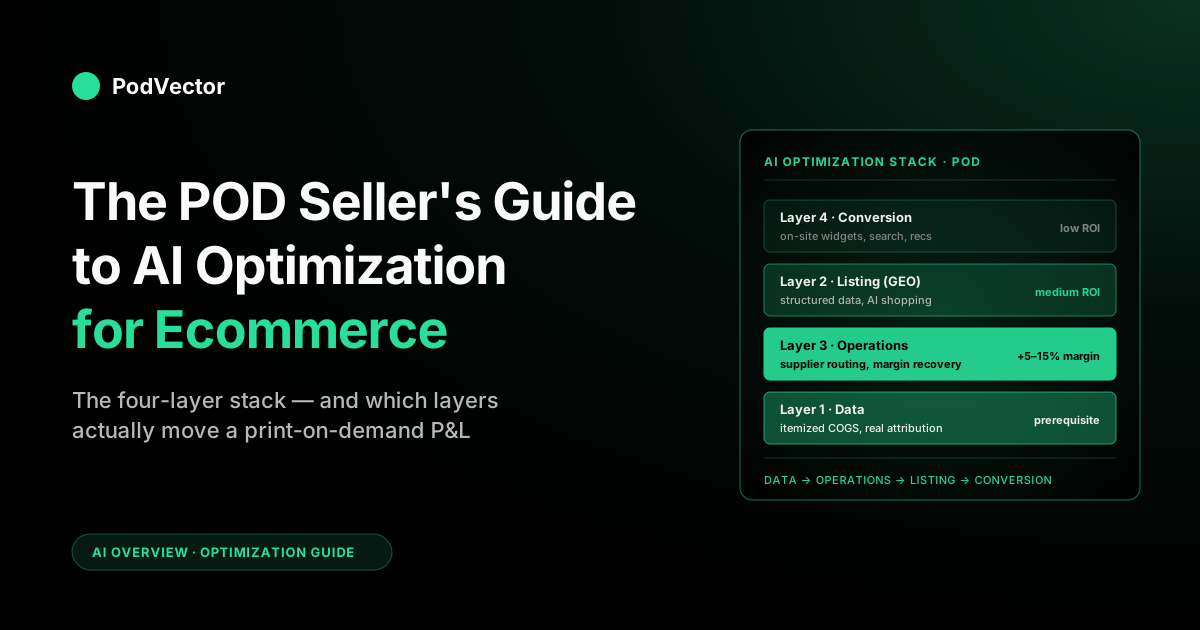
Quick Answer: "AI optimization for ecommerce" is a four-layer stack — data, listings, operations, and conversion — and only some of those layers translate cleanly to print-on-demand. For POD specifically, the highest-leverage optimization happens at the data and operations layers (true per-order margin, supplier routing, design-level profitability), not at the storefront layer everyone writes about.
Generic guides treat AI optimization as conversion-rate widgets because they're written for wholesale brands. For POD, the biggest wins come from optimizing what you can't see in Shopify's dashboard: itemized supplier cost, contribution margin per design, and cross-store P&L. This guide walks through each layer, what's worth doing in 2026, and what to skip.
What 'AI optimization for ecommerce' actually means
Search "AI optimization for ecommerce" and you'll find a tangle of overlapping definitions. Some guides mean conversion-rate optimization with AI personalization.
Others mean product-data optimization for AI-powered shopping engines. Others mean operational optimization — inventory, pricing, fulfillment routing. They're all using the same phrase to describe four different things, which makes the category genuinely confusing for an operator trying to pick where to start.
For a print-on-demand operator, the useful framing is to treat AI optimization as a stack with four layers. Each layer optimizes a different thing, has a different ROI curve, and a different cost to set up. Data optimization is about making the numbers underneath your store correct and queryable. Listing optimization is about how products surface — to Google, to ChatGPT, to Amazon Rufus, to shopping agents. Operations optimization is about supplier routing, pricing, and margin recovery. Conversion optimization is about what happens once a shopper lands.
Each layer has AI tools attached to it. None of them are interchangeable.
The mistake operators make is assuming the layers can be tackled in any order. They can't.
Listing optimization fails if your data is wrong. Operations optimization fails if your data is wrong.
Conversion optimization is the layer where most marketing budget goes — but it's also the one with the smallest impact on a POD P&L, because your conversion rate is mostly capped by traffic quality, not by on-site widgets. The order of operations matters more than the choice of vendor.
What changed between 2023 and 2026
Three shifts redefined what "AI optimization" means for an ecommerce operator:
- Data became table stakes. In 2023, "AI optimization" usually meant a recommendation engine bolted onto a store with messy backend data. In 2026, the leading tools insist on fixing the data layer first — itemized supplier costs, real attribution, clean product attributes. The era of "AI insights" floating on top of broken numbers is ending.
- Generative shopping arrived. A meaningful share of product research now happens through ChatGPT, Gemini, Perplexity, Amazon Rufus, and Google's AI Overviews — and the order volume attributed to those surfaces grew roughly 59x in 2025 over 2024 off a small base, with AI Overviews now showing on a large share of commercial queries. Optimizing your listings for those surfaces (sometimes called GEO — generative engine optimization) is now a real channel, not a thought experiment.
- Optimization moved from rules to agents. The first wave of AI optimization tools were rule engines with a chat skin. The 2026 generation are autonomous agents that read live data, propose changes, and (increasingly) execute bounded actions on a merchant's behalf. The shift changes how you evaluate vendors — you're not buying a dashboard anymore, you're buying an operator that reasons over your data and proposes the next move.
The four layers of AI optimization (and which matter for POD)
Here's the stack, with rough P&L impact for a typical POD operator:
- Layer 1 — Data optimization. Foundation. Wrong here means everything above is wrong too. Highest indirect impact.
- Layer 2 — Listing optimization. Moves traffic. Becoming more important as AI-mediated discovery grows. Medium impact.
- Layer 3 — Operations optimization. Moves margin. Highest direct impact for POD specifically, because operations is where POD economics live.
- Layer 4 — Conversion optimization. Moves on-site behavior. Smallest impact for POD, despite being the most marketed.
If you have one Saturday afternoon to spend on AI optimization, spend it on Layer 1. If you have a quarter, work through Layers 1 → 3 → 2 → 4 in that order. Conversion-layer tools sound exciting; they're the worst use of early time. The reasoning is in the layer-by-layer breakdown that follows.
Layer 1: Data optimization — the prerequisite nobody writes about
Most "AI optimization" guides skip the data layer because it's unglamorous. It's also the layer that determines whether everything above it is useful or noise. Three things have to be true before any AI tool you buy can produce trustworthy output:
Itemized cost data, not estimated COGS
Generic ecommerce AI tools assume a flat unit cost: "this t-shirt costs $8." POD doesn't work that way. A Printify hoodie produced in the Midwest and shipped to Oregon costs differently than the same hoodie shipped to New Jersey, because the shipping leg is part of the variable cost. The Printify (or Printful) invoice is the only source of truth, and it's an itemized record per order.
An AI tool that asks you to type in a COGS estimate is producing margin numbers that are wrong by a percentage that compounds over thousands of orders. An AI tool that reads itemized supplier line items via API gives you margin numbers you can act on. That's the difference between "AI insights" and "AI insights you trust." For the deeper architecture, see the complete guide to AI analytics for print-on-demand.
Product attribute completeness
The AI shopping engines Google, ChatGPT, and Amazon are building all read structured product attributes — material, fit, color, gender, size range, care instructions, country of origin. Stores with 99%+ attribute completion show up 3–4x more often in AI-generated product recommendations than stores with sparse attributes. POD stores are notorious for thin attribute coverage because most operators populate only the bare-minimum Shopify fields.
The optimization here is unsexy: audit every product, fill in every attribute, including the ones that feel optional. AI generators (ChatGPT, Claude, Gemini) can draft the attribute values from a product image and a one-line prompt — that work that used to take a week of manual editing now takes a long afternoon.
Attribution that reconciles all four cost layers
POD has four cost layers between revenue and contribution margin: ad spend, supplier cost, platform fees (Shopify, Etsy, etc.), and payment processing. A 4x ROAS in Shopify's dashboard can be a loser once those layers are reconciled.
AI tools that report ROAS as revenue-divided-by-spend are reporting vanity numbers; AI tools that reconcile all four — and attribute revenue at the order level rather than session level — are reporting numbers you can spend against. The math behind this is in the complete guide to Meta Ads ROAS and attribution for POD.
Layer 2: Listing optimization — for humans and for AI shoppers
Listing optimization used to mean "write a good title and description, add three keywords." In 2026 it's a two-audience problem: you're writing for a human who skims, and you're writing for a language model that's about to summarize twenty similar products into a one-paragraph recommendation. The two audiences want different things. Optimize for both.
Optimize for human shoppers
The fundamentals haven't changed. Title leads with the value, not the brand.
Description opens with the use case, not the materials. Bullet points cover the questions a buyer would ask.
Imagery shows the product on a person, not floating in white space. AI generators speed every one of those tasks up — Midjourney for lifestyle mockups, Claude or ChatGPT for description drafts, Adobe Firefly for variant generation — but they don't change what good copy looks like.
Optimize for AI shopping surfaces (GEO)
The new layer is generative engine optimization. When a shopper asks ChatGPT or Gemini "what's the best vintage-design hoodie for a Christmas gift," the model is summarizing structured product data from across the web. Listings that show up in those answers share a few traits:
- Structured data is filled in — and complete, not partial. Schema.org Product markup with Offer (price, availability, currency), Brand, material, color, plus AggregateRating and ImageObject. The 2026 GEO guides are explicit that incomplete Product schema is the single most common reason a listing gets skipped in AI answers. Add FAQPage schema to the product page so the model can lift your Q&A directly, and validate everything in Google's Rich Results Test.
- Your product feed is accurate and includes GTIN/MPN. AI shopping surfaces read the same feeds that power Google Shopping, Meta, and TikTok. Stale prices, missing availability, or absent GTIN/MPN identifiers get a product filtered out before the model ever considers it. Keep one clean, current feed; resolve Google Merchant Center disapprovals before they compound.
- Natural-language descriptions answer specific buyer questions — and follow-up ones. "Will this fit a tall person?" "Is this hoodie soft?" Shopping increasingly happens in multi-turn conversations ("show me something similar but cheaper"), so each description should be a self-contained chunk a model can lift to answer one question. Models reward listings that answer directly, in the description body, not just in a FAQ tab.
- Reviews are accessible and authentic. Models favor listings with surfaceable, descriptive review content. Hidden review widgets that load via JavaScript don't get read.
- Your AI crawlers aren't blocked (agentic readiness). The newest GEO failure mode isn't bad content — it's a store the shopping bots can't reach. Check that robots.txt, your CDN's bot rules, and any WAF aren't silently blocking OAI-SearchBot, PerplexityBot, Google-Extended, and the other AI crawlers. A listing an agent can't fetch is a listing it can't recommend.
- Off-site citations back you up. AI answers lean on third-party signal — Reddit threads, YouTube reviews, and publisher listicles ("best vintage hoodies") get cited far more than a brand's own page. Earned mentions in those places raise the odds your product makes the shortlist.
This is a real and growing channel. It's also the layer where an hour of work has high upside, because most POD stores aren't doing it yet. For a deeper look at the AI-discovery side, see the POD seller's guide to AI search for ecommerce and the POD seller's guide to generative AI for ecommerce.
The product-page experience itself
Page-level optimization (load time, image weight, mobile experience) still matters, especially for AI crawlers that judge page quality. AI tools can audit product pages at scale — pointing out which descriptions are sparse, which images are too heavy, which schema fields are missing.
That's a one-shot audit, not an ongoing subscription. Use it once, fix what it finds, move on.
Layer 3: Operations optimization — supplier routing and margin recovery
This is where AI optimization earns its keep for POD. Wholesale brands optimize inventory and warehouse picking; POD operators optimize supplier routing, design-level profitability, and the supplier-cost arbitrage between Printify and Printful. None of those are addressed by generic ecommerce AI tools. POD-aware AI handles them as first-class concepts.
Margin recovery (the biggest line)
The single largest impact of AI optimization on a POD P&L is margin you didn't know you were leaking. Designs that look profitable in Shopify's dashboard but are net-negative once Printify fulfillment, shipping, ads, and fees are factored in.
Campaigns with "great ROAS" that are quietly underwater on contribution margin. Routing decisions that send a product to the more expensive supplier when the cheaper one would have produced an identical end result.
An AI analytics agent that reads live data — order line items, supplier invoices, ad-platform spend, processing fees — surfaces these in days. The pattern in the field: operators who switch from manual or generic dashboards to POD-aware AI analytics commonly recover 5–15% of revenue as margin in the first 90 days. The variance comes from how much was leaking in the first place.
Supplier routing
Most working POD operators run both Printify and Printful, or are weighing the tradeoff. Routing each product to the right supplier — by geography, product type, base cost, shipping speed — is a real optimization lever.
AI can model this: given an order's destination, product type, and supplier-side prices in real time, route to the supplier with the best margin or fastest delivery. Generic ecommerce AI doesn't model multiple fulfillment networks. POD-aware AI does. (Background: Printify alternatives compared.)
Design-level profitability
A working POD store has hundreds or thousands of designs across product types and colors. The combinatorial volume is where AI's leverage actually lives: a question like "which 12 designs are losing money after fulfillment and ad spend, and which are 90th-percentile profitable" is unanswerable in a spreadsheet but trivial for an AI analytics agent reading live data. Once you know which designs to kill and which to scale into more product types, your catalog gets cleaner and your ad spend more focused — both of which compound on margin.
Pricing optimization
Dynamic pricing — adjusting price by SKU based on demand, supplier cost, and competitor pricing — is a wholesale-brand pattern that translates partially to POD. The version that works for POD is bounded: identify which designs have headroom (high conversion at current price, low elasticity), test a price uplift, measure margin impact.
AI tools that read live conversion and margin data can run this loop at catalog scale; spreadsheets can't. The version that doesn't translate well to POD is real-time price thrashing — POD shoppers don't shop around the way Amazon shoppers do, and price flicker hurts trust.
Layer 4: Conversion optimization — useful, but smaller than vendors claim
Storefront-side AI — personalized recommendations, AI search, on-site chat, abandoned-cart recovery — gets the most marketing attention because it has the most vendors selling into it. For a POD operator, it's also the layer with the smallest direct P&L impact. Worth doing, but not first.
The reason: a well-designed POD storefront's conversion rate is mostly capped by traffic quality, not by on-site widgets. If the visitor was searching for "vintage Christmas hoodie" and you sell vintage Christmas hoodies, they'll convert.
If they wandered in from a broad-targeted ad, they won't, regardless of how clever your recommendation engine is. Conversion-layer AI helps at the margin — usually a few percentage points of lift — but it doesn't transform a store the way operations-layer AI does.
What's worth doing here:
- AI search on stores with large catalogs. If a shopper can't find the design they want, they leave. AI search beats keyword search for natural-language queries ("tall guy hoodie," "subtle wedding shirt"). High-leverage on stores with 500+ SKUs.
- Personalized recommendations as light upsells. Shopify's native recommendations are decent. Third-party AI recommenders are better but rarely worth the subscription unless your AOV justifies it.
- Abandoned-cart sequences with AI-personalized copy. Decent ROI, low effort, mature category.
- On-site chat answering shopper questions. Reduces support load and lifts pre-purchase conversion modestly.
What's mostly hype:
- Real-time A/B testing AI for under-1000-orders/day stores. Not enough volume for the algorithms to learn faster than a human with intuition. Most POD operators don't hit the volume threshold.
- "AI conversion-rate optimization" platforms that don't read your supplier data. They optimize the wrong thing — they push more orders without telling you those orders are net-negative.
For a deeper conversion-layer comparison, see best AI for ecommerce compared.
How to start AI optimization without buying eight tools
The default mistake is to subscribe to one tool per layer and end up with four monthly bills, four sets of credentials, and four data silos that don't talk to each other. The 2026 trend is consolidation: integrated platforms that handle multiple layers at once, because the data needs to be shared across them anyway. A practical sequence for a POD operator:
Week 1–2: Fix the data layer
Connect your stores, ad accounts, and POD suppliers to a unified analytics layer. The point isn't to buy AI yet — it's to make the data correct and queryable.
If you're using a POD-aware analytics tool that reads itemized Printify/Printful invoices, you've already done most of this work. If you're using Shopify's native dashboards plus a spreadsheet, you haven't, and any AI you bolt on will be confused.
Week 3–4: Catalog audit
Use a generative tool (ChatGPT, Claude, Gemini) to audit one product page against your store's best converting page. Have it list every missing attribute, every weak description, every schema field that's empty. Then have it draft fixes for the top 50 products by traffic. This is a one-week sprint, not a tool subscription.
Month 2: Operations layer
Bring in a POD-aware analytics agent. Ask it the questions that should have been answered six months ago: which designs are losing money, which campaigns are below breakeven on contribution margin, which supplier should each product be routing through.
PodVector AI's Victor is one approach here — he's an AI employee who sees your orders, supplier costs, and ad spend together, so he can answer margin questions in plain English, no dashboards needed. Background on the approach: the POD seller's guide to AI for ecommerce business and the POD seller's guide to AI solutions for ecommerce.
Month 3: Conversion layer (optional)
Only after the data, listing, and operations layers are working should you spend time on storefront-AI. By that point, you'll know which problem is actually worth solving — most operators discover the bottleneck wasn't conversion rate at all, it was traffic quality or unrecognized margin leak.
Common AI optimization mistakes POD operators make
Buying conversion-layer tools first
Storefront-AI vendors have the biggest marketing budgets, so they show up first in search results. They're also the lowest-ROI category for POD specifically. Resist the order of operations the marketing pushes you toward.
Skipping the data layer
An AI insight built on wrong data is worse than no insight, because it gives confidence in a wrong direction. Generic ecommerce AI assumes flat COGS; POD has per-order variable cost. Tools that don't read itemized supplier data are reporting margin that's wrong by a meaningful percentage.
Treating GEO as a side project
The shift toward AI-mediated product discovery is happening fast. POD stores that haven't filled in their structured data and reviewed their description quality for AI summarization will quietly lose share over the next 12 months — not because they did something wrong, but because their listings won't surface in the new shopping flows.
Measuring AI optimization in vanity metrics
"AI lifted my CTR by 8%" is meaningless if contribution margin didn't move. The metrics that matter are contribution margin per order, contribution margin per design, and cost per profitable customer — not click-through rate or session-to-cart. Tools that report only the upper-funnel metrics are optimizing for the wrong number.
Forgetting that one operator can't run eight tools
Tool sprawl kills small POD operations. Each tool added is a credential to manage, a data silo to reconcile, a monthly fee to justify. The 2026 trend toward unified platforms — one analytics layer, one operations layer, integrated — exists because the alternative doesn't scale. Don't subscribe to the sprawl.
How to measure whether AI optimization is working
Pick three metrics, measure them weekly, and tie every AI tool subscription to one of them. If a tool can't be tied to one of these, cancel it.
- Contribution margin %. Revenue minus all four cost layers (supplier, ads, platform fees, processing), divided by revenue. The single most important number for any POD operator. AI optimization should move this up. If it isn't, something's optimizing the wrong thing.
- Net new profitable designs per month. Designs that, after 30 days of live ad spend, are above breakeven on contribution margin. Creative-velocity tools should move this up. Operations tools surface which existing designs to kill, freeing budget to test new ones.
- Operator hours per $10K revenue. Implicit measure of whether AI is buying you time. If you're using AI tools but spending the same hours on dashboards and reconciliation, the tools aren't doing the job. The point is to free creative and strategic time, not to add another monitoring tab.
One newer metric is worth watching alongside the three above: AI-surface visibility — how often your products show up in AI Overviews, ChatGPT and Gemini recommendations, and as cited sources in generative answers. It's the leading indicator that your Layer 2 GEO work is landing, the same way impressions are the leading indicator for traditional SEO. Track brand mentions in AI responses and assisted conversions from AI-driven sessions; treat a rising trend as confirmation, not a number to optimize in isolation.
The agentic shift: from optimization tools to optimization agents
The frontier in 2026 is the move from optimization tools (you query them, they show you a chart) to optimization agents (you ask them a question, they reason across your data, they propose actions, and increasingly they execute bounded actions on your behalf). The distinction matters because it changes what you're paying for.
An optimization tool requires you to know what to ask. You set up a dashboard.
You check it. You decide.
The dashboard is a UI between you and your data. An optimization agent inverts that: you describe a goal ("find designs losing money this month, recommend which to pause"), and the agent does the analysis, presents the answer, and (in the agentic-execution model) takes the action with your approval.
The other agentic shift: shoppers buying through agents
There are two agentic shifts happening at once, and most guides only cover one. The first is on your side of the store — the AI employee described above. The second is on the buyer's side: agentic checkout, where a shopper's AI assistant doesn't just recommend a product but completes the purchase on their behalf. Google, OpenAI, and the major retail platforms all shipped agent-driven checkout flows in the 2026 cycle.
For a POD operator, the practical takeaway loops straight back to the data and listing layers. An AI agent buying for a shopper relies on the same clean product feed, complete Product schema, and accurate availability that GEO depends on — a listing an agent can't parse is a listing it can't buy. The work you do at Layer 1 and Layer 2 is what makes your catalog legible to the shoppers' agents, not just the search engines. There's nothing extra to buy here; there's a correctness bar to clear.
For POD, the agentic angle is especially interesting because operations questions are messy. They span multiple data sources (supplier invoices, ad spend, store orders, returns).
They require judgment calls (is this design dying or just seasonal?). They're the kind of work where having a competent analyst on call is worth a lot — and where having to build the analysis yourself in spreadsheets is the bottleneck for most one-or-two-person operations.
This is the direction PodVector AI's Victor is built for: ask anything about your store in plain English, and get a clear answer based on your real orders, costs, and ad spend. Victor can also take action for you — like changing prices, pausing ads, or building email flows — once you approve it. The deeper category overview is in the complete guide to AI agents for ecommerce analytics and the agentic-pattern explainer at agentic AI for ecommerce — what it looks like for POD sellers.
For broader context on what's available across all four optimization layers, see PodVector AI's AI overview cluster and the AI analytics topic hub. For a perspective from outside the POD world that lays out the wholesale-side pattern (useful as a contrast), Extuitive's 2026 use-case guide covers the eleven non-POD-specific use cases the bigger ecommerce literature focuses on.
FAQs
What's the difference between AI optimization and AI personalization?
Personalization is one optimization tactic at the conversion layer. Optimization is the broader category — it includes data, listing, operations, and conversion work. Vendors that pitch "AI optimization" but only deliver personalization are selling Layer 4 only and ignoring the three layers underneath it.
Do I need to use AI to compete in 2026?
You need correct data. You need decent listings.
You need to know which designs are profitable. Whether you reach those outcomes via AI tools, manual spreadsheets, or hiring an analyst is a means question. The reason most POD operators end up using AI is that the manual paths don't scale past one or two stores; AI is the scalable path, not the only path.
How much does AI optimization cost for a POD store?
If you're consolidated on one POD-aware analytics platform plus generative tools you already use (ChatGPT, Claude, Midjourney), expect a total of $50–250/month for a one-or-two-person operation. If you're running point solutions across four layers, you'll easily spend $400–1,000/month and get worse results because the data doesn't connect across them. The consolidation pattern wins on both cost and effectiveness.
Will AI optimization replace the need for a marketer or analyst?
It replaces the analytics-as-grunt-work part of those roles — the report-building, the spreadsheet-reconciliation, the ad-hoc queries. It doesn't replace judgment, taste, or the creative work of choosing what to test next. POD operators who use AI to remove the analytics drudge work and spend the recovered time on creative and strategy are the ones who scale.
Where should I start if I only have one weekend?
Audit your data first. Connect your store, ad accounts, and POD supplier to a single analytics view that reads itemized supplier costs. If you don't already have one, that's the first investment. Everything else — listing, operations, conversion AI — depends on the numbers underneath being right. Once they are, the rest of the optimization stack starts to compound.
How is AI optimization different for Shopify vs. Etsy POD stores?
The optimization layers are the same; the access points differ. Shopify gives you full API access, so AI tools can read clean data and (in some cases) write back changes.
Etsy's API is more limited, which means listing and conversion-layer AI is more constrained — you're often working through a separate analytics layer rather than through the platform itself. Operations-layer AI works the same on both, because it reads supplier and ad data directly.
What's GEO and is it worth optimizing for?
Generative engine optimization — making your listings legible to AI shopping engines like ChatGPT, Gemini, and Amazon Rufus. Yes, it's worth optimizing for, because the share of product discovery happening through those surfaces is growing fast.
The good news: most POD stores haven't done it yet, so the work is high-leverage. Fill in your structured data, write descriptions that answer specific buyer questions, make sure reviews are crawlable. That covers most of the upside.
The optimization layer that actually moves a POD P&L
Listing tweaks and conversion widgets are the loudest part of the AI-optimization category. Operations and data are the quiet part — and the part that recovers 5–15% of revenue as margin in the first 90 days for the operators who get it right. Victor is built for that layer: an AI employee who sees your orders, supplier costs, and ad spend together, so he can answer margin questions in plain English. And see what your real margin looks like across designs, campaigns, and suppliers — before optimizing anything else.
Try Victor free