
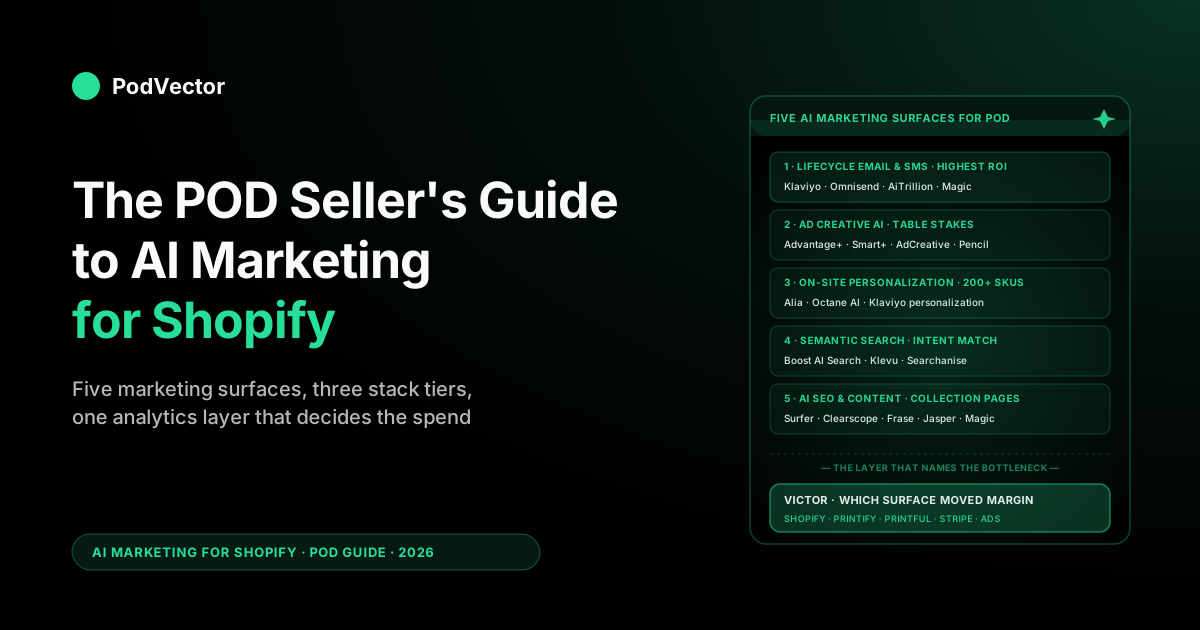
Quick Answer: AI marketing for Shopify in 2026 isn't one tool — it's five distinct surfaces: lifecycle email/SMS, AI ad creative, on-site personalization, semantic search, and AI SEO. A decision layer on top decides where the next dollar of spend goes.
For print-on-demand the math is tighter than the generic Shopify roundups admit. POD runs at 5–15% net per order, so a $79–$149/month tool has to lift conversion by half a point or add a couple of dollars to average order value — or it eats the margin from two or three orders every month.
Below: which surfaces actually pay back for POD, what to skip at each catalog size, the five mistakes that cost operators the most, and how to wire up margin-aware measurement so you know which surface moved the next dollar.
What "AI marketing for Shopify" means for POD specifically
"AI marketing for Shopify" reads like one workstream in the generic guides. It isn't.
The phrase covers at least five distinct surfaces — lifecycle email, paid-ad creative, on-site personalization, search and merchandising, and AI-assisted SEO — each with its own tools, its own ROI threshold, and its own failure modes. Most operator confusion comes from collapsing them into one budget line.
The thing the generic Shopify AI roundups miss is what makes POD different. Stocked DTC brands run at 40–60% gross margin and a single supplier; the math on a $99/month Klaviyo Personalization seat or a $149/month Octane AI quiz is simple — one extra order a week pays for the tool.
Print-on-demand operations run at 5–15% net per order across Printify, Printful, and Gelato, with item-level cost varying by base, by size, by region, and with refund variance that eats another point or two on top. A $149/month tool that lifts CVR by 0.3 points on a product whose net is $0.40 per order is losing the operator money every month — not because the tool doesn't work, but because the lift it produces is too small to clear the floor.
Three POD-specific realities the generic guides usually skip:
- The product feed is shared. You don't write your own product data by hand. Printify and Printful send it to Shopify on a schedule, and that data doesn't always line up cleanly with Shopify's AI marketing tools (or with the AI shopping tools your marketing is supposed to reach). Your marketing ends up working with whatever the supplier sync sends over.
- Margin is computed at the item level, not the order level. An AI tool that lifts a metric in aggregate without seeing item-level cost can recommend boosting a discount on a product whose net is already negative — and routinely does. Margin awareness has to live underneath the marketing layer, not next to it.
- The catalog moves faster than DTC. POD stores often add 5–20 new designs a week. AI marketing tools tuned for stocked catalogs (slow turnover, deep history per SKU) underperform on POD's "new SKU every Tuesday" cadence because their personalization models never accumulate enough signal per design.
These three constraints decide which AI marketing surfaces earn their seat for a POD store and which ones are theater. The rest of this guide walks the surfaces in priority order, then the stack recommendations by store size, then the measurement framework that tells you whether any of it worked. We've covered the broader category in the POD seller's guide to AI marketing for ecommerce; this piece zooms specifically into the Shopify-on-POD execution.
The five AI marketing surfaces that move POD margin
The AI marketing stack on Shopify in 2026 has converged into roughly five surfaces. They overlap in places — Klaviyo and Octane AI both touch personalization, AdCreative.ai and Pencil overlap on creative volume — but the categories are clean enough that an operator can budget against them.
1. Lifecycle email and SMS — the highest-ROI AI surface for POD
Lifecycle (welcome series, abandoned cart, post-purchase, re-engagement, win-back) is where AI marketing pays back fastest for POD operators, full stop. Klaviyo's predictive analytics, AI subject-line generator, and AI-driven send-time optimization typically lift email-attributed revenue 12–25% in the first quarter for a POD store that wasn't already tuning send time per profile.
Omnisend's AI flows are competitive at half the price for stores under 5,000 active subscribers; AiTrillion bundles personalization plus loyalty for a single seat fee. The mechanism is straightforward — AI looks at each subscriber's interaction history to find the moment they're most likely to engage, so emails go out at optimal times for maximum impact (Shopify's published numbers show 78% of top-performing stores use at least one AI tool, and lifecycle email is consistently the largest contributor).
What makes this surface POD-friendly: the unit economics work even on a 10% net margin. A $99/month Klaviyo seat that drives one extra $30 order a day clears the seat fee on day three of the month.
Lifecycle is the rare AI marketing surface where the floor is low enough that almost every POD operator past the first few hundred orders should turn it on. The only POD-specific tweak: feed item-level cost into the segmentation layer so the AI doesn't recommend a 25% off win-back discount on a product whose net is already $0.80. Most operators discover this after running the win-back flow for a quarter and seeing the campaign's revenue line up but the margin line down.
2. AI-assisted ad creative — table stakes, not advantage
Meta Advantage+, TikTok Smart+, Google's Performance Max, and the third-party platforms (AdCreative.ai, Pencil, Creatify) that auto-generate variant creative for high-volume creative testing. The conversion lift comes from running 30–100 creative variants per design instead of 4–8, with the ad platform's own ML deciding which to scale. For POD operators running paid acquisition, this is now a baseline expectation rather than a competitive edge — Meta and TikTok require Advantage+ creative for top-tier auction priority, and operators who skip it are paying 15–30% higher CPMs against operators who adopted it.
The differentiation has moved upstream into which designs get the creative-test budget. Running 60 ad variants on a design that converts at 0.6% loses money 60 ways; running them on a design with a 1.7% organic conversion rate scales.
That selection question is upstream of the AI ad creative tool and is where most paid-spend leakage happens in 2026 POD ad budgets. The selection tool is the analytics layer (covered in the complete guide to AI analytics for print-on-demand), not another ad creative seat.
3. On-site personalization — the conditional bet
Alia (popup intelligence), Octane AI (personalization quizzes), Klaviyo's personalization layer, and the popup/nudge category (Privy, Justuno) round out the third surface. These detect visitor behavior in real time and adapt the on-site surface — a returning visitor who looked at three Father's Day designs gets a different popup than a first-time visitor. The lift is real but the ROI threshold is conditional on catalog size.
For POD specifically, on-site personalization earns its seat once the catalog crosses roughly 200–300 active designs and the store has multiple gift occasions or persona segments worth personalizing toward. Below that, a well-built static popup performs nearly as well at a fraction of the cost.
Above it, the personalization layer compounds — a Father's Day visitor who's also bought a graduation gift gets personalized differently than one with no recent gift purchase, and the lift across both is 8–15% on average order value when wired up well. The 78% Shopify-store-AI-adoption number is roughly accurate here; what the headline misses is that for stores under 200 SKUs the AI-adoption flag is mostly Klaviyo and Shopify Magic, not full on-site personalization.
4. Semantic search and AI merchandising
Boost AI Search, Searchanise, Klevu — the category that replaces Shopify's default keyword search with an AI-powered semantic search that handles synonyms, intent matching, and natural-language queries. For POD specifically, the lift here is real because POD stores have a high "intent vocabulary mismatch" — a shopper searches "fishing dad" and your store has "Reel Cool Dad," "Hooked on Daddy," and "Best Catch Dad" but no listing literally called "fishing dad." Semantic search bridges the gap, often lifting search-led conversion by 15–35% when the catalog is design-heavy and titles are creative.
ROI threshold for POD: semantic search starts paying back once the catalog passes 200 SKUs and search-led sessions are 15%+ of total. Below that, Shopify's default search plus a smart synonym list does most of the same work for free. The decision rule we usually give operators: pull your search-to-add-to-cart rate from Shopify analytics, and if it's below 25% of category benchmark, semantic search is probably the bottleneck. If it's at or above benchmark, the marketing dollar is better spent on lifecycle or paid acquisition.
5. AI SEO and content generation
The fifth surface is AI-assisted content for organic acquisition — Surfer SEO, Clearscope, Frase for the SEO layer; Jasper, Copy.ai, and Shopify Magic for the writing layer. For POD operators, the highest-leverage AI SEO play in 2026 is collection-page content (gift guides, occasion roundups, niche pages) where AI handles the first draft and a human editor handles the design-specific framing. The reason: Shopify's collection pages historically rank for the "$type for $audience" queries that drive POD acquisition (e.g., "funny mugs for engineers"), and AI tooling makes it tractable to produce 30–80 well-targeted collection pages a quarter instead of 4–6.
The pitfall here is identical to the one covered in the POD seller's guide to AI writer for ecommerce: AI content that hallucinates supplier-truth fields (sizing, fabric, ship windows) generates chargebacks. The fix is the same — template the spec layer from the live Printify/Printful feed and let the AI handle everything else.
Operators who maintain that discipline routinely 3–5× their organic traffic over a year of disciplined AI-assisted content output. We've covered the AI SEO tooling specifics in the POD seller's guide to AI SEO for Shopify.
Two surfaces deliberately left off this list: AI chatbots for support (covered as a separate workflow in AI chatbot for Shopify: what it looks like for POD sellers) and AI image generation (more relevant to design production than marketing — covered in the POD seller's guide to AI image generators that integrate with Shopify). Both are real surfaces; neither is a marketing surface in the strict sense.
A POD AI marketing stack by store size
The right AI marketing stack scales with the catalog and the cadence, not with the budget. Three tiers we see in practice:
| Layer | Solo / <100 SKUs | Growing / 100–500 SKUs | Mid-market / 500+ SKUs |
|---|---|---|---|
| Lifecycle email/SMS | Shopify Email + Magic (free) or Omnisend free tier | Klaviyo ($99–199/mo) or Omnisend Standard | Klaviyo + Postscript SMS + AiTrillion loyalty |
| Ad creative AI | Meta Advantage+ (free in ads) | Advantage+ + AdCreative.ai ($29–49/mo) | Advantage+ + Pencil + in-house creative |
| On-site personalization | Skip — static popup is enough | Alia or Octane AI ($49–149/mo) | Klaviyo personalization + Octane AI |
| Search / merchandising | Default Shopify search + synonym list | Boost AI Search ($29/mo) | Klevu or Searchanise ($199+/mo) |
| AI SEO / content | Shopify Magic + manual editing | Surfer SEO + Magic + Jasper ($89–149/mo) | Surfer + Clearscope + content team |
| Analytics / decision layer | PodVector AI Victor (live warehouse) | Victor + Klaviyo segment AI | Victor + Klaviyo + dashboard layer |
| Total monthly | ~$0–80/mo | ~$200–500/mo | ~$800–2,500/mo |
The single most expensive mistake we see at every tier: skipping the analytics layer and buying tools further down the menu. A $149/month personalization quiz that fires on every visitor optimizes a number that may or may not matter; the analytics layer tells you whether the quiz interactions are correlated with margin-positive purchases or with refund-prone purchases.
Without that signal the quiz is theater. We've laid out the analytics architecture for POD specifically in the complete guide to AI analytics for print-on-demand.
The second most expensive mistake: buying tier-3 tools at tier-1 catalog size. A $199/month Klevu seat on a 60-SKU store optimizes a search experience that nobody is using because the catalog isn't deep enough to need semantic disambiguation. The decision rule scales with the catalog, not with the operator's optimism.
Five POD-specific pitfalls in AI marketing
Five mistakes we see repeatedly across POD-on-Shopify stores running AI marketing. Avoiding them is worth more than picking the "best" tool from each category.
1. Optimizing email revenue without optimizing email margin
Klaviyo's predictive segmentation can rebuild a win-back flow that drives a 30% lift in email-attributed revenue — by recommending 25–35% off discount codes that win the click. The catch for POD: the same discount can drop net margin per recovered order from $4.20 to –$0.30.
Email-attributed revenue goes up; net margin goes down. The fix is feeding item-level cost into the Klaviyo segmentation layer so the AI optimizes net contribution, not gross revenue. Most stores discover this only when running the quarterly review and seeing margin flat against revenue up 18%.
2. Running creative tests on the wrong designs
The Advantage+ / AdCreative.ai stack scales whatever you point it at. Pointed at a design with a 0.6% organic conversion rate, it scales 0.6%.
Pointed at a design with a 1.8% rate, it scales 1.8%. The decision of which design gets the creative-test budget is upstream of the AI tool and is where most paid-spend leakage happens.
We see operators routinely running 50-variant creative tests on designs the analytics layer would have flagged as "skip" — and the spend takes a quarter to claw back. The correct order: analytics first, design selection second, creative volume third.
3. Letting the AI rewrite supplier-truth fields
This is the AI marketing version of the writing-side pitfall covered in the POD seller's guide to AI writer for ecommerce. An AI tool that rewrites your sizing chart, fabric content, or shipping window in pursuit of "more compelling copy" can manufacture chargebacks at a rate that erases the marketing lift.
Every supplier-truth field has to stay templated from the live Printify or Printful feed; the AI gets the rest of the description, the lifecycle email body, and the ad headline — but never the spec layer. POD operators who maintain that discipline don't see refund or chargeback spikes from AI work; operators who don't typically see refund rates climb 1–3 points within a quarter.
4. Buying personalization before the catalog warrants it
The Octane AI quiz, the Klaviyo personalization seat, the Klevu enterprise search — these are all real ROI for the right catalog size and wasted spend below it. The threshold rule of thumb: 200+ active designs and 15%+ of sessions touching the relevant surface (search, popups, or quiz) before the personalization layer earns its seat. Below that, the marketing dollar earns more in lifecycle email, AI SEO, or paid ad creative volume.
5. Trusting the in-tool dashboard for attribution
Every AI marketing tool's dashboard claims credit for every conversion that touched it, and the totals across all the dashboards usually add up to 200–300% of actual revenue. A POD store running Klaviyo (with its own AI revenue line), Octane AI (with its own attributed lift), and Advantage+ (with its own ROAS reading) and summing them in a spreadsheet will conclude that AI marketing drove $48k in a $22k revenue month.
The fix is server-side, time-decay attribution living downstream of the tools — not a sum of in-tool dashboards. We covered the attribution mechanics in the POD seller's guide to AI for Shopify.
How to measure whether AI marketing moved margin
The hardest part of AI marketing for Shopify isn't picking the tools; it's attributing the lift. The measurement framework that works for POD has four signals, in priority order:
- Item-level net margin pre/post tool launch. Pull Printify/Printful cost feed plus Shopify revenue plus Stripe fees plus refund accrual, compute net per order, compare 30-day pre vs. 30-day post for the products the tool touched. CVR lift means nothing if margin per order dropped to compensate.
- Cohorted lifecycle email revenue. Klaviyo's revenue dashboard inflates because it counts assisted conversions broadly. The cleaner read is cohort-level: subscribers who entered the welcome series in a given week, their 60-day net contribution, compared across pre-AI-tool and post-AI-tool cohorts.
- Creative-test win rate, not creative-test volume. AdCreative.ai produces 60 variants; the metric is what fraction of variants beat the control on margin-per-impression, not on click-through. Most stores running creative AI for a quarter find the win rate is roughly the same as manual creative — the lift comes from running more tests, not from each test winning more often. Budget against that reality.
- Refund and chargeback rate as a canary. A revenue lift paired with a 2-point refund rate increase usually means the AI surface is over-promising on the product (sizing, ship window, fabric) and the chargebacks are absorbing the lift. Refund rate is the single most under-watched metric in POD AI marketing.
This is where Victor pays back. Victor is the AI employee who can manage your Meta Ads, Google Ads, Shopify catalog, and Printify and Printful orders, with your approval. He works from your store's real-time data, so he always acts on today's numbers, not old reports.
So before you wire up a $149/month personalization tool or a $199/month semantic search, he pinpoints which surface is actually bottlenecking the next dollar — lifecycle, creative, search, personalization, SEO — and, with your approval, moves the spend there instead of toward the bottleneck a tool's marketing page assumes you have.
After the tool goes live, Victor checks whether the extra sales actually turned into more profit per order — or got eaten up by refunds, ad costs, or higher supplier prices — and adjusts or pulls back the ad spend when it didn't. Because Victor reads your Shopify, Printify, Printful, and ad accounts live, he always works from today's numbers instead of numbers pieced together after the fact. We covered the pattern in the complete guide to AI analytics for print-on-demand.
The employee roadmap — what AI marketing looks like next
Today's AI marketing stack on Shopify is mostly recommendation AI — Klaviyo recommends a send time, AdCreative recommends a variant, Octane recommends a quiz path — and a human (or a Shopify Flow rule) executes the recommendation. The next wave is agentic: AI that doesn't just recommend but coordinates the execution across the marketing surfaces. The pattern worth naming explicitly because it shapes which tools to buy now and which to skip:
- Today: Victor runs the marketing optimization an operator would otherwise hand to an analyst plus an ops person — flagging which lifecycle flow is leaking margin, pausing the ad creative test that's a money pit, and fixing the collection page that's one structural change away from doubling its organic traffic, each gated behind your approval.
- On the roadmap: Victor coordinates with the marketing stack to execute the changes — pushing a corrected segmentation rule through Klaviyo, killing an underperforming ad creative test in Meta, swapping the popup priority in Alia, queuing a metafield correction in Shopify — all gated behind operator approval, all measured against item-level margin.
The lesson for picking tools: every tool you buy this year should connect easily to your other tools and share updates automatically. The real value going forward will come from tools working together, not from any single tool's own screen. Tools that lock you into their own dashboard give you a short-term boost but cost you flexibility later. We've covered this pattern in detail in agentic AI for ecommerce: what it looks like for POD sellers and the complete guide to AI agents for ecommerce analytics.
For background on how this connects to the broader Shopify AI roadmap, see the POD seller's guide to Shopify AI and the cluster's other angles at the AI overview cluster hub and the AI analytics topic hub. For a wider-angle view of what's working across the Shopify ecosystem, the Ringly roundup of the best AI tools for Shopify in 2026 and Shopify's own ecommerce AI marketing tools roundup cover the generic tool landscape; this guide covers the POD-specific economics underneath.
FAQs
What's the highest-ROI AI marketing surface for a small POD Shopify store?
For most stores under 500 SKUs: lifecycle email and SMS, full stop. Klaviyo's AI subject-line generator, predictive send-time, and predictive segmentation typically lift email-attributed revenue 12–25% in the first quarter, and the seat fee ($99–199/month) clears within the first week of any month past the first few hundred subscribers. The other surfaces (personalization quizzes, semantic search, ad creative AI) earn their seat at larger catalog sizes; lifecycle is the rare one that pays back at almost every scale.
Do I need to pay Shopify Plus to use AI marketing tools?
No. Shopify Magic, Shopify Email, Sidekick, and Inbox are included in every plan, as are the connectors for Klaviyo, Omnisend, Octane AI, AdCreative.ai, and the major paid-ad AI surfaces (Meta Advantage+, TikTok Smart+, Google Performance Max). Plus adds Shopify Flow for triggered automations and a few governance features but isn't a prerequisite. The AI marketing economics work on every plan.
How much should a POD operator budget for AI marketing tools?
Three rough tiers: $0–80/month for solo stores under 100 SKUs (Shopify Email + Magic + Meta Advantage+), $200–500/month for growing stores with 100–500 SKUs (add Klaviyo + Surfer + Boost AI Search + a personalization or quiz seat), $800–2,500/month for mid-market stores with 500+ SKUs (Klaviyo + Klevu + Octane + Pencil + Surfer + dashboard layer). The analytics layer (Victor or equivalent) sits across all three tiers and is the prerequisite for the other spend to pay back.
Will AI marketing tools cause refunds or chargebacks?
Only if you let them rewrite supplier-truth fields — sizing, fabric, shipping windows, color accuracy. The fix is templating the spec layer from the live Printify or Printful feed and letting the AI handle everything else (subject lines, body copy, popup messages, ad headlines).
POD operators who maintain that discipline don't see refund or chargeback spikes from AI marketing. Operators who let the LLM hallucinate sizing details typically see refund rates climb 1–3 points within a quarter, which can erase the AI marketing lift entirely.
What's the difference between Klaviyo and Shopify Email for POD lifecycle?
Shopify Email + Magic is free, handles the welcome series and abandoned cart at competent quality, and is the right starting point for stores under roughly 1,000 active subscribers. Klaviyo's advantage is predictive segmentation (knowing which subscribers to target with which message and when) and a wider integration surface — at scale, Klaviyo lifts email-attributed revenue 15–30% over Shopify Email's defaults. The crossover point is usually somewhere between 1,500 and 3,000 active subscribers; before that, Shopify Email + Magic is the correct call.
How does AI marketing for POD differ from AI marketing for stocked DTC?
Three things. (1) Margin is computed at the item level rather than the SKU level — a "Father's Day Funny Dad" design has different net per order in size XL versus 2XL, on a Bella+Canvas base versus a Gildan base, shipping to California versus to Germany. AI tools that optimize on aggregate metrics miss this. (2) The catalog moves faster — POD stores add 5–20 designs a week, so personalization models that need months of per-SKU history underperform. (3) The product feed is shared with Printify or Printful, so the AI marketing layer inherits whatever the supplier sync produces rather than writing it.
Can AI marketing tools help with Printify and Printful product photography?
The "AI marketing" framing usually means lifecycle, ads, personalization, search, and SEO — product photography is upstream of marketing in a stocked DTC sense but lives differently in POD because the supplier produces the mockups. Tools like Photoroom and Pixelcut can clean and re-style supplier mockups for ad creative use, which lifts ad CTR meaningfully when the default supplier mockups look generic. We've covered the image-generation tooling separately in the POD seller's guide to AI image generators that integrate with Shopify.
How do I know whether an AI marketing tool actually moved margin?
Four signals, in priority order. (1) Item-level net margin pre/post tool launch — pull Printify/Printful cost plus Shopify revenue plus Stripe fees plus refund accrual, compare 30-day windows. (2) Cohorted email revenue, not aggregate (Klaviyo dashboards inflate). (3) Creative-test win rate, not test volume (more tests doesn't mean more winners). (4) Refund and chargeback rate as a canary — revenue up + refunds up usually means the AI is over-promising on the product. The combination is what tells you whether the lift was real.
Is Shopify Magic enough on its own for AI marketing?
Magic is broader and cheaper (free) but shallower than the specialized tools. It handles draft generation across product copy, blog posts, FAQ blocks, and email campaigns competently — but it doesn't run predictive send-time, doesn't handle on-site personalization, doesn't run multi-variant ad creative testing, and doesn't do semantic search. The pattern that works: turn Magic on (every store should), use it for the breadth, then layer specialized third-party tools on top of the specific bottlenecks Magic doesn't cover.
What's coming next in AI marketing for Shopify?
By 2026, AI tools won't just suggest a send time or a creative idea. They'll take action across your whole marketing setup, but only after you say yes. Today's tools give you suggestions. Tomorrow's tools will update a Klaviyo flow, pause a weak Meta ad set, update a Shopify listing, and then wait for your approval before anything goes live. The lesson for picking tools now: choose ones that connect easily with your other tools instead of locking you into their own screen, because working together is where the next round of value will land.
Spend the AI marketing budget on the bottleneck that actually exists
Every AI marketing tool in this guide earns its seat only when the bottleneck it solves is the one your POD store is currently hitting. PodVector AI's Victor is the agentic AI employee that sits on top of your live Shopify, Printify, Printful, and ad-platform data and tells you which surface is leaking margin, which lifecycle flow is over-discounting, which ad creative test is a money pit, and which AI tool to roll back — then, with your approval, reallocates the spend and updates the catalog so the next dollar of AI marketing budget goes to the work that moves the next dollar of net margin.
Try Victor free