
Quick Answer: AI personalization for ecommerce is the use of machine-learning models to tailor recommendations, on-site search, email/SMS, ad creative, and on-site content to each visitor's predicted intent in real time — and in 2026 that stack is extending into conversational AI shopping assistants and agentic, hyper-personalized decisioning that acts without a marketer defining segments first. For a POD seller, most of the famous Amazon/Sephora/Stitch Fix case studies don't transfer, because they assume catalog density and repeat-buyer profiles a POD store doesn't have. The realistic POD budget is under 1% of revenue: Klaviyo for triggered email, the native or low-cost Shopify recommendation and search layer, niche-specific landing pages, and a margin-aware data foundation that tells you whether any of it is moving profit instead of just lifting vanity conversion rate.
What AI personalization for ecommerce means in 2026
Personalization in ecommerce used to mean inserting a first name into a subject line and showing a "recommended for you" widget at the bottom of the cart. In 2026 the bar is much higher. Across Braze's ecommerce-personalization guide, Bloomreach's AI personalization examples, and Netguru's AI personalization breakdown, the consensus definition is the same: AI personalization is the use of machine-learning models to tailor merchandising, search, content, email, and ad creative to the predicted intent of an individual session, in real time, without requiring a marketer to define static segments in advance. The 2026 versions of these guides go a step further, framing the frontier as hyper-personalization — agentic AI that resolves identity across channels and adapts the experience moment to moment rather than on a daily batch, increasingly fronted by a conversational AI shopping assistant.
The reported numbers from those sources are striking: 15–25% higher conversion rates than generic experiences, five-to-eight-times return on marketing spend, 92% of organizations now exploring AI for personalization, and 76% of shoppers frustrated when personalization misses. The case studies are just as eye-catching — Yves Rocher reporting an 11x purchase rate from AI recommendations over top-seller widgets, Benefit Cosmetics lifting email revenue 40%. Those numbers are real for the brands they describe — inventoried catalogs with high repeat-purchase rates, 50%+ gross margins, and the staffing to run dedicated personalization platforms costing $30K–$200K per year.
For a POD seller, the question isn't whether AI personalization works. It does.
The question is which parts work at POD economics, which parts are a tax that doesn't pay back, and how to assemble a personalization stack at a small fraction of the cost the SERP recommends. We covered the broader AI ecommerce frame in the POD seller's guide to AI for ecommerce; the full AI overview cluster sits underneath the broader AI analytics topic. This guide narrows specifically to the personalization slice.
The five personalization layers (and how each one bends for POD)
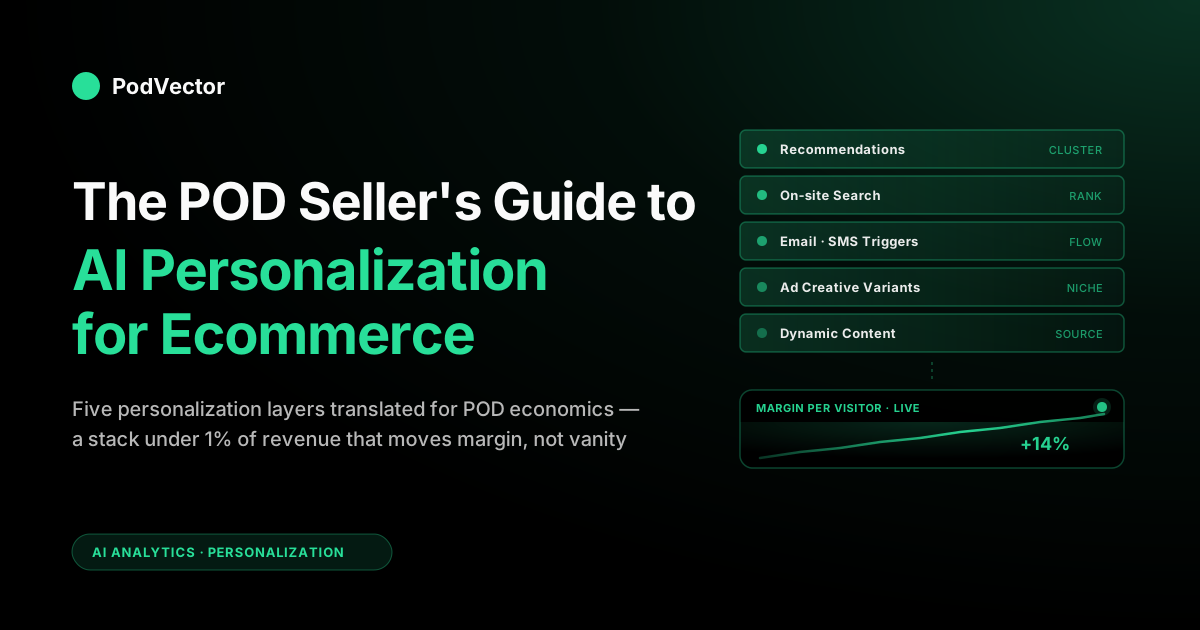
Every comprehensive personalization article eventually breaks the discipline into a layered stack. The labels vary; the layers are consistent. Here's the standard five-layer model and how each layer behaves in a POD context, where you have tens of thousands of designs, mostly one-time buyers, and 20–35% margins.
1. Recommendation engines
The recommendation engine is the layer most people picture when they hear "ecommerce personalization." It ranks products on the homepage, the product page, the cart, and the post-purchase upsell. The dominant approach in mainstream ecommerce is collaborative filtering — "customers who bought X also bought Y" — which depends on each SKU having enough sales history for the model to find statistical neighbors.
This is exactly where POD breaks. A typical POD catalog has 5,000–50,000 listings where most designs sell 0–10 units a month.
Collaborative filtering on a sparse catalog produces noisy recommendations or gives up and falls back to bestsellers, which defeats the personalization premise. The architecture that works for POD is content-based filtering at the design-cluster level — group designs by visual style, niche, and theme, then recommend within the cluster the visitor is engaging with.
Shopify's native Search & Discovery, LimeSpot, and Rebuy can be configured to do this if you tag designs with niche and style metadata. We dug deeper into the underlying analytics shape in the complete guide to AI analytics for print-on-demand.
2. Personalized on-site search
Visitors who use the search bar convert at 2–5x the rate of visitors who don't. That makes search ranking one of the highest-leverage personalization layers and one of the most underused by POD sellers.
Default Shopify search ranks alphabetically or by recency. AI search ranking learns which results visitors click and converts on, then re-ranks future searches by predicted intent — so a visitor who landed from a Pinterest pin about minimalist art sees minimalist designs first when they search "shirt," not whatever was uploaded most recently.
The vendor list here is short: Algolia, Searchspring, Bloomreach, and the upgraded Shopify Search & Discovery. For a POD store under $1M ARR, the native option is sufficient if you set up synonyms and boost rules tied to your top niches.
The lift is real even at this baseline — 15–30% improvement in search-converter rate is the typical reported range. We compared the broader AI search-tools landscape in best AI search analytics tools for ecommerce.
3. Email and SMS personalization
This is the layer where POD economics actually align with the SERP's case studies. Klaviyo, Omnisend, and Attentive personalize subject lines, hero images, and product blocks based on the recipient's recent activity. The triggered-flow numbers — post-purchase, abandoned-cart, browse-abandonment — are the same in POD as they are in DTC, which makes this the highest-ROI personalization layer for a POD seller.
The POD-specific twist is that you should anchor flows to design metadata rather than SKU. A buyer who bought a "minimalist mountain line-art" tee shouldn't get a follow-up email recommending another mountain design — they probably already own one — but should get cluster-adjacent designs in the same style or niche. Klaviyo's product feeds combined with collection-level segmentation handle this if your collections are tagged by style and niche.
4. Ad creative personalization
AI personalization at the ad layer means generating multiple creative variants from a single source design, then letting the ad platform's optimizer route each variant to the audience it converts best with. For an inventoried brand, this might mean different photo treatments of the same SKU. For a POD brand, it usually means different niche-specific hero designs presented to different audiences — a teacher-themed design to teacher-affinity audiences, a nurse-themed design to nurse-affinity audiences — driven from the same campaign infrastructure.
Tools like Pencil, AdCreative, and Foreplay automate this generation. In-house GPT/Claude workflows do the same job for stores already comfortable with prompt-driven content. The lift is real but uneven — campaigns running 4–8 niche-specific variants typically outperform single-creative campaigns by 15–40% on cost per purchase, with most of the gain coming from the audience-creative match rather than from the AI generation itself.
5. Dynamic content and landing pages
The fifth layer is the on-site content visitors see — homepage hero, featured collections, navigation, even copy tone. Mainstream personalization platforms like Dynamic Yield, Bloomreach, and Optimizely handle this for enterprise brands. For a POD seller, the budget version is URL-parameter routing combined with collection-specific landing pages: a Pinterest pin about minimalist art links to /collections/minimalist?utm_source=pinterest, which renders a hero featuring minimalist designs and a curated grid below.
This is the layer where the gap between the SERP's recommendations and POD reality is widest. The SERP recommends $4K–$16K/month enterprise platforms.
The realistic POD answer is good URL-routing hygiene plus 8–15 niche-specific landing pages built directly in your theme. The lift from doing this well is 10–25% on session conversion — meaningful, but achievable without an enterprise platform contract.
Famous case studies — and which ones actually translate to POD
Every personalization guide leans on the same handful of case studies. Most of them are misleading for POD because the structural assumptions don't hold. Here's the honest translation of the cases the SERP keeps citing.
Amazon's recommendation engine
Amazon's recommendation engine is the canonical case for collaborative filtering at scale. It works because Amazon has millions of SKUs, billions of purchase records, and decades of customer profiles.
None of that translates to POD. The lesson POD sellers should take from Amazon is not the algorithm but the metric — Amazon optimizes for predicted profit per recommendation, not predicted purchase probability. Bring that thinking to your POD recommendations and you'll outperform stores that optimize for clicks.
Sephora's Color iQ and AI beauty matching
Sephora's personalization is built on visual and physical attributes — skin tone, lip shape, hair texture — matched to product attributes. Beautiful case study; almost zero relevance to POD.
The transferable principle is that visual matching beats behavioral history when behavioral history is sparse. For POD that translates to design-style clustering: group by visual attribute (minimalist, illustrated, typographic), then recommend within the cluster a visitor is engaging with. That's the practical Sephora lesson for POD.
Netflix's content-based recommendations
Netflix is the closest mainstream analog to POD. Sparse catalog metadata isn't the issue — Netflix has rich content tags.
But Netflix recommends within taste-clusters (people who like this kind of show) rather than purchase-history neighbors, because subscription viewing isn't a purchase signal in the same way. POD personalization has the same shape: a visitor who clicks five minimalist designs is signaling taste, and the recommendation engine should reinforce that taste rather than try to cross-sell into a different aesthetic. Netflix's content-based approach is the architecture POD should copy.
Stitch Fix's curation model
Stitch Fix is underused as a POD reference and probably the closest fit. Stitch Fix combines algorithmic recommendation with human curation, optimizing for fit, taste, and budget per customer.
POD sellers can borrow the principle without the staffing — use AI to pre-cluster designs, then let your editorial collections (curated drops, themed collections, niche-specific pages) carry the personalization weight. The result is a store that feels curated to the niche the visitor came in through, without per-visitor manual curation.
ASOS, Wayfair, Nike
These three keep showing up in personalization guides with impressive conversion-lift numbers. Their relevance to POD is small.
ASOS has a fashion catalog with rich attribute metadata and millions of repeat customers; Wayfair has high-AOV, high-consideration purchases; Nike has brand equity that lets them personalize without losing identity. None of these structural advantages applies to a POD store. Read these case studies as directional inspiration, not as templates.
The honest pattern
The personalization wins that translate to POD share three properties: they work on session-1 visitors with no purchase history; they reinforce niche identity rather than cross-selling across niches; and they optimize for margin per visitor rather than conversion rate. Cases that share those properties (Netflix's content-based filtering, Stitch Fix's curation model, Sephora's visual matching as principle) translate. Cases that don't (Amazon's collaborative filtering, ASOS's catalog density advantage) don't.
A realistic personalization budget for a POD seller
Generic guides recommend platforms that price between $30K and $200K per year. For a POD store under $5M ARR that math doesn't work and probably can't be made to work even with optimistic conversion-lift assumptions. Here's the realistic budget by revenue tier.
Under $250K ARR
Total personalization tooling: $0–$200/month. Klaviyo's free tier or a starter plan handles email triggers. Native Shopify Search & Discovery handles search and recommendations. Landing-page personalization is URL-parameter routing built into the theme. Ad creative personalization is in-house Claude or GPT workflows. Skip every paid personalization platform at this stage; the math is unambiguous.
$250K–$1M ARR
Total personalization tooling: $200–$700/month. Klaviyo paid tier ($150–$400/month depending on list size).
Optional addition of LimeSpot or Rebuy for design-cluster recommendations ($60–$200/month). One ad creative tool — Pencil, Foreplay, or AdCreative — at $50–$200/month.
Still no enterprise personalization platform. The biggest unlock at this stage is a profit-attribution layer that tells you which of these tools is actually moving margin.
$1M–$5M ARR
Total personalization tooling: $700–$2,500/month. Klaviyo at the higher tier with SMS.
A more capable recommendation engine (Nosto or Searchspring entry level). Mutiny or a comparable landing-page personalization tool if you have meaningful paid traffic to differentiate.
The economics start to support $1K/month tools because the absolute margin lift now justifies them. Resist enterprise platforms until you have hard evidence that the existing stack has plateaued.
Above $5M ARR
Total personalization tooling: $2,500–$8,000/month. Now the math on Bloomreach, Dynamic Yield, or Optimizely starts to make sense, but only if you've earned it — meaning the lower-cost stack has been validated and is plateauing. Most POD brands at this scale are still better served by upgrading their analytics layer (so they can attribute personalization lift to margin) than by upgrading the personalization platform itself.
What's missing from every tier
None of these tiers includes a separate "AI personalization platform." That's deliberate. The personalization-as-a-platform category is built for inventoried brands with $50M+ revenue.
POD-scale personalization is assembled from purpose-built apps (Klaviyo, native Shopify, ad creative tools) plus an analytics foundation that proves which of them is earning its keep. Spending on a platform before that foundation is in place is the most common expensive mistake we see.
Privacy, consent, and personalization without behavioral history
Personalization assumes data; data is increasingly constrained. iOS tracking changes, GDPR and CCPA enforcement, browser cookie deprecation, and the shift to AI Overview-mediated discovery all reduce the behavioral data POD sellers can rely on. The SERP's enterprise case studies dance around this; for a POD store it's central.
The practical answer is to lean into first-party signals you already have and don't need to ask permission for. Referrer (where the visitor came from), landing page (what they clicked into), in-session behavior (what they're looking at right now), and email engagement on opt-in subscribers are all first-party and consent-clean. Most POD personalization should be built on these signals rather than on cross-site behavioral profiles.
The bigger privacy decision is around AI training. If you're using a third-party personalization platform that trains on your visitor data and pools it across customers, you're exporting your niche-affinity moat for free. Read the data-usage clause carefully — particularly for free-tier recommendation tools, which often pay for themselves by training on aggregated catalog and behavior data.
A 90-day implementation plan
Most personalization rollouts fail because operators try to ship five layers at once and end up with five half-configured systems and no clear lift signal. The order that works for POD:
Days 1–30: Email triggers
Set up four triggered Klaviyo flows: post-purchase (with cluster-adjacent design recommendations), abandoned cart (with the actual design abandoned plus one cluster-adjacent suggestion), browse abandonment (visitors who viewed but didn't add), and a niche-affinity welcome series for new subscribers. Tag your collections by niche and style first; the flows depend on it. Expected lift: 15–30% in email revenue per send within 30 days, the highest-ROI thing you'll ship.
Days 30–60: On-site search and recommendation
Configure Shopify Search & Discovery with synonyms, boost rules per top niche, and metafield-driven sort. Add design-cluster product recommendations to product pages (you can do this with native blocks or with LimeSpot/Rebuy).
Don't add anything else; let the data accumulate. Expected lift: 10–20% on search-converter rate and 5–15% on product-page add-to-cart rate.
Days 60–90: Ad creative and landing pages
Generate niche-specific ad creative variants for your top three audiences using Pencil, AdCreative, or in-house Claude workflows. Build niche-specific landing pages that match your top three referrer sources (Pinterest, Meta, organic).
Wire up URL-parameter routing so paid traffic lands on the matching collection. Expected lift: 10–25% on session conversion and 5–15% on cost per purchase.
What to skip in the first 90 days
No enterprise personalization platform. No "1:1 hyper-personalization" experiments. No predictive lifetime value modeling. These can all come later if the foundational layers prove out. Most POD operators who go straight to the advanced tier never get the foundational tier working, and the foundation is where 70%+ of the realistic lift lives.
Where this is going: agentic personalization
The shift the SERP describes — from rule-based to ML-driven personalization — is already moving into its next phase. Enterprise platforms like Braze and Bloomreach now ship agentic personalization: autonomous decisioning agents and conversational AI shopping assistants that test, route, and adapt without a marketer defining segments first. The next shift, in other words, is from ML personalization that recommends to agentic personalization that acts — and for enterprise brands it's here today. For POD it's mostly still roadmap, because the margin-aware data foundation that should govern an autonomous agent isn't in place yet.
Today, a personalization model surfaces a recommended product; you (or your team) decide whether to feature it on the homepage, write the email, build the ad creative, pause the underperforming variant. Tomorrow, an agent does each of those steps autonomously, within boundaries you set.
For POD specifically, agentic personalization will likely look like:
- An agent that watches conversion by traffic source and rewrites the landing page hook when CTR decays.
- An agent that detects a niche surge (sudden interest in a specific theme from a specific audience) and queues design generation, supplier-cost check, and ad creation in one move.
- An agent that personalizes post-purchase upsells based on observed margin per design family — not just sales volume — and updates the recommendation logic when the margin profile shifts.
- An agent that pauses personalization itself when its lift drops below the cost of running it.
That's the trajectory PodVector AI is on. Today, Victor sits in the answers tier — you ask "which audience segments converted best on Meta last week, broken out by design style, net of supplier and ad cost?" and Victor looks at your orders, supplier costs, ad spend and fees all together, then gives you the answer.
Tomorrow's roadmap is the action tier: pausing the underperforming variant, drafting the next creative, queuing the personalized email send. Same "answers now, actions next" pattern the broader AI agent space is converging on, applied to POD-specific personalization decisions. We covered the agent-action layer in detail in agentic AI for ecommerce: what it looks like for POD sellers.
Personalization mistakes that cost POD sellers money
Optimizing personalization for revenue, not margin
Most off-the-shelf recommendation engines rank by predicted purchase probability or predicted revenue. For POD that's the wrong objective: a recommendation can lift conversion while pushing buyers toward lower-margin designs.
The right objective is predicted margin contribution — purchase probability multiplied by margin per design. The gap between the two can be 5–10 margin points on a high-volume catalog.
Cross-niche recommendations that erode brand identity
A visitor on your dad-joke tee store doesn't want to see your golf-themed designs because some collaborative filter found correlation. Cross-niche recommendations look smart on the dashboard and damage long-term niche affinity, which is the moat in POD. Constrain recommendations to the niche the visitor entered through — explicitly, in the recommendation logic.
Buying enterprise platforms before having profit attribution
If you don't know whether a personalized recommendation drove a profitable order or an unprofitable one, you can't tell whether the personalization platform is helping. Wire up itemized supplier costs, payment fees, and ad-spend attribution before you sign a $48K/year personalization contract. We covered the analytics requirements in AI for ecommerce analytics: what it looks like for POD sellers.
Using generic ecommerce case-study numbers as your own forecast
"Sephora lifted conversion 20% with personalization" is true and almost entirely irrelevant to a POD store with 12% repeat-purchase rate and 25% margins. Discount third-party case studies that don't share the structural constraints of POD economics. Run your own A/B test before forecasting from someone else's number.
Forgetting that personalization tools have a cost-of-running
A personalization platform that costs $1,200/month and lifts conversion 8% on $80K monthly revenue with 25% margins adds $1,600 in margin and costs $1,200 — net $400/month. Possibly worth it; not the runaway win the SERP suggests. Always run the math at your scale and your margin profile, not the case study's.
Skipping the content-tagging foundation
Cluster-based personalization assumes your products are tagged with style, niche, theme, and occasion metadata. Most POD stores have product titles and a single collection assignment. The recommendation engine can't cluster what you haven't tagged. Two days spent on a tagging taxonomy is a higher-ROI investment than any personalization platform you can buy.
FAQs
What's the single highest-leverage AI personalization use case for a POD store?
Triggered post-purchase email flows tied to the design the buyer just bought, with cluster-adjacent recommendations in the same niche and style. Highest revenue per send, lowest infrastructure cost, works with the analytics most POD stores already have, and isn't constrained by the catalog-density problem that breaks on-site recommendations. If you ship one personalization thing in the next 30 days, ship this.
Can I do AI personalization without paying for a dedicated platform?
Yes, and most POD stores under $1M ARR should. Klaviyo's segmentation and triggered flows handle email personalization. Native Shopify Search & Discovery handles search and on-page recommendations adequately. URL-parameter routing handles landing-page personalization. Pencil, AdCreative, or in-house Claude workflows handle ad creative variants. The "personalization platform" category is for $50M+ inventoried brands.
How do I personalize when most visitors are first-time buyers?
Use first-party session signals instead of customer profiles. Referrer (where they came from), landing page (what they clicked into), and in-session behavior (what they're looking at right now) give you enough to drive content-based personalization without a behavioral history. This is one of the structural advantages of content-based filtering over collaborative filtering for POD.
Does personalization conflict with niche brand identity?
It does if you let cross-niche recommendations run unchecked. Generic recommendation engines try to maximize click-through, which often means recommending across niches when correlations show up in the data.
The fix is to constrain personalization to the niche the visitor entered through and let the algorithm optimize within that constraint. Niche-narrow personalization reinforces identity; cross-niche personalization erodes it.
What's the realistic conversion lift I should expect from AI personalization?
For a POD store implementing the foundational stack (email triggers, native search and recommendation, niche-specific landing pages), 8–18% lift on session conversion and 25–60% lift on email revenue per send are realistic ranges within 90 days. The SERP's 25%+ conversion-lift numbers are achievable but typically take 6–12 months and assume a deeper data and tooling foundation than most POD stores have on day one.
Do AI shopping assistants and chatbots count as personalization for POD?
They're the fastest-growing personalization surface in the 2026 guides — conversational AI that answers "show me minimalist gifts for a teacher under $30" and assembles a personalized result on the fly. For POD the value is real but secondary to email and search: a shopping assistant only personalizes well if your designs are tagged by niche, style, and occasion, the same content-tagging foundation every other layer depends on. Add it after the foundational layers are working, not before, and constrain it to the niche the visitor entered through so it reinforces identity instead of cross-selling across niches. We covered the conversational layer in conversational AI chatbot for ecommerce: what it looks like for POD sellers.
Is "hyper-personalization" different from regular AI personalization?
Hyper-personalization is the 2026 marketing term for agentic, real-time personalization that resolves a visitor's identity across channels and adapts the experience moment to moment instead of on a daily batch. It's a genuine capability in enterprise platforms — and almost entirely overkill at POD scale on day one. The POD version is narrower and cheaper: first-party session signals (referrer, landing page, in-session behavior) driving content-based personalization within the niche the visitor came in through. Get that working before paying for anything labeled "hyper."
How does AI personalization interact with AI Overview and ChatGPT search visibility?
They're different disciplines. AI Overview optimization is about getting cited by ChatGPT, Google AI Mode, and Perplexity in the answer rather than the result list; AI personalization optimizes the experience visitors have once they arrive.
The connection is that AI-Overview-cited traffic tends to be high-intent and benefits disproportionately from a personalized landing experience that matches the citation context. Cited well + personalized well compounds.
Should I use generative AI to write personalized product descriptions?
Yes, with constraints. The right pattern is to generate two or three description variants per design — a sentimental tone, a humorous tone, an aspirational tone — and route each variant by visitor signal (referrer, landing collection, paid audience).
Generating one description per visitor is overkill and tends to produce uneven brand voice. The two-or-three-variant pattern captures most of the lift with manageable QA. We covered the broader content angle in the POD seller's guide to generative AI for ecommerce.
What's the relationship between personalization and customer lifetime value for POD?
Personalization mostly increases first-purchase conversion and average order value; it has a smaller direct effect on POD lifetime value because POD repeat rates (8–18%) are structurally lower than DTC (25–45%). Where personalization does boost POD LTV is on the niche-affinity dimension — buyers who feel the store is curated to their niche return more often within their niche, which compounds slowly over a year. Don't expect LTV transformations in the first 90 days.
Where does Victor fit in a POD personalization stack?
Victor sits underneath every personalization tool, reading your live Shopify, supplier, and ad data. Klaviyo can run triggered flows; Victor tells you which flows actually moved margin and which moved vanity revenue.
Your recommendation engine can lift conversion; Victor tells you whether the lift was on profitable designs or low-margin ones. Personalization without margin-aware analytics is faith-based; the analytics layer is what turns it into a real business decision. We benchmarked the broader analytics-tools category in best AI tools for ecommerce data analysis.
Stop personalizing on faith. Personalize on margin.
Victor reads your live Shopify, Printify or Printful, and ad-account data, then answers margin-aware questions about which audiences, designs, and creative variants are actually profitable — the analytics foundation any serious POD personalization stack needs. Victor doesn't just answer, either: with your approval, he can also make changes in your Shopify store, Google Ads, Meta Ads and Klaviyo. And start with real answers instead of a recommendation widget.
Try Victor free