
Quick Answer: The best AI for a Shopify store depends on your business model. For print-on-demand, the right stack runs in this order: profit/operations AI first, creative AI second, customer-facing chat last.
If you don't have a store yet, "AI for Shopify" now also means AI store builders — Shopify's own AI Store Builder generates three complete store layouts from a few keywords, and third-party tools like BuildYourStore.AI, PagePilot.ai, Atlas, and Storebuild.ai spin up a storefront in minutes. Those are a launch-day convenience, not a P&L lever; once your store exists, the leverage moves to operations and creative AI. This guide is written for the store you already run.
That's the opposite of most "AI for Shopify stores" roundups, which list the same 7–10 generic tools — Shopify Magic, Jasper, Klaviyo, Tidio, Gorgias, Triple Whale, Surfer — in an order written for wholesale brands that hold inventory.
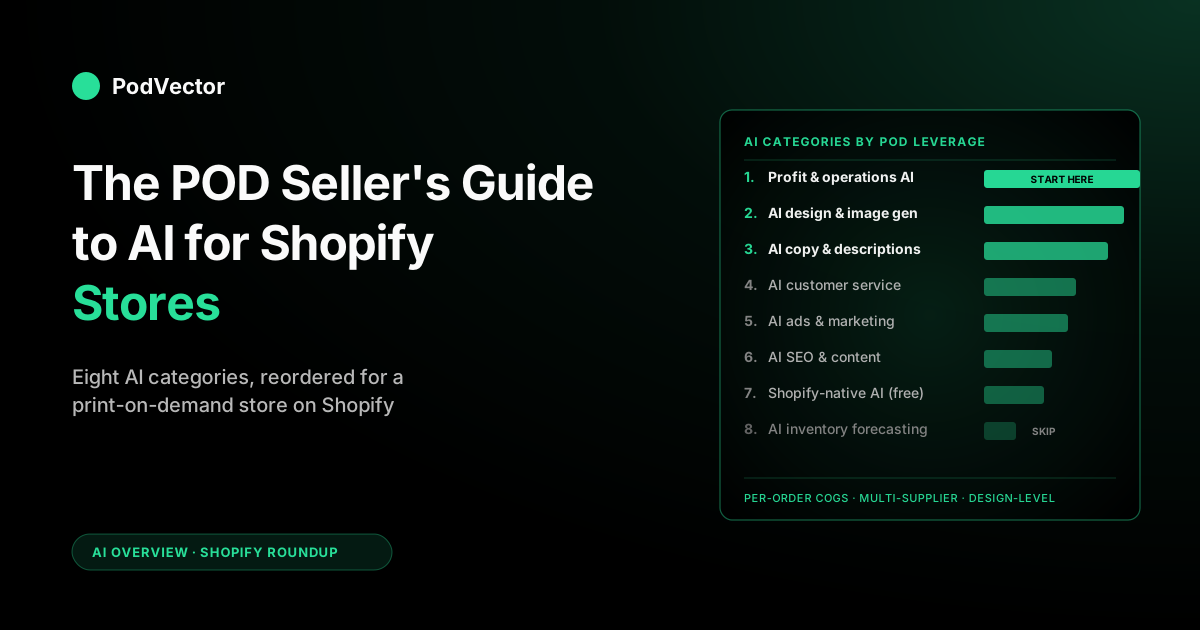
For a print-on-demand store, the order matters more than the list: profit/operations AI first (because POD's per-order COGS is where margin leaks), then creative AI (because designs are SKUs and AI changes cost-per-test 5–10x), then customer-facing AI last (because most POD storefronts are conversion-capped by traffic quality, not chat widgets). This guide walks every category in that order, names the tools that actually fit POD on Shopify, and flags the ones that are wholesale-DTC-by-analogy.
Why generic "AI for Shopify" lists fail POD operators
Search "AI for Shopify stores" and you'll find the same shape of article over and over: a roundup of 7 to 10 tools, usually starting with Shopify Magic, ending with a Klaviyo or Triple Whale slot, and treating every Shopify store as if it were a DTC brand holding inventory. The roundups themselves are well-researched.
They're just written for the wrong reader. POD is a different kind of Shopify store, and the tool order changes when the underlying business model changes.
Three things make a POD store on Shopify different from the average DTC store these tool lists are written for:
- Per-order COGS, not per-SKU. Your supplier cost is calculated per order from Printify or Printful, not stored as a unit cost field on the product. AI tools that ask you to type in a COGS estimate during onboarding are giving you fictional numbers from minute one.
- Designs are the SKUs. A working POD store has hundreds or thousands of designs, each on multiple product types and colors. The combinatorial volume is where AI's leverage actually lives, but generic tools weren't built for it.
- Two suppliers, not one. Most operators run Printify and Printful in parallel and route products by geography or product type. None of the generic "AI for Shopify" tools model a multi-supplier fulfillment graph.
Those three facts reorder the priority of every category below. Operations AI is the highest-leverage starting point for POD, not customer-facing chat.
Creative AI matters more for POD than for almost any other Shopify business model, because the design is the SKU. And inventory forecasting, the headline of every generic guide, is mostly noise — you don't hold inventory.
The eight AI categories that actually matter for a POD Shopify store
Every "AI for Shopify" tool falls into one of eight buckets. The order below is the order an operator should evaluate them in — highest leverage for POD first, lowest leverage last. Generic guides usually invert this list because they optimize for what storefront brands ask about, which is chat and recommendations.
- Profit & operations AI — the highest-ROI category for POD. Margin visibility, attribution, supplier cost reconciliation.
- AI design and image generation — Midjourney, Firefly, Photoroom. Design is the SKU; this category is creative leverage.
- AI copywriting and product descriptions — ChatGPT, Jasper, Copy.ai. Volume copy at near-zero marginal cost.
- AI customer service and on-site chat — Tidio, Gorgias, Shopify Inbox. Useful, table-stakes, lower transformation potential.
- AI ad creative and marketing automation — Klaviyo, Meta Advantage+, AdCreative.ai. Volume of creative variants tested.
- AI SEO and content — Surfer SEO, Clearscope, Frase. Demand-capture for evergreen design themes.
- Shopify-native AI features — Magic, Sidekick, Inbox. Free, included, useful for the basics.
- AI inventory and forecasting — Inventory Planner and similar. Mostly irrelevant to POD; noted for completeness.
1. Profit & operations AI (start here)
This is the category that generic "AI for Shopify" guides bury near the bottom and that POD operators should start with. The reason is simple: POD's variable cost per order is high (supplier + shipping + Shopify fees + payment processing + ad spend), the margins are thin, and the only way to know which designs and campaigns are actually profitable is to read all four cost layers in real time.
Tools that do that for POD are scarce. Tools that ask you to enter a COGS field manually are not in this category, no matter what their marketing claims.
What to look for
- Direct API integration with both Printify and Printful for itemized per-order supplier costs.
- Reconciliation against Shopify orders (revenue), Shopify fees, payment processing, and ad spend (Meta, TikTok, Google).
- Design-level profitability — not just store-level.
- Live data, not weekly batch reports.
- Natural-language interface for ad-hoc profit questions ("which designs lost money last week after fulfillment and ads?").
The contenders
Triple Whale is the most common name in this category, and a lot of POD operators try it first because it shows up in every generic roundup. The honest read: it's built for DTC brands holding inventory.
It will give you an attribution view across ad platforms, but its COGS and supplier-cost handling are designed for unit-cost models, not for per-order Printify or Printful invoices. Useful if you're already a Triple Whale customer; not the starting point for POD-specific profit visibility.
Lifetimely and Polar Analytics sit in the same general space — strong on cohort and LTV analysis, weaker on per-order POD supplier reconciliation. Same caveat.
Victor (PodVector AI) is built just for POD sellers on Shopify. He pulls your exact product costs straight from Printify and Printful, even before you make a sale. Then he matches those costs to your Shopify orders, ad spend, and fees, so he always knows your real profit — not a rough guess.
But the point isn't the reporting — it's the action. Victor pauses unprofitable ad sets, reallocates spend across Meta and Google, and re-routes orders between Printify and Printful, asking for your approval before each material move. You're handing off operations to an AI employee, not reading another dashboard. For the full category overview see the complete guide to AI analytics for print-on-demand; for comparison shopping in this category, best AI tools for ecommerce data analysis compared.
Why this category beats every other one for POD
Because the answer to "should I scale this design" depends entirely on whether the contribution margin is positive after all four cost layers. A POD store running blind on Shopify's native dashboard is making scale-or-kill decisions on revenue and gross margin numbers that don't include supplier costs as billed, leaving 5–15% of revenue on the table as margin you didn't know you were leaking. No other AI category recovers numbers that big that fast.
2. AI design and image generation
For POD, design is the SKU. AI in this category collapses the cost of producing a polished design from "a freelancer day" to "an afternoon of prompting," which means the cost per tested design dropped roughly 5–10x between 2023 and 2026. Operators who didn't restructure their creative process around that shift are competing against ones who did, and losing.
The tools that actually matter for POD
- Midjourney — the workhorse for original art and design concepts. Best output quality for stylized illustrations, niche aesthetics, and original imagery. License terms are POD-friendly with a paid plan.
- Adobe Firefly — commercial-safe training data, integrated with Photoshop and Illustrator. Good for operators who want to keep generations inside the Adobe workflow.
- DALL-E 3 (via ChatGPT) — strong for quick concept iteration and text-in-image cases, weaker than Midjourney for fine illustration.
- Photoroom — not generative; AI-powered background removal, mockup generation, and product photography. The cheap, high-leverage tool for turning Printify/Printful product mockups into polished marketing imagery.
- Stable Diffusion (local or via Leonardo, Krea) — for operators who want fine-grained control over models, LoRAs, and consistent character work across a design series.
The POD-specific workflow
Generative design works best when it's run as a pipeline, not a project. Set a daily prompt cadence (theme → style → variants), generate 20–50 candidates, cull to 3–5, mock them onto products, and push the survivors into ad testing.
The bottleneck moves from "production capacity" to "judgment about what to test next" — which is exactly the bottleneck you want, because that's where operator taste compounds. For the deep dive on this category specifically, see best AI art generator for print on demand compared.
What to verify before subscribing
Commercial-use licensing on the plan tier you're buying. Some image tools restrict commercial output on free or low-tier plans, which matters when you're selling the output on hoodies. Read the terms, not the marketing.
3. AI copywriting and product descriptions
For a POD store with hundreds or thousands of design SKUs across multiple product types, manually writing product descriptions is a non-starter. AI copywriting is the answer, with a caveat: generic copy that sounds machine-generated gets filtered out by both human shoppers and the LLM-mediated search agents that increasingly broker discovery.
The tools
- ChatGPT (Plus or API) — the most flexible and the cheapest entry point. Build a prompt template that takes design name, niche, audience, fit, material, and outputs a description. Run it in batches.
- A second frontier LLM — running the same brief through a different top-tier model often yields stronger tone control and long-form copy. Good when you want product descriptions that read more like brand voice than spec sheet.
- Jasper — the marketing-team-specific tool. Templates for product descriptions, ad copy, email sequences, and a brand voice feature that maintains consistency across outputs. $49/month for Creator. Worth it for operators who want a UI rather than a custom prompt setup.
- Copy.ai — similar slot to Jasper, more aggressive workflow automation. Good fit if you're chaining content production into a pipeline.
- Shopify Magic — free, built into Shopify, generates product descriptions from a few inputs. Quality is roughly "competent but generic." Use as a baseline floor; layer ChatGPT or another frontier LLM on top for anything you want to differentiate.
The POD-specific quality bar
The descriptions that work for POD share a pattern: they specify who the design is for (the niche audience), what the fit is like, what the print method and material are, and one or two evocative details that signal a human wrote (or at least edited) the copy. Pure-AI descriptions that read as generic apparel marketing get diluted in the long tail of POD competition. For the full breakdown of this category, see the POD seller's guide to ChatGPT for Shopify.
4. AI customer service and on-site chat
Customer service AI is the category every generic guide leads with because it's the most-marketed category and the easiest one to understand. For POD specifically, it's table stakes — useful, easy to set up, modest impact on the P&L. Don't make it your first AI investment.
The tools
- Shopify Inbox — free, native, AI-suggested responses to common questions. The right starting point for any POD store under $50K/month. Don't pay for anything else until Inbox stops being enough.
- Tidio — strong free tier, AI chat (Lyro) on paid plans, easy Shopify install. The most common upgrade from Shopify Inbox for POD operators.
- Gorgias — purpose-built for Shopify, deep order-data integration, AI auto-resolves common tickets (order status, shipping, returns). Starts around $80/month. Worth it once volume justifies — usually after $30K/month or higher ticket volume.
- Re:amaze, HelpScout, Front — alternatives in the same general slot, each with its own AI assist features. Choose by which UI fits your team, not by AI feature parity.
The POD-specific reality check
Most POD support volume is "where's my order" and "the print quality looks different from the mockup." AI handles the first cleanly with Shopify order data. The second is a brand decision (response template + replacement policy), not an AI problem.
Buying enterprise-grade chat AI for a store that mostly fields shipping questions is over-engineering. For chatbot specifically, see best AI chatbot for Shopify compared.
5. AI ad creative and marketing automation
This is where AI does meaningful work for POD on the customer-acquisition side. Two sub-categories.
Ad creative generation
- AdCreative.ai — generates static and video ad creative from product imagery. Useful for POD because you can feed product mockups directly. Pricing scales with volume.
- Pencil — similar slot, more focused on creative-testing workflows.
- Meta Advantage+ — Meta's own creative generation and audience optimization. Built into the ad platform. Free to use; performance varies by account history. The right thing to test first because it's free.
- Opus Clip / Captions.ai / Descript — short-form video tools. For POD operators running TikTok or Reels at scale, these collapse the time per video from hours to minutes.
Marketing automation
- Klaviyo — the default for Shopify email and SMS, with AI features for segmentation, send-time optimization, and predictive analytics. Starts around $30/month. Strong fit for POD because the segmentation by design preference and order history compounds.
- Postscript / Attentive — SMS-specific. Worth adding once email revenue exceeds $5K/month and SMS list-building justifies the cost.
The POD-specific use
For POD, ad creative volume matters more than chat sophistication. Each design needs creative, each creative needs variants, each variant needs testing.
AI tools that produce 10 variants of a working ad in 20 minutes change the math on how much of the catalog gets tested, which is upstream of every other revenue lever. Klaviyo's predictive features (CLV, churn risk, optimal send time) deliver value once your list crosses ~5,000 contacts. Below that, the basic flows are enough.
6. AI SEO and content
SEO is the slow-acting compound lever for POD on Shopify. AI tools in this category help with content planning, keyword research, on-page optimization, and (increasingly) generative engine optimization for LLM-mediated discovery.
The tools
- Surfer SEO — content optimization against ranking pages. Strong for blog content and category pages. Around $89/month.
- Clearscope — similar slot, more enterprise-priced, better content scoring algorithm.
- Frase — content brief and SERP analysis. Cheaper than Surfer, good fit for solo operators.
- Semrush / Ahrefs — the keyword research foundation. Both have added AI features (content gap analysis, AI writing assist) on top of their core data products.
- ChatGPT or another LLM with web search — increasingly competitive with paid tools for niche keyword research, especially for POD audiences that show up in long-tail and forum discussion.
The shift to GEO (generative engine optimization)
A growing share of product research now happens through ChatGPT, AI answer engines, and shopping agents instead of Google. Your product titles, descriptions, structured data, and reviews are now being read by language models, not just human shoppers.
The optimization layer for that is still emerging — fewer mature tools, more emphasis on schema markup, structured product data, and content that explicitly answers the questions LLMs are likely to be asked. For a deeper view on this transition, see the POD seller's guide to AI search for ecommerce.
7. Shopify-native AI features (Magic, Sidekick, Inbox, Store Builder)
The free baseline. Every Shopify store gets these by default; most operators underuse them.
Shopify Magic
Generative product descriptions, blog post writing, email drafting, image background editing. Quality is "competent generalist." Best used as the floor — get a draft in seconds, then layer ChatGPT or another frontier LLM on top for anything that needs to differentiate. Free, included.
Shopify Sidekick
An AI assistant that answers natural-language questions about your store data and automates basic tasks (creating discount codes, changing product settings, generating reports). Useful for the common admin tasks.
The honest limit: Sidekick reads Shopify's own data well, but doesn't pull supplier-cost data from Printify or Printful, so the profit and margin questions a POD operator most wants to ask aren't answerable through Sidekick today. For a fuller breakdown, see the POD seller's guide to Shopify Sidekick AI.
Shopify Inbox
Customer chat with AI-suggested responses. The right starting point for support before paying for Tidio or Gorgias. Free.
Shopify AI Store Builder
Shopify's newest native AI feature builds a complete store from a short text prompt — describe what you sell in a few keywords and it generates three full store layouts, each with images, copy, and a starting theme. It's the headline of most current "AI for Shopify" search results, alongside third-party builders like BuildYourStore.AI, PagePilot.ai, Atlas, and Storebuild.ai that do the same job.
For a POD operator, treat all of these as a one-time launch accelerator, not part of your ongoing stack. They get a credible storefront live in minutes — genuinely useful on day one — but they don't touch the decisions that move a running POD P&L: which designs to scale, which ad sets to pause, which supplier to route an order to. Use a builder to launch, then put your AI budget into the operations and creative categories above, where the leverage actually compounds.
8. AI inventory and forecasting (mostly skip)
This is the category that gets the most space in generic "AI for Shopify" guides and the least relevance to POD. You don't hold inventory.
You don't reorder stock. The forecasting models built for DTC brands assume unit costs, lead times, warehouse capacity, and reorder points — none of which apply to a print-on-demand operation routing orders to Printify or Printful on demand.
The one POD-adjacent variant: AI tools that predict design demand (which themes are trending, which colorways are about to spike, which niches are heating up). That's not really "inventory AI" — it's design intelligence.
Pinterest Trends, Google Trends, Etsy data scrapers, and a few specialized POD-trend tools serve this need; generic Shopify inventory AI does not. For background, see AI inventory forecasting Shopify: what it looks like for POD sellers.
How to choose your AI stack as a POD seller
The pattern that works for POD operators on Shopify, in order:
Start with the bottleneck, not the category
The most common bottleneck for POD stores under $50K/month is one of two things: you don't actually know which designs are profitable (operations bottleneck), or you can't ship enough new designs to find the next winner (creative bottleneck). The first calls for profit/operations AI.
The second calls for design and copy AI. Buying customer-facing AI as your first investment when your real problem is one of those two is a common, expensive misallocation.
Verify POD specificity in the demo
Three questions to ask any vendor before subscribing:
- Do you pull itemized per-order costs from Printify and Printful APIs, or do I enter a COGS estimate manually?
- Do you reconcile Shopify fees and payment processing into contribution margin, or just report ROAS?
- Do you model multi-supplier routing, or assume a single fulfillment source?
If the answer to any of those is "no" or "it's on the roadmap," the tool is a wholesale-DTC tool you'd be using by analogy. The numbers it produces will compound errors over time. For a deeper look at the agentic shift in this category specifically, see best AI agents for ecommerce 2026 compared.
Buy free first, paid second
Shopify Magic, Sidekick, Inbox, and Meta Advantage+ are all free. Run them for 30 days before subscribing to anything paid. The free tier surfaces what's actually missing, which informs what's worth paying for next.
Add tools to fix one problem at a time
The failure mode is subscribing to six tools at once and using none of them. Add one tool, integrate it, build the operating habit around it, then evaluate whether the next tool is worth adding. Three tools deeply integrated beats nine tools half-set-up.
A budget AI stack for a $5K/month POD store
For a solo POD operator running on Shopify at roughly $5K/month in revenue, here's the stack that delivers the most P&L impact for under $200/month:
- Profit/operations: a POD-aware AI analytics layer that pulls Printify/Printful supplier data and answers profit questions in plain language. The decisions this unlocks (which designs to scale, which to kill) compound faster than anything else on the list.
- Design: Midjourney ($10–30/month) for original concepts, Photoroom (free or $13/month) for mockup polish.
- Copy: ChatGPT Plus ($20/month) for batched product description generation and ad copy. Use a prompt template — don't free-form every description.
- Customer service: Shopify Inbox (free). Don't upgrade until support volume actually demands it.
- Marketing automation: Klaviyo ($30/month at this volume). Build flows for welcome, abandoned cart, post-purchase, and win-back. Don't add SMS yet.
- Ad creative: Meta Advantage+ (free) plus Canva Pro ($15/month) for variant production. Add AdCreative.ai or similar at higher volumes.
- SEO: ChatGPT for keyword research, Google Search Console for measurement. Don't pay for Surfer or Semrush at this revenue level.
- Shopify-native: Magic and Sidekick for the basics. Free.
Total subscription spend: roughly $100–180/month depending on which profit/operations tool you pick. The single highest-ROI line item on that list is the operations tool, because it changes the answer to "which designs do I scale" — and that's the decision that compounds.
Mistakes to avoid
Subscribing to a Triple Whale or generic DTC analytics tool first
These tools are excellent for DTC brands holding inventory. For POD on Shopify, they report against COGS data they can't actually pull from your Printify or Printful invoices, which means the profit numbers are estimates, not reality.
Pick a POD-specific tool for operations AI. Use the generic ones, if at all, only after the POD-specific layer is in place.
Treating AI as a feature menu, not an operating-model shift
Subscribing to six tools and not changing how you work captures none of the value. The operators who get ROI restructure their weekly cadence around AI-mediated questions and actions. The ones who layer tools on top of the old workflow report "AI didn't help" within 60 days.
Putting customer-facing AI first
Chat AI is the most-marketed category because it's what storefront brands ask for. For POD, it's table stakes, not transformational. Don't make it your first paid investment.
Skipping the agentic question
In 2026, every AI vendor pitch should be evaluated on what it's on roadmap to do autonomously, not just what it answers today. Tools without an agent roadmap are pitching the 2024 product at 2026 prices.
Align with vendors building toward bounded autonomous action — pausing campaigns, re-routing fulfillment, drafting customer responses with approval — because that's where the operating leverage moves next. For the framing in detail, see agentic AI for ecommerce: what it looks like for POD sellers.
Underinvesting in creative volume after switching to AI design tools
A common pattern: operator switches to Midjourney, ships exactly the same number of designs per month as before, and concludes "AI didn't help." The capacity went up. If the test budget didn't, the lift didn't materialize. Expand the testing pipeline in proportion to the new production capacity.
Ignoring your data
The most common reason AI tools fail for POD sellers is bad data: hand-guessed costs, missing supplier costs, or ad numbers that don't match. Victor fixes this. He pulls real product costs from Printify, Printful, and Gelato before you sell anything, and reads your ad accounts live. Fix your data first, and the payoff follows.
FAQs
What's the best AI for a Shopify store specifically running POD?
Depends on the bottleneck. For most POD operators, the highest-leverage starting point is profit/operations AI that reads itemized Printify and Printful supplier costs against live Shopify and ad-spend data — because that's the layer that changes which designs get scaled and which get killed, and those decisions compound.
Creative AI (Midjourney, Photoroom, ChatGPT for copy) is the second category to add. Customer-facing AI is table-stakes — start with free Shopify Inbox.
Can I run a POD Shopify store with only free AI tools?
For a while, yes. Shopify Magic, Shopify Inbox, Meta Advantage+, ChatGPT free, and Photoroom free tier together cover the basics.
You'll hit a ceiling on margin visibility (you won't actually know which designs are profitable without itemized supplier-cost reconciliation, which the free stack doesn't provide) and on creative quality (Midjourney's paid plan is meaningfully better than free image generators for POD-grade output). Free is enough to start; eventually the profit-visibility gap is what most operators pay to close first.
Is Shopify Magic enough for product descriptions?
For a baseline floor, yes. For descriptions that differentiate in a competitive niche, no. The pattern that works: generate a Magic draft, then run a second pass through ChatGPT or another frontier LLM to add niche specificity — who the design is for, fit notes, material details, evocative detail. That two-step costs almost nothing per description and meaningfully outperforms either alone.
Can AI build my entire Shopify store for me?
Yes, for the launch. Shopify's native AI Store Builder generates three complete store layouts from a few keywords, and third-party tools like BuildYourStore.AI, PagePilot.ai, Atlas, and Storebuild.ai do the same — a credible storefront, theme, and starter copy in minutes. That's a real time-saver on day one.
What it doesn't do is run the store. For a POD operation, the recurring decisions — which designs to scale, which ad sets to pause, which supplier to route an order to — depend on per-order supplier costs and live margin a store builder never touches. Use a builder to launch, then invest in the operations and creative AI that move the P&L afterward.
How is "AI for Shopify stores" different from generic "AI for ecommerce"?
Mostly it isn't, except that the Shopify framing tends to surface Shopify-native tools (Magic, Sidekick, Inbox) and Shopify app store tools (Klaviyo, Gorgias, Tidio) more prominently. The underlying categories are the same. The POD twist applies to both — the unit-economics issue (per-order COGS, multi-supplier routing) doesn't go away just because you're on Shopify rather than WooCommerce.
Will AI replace my need for a Shopify theme designer or copywriter?
For a solo POD operator, mostly yes for copy and partially yes for visual design. ChatGPT and other frontier LLMs write product descriptions and ad copy at a quality that beats most freelance work for a fraction of the cost.
For brand identity, theme customization, and high-stakes visual design, human designers still win — taste and original direction remain weak spots for AI. The pattern is "AI handles the volume work, humans handle the directional work."
Do I need separate AI tools for Printify versus Printful?
For most categories, no — the same chat AI, copy AI, and design AI work regardless of which supplier you're using. For profit/operations AI, you specifically want a tool that pulls from both Printify and Printful APIs simultaneously, because routing decisions between the two are a real margin lever and a tool that only reads one supplier gives you a partial view.
What's the ROI timeline on AI for a Shopify POD store?
Operations AI typically pays back within 30–60 days as recovered margin (designs you would have scaled but stopped scaling, campaigns you would have funded but paused). Creative AI shows ROI inside the first design batch — the cost-per-tested-design drops 5–10x immediately. Customer-facing and SEO AI are slower-acting; expect 3–6 months for measurable lift on either.
Where is "AI for Shopify stores" heading in the next 24 months?
Toward agents that take bounded actions on the store rather than answering questions about it. The pattern is "read live data, reason about it, act within bounds you set, report back." Vendors building toward that — pausing ad sets autonomously, re-routing fulfillment between suppliers, drafting and sending customer service responses with approval — are aligned with where the puck is going.
Vendors still pitching better dashboards in 2026 are aiming where the puck was. For a deeper read, see the POD seller's guide to AI Shopify store and the POD seller's guide to AI Shopify.
External reference: Shopify's own AI tools roundup covers the generic-DTC framing this guide reorders for POD. For broader topic context, the AI Overview cluster hub and the AI Analytics topic hub collect the rest of the series.
Hand off your POD Shopify ops to an AI employee
Victor runs your Meta and Google ads, your Shopify catalog, and your Printify/Printful fulfillment — pausing unprofitable ad sets, reallocating spend, and re-routing orders to the cheaper supplier, with your approval before each move. He reads itemized per-order supplier costs from the API, so every decision is built on real margin, not a manual COGS guess.
Built for POD-on-Shopify operators specifically — no DTC-tool-by-analogy, no dashboard sprawl.
Try Victor free