
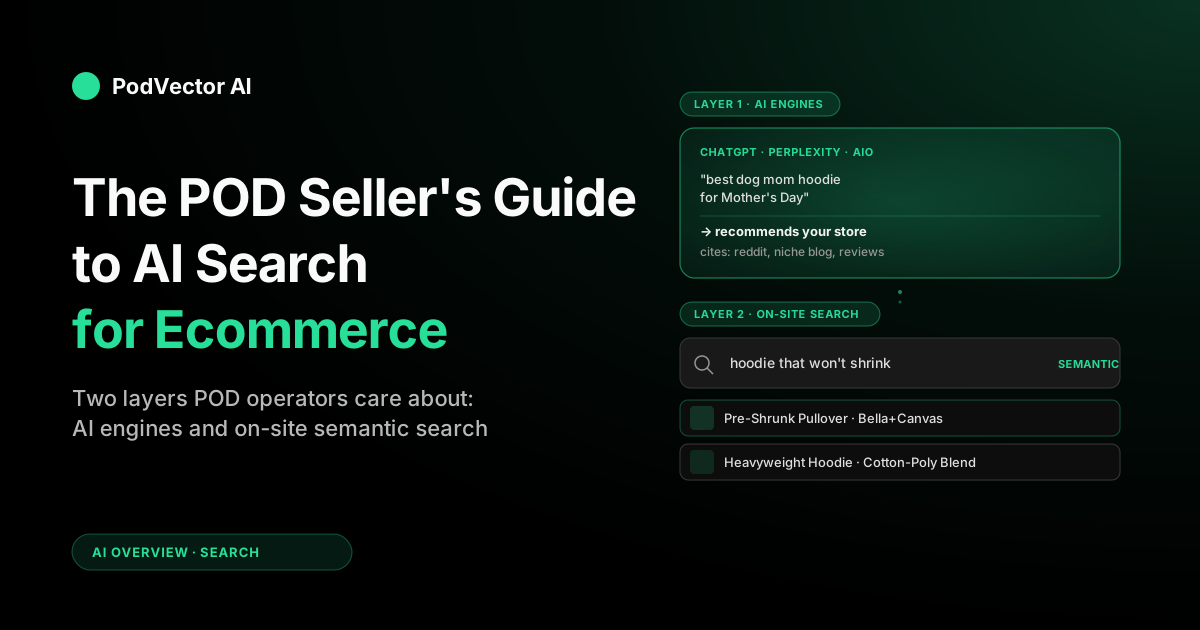
Quick Answer: "AI search for ecommerce" in 2026 covers two different things that POD sellers need to think about separately. The first is AI search engines — ChatGPT, Perplexity, Google's AI Overviews, Gemini — which now answer "best Christmas hoodie for new dads" by recommending specific stores and products. The second is on-site AI search — the semantic, intent-aware search bar inside your Shopify or Etsy storefront that helps shoppers find your designs.
For print-on-demand operators, both matter, but the leverage is different. AI search engines control discovery — whether a shopper hears about your store at all. On-site AI search controls conversion — whether the shopper who lands on your store finds the right design before bouncing.
This guide walks through both layers, what's specific to POD (slim margins, mockup-based catalogs, supplier-routed shipping), and a concrete action list for 2026.
What "AI search for ecommerce" actually means in 2026
Two years ago, "ecommerce search" meant the search bar on your storefront and the Google results page that fed it. In 2026 those are still there — but they're no longer the whole picture.
The category has split into two distinct layers. The first is the AI-native search engines that shoppers now use instead of Google for discovery questions: ChatGPT, Perplexity, Gemini, Claude, plus Google's own AI Overviews and Bing's Copilot. These answer "what's the best gift hoodie for a new dad" with three or four specific store recommendations and citation links, not ten blue results.
The second is the AI-powered search that runs inside your storefront — the semantic, intent-aware engine that understands a shopper typing "hoodie that won't shrink" doesn't want the word "shrink" matched literally. Tools like Algolia, Coveo, Constructor, and Shopify's own native search now ship with vector embeddings and large-language-model query understanding baked in.
Both shifts are operator-relevant for POD. The first decides whether shoppers hear about your store. The second decides whether they convert once they land on it. Confusing them — or optimizing for one and ignoring the other — is the most common 2026 mistake.
Why POD changes the requirements
Generic AI search guides are written for branded DTC stores with held inventory, a small fixed catalog, and a single fulfillment center. Print-on-demand inverts almost every assumption in that model.
If you read a Squarespace or Algolia post and apply the playbook straight, you'll spend money on things that don't move POD numbers — and miss things that do. The POD-specific gaps fall into four areas.
Catalogs are wide and auto-generated
A wholesale brand has 40 SKUs hand-described by a copywriter. A POD store has 800 designs auto-multiplied across 12 product types and 10 colors, which means 96,000 product pages, most of which share boilerplate copy.
AI search engines (ChatGPT, AI Overviews) discount stores that look auto-generated. On-site AI search has to retrieve the right design across that scale without keyword collisions. Both problems are POD-specific.
Margins are slim, so wasted clicks hurt more
A typical POD t-shirt nets $4–7 after Printify or Printful's base cost, payment processing, and ad fees. A shopper who lands on your store via an AI search engine and bounces because they can't find the right design has cost you nothing — but the AI engine learned that your store wasn't a useful recommendation for that query, and the citation gets weaker.
That feedback loop means on-site search quality directly affects off-site AI search visibility, in a way it doesn't for an Amazon seller with infinite shelf space.
Shipping ETAs are routed by supplier, not by your store
Shoppers ask AI search engines "will it arrive by Christmas." If your shipping copy says "5–7 business days" but Printify routes half the orders to a Latvian partner that takes 14 days, the AI engine will eventually catch the mismatch from review data — and your citation rate falls.
POD operators who run honest, supplier-specific shipping copy beat operators who paste a generic line, even when the supplier-specific copy is technically slower.
Mockups are the product photo, and AI vision tools know it
Visual search inside on-site AI tools matches photographs well and matches mockups poorly. A shopper using image search to find "this style of vintage typography hoodie" will surface real photographs before they surface mockup renders. POD stores that invest in flat-lay photography of one or two best-sellers consistently beat all-mockup stores on visual-search-driven discovery.
Layer 1: AI search engines (ChatGPT, Perplexity, AI Overviews)
The first layer is the one most POD operators underestimate. Shoppers asking "what's a good Christmas gift hoodie for someone who likes dad jokes" used to type that into Google and click a Pinterest board or a roundup article. In 2026 they ask ChatGPT and read its answer.
The AI engine doesn't just list ten links. It synthesizes a recommendation — usually 2–4 stores, with reasoning — and cites the sources it used to generate that answer. If your store isn't in the source pool, you don't appear in the answer. Squarespace's overview of ecommerce AI SEO walks through the general mechanics — what follows is the POD-specific overlay.
How AI engines actually source product recommendations
The three things that drive AI-engine product recommendations in 2026, in rough order of weight:
1. Off-site mentions in trusted source contexts. Reddit threads, niche review blogs, "best of" roundups, Trustpilot, Etsy reviews on your products, and YouTube product mentions are the citation graph the AI engine reads. A POD store with zero presence in those surfaces won't be recommended, regardless of on-site SEO.
2. Structured data on your storefront. Product schema, review schema, FAQ schema, and clean Open Graph metadata are what AI crawlers parse first. Shopify and Etsy both auto-generate baseline product schema, but most POD stores never enrich it.
3. Conversational, specific product copy. AI engines pull answers, not page rankings. Product descriptions written like answers to specific buyer questions — "fits true to size, runs unisex, prints on Bella+Canvas 3001" — get cited more than descriptions written like keyword strings.
What this means for POD specifically
Most POD stores will never out-mention an Amazon seller or a branded DTC label on Reddit or in product roundups. That's the wrong target. The leverage for a POD store is in niche-specific citation depth: if your store is the dog-mom-hoodie store, you want every "best dog mom hoodie" surface — Reddit r/dogs, BarkPost-style blogs, Etsy review aggregation — to mention you specifically.
This is a long-game investment. AI engines re-train and re-crawl on rolling windows, so a citation built today affects recommendations 4–12 weeks out. Operators who treat off-site visibility as a 2026 monthly investment, not a one-shot push, compound the advantage.
For a deeper breakdown of the AI-SEO mechanics behind this, see our AI SEO strategy guide. For the specific question of how AI-powered product content holds up on AI engine citations, see the POD seller's guide to AI product content creation.
Layer 2: On-site AI search on Shopify and Etsy
The second layer lives inside your storefront. When a shopper finally lands on your site — pushed there by an AI engine recommendation, a Google AIO citation, a Pinterest pin, or a Facebook ad — they almost always interact with the search bar before they buy.
Site search usage is roughly 16% of visitors on a typical ecommerce site, but those 16% generate around 55% of online revenue (the conversion rate on site-search users runs about 6× site average). On a POD storefront with 800 designs, that ratio runs even higher — shoppers can't navigate 800 designs by category alone.
What AI on-site search actually does differently
Old-style ecommerce search did literal keyword matching. A shopper typing "hoodie cool dad" got results matching the words "hoodie," "cool," and "dad" — and missed every design titled "Pops Pullover" or "Father's Day Sweatshirt."
AI-powered search uses vector embeddings to understand semantic similarity. The same query now surfaces all three: hoodie, pullover, sweatshirt — and weights them by what other shoppers with similar queries actually bought. Typos, synonyms, plurals, and intent variations get handled automatically.
Three more capabilities ship in 2026's on-site AI search:
- Conversational query refinement. A shopper can ask "what's the warmest hoodie you have" and the search returns ranked by an inferred warmth attribute, even if "warmth" isn't a tagged field.
- Visual search. Upload an image, get matching designs. Strongest for photography-led catalogs; weak for mockup-only POD catalogs (see the mockup section above).
- Zero-result deflection. A shopper searching for something you don't carry gets recommendations for the closest thing you do carry, with an honest "we don't have an exact match, but here's the closest" instead of an empty page.
What's available to POD operators in 2026
The enterprise AI search platforms (Coveo, Constructor, Algolia NeuralSearch, Zoovu) are real but expensive — usually $25K+/year, with implementation effort, and overkill for POD stores under $1M ARR.
For POD operators, the practical options are:
Shopify native search — substantially improved in 2024–2025 with semantic understanding built in. Free with Shopify, good enough for most stores under $500K ARR. Doesn't handle attribute filtering as well as paid tools, but for a 800-design POD catalog it's usable.
Searchanise, Klevu, or Doofinder — mid-market AI search apps in the Shopify App Store, $30–200/mo, ship semantic search and merchandising controls. Klevu in particular has strong out-of-box AI relevance for POD-shape catalogs.
Etsy's built-in search — you don't choose; Etsy chooses for you. The 2026 Etsy search algorithm is itself semantic (see next section), which means optimizing for it looks more like optimizing for AI search engines than for old keyword-stuffed Etsy SEO.
For the broader picture of AI tooling across the POD-on-Shopify stack, the comparison covered in our roundup of AI tools for print-on-demand goes deeper. For the specific question of how on-site AI recommendation engines work alongside search, see the POD seller's guide to AI recommendation engines.
The Etsy angle: 2026's algorithm is already semantic
POD sellers on Etsy in 2026 are running into a different problem than POD sellers on Shopify. Etsy's search algorithm was overhauled in late 2025 to use semantic understanding instead of keyword matching, and the new system penalizes keyword-stuffed titles that worked under the old algorithm.
The official Etsy guidance is "buyer-friendly natural language titles under 15 words." The mechanical effect is that titles like "Funny Dog Mom Shirt Gift for Her Mother's Day Dog Lover Pet Owner Shirt Tee Top" — which were the optimal Etsy SEO format in 2023 — now rank worse than "Hand-Lettered Dog Mom T-Shirt for Mother's Day."
Two consequences for POD on Etsy:
1. Titles convert better when they're written for buyers, not for Etsy. The semantic algorithm reads intent. "Hand-Lettered Dog Mom T-Shirt for Mother's Day" tells the algorithm what the design actually is and who it's for. The keyword-stuffed version tells the algorithm nothing more than the natural one, but reads worse to a shopper, so click-through suffers.
2. Tags should describe attributes and audiences, not synonyms. The old "fill all 13 tags with keyword variants" approach is now actively penalized. The new approach is one tag per attribute or audience signal: "dog mom," "mother's day," "hand-lettered," "unisex tee," etc.
For POD operators running on both Shopify and Etsy, the implication is convergent: write product copy that's buyer-direct and attribute-clear on both platforms. The same copy that wins on Etsy's 2026 semantic algorithm also gets cited more often by AI search engines on the Layer 1 side.
What POD sellers should actually do in 2026
Here's the concrete short list — what moves the needle for a POD operator in the AI search era, ordered by leverage.
1. Rewrite your top 20 product descriptions as answers, not keyword strings
Open the analytics for your store. Find the 20 designs that drive 80% of the revenue. Rewrite each product description in 2–3 paragraphs that answer real buyer questions: who is this for, how does it fit, what's it printed on, will it shrink. Skip the keyword stuffing.
This single change moves both Layer 1 (AI engine citation) and Layer 2 (on-site semantic relevance) at the same time. It's the highest-leverage action on this list.
2. Add product, review, and FAQ schema to your top pages
Shopify and Etsy auto-generate baseline product schema, but most POD stores never enrich it with review counts, fit notes, or FAQ sections. AI crawlers parse this aggressively. The Shopify apps for review schema (Loox, Judge.me, Stamped) emit it automatically once installed; the FAQ schema usually needs a small theme edit.
3. Build off-site mentions in your niche
For each of your top 3 niches (dog moms, gamer dads, plant parents, whatever your store actually sells), find the 5–10 surfaces where shoppers in that niche hang out: subreddits, Discord servers, niche blogs, Pinterest boards, Trustpilot. Get authentic mentions in those surfaces over time.
This is slow, but it compounds. AI engines re-crawl these surfaces and update citations on rolling windows.
4. Upgrade on-site search if you're above $100K/year
Under $100K ARR, Shopify native search is fine. Above $100K ARR, the lift from Klevu or Searchanise (semantic search, merchandising controls, zero-result deflection) usually pays back inside a quarter. Don't pay enterprise prices (Coveo, Constructor) until you're past $1M ARR.
5. Add real photography for your top 3 best-sellers
One flat-lay photo of each of your top-selling designs, ideally with a person modeling it, beats every mockup on visual search. You don't need a photo studio — a phone camera on a white sheet in natural light works.
6. Update your shipping copy to match what suppliers actually do
Audit your store's "shipping" page against actual Printify or Printful production-partner ETAs by destination. Replace generic "5–7 business days" copy with per-region estimates that match reality. This protects your AI-engine citation rate over time, because review-data drift is the fastest way to lose AI-engine trust.
7. Track which AI engines drive traffic and citations
Most analytics tools now report "AI search referrer" traffic separately — Google Analytics 4 tags it under the source category "AI Overviews," and tools like Ahrefs and Semrush now expose ChatGPT/Perplexity citation tracking. Set up a monthly review of which AI surfaces send traffic and which mention your store without sending traffic (citation without click — still valuable).
How to measure AI search performance for POD
POD operators measuring AI search need to track three different signals because the three layers above behave differently.
Layer 1 (AI search engines) metrics
- AI referrer traffic. GA4 source breakdown filtered to AI sources (ChatGPT, Perplexity, Gemini, Google AI Overviews). This is the most direct signal.
- Citation tracking. Tools like Ahrefs' Brand Radar or Semrush's AI Visibility track whether your domain is mentioned in AI engine answers, even when the shopper doesn't click through.
- Branded search lift. If AI engines mention your store, branded search volume on Google rises 2–6 weeks later. Tracking branded search through Search Console gives you a delayed but reliable signal.
Layer 2 (on-site AI search) metrics
- Search conversion rate. Conversion rate of sessions that used the on-site search bar. Should be 3–6× site average; lower than 3× means the search engine is weak.
- Zero-result rate. Share of searches returning no results. Under 5% is healthy; over 10% means the search engine isn't handling synonyms or intent.
- Top zero-result queries. The exact queries returning empty pages tell you what designs to add, or what synonyms to ingest.
Layer 3 (cross-layer attribution)
The hard part is connecting Layer 1 and Layer 2 — knowing which off-site AI mention drove which on-site sale. Most POD operators give up on this and track them separately. Victor can see your Shopify orders, ad spend, GA4 sessions, and supplier costs all together. That means he can tell you which AI-driven sessions turned into sales, and the real cost and profit behind each one — which is the only way to know the true ROI per AI surface.
This is where most POD stacks fall down — the data exists but lives in five different tools that don't talk to each other. For a deeper view of what an AI-AI employee layer over that warehouse looks like in practice, the cross-cluster guide on AI tools for ecommerce product ranking covers the analytics side, and the AI analytics overview hub indexes the rest of the cluster. For the broader topic of how AI analytics fits POD, see the AI Analytics topic page.
Mistakes POD sellers make with AI search
Confusing the two layers. Optimizing on-site search and ignoring AI engines (or vice versa) leaves half the value on the table. They feed each other — strong on-site search drives better engagement signals, which feed back into AI engine recommendation weight.
Treating AI search engines as a 30-day campaign. AI engines re-train and re-crawl on rolling windows. The off-site mentions you build today affect recommendations 4–12 weeks out. POD operators who run a one-month push and stop don't see the compounding payoff.
Keyword-stuffing Etsy titles in 2026. The old playbook is now actively penalized by Etsy's semantic algorithm. POD sellers who haven't updated their listing titles since 2023 are losing rank week by week, even when nothing else has changed.
Paying for enterprise on-site search too early. Coveo and Constructor are real tools, but POD stores under $1M ARR almost never see ROI on the implementation cost. Shopify native or a $50/mo Klevu install beats a half-implemented $25K/year platform.
Auto-generating 800 product descriptions with one template. AI engines and on-site semantic search both discount stores that look templated. You don't need 800 hand-written descriptions — but the top 20 should be unique, and the rest should at minimum carry attribute-specific copy generated from real design metadata. For more on the writing side, see our guide to AI product description generation for Shopify.
FAQs
Is "AI search for ecommerce" the same as AI SEO?
Overlapping but not identical. AI SEO usually refers narrowly to optimizing for being cited in AI engine answers (Layer 1 in this guide). AI search for ecommerce covers both that and the on-site AI search engine running on your storefront (Layer 2). Most operator playbooks treat them as one project because they share the same upstream work — structured data, clear product copy, off-site visibility.
Will AI search engines kill Google for ecommerce traffic?
Not in 2026, and probably not in 2027 either. AI search engines today represent roughly 5–12% of discovery traffic for POD-shape ecommerce, depending on niche. Google still drives the majority. The shift is meaningful but gradual — POD operators should invest in AI search visibility now precisely because it's still cheap to compete in.
Does Shopify's native search work for POD stores?
For stores under $500K ARR, yes — Shopify's 2025 search overhaul ships real semantic understanding, and the gap to paid tools is smaller than it used to be. Above $500K ARR, the lift from Klevu, Searchanise, or Doofinder usually justifies the cost. Stay away from enterprise platforms (Coveo, Constructor) unless you're past $1M ARR and have engineering resource for implementation.
How do I show up in ChatGPT's product recommendations?
Three levers, in order of weight: get mentioned in niche-specific surfaces (Reddit, niche blogs, Trustpilot) where ChatGPT crawls; emit clean product, review, and FAQ schema on your storefront; write conversational, specific product copy that reads like an answer to a buyer question. None of these are quick wins — AI engines re-train on rolling windows of 4–12 weeks.
Does visual search work for POD mockups?
Weakly. Visual search engines match photographs better than mockup renders, so all-mockup POD catalogs underperform on visual discovery. The fix is to add 1–3 real flat-lay or model photos for your top-selling designs. You don't need a studio — a phone and natural light is enough.
What's the single highest-leverage thing I can do this month?
Rewrite the product descriptions for your top 20 designs as direct answers to real buyer questions, not keyword strings. That one change moves both layers — AI engine citation and on-site semantic relevance — and compounds over time as AI engines re-crawl.
See your AI search performance in one place
AI search visibility, on-site search conversion, supplier ETAs, ad ROAS, and margin per design — all live in different tools for most POD stores. Victor is the AI employee that joins them and answers operator questions in plain English: "Which AI search referrers actually convert?" "What's my margin on the designs ChatGPT keeps recommending?" "Did the latest product-title rewrites lift Shopify conversion?"
Nothing to build. Nothing to code. Just connect Shopify, Printify, Printful, your ad accounts, and your analytics. Victor pulls it all together, so he can answer your questions using the full picture across all of them.
and start asking your data the questions you've been avoiding.
Try Victor free