
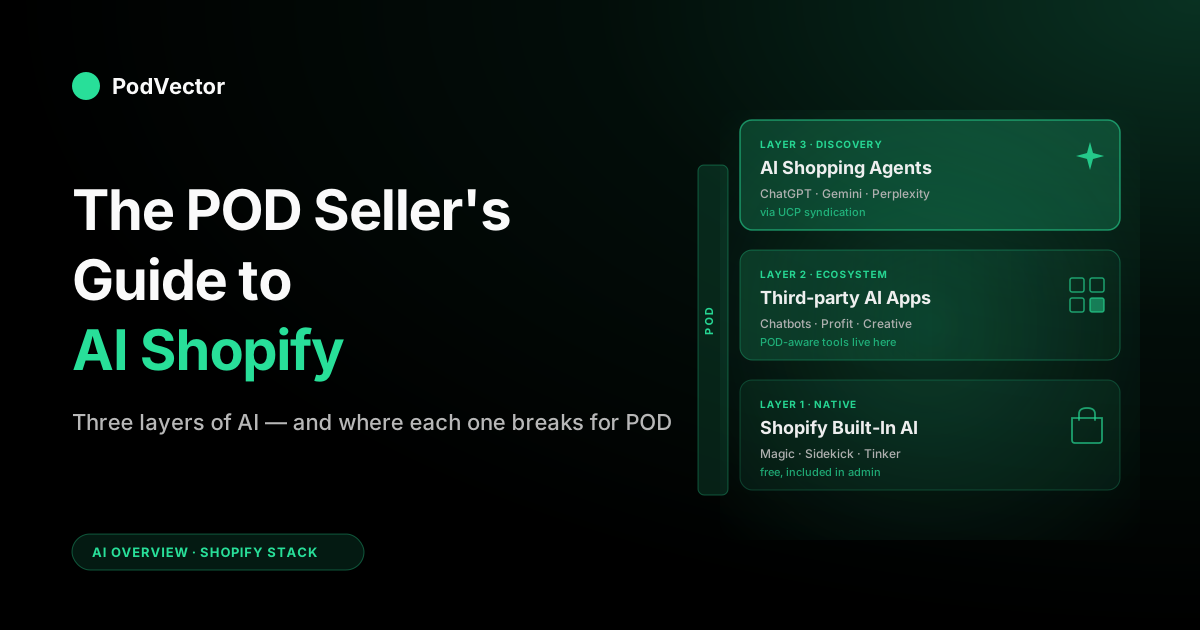
Quick Answer: "AI on Shopify" in 2026 is three overlapping layers — native features (Magic, Sidekick, the AI Store Builder, Tinker, UCP), third-party AI apps that install into your store, and AI shopping agents that discover your catalog from outside it. For a print-on-demand seller, the native layer is good but blind to supplier costs, the third-party layer is a mixed bag, and the shopping-agent layer is quietly becoming one of the most important traffic sources of the decade. This guide walks through what each layer actually does for a POD store, where the POD-specific gaps are, and the stack that covers them.
The three layers of AI on Shopify in 2026
When a POD seller asks "what's the deal with AI and Shopify?", they usually mean one of three different things at once. Separating them is the first step to deciding where to spend time.
- Native AI — features Shopify ships and operates, included in the admin or platform. Magic, Sidekick, the AI Store Builder, Tinker, the AI Toolkit, and the Universal Commerce Protocol (UCP) belong here.
- Third-party AI apps — AI tools you install from the Shopify App Store or connect via API. Chatbots, creative generators, forecasting apps, margin reconcilers, ad optimizers. Some are purpose-built for POD; most are not.
- AI shopping agents — LLMs and assistants that discover and recommend your products to shoppers from outside your store. ChatGPT Shopping, Microsoft Copilot, and the other major assistants. You don't install them; they surface your catalog based on metadata and syndication.
The mistake most POD stores make is assuming "AI on Shopify" is just the first layer. It's not. By 2026, the second and third layers are where most of the leverage — and most of the confusion — actually lives.
Layer 1: Shopify's native AI features
Shopify has shipped six major AI surfaces, each doing a different job. They're free, they work, and they have predictable limits — especially for print-on-demand.
Shopify Magic
Magic is the generative layer: product descriptions, email copy, blog drafts, image background removal, banner generation, and code snippets for theme work. For a POD store with 500+ product variants, Magic cuts the copywriting time on new drops from a day to under an hour.
It does not evaluate whether your copy converts, and it has no awareness of your Printify or Printful production costs. Treat it as a drafting tool, not a strategy tool.
Sidekick
Sidekick is the conversational admin assistant. It lives in your Shopify admin as a chat panel, answers questions about your store's data, builds custom reports, and executes store changes when you ask ("pause all campaigns tagged 'summer' and add a 15% discount code for returning customers"). For quick operational questions, it replaces 10+ clicks of admin navigation with a single sentence.
Through 2026 Sidekick has shifted from answering to acting. It now creates customers and companies from a plain-English description (handling the form-filling itself), writes ShopifyQL queries against web-performance, payments, fulfillment, and payout data, and keeps prior conversations in a sidebar so multi-step work survives across sessions. The direction is clear: Sidekick is becoming a workflow executor inside the admin, not just a Q&A box.
Sidekick's core limitation for POD is that it only sees Shopify's own data. Revenue, orders, customer segments, traffic, discounts — yes. Printify or Printful per-order production costs, shipping tier breakdowns, supplier-side discounts — no. That gap is covered more fully in our guide to Shopify AI for POD sellers.
The AI Store Builder
The AI Store Builder is Shopify's newest front-door feature: describe your business in a few words and it generates a full, themed storefront — layout, sections, and starter copy — in seconds, for free. For a POD seller launching a new niche brand or a seasonal microstore, it collapses the "buy a theme, hire a designer, wire up pages" step into a single prompt.
What it gives you is a competent starting point, not a finished store. It has no idea which of your designs sell or what your Printify/Printful base costs are, so treat the generated storefront as scaffolding — then layer your real catalog, metadata, and the cost-aware tooling below on top of it.
Tinker
Tinker is Shopify's sandboxed AI workspace for generating and editing theme sections. Describe a section in plain English, get back previewable Liquid code. For POD stores, Tinker lowers the activation cost of testing a new hero block or product page layout — you don't need to hire a Shopify developer for every theme hypothesis.
The AI Toolkit
The AI Toolkit is developer-facing infrastructure that lets external AI coding agents (Cursor, GitHub Copilot, and similar tools) interact with Shopify's APIs and docs with proper context. Most merchants never touch it directly, but it's the reason third-party AI apps are getting noticeably better in 2026: developers can ship Shopify integrations faster and with fewer edge-case bugs. Presta's toolkit breakdown is the best external reference if you're evaluating custom work.
Universal Commerce Protocol (UCP)
UCP is Shopify's syndication layer, co-developed with Google, that makes your catalog discoverable by AI shopping agents. It runs automatically — you don't install it.
What you do control is the quality of the metadata you feed it: product titles, descriptions, attributes, categories, images. We'll come back to UCP in the shopping-agent section because its importance is growing fast.
Layer 2: Third-party AI apps in the Shopify ecosystem
The Shopify App Store has hundreds of apps with "AI" in the name. For a POD seller, most of them fall into five functional categories. Knowing the category is how you decide whether the app is a duplicate of something Shopify already does for free.
Customer support chatbots
AI chatbots that handle pre-sale questions, shipping status, and returns. Shopify Inbox has basic chat, but specialized tools (Gorgias, Ringly, TxtCart) go further with phone, multilingual, and abandoned-cart support.
Worth paying for when you're past roughly 50 support tickets a week — below that, Inbox is usually enough. See the options in the AI chatbot for Shopify guide for POD sellers.
Creative and design AI
Tools that generate images, mockups, or design variations for listings. For POD specifically, this is a mixed category — Shopify Magic handles basic image editing, but POD-specific design generation (running new art through Midjourney/DALL-E, variant mockup generation) still usually happens outside Shopify and gets pushed in via Printify or Printful.
Marketing and ad AI
Apps that write email copy, generate ad creative, optimize spend, or personalize on-site merchandising. Klaviyo, Omnisend, Attentive, and Jasper all have AI features here.
The important thing to check: does the app attribute revenue back in a way that matches how you calculate profit? Many of these tools show revenue lift but ignore COGS — which for POD is the difference between a profitable campaign and a money-losing one.
Analytics and profit AI
Tools that reconcile orders, costs, and ad spend into a profit view. For traditional ecom, TrueProfit, BeProfit, and Lifetimely cover the category.
For POD, you need an analytics tool that tracks your supplier costs (Printify, Printful) down to each order line — something most tools don't do well. Victor is built for exactly this. He reads your Printify and Printful costs, matches them to your Shopify orders and your Meta and Google ad spend, and answers plain-English questions about your profit. A category overview is in the complete guide to AI agents for ecommerce analytics.
Inventory and forecasting AI
Apps that predict demand and adjust stock. For POD this category is narrower than for traditional ecommerce — you don't hold inventory, so the forecasting question collapses to "which designs should I actively promote next" rather than "how many units to reorder." Covered in AI inventory forecasting for Shopify POD.
Layer 3: AI shopping agents and discovery
This is the layer most POD sellers underweight, and it's the one changing fastest. In 2026, a growing share of product discovery happens inside AI assistants: a shopper asks ChatGPT for "a funny dad shirt with a golf theme for Father's Day," and the assistant surfaces products from stores that have made their catalogs discoverable.
The mechanics:
- Shopify's UCP syndicates your catalog to the major AI shopping agents automatically. You don't install it; it's on when your store is on.
- Your metadata quality determines whether you show up. Clean titles, rich descriptions, full attribute data, accurate categories, and high-quality images are what the agents use to match a shopper's prompt to a product.
- The traffic pattern is different from Google SEO. Shoppers using AI agents typically have stronger intent — they're describing what they want, not browsing. Conversion rates on agent-driven traffic are meaningfully higher than on generic paid traffic.
Shopify reported that orders from AI-search surfaces grew roughly 15× between January 2025 and January 2026, and the trajectory is steeper for discovery-heavy categories like apparel and print-on-demand. Techcrunch's coverage of Shopify's agentic commerce strategy captures how aggressively the platform is positioning for this.
For POD sellers, the near-term action is boring and concrete: audit your product metadata. Replace "Shirt 023" with descriptive titles that include design theme, audience, and occasion.
Fill in every attribute field. Upload real lifestyle images, not just white-background mockups. The stores winning AI-search traffic in 2026 are the ones whose catalog was ready when the protocol lit up.
How AI on Shopify behaves differently for POD
Print-on-demand has three structural characteristics that change how each layer of AI performs. If you're evaluating AI tools based on general Shopify reviews, you'll likely overspend on things that don't move the needle and underspend on the thing that does.
Supplier costs live outside Shopify
Your real cost of goods — base product, print variant, shipping tier, premium discount — is computed on Printify's or Printful's side and invoiced to you separately. Shopify never sees it automatically.
That means any AI tool that only sees Shopify data is missing the single most important input for profit decisions. Sidekick, most native analytics, and most generic AI apps are in this bucket.
Catalogs are unusually wide
A POD store commonly has 500–10,000 SKUs, most of which are variant combinations of the same design. Generic AI tools built for stores with 50 products apply their logic per-SKU and drown.
POD-aware tools aggregate at the design family level and treat the variant sprawl correctly. This matters for analytics, for recommendations, and for the copy/creative AI tools when they're asked to generate content at scale.
Margins are thin
Traditional ecom can absorb a 10% estimation error on COGS. POD often can't — margins per order can be in the 15–30% range, which means a $2 shipping surcharge or a missed premium-tier discount flips profitable to unprofitable. AI tools that display "approximate" profit figures are fine for a boutique. For POD, the approximation is the problem.
A POD-specific AI Shopify stack for 2026
Given the layers and the POD constraints, here's the realistic stack order — what to turn on, what to install, and what to do about shopping-agent discovery. Start from the top; the leverage compounds as you go down.
- Turn on Sidekick and use it. Free, fast, replaces routine admin clicks. Use it for revenue, operational, and catalog questions. Don't ask it profit questions.
- Use Magic for bulk content. Product descriptions, email drafts, basic image edits. Hand-polish the 20% of products you're actively advertising.
- Clean your catalog metadata for AI shopping agents. This is the single highest-leverage one-time effort of 2026 for POD. Good titles, rich descriptions, complete attributes, quality images. UCP handles the rest.
- Install a POD-aware profit tool. One that reads your Printify and Printful costs down to each order line, and matches them to your Shopify orders and ad spend. This is Victor's purpose — he answers plain-English profit questions using your real, up-to-date numbers, so you stop guessing on your cost of goods. The complete guide to AI analytics for print-on-demand walks through the evaluation framework.
- Add a customer support AI when you're doing 50+ tickets a week. Shopify Inbox first; upgrade to a dedicated tool when Inbox's ceiling is visible.
- Evaluate creative and ad-optimization AI last. Most POD stores don't need these until they're past $500K/year in revenue or running 6-figure monthly ad spend. Below that, the leverage is in layers 1–5.
The pattern that separates profitable POD stores from unprofitable ones in 2026 is not the number of AI tools. It's whether the one AI tool that sees supplier costs has been installed. Every other decision compounds on top of that baseline.
The employee roadmap — what acts vs. what just answers
The industry is mid-transition from "AI that answers" to "AI that acts." Shopify's Spring 2026 Edition signaled this explicitly with Agentic Storefronts (stores built to be navigated and transacted by AI shopping agents, not just humans) and Campaign Autopilot (marketing that an agent plans, launches, and adjusts). Sidekick itself is moving from a Q&A interface toward a workflow executor that builds apps, creates flows, and executes multi-step admin tasks on instruction.
For POD, the agentic shift matters in four places:
- Ad pausing and scaling — an agent watches campaign-level profit and pauses losers or scales winners without a human in the loop.
- Supplier routing — an agent notices that Printful's shipping is cheaper to EU customers for a given product and routes those orders accordingly.
- Design de-listing — an agent flags designs that are costing more in refunds than they're producing in margin and recommends (or executes) pulling them.
- Creative iteration — an agent tests hero-image variations against ad performance and rotates in the winner.
No current agent does all four reliably for a POD store. The honest 2026 state is: most agentic AI products answer well and act narrowly.
The question for a POD seller evaluating agents is which specific action the agent reliably executes, not whether it's "agentic" in the abstract. Victor's roadmap is explicit about this — it answers profit questions today and is extending into narrow, high-confidence actions (ad adjustments, supplier routing, design de-listing) as the underlying data-quality bar is met. This positioning is expanded in our guide to AI for ecommerce for POD sellers.
Mistakes POD sellers make with AI on Shopify
Paying for content AI that duplicates Magic
Third-party "AI product description" apps often run $30–60/month for features Shopify Magic does for free. Check Magic first. Upgrade to a paid tool only if you have a concrete reason — editorial voice, multi-language, batch workflows Magic doesn't support.
Treating Sidekick's profit answers as ground truth
Sidekick will confidently return a profit number. That number does not include your Printify production cost or your Printful shipping tier surcharge. For POD, the delta between Sidekick's profit and your real profit is often 20–50%. Use Sidekick for revenue and operational questions; use a POD-aware analytics tool for profit.
Ignoring catalog metadata because "it's just data hygiene"
Metadata hygiene is the new SEO for AI shopping agents. Stores with complete, descriptive catalog data will capture a disproportionate share of AI-search traffic over the next 24 months. Treat a metadata cleanup as a high-leverage project, not a chore.
Installing AI apps without checking the COGS assumption
Most AI marketing and analytics apps assume that cost of goods is a fixed percentage of price — a reasonable default for retailers holding stock, but wrong for POD where costs vary by variant, supplier, and shipping zone. Before installing, ask the vendor: how does your tool handle per-order supplier costs from Printify/Printful? If the answer is fuzzy, the tool's profit numbers will be fuzzy too.
Chasing every new AI announcement
Shopify ships AI features at a pace that's hard to keep up with. Not every feature is worth adopting the week it drops. The discipline that pays off for POD is boring: keep doing what works, evaluate new features quarterly, and only adopt when the feature fills an actual gap in your stack.
FAQs
Is AI on Shopify actually useful for a small POD store?
Yes, specifically the free native pieces (Magic, Sidekick) and the catalog-metadata work that feeds AI shopping agents. Paid AI apps become worth it at specific thresholds — usually once you're past $100K/year in revenue or 50+ weekly support tickets. Below that, the free native layer plus good metadata hygiene covers most of the value.
What's the difference between Shopify Magic and ChatGPT for a POD store?
Magic is integrated into the Shopify admin and knows your products, customers, and store context. ChatGPT is a general-purpose LLM with no native Shopify awareness.
For basic product descriptions and emails, Magic is faster because it pulls your data. For longer-form content (blog posts, landing page copy, ad scripts), ChatGPT's editorial range is wider. Most POD stores use both.
Can AI on Shopify track my Printify or Printful profit?
Shopify's native AI cannot — Shopify never sees your supplier invoices, so any profit number it gives you is just an estimate or placeholder for your cost of goods. For accurate per-order profit on POD, you need a tool that reads your Printify and Printful costs directly and matches them to your Shopify orders. Victor is built for exactly this; TrueProfit and BeProfit offer partial coverage.
How do AI shopping agents like ChatGPT find my products?
Through Shopify's Universal Commerce Protocol (UCP), which syndicates your catalog to the major AI agents automatically. What you control is the metadata the agents use to match your products to shopper prompts: titles, descriptions, attributes, categories, and images. High-quality metadata means higher inclusion rates in AI-surfaced recommendations.
Should I wait for Shopify to build POD-specific AI before paying for a third-party tool?
No. Integrating deeply with Printify and Printful invoice data across premium tiers and shipping zones isn't core to Shopify's roadmap — the specialization that makes POD analytics accurate is exactly what makes it unlikely to be built natively. Third-party POD-aware tools close that gap today and will likely continue to.
What's the highest-ROI AI move for a POD store in 2026?
Two things, in order. First, clean your catalog metadata for AI shopping-agent discovery — this is a one-time effort that compounds as AI-search traffic grows.
Second, install a profit agent that reads your Printify and Printful invoices so every downstream decision (ad scaling, design promotion, supplier choice) runs on real COGS instead of estimates. Both are high-leverage and often skipped.
Is Sidekick going to replace third-party AI apps for POD?
Not for the POD-specific gaps. Sidekick is getting more capable at Shopify-data tasks — reports, admin actions, workflow execution — but it doesn't read Printify invoices and won't in any announced roadmap. The ecosystem is converging on a split: Sidekick for Shopify-native work, purpose-built tools for cross-system work like supplier cost reconciliation and multi-channel ad attribution.
When should a POD store start using AI shopping agents as a channel?
The moment your catalog is metadata-clean. Unlike paid channels, there's no spend threshold — you don't "start using" AI shopping agents, you make yourself discoverable to them.
The stores that are visible inside AI shopping agents in 2026 are the ones whose catalogs were well-structured when the protocols went live. If you're behind on metadata, that's the first project.
See what AI on Shopify misses for POD
Shopify's native AI handles content and admin. It doesn't see your Printify or Printful costs. Victor does — a live-data AI employee that reads your supplier invoices, joins them to Shopify orders and ad spend, reallocates ad budget toward the variants that actually clear margin, and acts on your approval.
Try Victor free