
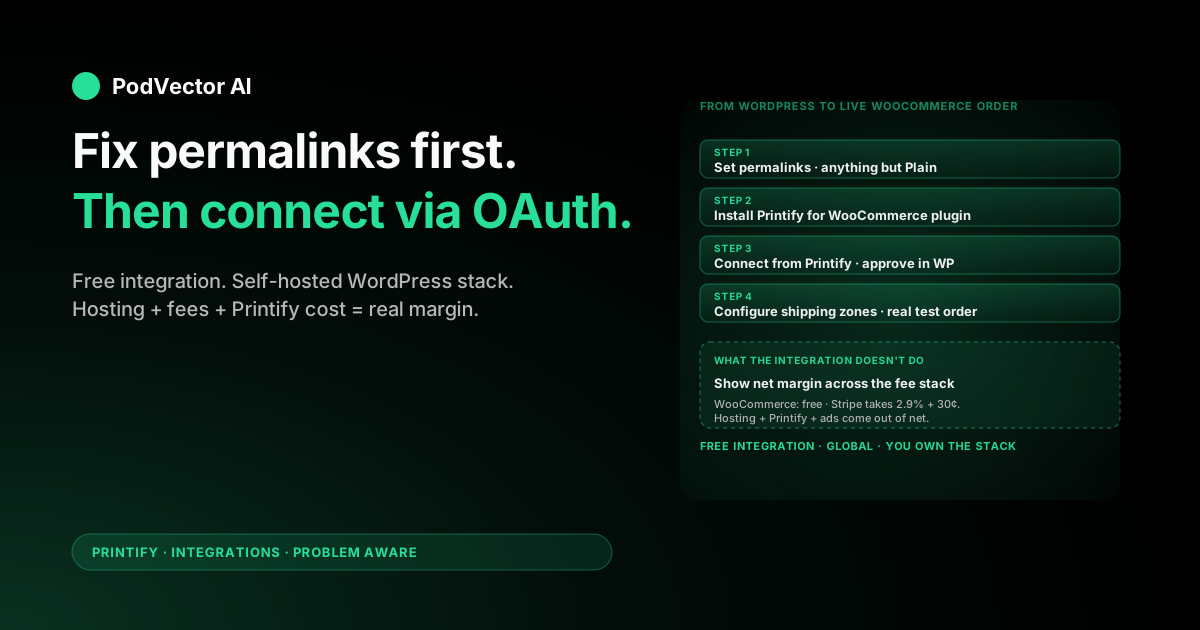
Quick Answer: The Printify–WooCommerce integration is free and takes about 20–30 minutes of active work. You install the Printify for WooCommerce plugin on your WordPress site, set permalinks to anything other than "Plain," then authorize the connection from the Printify dashboard.
The settings most guides skip: permalinks (the REST API silently fails without this) and shipping zones (WooCommerce uses zone-based rules that don't map cleanly to Printify's flat rates). Get those two right and the rest is wiring.
The integration is the easy part. Once orders are flowing, your revenue lives in WooCommerce, production cost lives in Printify, ad spend lives in Meta and Google, and your hosting bill lives in your hosting dashboard. None of those numbers share a screen by default — and that's where most stores quietly lose money.
What the Printify–WooCommerce integration actually does
The integration is the official bridge between a self-hosted WooCommerce store on WordPress and Printify's print-on-demand network. Once connected, Printify becomes the production layer for any product you publish into your WooCommerce catalog.
Functionally it does three things. It pushes products you build in Printify into your WooCommerce store as live listings with images, variants, and prices. It listens for orders placed on those listings and queues them for production at the print provider you picked. And it pushes tracking data back to WooCommerce so the buyer sees normal WooCommerce order status emails.
WooCommerce owns the storefront, checkout, payment processing, customer accounts, and email. Printify never touches the buyer side — they only see your WordPress branding and your WooCommerce order emails. Whether Printify's margins actually work for your category is a separate question from whether the integration works mechanically.
Why pick WooCommerce over Shopify for POD
The two-line answer: WooCommerce gives you total control and zero per-transaction storefront fees, but you carry the WordPress maintenance, security, and hosting burden yourself.
Shopify costs $39/month minimum plus 2.9% + 30¢ per transaction. WooCommerce itself is free, but you'll pay for hosting ($5–30/month for a small store, $80+ as you scale), an SSL certificate (often free via Let's Encrypt), a backup plugin, and a security plugin. Stripe and PayPal still take 2.9% + 30¢ — that fee is the payment processor, not the storefront.
For sellers under roughly $5K/month revenue, the platforms cost about the same once you add hosting. Above that, WooCommerce gets cheaper. Below that, Shopify saves you the maintenance time. If you're still deciding, our breakdown of POD-ready store platforms compares them side by side.
Before you connect: prerequisites
This is the part most guides hand-wave. WooCommerce has more moving parts than Shopify because you own the stack. Walk through this list before you click anything.
- A working WordPress site with HTTPS. Self-hosted on any provider — Hostinger, SiteGround, Cloudways, your own VPS. The site must be reachable on HTTPS; Printify's API calls won't authenticate against a plain-HTTP store.
- WooCommerce installed and activated. Free plugin from the WordPress repo. Walk through the WooCommerce setup wizard once so your store address, currency, and tax zones are configured.
- A payment gateway live in WooCommerce. Stripe, PayPal, or Square. Test mode is fine for connecting and publishing, but live mode must be on before you take real orders.
- WordPress admin access. You'll install a plugin and edit settings — Administrator role minimum.
- A Printify account. Free to create, no card at signup. You'll add a payment method before any order goes to production. Printify's free plan supports up to 5 connected stores.
- A payment method in Printify. Credit card or PayPal. This is the card Printify charges per order when production starts — it's separate from how you get paid in WooCommerce.
- A clear product idea, or at least a category. Don't connect a blank store. Have one design and one product type ready to publish so you can test the full pipeline within an hour of connecting.
The two prerequisites that trip up most first-time setups: a stale WordPress version (update to current before installing anything) and a security plugin (Wordfence, iThemes Security) blocking the REST API. If you're using one, whitelist Printify's API endpoints before you start.
Step 1: Fix permalinks (the silent-failure setting)
This is the setting that quietly breaks more Printify–WooCommerce connections than any other. WooCommerce's REST API requires "pretty permalinks" — anything other than the default "Plain" structure. With Plain selected, Printify's connect button appears to work, then orders never sync.
Fix it before anything else.
- In WordPress admin, go to Settings → Permalinks.
- Pick any option other than "Plain." "Post name" is the most common choice and the one Printify's docs recommend. "Day and name" works too.
- Click "Save Changes." WordPress regenerates the rewrite rules; this also fixes any 404s on your existing store pages.
If you change permalinks on an existing store with traffic, set up 301 redirects from the old URL structure to the new one. WordPress doesn't do this automatically, and your indexed pages will start 404-ing in Google.
Step 2: Install the Printify for WooCommerce plugin
Printify ships a free official plugin in the WordPress plugin directory. It's what handles the REST API authentication and the product/order sync.
- In WordPress admin, go to Plugins → Add New.
- Search "Printify for WooCommerce." The official one is published by Printify (verify the author before installing — there are copycat plugins).
- Click "Install Now," then "Activate." The plugin appears in your sidebar after activation.
- Confirm REST API access. The plugin auto-generates the WooCommerce REST API keys it needs. If you see an error about missing keys, go to WooCommerce → Settings → Advanced → REST API and verify the Printify integration has read/write access.
Don't enable the WooCommerce Legacy REST API unless Printify's plugin tells you to — most current setups use the standard REST API, and the legacy version is deprecated.
Step 3: Connect from the Printify dashboard
With the plugin installed, the connection itself runs from Printify's side via OAuth — similar to the Shopify flow.
- Log into Printify. Go to printify.com and sign in. If you don't have an account, sign up — it's free.
- Open "My stores." Click the user icon in the upper-right corner and select Manage my stores.
- Click "Add new store." A list of integration options appears (Shopify, Etsy, eBay, WooCommerce, TikTok Shop, and others).
- Pick WooCommerce. Click the Connect button under the WooCommerce card.
- Enter your WooCommerce store URL. Paste the full address with HTTPS — e.g.,
https://your-store.com. Click Connect. - Approve the connection in WordPress. You'll be redirected to your WordPress admin with a prompt to approve the Printify app's read/write access. Click Approve.
- Confirm the redirect. WordPress hands you back to Printify with the store now showing in Manage my stores as connected.
Total clicks: about a dozen. Total time: 5–10 minutes if your WordPress and Printify logins are at hand. If the approval screen never loads, the cause is almost always permalinks or a security plugin blocking the API request — check both before retrying.
Publish your first product to WooCommerce
The connection is live, but WooCommerce still shows zero Printify products. You need to push one through to confirm the data path works.
- Open the Printify catalog. From Printify dashboard, click Catalog. Pick a starter product — a unisex T-shirt is fastest because shipping rates are well-defined for most regions.
- Pick a print provider. Each provider has its own cost, shipping speed, and quality profile. Sort by location closest to your target buyers; international shipping is where margins die.
- Upload your design. Drag a PNG with a transparent background onto the mockup. Printify shows live previews per variant. The full guide to Printify's mockup tools covers what to actually generate.
- Add product information. Title, description, tags. Don't skip the description — WooCommerce's search and Google's index both use it.
- Set retail price. Printify shows your production cost; you set the retail price. The default 40% margin is a starting point, not a strategy — see the fee section below for what to actually price for.
- Pick "Publish to WooCommerce." Choose whether the product publishes as Active (visible to buyers immediately) or as a Draft (hidden until you flip it). Drafts are the right default for a first product so you can review the WooCommerce-side listing before going live.
- Verify in WordPress admin. Within a minute or two, the product appears under Products in WooCommerce with all variants and images synced.
If the product doesn't show up in WooCommerce within 5 minutes, the most common cause is image hosting. Some hosting providers throttle file uploads from external services — check Media Library for partial uploads, and contact your host if Printify's image transfers are timing out.
Configure shipping zones (where most setups go wrong)
WooCommerce uses a zone-based shipping system that doesn't map cleanly to Printify's flat-rate table. Get this wrong and you'll either undercharge buyers (you eat the gap) or scare them off at checkout (cart abandonment spikes). You have three paths.
Option 1: Mirror Printify's flat rates in WooCommerce shipping zones
You set up WooCommerce shipping zones (United States, Canada, Europe, Rest of World) and add flat-rate methods that match Printify's regional rates. Buyer pays your rate. Printify charges you Printify's rate. If they match, your shipping margin is zero.
Best for: stores selling one or two product categories where Printify's flat rates are stable. Cleanest setup. The downside is manual upkeep — when Printify changes rates, your zones don't update automatically.
Option 2: Use a real-time shipping plugin
Plugins like Printify's own shipping settings or third-party calculators query Printify's live rates per order and show the buyer the exact cost. Your spread is always zero on shipping.
Best for: stores selling multiple categories with very different shipping costs (a mug and a hoodie can't share a flat rate without one losing money). Adds complexity, but eliminates the rate-drift problem.
Option 3: Set custom rates and bake the rest into the product price
You charge a single flat shipping rate (often free shipping or $5 worldwide) and pad the product price to cover the actual Printify shipping cost. You eat or profit on the difference per order.
Best for: stores with strong brand pricing power and consistent geography. Risky for international orders because Printify's international rates can hit $10–20 even on light goods. Run the math on your worst-case destination before flipping this on.
Whatever you pick, document it and revisit quarterly. Shipping is the most volatile cost in POD and the one that erodes margin invisibly.
Place a real test order before you market
Do not run ads before a real test order has gone through your WooCommerce checkout and produced a tracking number from Printify. The most expensive way to find a broken integration is from a refund request.
- Add the test product to cart on your live WooCommerce store. Use a real address — your own.
- Check out and pay. Use a real card. You'll refund yourself later.
- Confirm WooCommerce shows the order as paid. Within seconds, the order should appear in WordPress admin → WooCommerce → Orders.
- Confirm Printify received the order. Within a minute, the order should appear in Printify → My orders with status "Awaiting payment" or "In production." If it's not there after 5 minutes, the order didn't sync — fix that before doing anything else.
- Approve production. Some Printify configurations require manual approval; flip the auto-fulfill setting on once you're past testing so this isn't a recurring chokepoint.
- Wait for the tracking number. Printify pushes the tracking back to WooCommerce when the print provider hands off to the carrier. WooCommerce emails the buyer automatically.
- Receive the product. Hold it. Verify the print quality matches the mockup. The first physical sample tells you more about your print provider than any review will.
How orders flow once you're live
Once the integration is live, the order flow is automatic — but knowing each step matters when something breaks.
- Buyer checks out on your WooCommerce store.
- WooCommerce captures payment via your gateway (Stripe, PayPal, etc.).
- WooCommerce pushes the order to Printify via the REST API.
- Printify charges your payment method on file for production + shipping cost.
- The print provider produces and ships the order.
- Printify pushes the tracking number back to WooCommerce.
- WooCommerce emails the buyer their tracking number.
You're paid via your payment gateway (less the gateway's fee). You pay Printify out of band, via the card on file. The gap between what you collect and what you pay is your gross margin — before ad spend.
That out-of-band charging is what makes margin tracking hard. WooCommerce shows revenue. Printify shows production cost in a different system. Neither shows the other. We'll come back to that.
The fee stack: what WooCommerce and Printify each take
Run this math on every product before you list it. WooCommerce is often pitched as "free" — and the storefront itself is. The infrastructure and processing costs are not.
| Cost | Who charges it | Typical rate (2026) |
|---|---|---|
| WordPress hosting | Your hosting provider | $5–30/month (shared) → $80+/month (managed) |
| Domain + SSL | Registrar / hosting | $12–15/year domain; SSL usually free |
| WooCommerce storefront | WooCommerce | Free (open source) |
| Payment processor fee | Stripe / PayPal / Square | 2.9% + 30¢ per transaction (US cards) |
| Printify production cost | Printify | Per-item, varies by product (e.g., $9.30 for a Bella+Canvas 3001 T-shirt) |
| Printify shipping | Printify | $4–8 US, $10–20+ international |
| Printify Premium (optional) | Printify | $14.99/month for a 20% production discount |
| Ad spend | Meta, Google, TikTok, etc. | Whatever you spend — not in WooCommerce or Printify |
A worked example: you sell a $24.99 T-shirt. Stripe takes $1.02 (2.9% + 30¢). Printify charges $9.30 production + $4.99 shipping = $14.29. Your gross margin before ads and hosting is $24.99 − $1.02 − $14.29 = $9.68. If your average ad cost per sale is $8, you net $1.68 per shirt — and that's before you allocate the $15/month hosting fee. If ad cost climbs to $10, you're losing money on every order.
None of those numbers live in one place by default. That's the next problem.
Running the business after the integration is live
Once orders are flowing, the day-to-day work splits into three jobs that no setup guide explains.
Sync monitoring. Printify-to-WooCommerce sync fails occasionally — a plugin update breaks compatibility, a security plugin throttles the API, a variant mapping breaks, or an order stalls because your card was declined. Each failure is recoverable if you catch it fast and silent if you don't. Most stores find out about sync failures from a customer email three days later.
Margin tracking across sources. WooCommerce has your revenue and Stripe fees. Printify has your production and shipping costs. Meta and Google have your ad spend. Your hosting bill is in a fourth dashboard. No single screen shows you net margin per SKU, per day, per ad campaign.
The default answer is a Sunday-night spreadsheet that reconciles four sources by hand. The better answer is to let Victor, PodVector AI's AI employee, pull your orders, ad spend and supplier costs together for you. He can tell you the true profit on each product, with no spreadsheet needed. Even then, somebody still has to ask the questions and act on what Victor finds.
Listing and ad operations. Top-converting variants need more ad spend. Slow movers need to be paused or repriced. New designs need WooCommerce listings, Printify mockups, and ad creative across two or three platforms. This is the work that pays the rent, and it's also the work that gets put off when the operator is reconciling spreadsheets on Sunday.
If your POD business runs on Shopify, an AI employee like Victor joins your Shopify orders, itemized Printify costs, and Meta/Google ad spend into one live view, then proposes profit moves — pausing unprofitable variants, shifting ad budget — that you approve. That pays for itself the first time it flags a campaign that was bleeding $40/day before you would have caught it manually.
Troubleshooting common connection issues
Printify's connect button redirects but the store never appears
Permalinks are still set to "Plain." Go to Settings → Permalinks in WordPress, pick "Post name," save, and retry the connection. This is the single most common failure mode.
The approval screen loads but throws a 403 error
A security plugin (Wordfence, iThemes, Sucuri) is blocking the REST API request. Whitelist Printify's API endpoints in the plugin's firewall rules, or temporarily disable the firewall during connection setup and re-enable after.
Products don't appear in WooCommerce after publishing
Most common cause: image upload failure between Printify and your WordPress media library. Check Media Library for partial uploads, and contact your host if file uploads are throttled. Second cause: you published to Draft and never flipped the listing to Published in WooCommerce.
Orders sync to Printify but never go to production
Your Printify payment method failed. Check Printify → Payment settings. A declined card moves orders into "Action required" and they sit there until you fix the card. Add a backup payment method so a single declined transaction doesn't pause every order.
Shipping charges at checkout don't match Printify's real cost
Your WooCommerce shipping zones don't match Printify's current rate table. Update the zones manually, or switch to a real-time shipping plugin that queries Printify's API per order.
Tracking numbers don't appear in the customer email
Check that WooCommerce order status emails are enabled (WooCommerce → Settings → Emails). Then verify in Printify that the order moved to "Shipped" status — Printify only pushes tracking after the print provider scans the package to the carrier, which can lag 12–24 hours after "Production complete."
The connection breaks after a WordPress or WooCommerce update
Plugin conflicts are the WooCommerce tax. Before every WordPress core, WooCommerce, or Printify plugin update, back up your site. After updating, run a manual sync test (publish a draft product, place a test order) before assuming nothing broke.
FAQs
Is the Printify–WooCommerce integration free?
Yes. The integration itself, the Printify for WooCommerce plugin, and WooCommerce itself are all free. You pay for hosting, your payment processor's transaction fees (typically 2.9% + 30¢), Printify's per-order production and shipping costs, and optionally Printify Premium ($14.99/month) for a 20% production discount.
How long does the full setup take?
About 20–30 minutes of active work to install the plugin, fix permalinks, connect, publish a first product, and configure shipping. Add another 5–10 business days if you're waiting on a physical sample to arrive before going live.
Do I need to enable the WooCommerce Legacy REST API?
Not in most current setups. Printify's plugin uses the standard REST API. Only enable Legacy if Printify's plugin specifically prompts you to — the Legacy API is deprecated and adds an attack surface.
Can I run Printify alongside another POD provider on the same WooCommerce store?
Yes. WooCommerce doesn't care which app published a product. You can run Printify and Printful (or any other POD provider) side by side, each pushing into the same WooCommerce catalog. Margin reporting gets harder, but the storefront handles it fine.
Does the integration work for non-US sellers?
Yes. The Printify–WooCommerce integration is global. Your Printify print provider options depend on your buyers' region, not yours.
What happens if my WordPress site goes down?
Orders stop arriving in Printify until the site is back up. Existing orders already in Printify continue to production. The integration depends on WooCommerce's webhooks reaching Printify — if your host is down, the webhooks queue and retry, but extended outages will drop them. Managed WordPress hosts (WP Engine, Kinsta, Cloudways) have better uptime than budget shared hosts.
Can I migrate from Shopify to WooCommerce and keep my Printify products?
Partially. Your Printify product designs and mockups are tied to your Printify account, not your storefront. Disconnect the Shopify store from Printify, connect the WooCommerce store, and republish each product. Existing Shopify orders don't transfer — they stay in Shopify.
How do refunds work?
You refund the buyer in WooCommerce via your payment gateway. That's the customer-facing side. Whether Printify reships, refunds you, or charges you depends on the reason — production defects and shipping damage are usually Printify's cost; buyer's-remorse returns are usually yours. Document everything with photos before opening a ticket with Printify.
How does WooCommerce compare to Etsy as a Printify front-end?
Different audiences. WooCommerce gives you a branded store you control end-to-end. Etsy gives you a marketplace with built-in traffic but high competition and Etsy's per-listing fees. Most serious POD sellers run both — Etsy for discovery, WooCommerce or Shopify for branded direct sales. See our Amazon integration guide for the third major marketplace path.
Related reading
For the broader Printify integration set, see our Printify integrations hub and the Printify topic page. If you're weighing marketplace integrations alongside WooCommerce, our Amazon-Printify setup guide and its step-by-step walkthrough variant cover the largest marketplace path. Printify's official help article is the source of truth for current connect-button behavior.
Hand off the operations to Victor
You connected Printify to WooCommerce. You picked your shipping zones. You published your first product. Now you have revenue in WooCommerce, production cost in Printify, ad spend in Meta and Google, a hosting bill on its own card, and no shared view of which SKUs actually make money.
Victor is an AI employee built for POD sellers who run on Shopify. He joins your Shopify orders, itemized Printify costs, and Meta/Google ad spend into one live view, answers questions in plain English ("which products lost money after fees, shipping, and ad spend last week?"), and — with your approval — pauses unprofitable variants and adjusts pricing on the Shopify side, while flagging the ad-spend moves worth making. You stay in control; Victor does the busywork.
Stop reconciling four dashboards every Sunday.
Try Victor free