
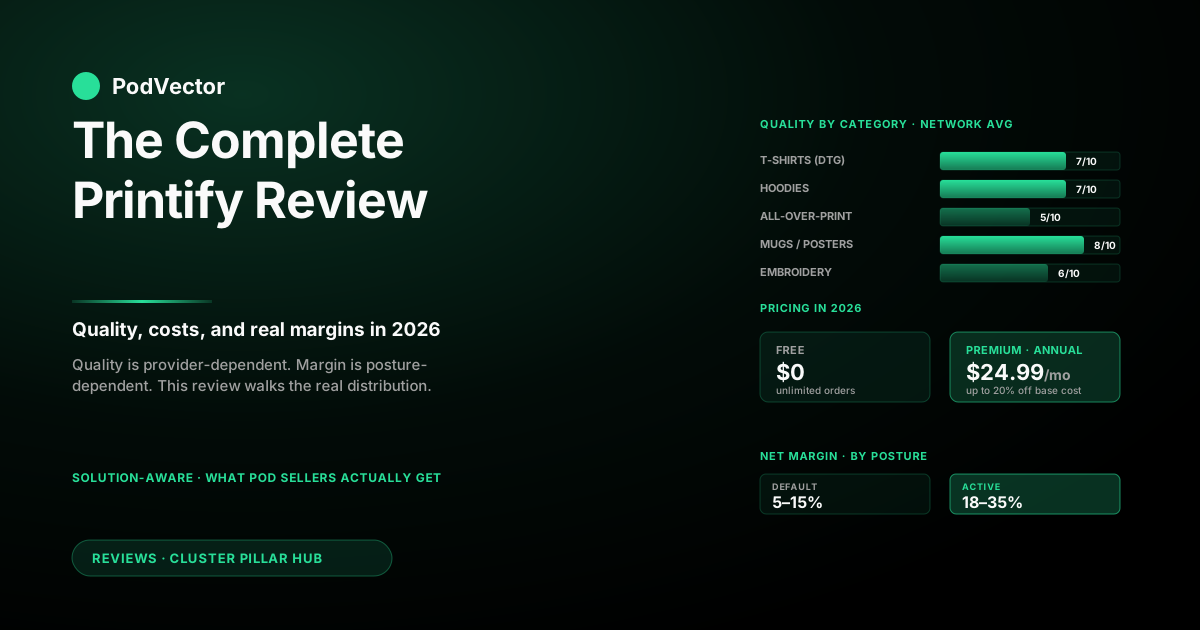
Quick Answer: Printify in 2026 is still the highest-margin infrastructure layer in print-on-demand, but "Printify" is less a product than a 90+ provider marketplace that you have to actively source across. Quality is provider-dependent, not platform-dependent — two sellers using the same SKU on Printify can land 9/10 and 5/10 prints depending on whether they picked Monster Digital or a bottom-quartile fulfiller. Pricing tiers are Free ($0, unlimited orders, list base costs) and Premium (now $39/mo month-to-month or $24.99/mo billed annually after the February 17, 2026 increase) with up to 20% off base cost — Premium pays for itself between 15–25 monthly orders depending on SKU mix.
Real net margins after base, shipping absorption, channel fees, and ad spend cluster at 5–15% for sellers who default to auto-routing and 18–35% for sellers who curate providers, run Premium, and price with intent. The verdict: recommend for margin-focused sellers willing to treat sourcing as an ongoing operation; skip if you want Printful's zero-thought consistency or Amazon Merch's hands-off royalty flow. This review walks through the marketplace mechanics, the real quality distribution, the landed cost math, the shipping performance, the integration surface, and the operational posture that separates a 5% Printify seller from a 30% one.
What Printify is (and what you're actually reviewing)
Most Printify reviews treat Printify as a single product and ask "is it good?" That framing misses what you're actually buying. Printify is a marketplace, not a printer. It operates the catalog, mockup generator, routing engine, and sales-channel integrations; 90+ independently-owned print providers do the actual production and shipping. When a review says "Printify's quality is inconsistent," the accurate restatement is that provider quality varies across the network and Printify the company does not enforce a tight floor. Conversely, when a review says "Printify's margins are the best in POD," what's really being said is that the marketplace's base-cost range dips below any single-supplier peer's floor because providers compete on price inside it.
This distinction shapes every conclusion in this review. If you buy the "Printify is a printer" framing, you'll walk away disappointed the first time a provider ships a misaligned DTG — you'll blame the platform for an outcome it didn't cause.
If you buy the "Printify is a sourcing platform" framing, you'll build the operational habit of sampling providers, scoring them, and routing intentionally — and you'll capture the 12–18% margin advantage that the marketplace model enables. For the full mechanical walkthrough of the platform, our complete Printify guide covers the 6-step seller workflow, and the complete guide to Printify for POD sellers sits as the topic-pillar hub this review links into.
What this review covers: the 2026 pricing after the February bump, the real quality distribution by product category, the shipping performance, the integrations, the actual net margin POD sellers retain, and the operational posture that separates high-margin Printify sellers from low-margin ones. What it doesn't: cherry-picked testimonials from Printify's own site, or vague "it depends on your niche" conclusions that make the review impossible to act on.
Pricing in 2026: Free vs Premium after the February bump
Printify's public pricing as of April 2026:
| Plan | Monthly | Annual | Product discount | Stores | Orders/mo |
|---|---|---|---|---|---|
| Free | $0 | $0 | None (list base cost) | Up to 5 | Unlimited |
| Premium | $39 | $299 ($24.99/mo) | Up to 20% off base | Up to 10 | Unlimited |
| Enterprise | Custom | Custom | Custom | Unlimited | 10,000+ |
The February 17, 2026 change was a $10/mo bump on the month-to-month Premium SKU (from $29 to $39). Crucially, annual Premium did not move — it remains $299/year, which works out to $24.99/mo and is now the obvious value SKU for any seller committed to more than a quarter. Enterprise pricing is opaque by design and kicks in around the 10,000 orders/month tier where operational support, dedicated account managers, and custom pricing actually move the needle.
The real Premium decision isn't the $39 sticker — it's the break-even math against the 20% product discount. On a Bella+Canvas 3001 with a ~$9 base cost, Premium shaves ~$1.50 off landed.
At 15–25 orders/month, the monthly Premium fee pays itself back; at 100 orders/month, Premium retains $150/mo in margin that Free-plan sellers leak. The cutoff is volume-dependent and SKU-dependent, but the decision becomes obvious above ~25 orders/month. For the granular break-even math by product, see our complete guide to Printify Premium for POD sellers and the broader Printify costs, fees, and discounts guide.
What the sticker pricing doesn't show: Printify takes no per-order commission, no royalty, and no listing fee. You pay base cost + shipping to Printify when the order fires; the retail-price spread is 100% yours to keep minus your sales channel's fees. That structure is what makes Printify margin-friendly relative to platforms like Amazon Merch (royalty model) or Redbubble (marketplace-tax model).
The 1,300+ SKU catalog: breadth vs depth
Printify's catalog holds roughly 1,300 products in 2026, spread across apparel (t-shirts, hoodies, sweatshirts, tanks, long sleeves, leggings, kids/baby apparel), accessories (hats, bags, socks, phone cases), home goods (mugs, pillows, blankets, wall art, posters, canvas prints), drinkware (tumblers, water bottles), pet products, and seasonal items. On raw breadth, Printify is the largest POD catalog on the market — roughly 2x Printful's active SKU count and materially wider than Gelato's.
The caveat that breadth hides: catalog depth is uneven by product type. The apparel section is densely populated (dozens of providers per garment, competitive base costs, real sourcing optionality).
The home-goods section is thinner — some specialty items have two or three providers, and losing one to a stockout can cascade. The accessories section is a mixed bag; phone cases are well-covered, specialty items (enamel pins, stickers, die-cuts) are shallow. A reviewer who browses the catalog on the homepage sees "1,300+ products" and concludes "unlimited product-market fit optionality." A seller who actually builds a catalog discovers that only ~200 SKUs have the provider depth to be production-safe for a scaling store.
The catalog's 2026 expansion direction is worth noting: Printify has been adding niche apparel (performance wear, sustainability-certified garments) and home-decor categories (framed posters, metal prints) rather than deepening provider coverage on existing SKUs. That's a demand signal — they're chasing breadth for acquisition, not depth for scaling sellers.
If your business depends on a handful of SKUs, verify there's three-provider redundancy before you commit. For product selection specifically by margin potential, our guide to Printify's most profitable products segments the catalog by what actually converts and retains margin.
The provider-selection problem (the core risk)
This is the section most Printify reviews gloss over and where the honest review lives. On any given SKU, Printify presents you with a list of 3–12 providers, each with their own base cost, production time, print method, shipping origin, and user-score rating. The platform's default "Printify Choice" routing will pick a provider for you based on availability and rating; most beginners accept this default. Accepting the default is the most common cause of the gap between Printify's advertised profitability and the margin sellers actually keep.
The per-SKU variance across providers on Printify in 2026:
- Base cost: spreads 10–20% for the same apparel SKU. A Bella+Canvas 3001 ranges from ~$8.50 to ~$10.50 before Premium discount depending on provider.
- Production time: ranges from 2 business days (fastest providers, US-domestic) to 7+ business days (specialty, all-over-print, embroidery). Auto-routing doesn't optimize for production time — it optimizes for availability.
- Print method: DTG vs DTF vs sublimation vs embroidery, all potentially offered for the same garment. Different methods produce materially different looks; a customer who ordered expecting DTG softness and received DTF heft will file a return.
- Shipping origin: decides landed delivery time. A US customer ordering from a Michigan provider sees 3–5 day delivery; from a Latvian provider, 10–14 days.
- Quality floor: top-quartile providers (Monster Digital, SwiftPOD, District Photo) are 9/10 consistency; bottom-quartile providers are 5–6/10 and post failures show up on r/PrintOnDemand most weeks.
Printify's own "Printify Choice" algorithm weighs provider ratings and stock availability, but does not weigh base cost or your preferred production cadence. Left to auto-routing, you will sometimes get a slower or more expensive provider than the best-available option.
The operational fix is to pin providers per SKU — explicitly lock each product to the specific provider you've sampled and verified — and re-evaluate quarterly. That single habit moves the typical Printify seller from the 5–15% margin band into the 18–35% band, and it's why this review treats provider selection as the highest-leverage decision you'll make on the platform.
Printify added an "Express Delivery" lane in 2024 that routes eligible orders to a subset of fast providers with SLA-backed delivery windows. It's useful for a specific use case (holiday rush, gift-hotspot SKUs) but charges a premium base cost and isn't a substitute for deliberate provider selection on your catalog.
Quality review by product category
Quality distribution across Printify's catalog in 2026, based on aggregated seller feedback and sample testing:
| Category | Top-provider quality | Network-average quality | Main failure mode |
|---|---|---|---|
| T-shirts (DTG) | 9/10 | 7/10 | Color accuracy on dark garments; wash fading after 10+ cycles |
| Hoodies & sweatshirts | 9/10 | 7/10 | Front-print alignment drift on oversized fits |
| All-over-print (AOP) | 7/10 | 5/10 | Seam misalignment; stretch distortion on polyester blends |
| Mugs (sublimation) | 9/10 | 8/10 | Rare, mostly edge-wrapping; consistent otherwise |
| Posters & wall art | 9/10 | 8/10 | Color cast on matte; shipping tube dents |
| Canvas prints | 8/10 | 7/10 | Frame-edge bleed on tight crops |
| Embroidery | 8/10 | 6/10 | Stitch density inconsistency between providers |
| Phone cases | 8/10 | 7/10 | Print wrap-angle inconsistency; color desaturation |
| Tumblers / drinkware | 7/10 | 6/10 | Heat-transfer color shift; finish durability varies |
Two takeaways. First, quality is strictly provider-dependent — the spread between top-provider and network-average is 2+ points on most categories, which is the gap between a five-star review and a refund request.
Second, the failure modes are consistent enough to build sampling protocols around them. For apparel, test color accuracy on dark garments and 10+ wash cycles before committing to a provider.
For AOP, test seam alignment on the specific size mix you plan to sell. For embroidery, order the same design from two providers and compare stitch density side-by-side.
The "sample rule" from top-ranked reviewers holds: budget $20–50 per SKU × provider combination you plan to scale, and treat samples as the cost of avoiding refunds later. A $30 sample that tells you a provider under-performs saves $500 in customer refunds across 50 orders.
Samples also double as photography assets for your storefront, which recovers some of the cost as content. The same operational discipline applies across brands — see our complete Printful review for how the comparable analysis plays out on an integrated-supplier model.
Shipping: times, zones, and what customers actually see
Shipping on Printify is the part that most reviews oversimplify. The actual landed delivery time is a function of three things: provider production time, shipping carrier/class, and provider-to-customer geography. Printify's marketing quotes "3–7 business days" for US domestic; the real distribution is wider.
US-domestic landed delivery (production + shipping):
- Fastest providers (Monster Digital, SwiftPOD, District Photo): 5–8 business days landed, consistent.
- Mid-tier providers: 7–12 business days landed, with a long tail from slow-moving SKUs.
- Specialty / AOP / embroidery providers: 10–15+ business days landed, routinely.
- International shipping (non-US customers): add 5–14 days depending on corridor; customs friction is the primary variable.
The customer-visible expectation problem: a US customer who orders on Monday evening will typically see "arrives in 3–5 days" messaging on the sales channel, then experience 5–10 days of actual production before shipping tracking updates. Managing that gap is a storefront communication problem, not a Printify problem — but it's yours to solve.
The practical fix is to display realistic estimates on your product pages ("Ships in 3–5 business days; delivered within 5–10 business days total") rather than relying on your sales channel's default delivery estimate, which is calibrated to inventoried retailers. The full deep-dive on shipping corridors, class choices, and international handling will live in our upcoming complete Printify shipping guide.
Integrations: the sales-channel surface
Printify's integration set is the deepest in POD. Native connections in 2026: Shopify, Etsy, eBay, Amazon, TikTok Shop, WooCommerce, Wix, Squarespace, BigCommerce, Walmart, PrestaShop, plus the built-in Pop-Up Store (lightweight showcase, not a commerce platform). The depth of the Shopify integration is the category leader — order sync, inventory sync, multi-variant support, and order-status webhooks all work without third-party middleware.
The Etsy integration in 2026 is solid on sync but constrained by Etsy's own platform dynamics (per-listing fees, review gating, category policy changes). TikTok Shop support has matured materially since 2024 and is now production-grade for sellers running TikTok-native ad motions.
Amazon and eBay integrations exist but are less commonly the primary channel — Amazon in particular favors Merch on Demand's royalty model over Printify's manage-your-own-listings workflow. Our complete Printify integrations guide covers per-channel setup, gotchas, and the order-sync edge cases that cause the most operational support tickets.
The gap worth naming: Printify's integration surface ends at order fulfillment. It does not integrate with profit-tracking stacks, ad-platform spend pulls (Meta, Google, TikTok Ads APIs), or channel-fee reconciliation.
That's an accounting/analytics layer Printify leaves to you, which is structurally why so many Printify sellers run at a profit they can't actually see — the landed-cost data and the retail-revenue data live in different tools. This is the visibility problem PodVector AI's Victor was built to close: a warehouse-backed agent that unifies your Printify cost data, channel revenue, and ad spend into one contribution-margin view per order and per SKU.
Real margins: the profit math most reviews skip
Reviews love to quote "30–50% margins" without defining which margin. The useful metric is net contribution per order after base cost, shipping absorption, channel fees, and ad spend. On a $24.99 t-shirt sold on Shopify, the real distribution:
| Operating posture | Net per order | Net margin | Monthly net at 200 orders |
|---|---|---|---|
| Default: Free plan, auto-routed provider, flat pricing | $2–$4 | 8–15% | $400–$800 |
| Active: Premium, pinned providers, intent pricing | $5–$8 | 20–32% | $1,000–$1,600 |
| Optimized: bundles, upsells, tracked attribution, top-tier providers only | $7–$11 | 28–44% | $1,400–$2,200 |
The jump from Default to Active is the high-value operational change on the list — it typically doubles net margin per order. The jump from Active to Optimized requires structural moves (AOV growth via bundling, correctly attributed ad spend, provider-quality discipline) that take quarters, not weeks. Most sellers stay in the Default band longer than they should because they can't see per-order margin without exporting Printify's order data, joining it to Shopify's revenue data, and subtracting Meta/Google ad spend — a three-tool manual export that almost no seller runs weekly.
This is the margin-visibility ceiling that Victor, PodVector AI's AI employee, was built to dissolve. Victor keeps your Printify order costs, Shopify revenue, and your Meta and Google ad spend together, so he can tell you the true profit on each order. Then he answers questions like "which of my Printify providers has the highest net margin this month?" and "which SKUs are losing money after ad spend?" in plain language.
The employee roadmap is to move from answering the margin question to acting on it — auto-suggesting provider swaps, pricing adjustments, and SKU retires based on the same data. Our complete Printify profitability analysis has the full breakdown of the volume-tier math, the five hidden margin killers, and the five levers profitable Printify sellers actually pull.
Pros and cons after 200+ fulfilled orders
What Printify gets right:
- Lowest landed cost in POD when you actively source, especially on apparel. The marketplace model compresses base-cost floors in a way single-supplier platforms cannot match.
- Catalog breadth at 1,300+ SKUs enables fast product-market-fit testing. A new seller can launch 30 SKUs across categories in a weekend and read the demand signal cheaply.
- Integration depth, especially Shopify, Etsy, and TikTok Shop, is production-grade.
- No order commission or royalty. The retail-price spread is fully yours after base cost + shipping.
- Free plan is generous — unlimited orders, 5 stores, full catalog access. The cheapest way to validate an idea in POD.
- Premium pays back fast at ~25 orders/month, and annual Premium at $24.99/mo is one of the best-value SKUs in the POD stack.
What Printify gets wrong:
- Quality variance is real and unsolved. Providers churn in and out of the network; a provider you sampled six months ago may no longer be the same provider's same team.
- Auto-routing does not optimize for margin. The default behavior leaves money on the table.
- Mid-fulfillment re-routing happens silently when a provider goes low-stock — you find out from the shipping notification, not a pre-warning.
- No native profit visibility. Printify shows gross order economics; it does not reconcile channel fees or ad spend. You have to build or buy the margin layer.
- International shipping remains uneven. EU and UK have improved materially in 2025–2026, but ROW corridors still cause support tickets.
- Express Delivery charges a premium and is narrower than the marketing suggests — it's a specific-SKU tactical tool, not a catalog-wide SLA.
Printify vs Printful: the honest head-to-head
The two platforms solve the same problem differently. Printful is vertically integrated — they own their own print facilities, enforce their own QA floor, and charge a premium for that consistency. Printify is a marketplace — higher ceiling, lower floor, more operational load on the seller. The honest choice:
| Criterion | Printify | Printful |
|---|---|---|
| Base cost | Lower (10–20% below Printful on apparel, when provider-selected) | Higher, more stable |
| Quality consistency | Provider-dependent; 5–9/10 spread | Integrated; 8–9/10 consistent |
| Catalog size | ~1,300 SKUs | ~400 SKUs |
| Production speed | Provider-dependent; 2–7 business days | 2–5 business days, consistent |
| Branding options | Neck labels, inserts via select providers | Broader: pack-ins, branded labels, custom packing |
| Pricing floor | Free plan w/ unlimited orders | Free plan w/ 3-store limit in 2026 |
| Operational load | High (provider selection, sampling, monitoring) | Low (pick product, upload, done) |
| Best fit | Margin-focused sellers scaling on apparel | Brand-focused sellers, retail-ready fulfillment |
The oversimplified but honest rule: if your bottleneck is margin, pick Printify and do the sourcing work. If your bottleneck is time or brand consistency, pick Printful and pay the integrated premium. For direct-to-consumer scaling brands with dedicated operations headcount, most end up running both — Printify for core apparel margin and Printful for branded specialty runs. See Merch Titans' 2026 Printify review for an alternative read on the head-to-head from an ecommerce-operator perspective, and our Printify alternatives comparison for how both stack up against Gelato, Gooten, and the long tail of 2026 POD challengers.
Who Printify is for (and who should avoid it)
Printify is the right call for:
- Margin-focused sellers scaling apparel on Shopify, Etsy, or TikTok Shop — the base-cost advantage is largest where Printify's catalog is deepest.
- Operators willing to sample providers, pin them per SKU, and re-evaluate quarterly.
- Early-stage sellers validating product-market fit across many SKUs cheaply — the Free plan and catalog breadth make $0 validation possible.
- Sellers with existing analytics stacks (or Victor) that reconcile landed cost against channel revenue and ad spend, so the low base cost actually translates into retained margin.
Printify is the wrong call for:
- Sellers who want zero operational load on sourcing — Printful's integrated model is the better buy despite the cost premium.
- Brands with strict QA tolerances (e.g., retail partnerships, influencer drops with print-quality guarantees) — use Printful or a contract manufacturer.
- Amazon-first sellers — Merch on Demand's royalty model eliminates inventory and listing work Printify leaves to you.
- Sellers unwilling to budget $100–500 upfront for provider sampling — without it, you're scaling on faith and will learn the quality floor through refund volume.
Verdict and operational checklist
Our verdict: Printify in 2026 remains the highest-ceiling POD platform for margin-focused sellers, and the lowest-floor one for inattentive sellers. The platform itself deserves an 8.5/10 — excellent catalog, best-in-class integrations, fair pricing after the February bump, and a provider-optionality architecture that compounds in your favor if you work it. It does not deserve the "just works" framing Printify's marketing implies; the operational load is real and the difference between a 5% and 30% net margin is almost entirely in how you source and monitor providers.
The operational checklist for a Printify seller starting in 2026:
- Start on the Free plan. Validate your first 5–10 SKUs at zero fixed cost. Move to annual Premium ($24.99/mo) once you hit 25 consistent orders/month on any single product.
- Sample every provider on every SKU you plan to scale. Budget $20–50 per SKU × provider. Treat samples as photography assets too.
- Pin providers per SKU. Never rely on Printify Choice for scaling products; it optimizes for availability, not margin.
- Build the margin layer. Either manually reconcile Printify cost + channel revenue + ad spend weekly, or use Victor to do it in live-data. Decisions made on gross margin alone consistently overstate profitability.
- Re-evaluate providers quarterly. Run a refresh sample once per quarter; providers drift, and the one you picked in January may be mid-tier by April.
- Price with intent, not instinct. Back-solve from a target net margin (say, 25%) to a retail price — don't anchor on Printify's suggested pricing, which is calibrated to volume, not retention.
FAQs
Is Printify actually free?
Yes. The Free plan costs $0/mo, has no order limit, gives access to the full catalog, and supports up to 5 connected stores. You only pay Printify when an order fires — base cost plus shipping. No credit card is required at signup. The Free plan is the cheapest way to validate a POD idea in 2026.
Is Printify Premium worth it?
Above ~25 orders/month on a single product line, yes. Premium is $39/mo month-to-month or $24.99/mo billed annually, and returns up to 20% off base cost.
On a typical apparel SKU, that's ~$1.50/order retained margin — so 25 orders/month covers the monthly fee and anything beyond is pure retained profit. Our dedicated Premium breakdown walks through the break-even math by SKU.
Is Printify quality reliable?
Provider-dependent, not platform-dependent. Top-quartile providers (Monster Digital, SwiftPOD, District Photo) ship 8–9/10 consistently; bottom-quartile providers produce the r/PrintOnDemand failure posts. The single operational habit that solves this is sampling every provider before scaling a SKU and pinning the winner.
How long does Printify actually take to ship?
US-domestic landed delivery (production + shipping) runs 5–8 business days with the fastest providers, 7–12 with mid-tier, and 10–15+ on AOP/embroidery/specialty. International delivery adds 5–14 days depending on corridor. The marketing-quoted "3–7 days" is production time only and misleads customers if you display it as delivery time on your storefront.
What's the net margin I should actually expect on Printify?
5–15% if you default to Free plan + auto-routed providers + instinct pricing. 18–35% if you run Premium, pin curated providers, and price with intent. The operational posture matters more than the platform — the same SKU on the same platform can return 8% or 28% margin depending on the decisions surrounding it.
Printify or Printful — which is better?
Printify if your bottleneck is margin and you're willing to manage provider selection. Printful if your bottleneck is time, brand consistency, or retail-ready fulfillment. Many scaling brands run both. See our full Printful review and Printify alternatives for the head-to-head.
Does Printify charge me or the customer?
Printify charges you, the seller, when an order fires. The customer pays your retail price through your sales channel (Shopify, Etsy, etc.); Printify then deducts base cost + shipping from your linked payment method. The retail-to-cost spread minus channel fees and ad spend is your margin. See our dedicated explainer on Printify's billing flow.
Can I use Printify with Amazon?
Yes, Printify has an Amazon integration, but Amazon's Merch on Demand royalty model is usually the better fit for Amazon-first sellers because it eliminates inventory and listing management. Printify-to-Amazon works best for sellers who already run Amazon as a secondary channel behind Shopify or Etsy.
See your real Printify margins in one view
Printify's low base cost is only half the margin story — the other half is your channel fees, ad spend, and returns reserve, which Printify won't show you. Victor, PodVector AI's POD-margin agent, pulls your Printify orders, Shopify revenue, and Meta/Google ad spend into a single live-data view and answers "which provider is keeping the most margin this month?" in plain English.
Try Victor free