
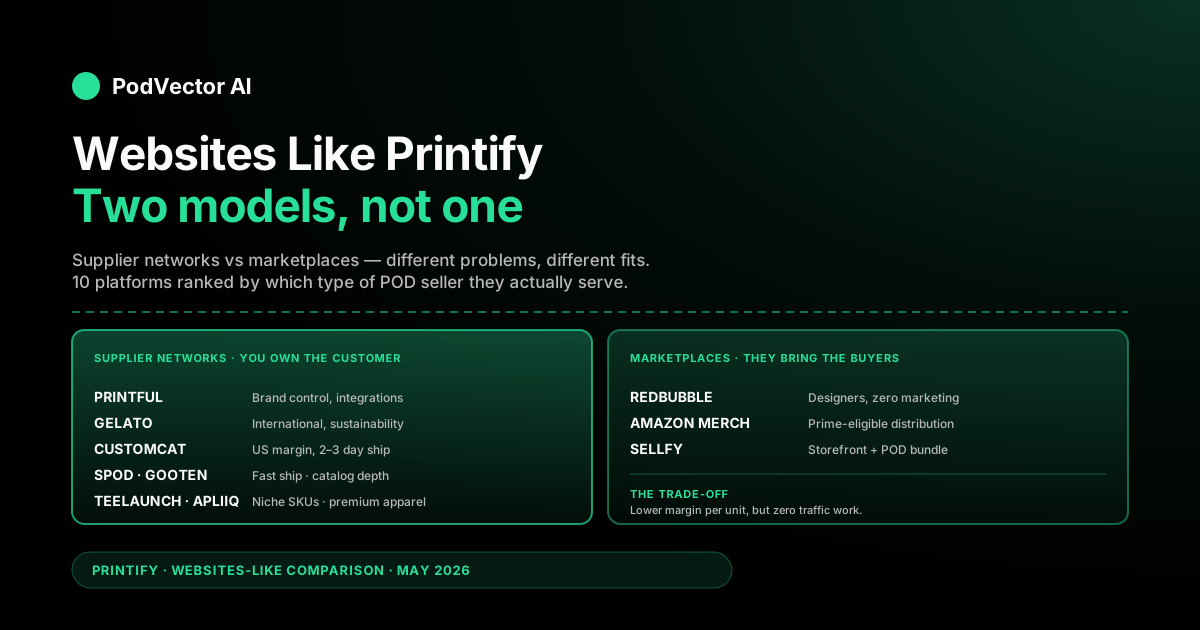
Quick Answer: The 10 best websites like Printify in 2026 are Printful, Gelato, CustomCat, Gooten, SPOD, Teelaunch, Apliiq, Sellfy, Redbubble, and Amazon Merch on Demand. Printful is the closest 1:1 swap, Gelato wins international, CustomCat wins US margin, and the rest cover niche edges like premium streetwear, marketplace traffic, or Prime distribution.
"Websites like Printify" actually splits into two categories: supplier networks you plug into your own store (Printful, Gelato, CustomCat) and marketplaces that bring their own buyers (Redbubble, Amazon Merch, Zazzle). They solve different problems.
This guide compares both, ranks them by which type of POD seller they fit best, and shows where each one beats Printify on real margin — not just on feature lists. (For Printful's own take on Printify alternatives, the Printful blog roundup is a useful counterpoint.)
The two types of "websites like Printify"
When sellers search for "websites like Printify," they usually mean one of two very different things. Getting the category right matters more than the platform pick inside it.
Supplier networks. Printify itself is a supplier network — you bring the storefront (Shopify, Etsy, your own site), they handle print and ship. Printful, Gelato, CustomCat, Gooten, SPOD, Teelaunch, and Apliiq are all supplier networks. You own the customer, the brand, and the margin.
Marketplaces. Redbubble, Zazzle, Amazon Merch on Demand, and Spring are marketplaces. You upload designs, they handle everything — including bringing the buyers. Lower margin, less control, but zero marketing work.
If your problem is "Printify's print provider lottery hurt my brand," you want a supplier network with vertical integration. If your problem is "I can't drive traffic to my Shopify store," you want a marketplace. Mixing the two solves neither.
This guide covers seven supplier networks and three marketplaces, with a clear note on which model each one is.
How to evaluate any Printify-style website
Feature lists are the wrong frame. A platform with 900 products and 32 integrations can still lose money on every order you ship. POD economics come down to five variables, in order of margin impact.
Base cost per SKU. The blank plus the print plus the platform's cut. A $0.50 difference per shirt is $500 across 1,000 orders — usually larger than any subscription fee you'll ever pay.
Shipping cost into your top three destinations. Not the global average. The cost into the three countries that drive most of your volume. Gelato wins in Europe, CustomCat wins in the US, and the rest depend on geography.
Actual fulfillment speed. The advertised window is marketing. The actual window shows up in your tracking data after 200 orders. Most platforms slip 1–2 business days against their published number.
Defect and reprint rate. Industry baseline is 2–4% returns or reprints. Anything above 5% on a single platform burns more margin than any pricing difference can recover.
Integration fit with your storefront. A perfect Shopify integration is worthless if you sell on Etsy and the platform's Etsy app sync breaks weekly. Match the integration depth to where you actually sell.
Every platform below is rated against these five, not against a generic feature checklist.
The 10 best websites like Printify in 2026
Ranked roughly by how often each one is the right answer for a typical POD seller leaving Printify. Read the "best for" tag — the right pick depends on which Printify problem you're solving.
1. Printful — best overall alternative
Model: Supplier network. Best for: sellers who want one brand-friendly producer instead of Printify's 100+ partner lottery.
Printful is the closest 1:1 swap for Printify and the most-recommended alternative for a reason. It owns its fulfillment centers in the US, Mexico, Spain, Latvia, Japan, and Australia, which means consistent print quality on every order — not "depends on which provider got it." (For a deeper read on where Printify itself stands today, see our complete Printify review.)
The catalog hits ~370 products, narrower than Printify's 900+ but wider than most vertically integrated competitors. Integrations cover Shopify, Etsy, WooCommerce, eBay, Wix, Squarespace, Amazon, TikTok Shop, and 20+ others.
Where it beats Printify: branding (inside labels on most apparel, custom pack-in inserts, branded packaging on select tiers), consistency (one printer per region, not a marketplace), and integration depth.
Where it loses: base costs run 10–25% higher than Printify on common SKUs like the Bella + Canvas 3001 tee. You're paying for the consistency premium.
Pricing: free to start. No monthly fee. Printful Growth ($24.99/mo, 30% off branding) and Printful Business ($49.99/mo, broader discounts) become worthwhile around 50+ orders/month.
2. Gelato — best for international sellers
Model: Supplier network. Best for: sellers whose top destinations include Europe, the UK, Australia, or anywhere outside the US.
Gelato runs a network of 130+ local print partners across 32 countries. Orders route to the closest facility automatically, which cuts shipping time and cost — a German customer's order prints in Germany, not Las Vegas. We break the two head-to-head in Printify vs Gelato.
The product catalog is narrower than Printify (~200 products, heavy on apparel, wall art, mugs, and stationery), and the Shopify/Etsy integrations are mature but not as deep as Printful's.
Where it beats Printify: international shipping (often $4–7 cheaper per order to EU destinations), faster delivery in non-US markets, and a genuinely better sustainability story for brands that care.
Where it loses: US-only sellers see no real benefit over Printify, and the catalog gap shows on accessories and home goods.
Pricing: free to start. Gelato+ ($14.99/mo) and Gelato+ Gold ($119/mo) unlock per-product discounts; Gold pays back around 100+ orders/month.
3. CustomCat — best for US margin
Model: Supplier network. Best for: high-volume US sellers whose hero SKUs are eating margin on Printify.
CustomCat operates its own facilities in Michigan and Pennsylvania and ships most US orders in 2–3 business days. Base costs on common apparel run 15–30% below Printify, which is enormous once a single design starts moving 50+ units a month.
The catalog covers 550+ products, including hard goods like drinkware, jewelry, and home decor — broader than Printful, narrower than Printify.
Where it beats Printify: raw base cost on common SKUs, US fulfillment speed, and a far simpler "one printer" experience compared to Printify's provider rotation.
Where it loses: international shipping is weak (US-only production), and the Shopify/Etsy integrations are functional but not best-in-class.
Pricing: free plan, plus CustomCat Pro ($30/mo) for deeper per-unit discounts. Pro pays back fast for any seller doing 100+ orders/month.
4. Gooten — best for diverse catalog
Model: Supplier network. Best for: sellers expanding beyond apparel into homeware, accessories, and stationery.
Gooten runs a 50+ manufacturer network across 70+ regions, similar in structure to Printify but with a heavier mix of homeware: bedding, wall art, drinkware, pet products, doormats. The catalog hits 280+ items, and many are categories Printify covers thinly or not at all.
The Shopify, Etsy, and BigCommerce integrations are reliable; the Gooten dashboard is dated but functional. Most sellers use Gooten as a supplementary supplier for hard-goods categories, not as a Printify replacement.
Where it beats Printify: catalog depth in homeware and accessories, and a single-API option for sellers building custom integrations.
Where it loses: apparel base costs are roughly Printify-equivalent (no margin win there), and the UI looks five years behind Printful's.
Pricing: free to start. No subscription tier — you pay per product.
5. SPOD — best for fastest fulfillment
Model: Supplier network. Best for: sellers whose customers complain about Printify shipping times.
SPOD (the on-demand arm of Spreadshirt) advertises 48-hour production on most US and EU orders — the fastest published window in the category. Real-world data backs this up; SPOD slips less against its published time than most competitors.
The catalog is narrower (~200 products, heavy apparel focus), and the integrations cover Shopify, WooCommerce, Order Desk, and a smaller set of niche tools.
Where it beats Printify: raw fulfillment speed, especially in Europe (orders printed in Germany and the Czech Republic), plus competitive base costs on the apparel categories it does carry.
Where it loses: limited product range outside apparel and accessories, and no marketplace-style supplier rotation if a facility goes down.
Pricing: free, no subscription. You pay per product at advertised wholesale rates.
6. Teelaunch — best for niche products
Model: Supplier network. Best for: sellers who want product categories nobody else carries.
Teelaunch's edge is unusual SKUs: customizable Bluetooth speakers, wireless chargers, kitchen knives, cutting boards, jewelry boxes, and other items most POD platforms ignore. For a seller in a specific niche (camping, kitchen, music), Teelaunch can carry the one product Printify doesn't.
The Shopify and Etsy integrations are solid; the catalog of apparel and standard mugs is small and unremarkable.
Where it beats Printify: unique product categories that let a niche store sell things no other POD competitor can match.
Where it loses: on apparel and core POD products, Teelaunch is unremarkable. Use it as a supplement, not a replacement.
Pricing: free, no subscription.
7. Apliiq — best for premium streetwear
Model: Supplier network. Best for: brand-builders selling cut-and-sew apparel, hoodies with custom labels, and streetwear-grade product.
Apliiq specializes in higher-quality apparel with branding options Printify cannot match: woven labels, neck tags, hem tags, pocket prints, sleeve prints, and full cut-and-sew options. The garments cost more, but the perceived quality lets sellers charge $45–80 for a hoodie instead of $32.
The Shopify integration is the primary path; Etsy and custom integrations exist but feel secondary.
Where it beats Printify: apparel quality, branding depth, and the ability to charge premium prices on hoodies and heavyweight tees.
Where it loses: higher base costs, slower fulfillment (5–7 days standard), and a narrow product range outside apparel.
Pricing: free to start. The premium pricing model is built into per-unit costs.
8. Sellfy — best storefront-included
Model: Storefront with built-in POD. Best for: sellers without a Shopify store who want a quick storefront-plus-supplier combo.
Sellfy is unusual on this list — it's a hosted storefront with a built-in print-on-demand catalog. You don't need Shopify or Etsy; Sellfy handles the cart, checkout, and supplier in one product.
The POD catalog is smaller than dedicated suppliers (~50 products), and you're paying both a Sellfy subscription and the per-product POD cost. The trade-off is speed: you can launch a POD store in a couple of hours instead of a couple of weeks.
Where it beats Printify: the time from "I have a design" to "I have a working store" — Printify still requires a separate storefront like Shopify or Etsy.
Where it loses: product range, integration ecosystem, and long-run margin (the bundled approach costs more once volume scales).
Pricing: Starter ($29/mo), Business ($79/mo), Premium ($159/mo). The free trial is 14 days.
9. Redbubble — best marketplace alternative
Model: Marketplace. Best for: designers who'd rather upload work than run a store.
Redbubble is the largest POD marketplace by buyer volume — millions of shoppers browse the site directly looking for designs. Sellers upload artwork, set a markup, and Redbubble handles everything else: production, shipping, support, returns, and crucially, traffic. For a full side-by-side, see Printify vs Redbubble.
Margins are lower than supplier networks (you might net $2–5 per shirt instead of $8–15), but the seller does zero marketing. For artists with strong work and weak marketing skills, Redbubble can pay better than running a self-driven Shopify store.
Where it beats Printify: built-in buyer traffic and zero-effort fulfillment. There is no store to manage.
Where it loses: margin per unit, brand control (it's Redbubble's brand on the receipt), and the ability to build a customer list you own.
Pricing: free to sell. You set markup percentage; Redbubble keeps the base.
10. Amazon Merch on Demand — best for Prime distribution
Model: Marketplace (invite-tiered). Best for: US sellers who want Prime-eligible POD without running an Amazon FBA business.
Amazon Merch on Demand lets approved sellers upload designs onto Amazon-fulfilled apparel. The listings are Prime-eligible, meaning the same 2-day delivery customers expect from any Amazon product — a distribution advantage no other POD platform can touch.
The catch is the invite-tier system: new accounts start at Tier 10 (10 designs total) and earn higher tiers by making sales. The catalog is narrow (mostly T-shirts, hoodies, PopSockets, sweatshirts), and royalties run lower than supplier-network margins.
Where it beats Printify: Prime shipping eligibility and access to Amazon's buyer base.
Where it loses: tier-gated upload limits, narrow product range, and royalty math that rarely beats a Shopify-plus-Printify setup at scale.
Pricing: free. Royalties are paid per sale on a published schedule.
Side-by-side comparison table
Headline differences at a glance. "Base cost" is relative to Printify on a Bella + Canvas 3001 tee at print-ready volume.
| Website | Model | Base Cost vs Printify | US Speed | Intl Speed | Best For |
|---|---|---|---|---|---|
| Printful | Supplier | +10–25% | 3–5 days | 5–8 days | Brand control |
| Gelato | Supplier | Even / -5% | 3–5 days | 2–5 days | International |
| CustomCat | Supplier | -15–30% | 2–3 days | 7–14 days | US margin |
| Gooten | Supplier | Even | 3–6 days | 5–10 days | Catalog depth |
| SPOD | Supplier | -5–10% | 2–3 days | 2–4 days (EU) | Fastest ship |
| Teelaunch | Supplier | Varies | 3–7 days | 7–14 days | Niche products |
| Apliiq | Supplier | +30–60% | 5–7 days | 8–14 days | Premium apparel |
| Sellfy | Storefront+Supplier | Even (+ sub) | 3–5 days | 5–10 days | No-store sellers |
| Redbubble | Marketplace | N/A (royalty) | 3–7 days | 7–14 days | Designers, no store |
| Amazon Merch | Marketplace | N/A (royalty) | 2 days (Prime) | Limited | Prime distribution |
Which website is best for your seller profile?
Use the closest match. The right pick depends more on the seller than the platform.
If you sell on Etsy and ship mostly to the US: CustomCat or SPOD. Both undercut Printify on US base cost, and both have Etsy integrations that work without weekly babysitting. (Considering Etsy's own POD options? Read Printify vs Etsy first.)
If you sell on Shopify and ship internationally: Gelato. The local production network drops EU shipping costs enough to recover any per-unit cost gap, and the integration is one of the most mature on Shopify.
If you're building a real apparel brand: Printful or Apliiq. Printful for breadth and consistency, Apliiq for premium streetwear price points.
If you don't have a store and don't want to build one: Sellfy (storefront-included) or Redbubble (marketplace, zero marketing). They solve different versions of "I don't want to run Shopify."
If you need product categories Printify doesn't carry: Teelaunch (electronics, kitchen, jewelry) or Gooten (homeware, bedding, pet).
If you want Prime-eligible delivery on POD apparel: Amazon Merch on Demand. Nothing else competes on this specific axis.
For most sellers, the answer is a combination — Printify for breadth, Printful or CustomCat for hero SKUs once volume justifies the switch. For the full landscape of POD comparisons in this cluster, see our Printify comparison hub, or browse everything Printify-related on the Printify topic hub.
The hidden cost most "alternatives" lists miss
Every "websites like Printify" roundup ranks platforms in the abstract. The number that actually matters is profit per SKU on your specific catalog, at your sales volume, shipping to your top countries — and no public comparison table can answer that.
A Bella + Canvas 3001 tee is cheaper on CustomCat than Printify. But if 60% of your buyers are in the UK, CustomCat's $9 international shipping wipes out the base-cost win. Gelato might net you $4 more per order even though its base cost looks identical to Printify on paper. (For the shipping cost reality on Printify itself, see our guide to Printify shipping.)
The right way to compare is to run the math against your actual sales mix, not the supplier's marketing claims. Pull your last 90 days of orders, tag each one with destination and SKU, and re-cost the same orders under each supplier's published price list and shipping table.
Most sellers don't do this because it's tedious. The ones who do find the right supplier for each hero SKU and split fulfillment by product — Printify for low-volume SKUs, Printful for branded apparel, CustomCat for hero tees, Gelato for international orders.
This is where an AI employee pays for itself. Hook your sales data and the supplier price tables into a single source of truth, ask "which supplier nets the most margin per order on each of my top 20 SKUs?" — and route accordingly.
How to test a new website without breaking your store
Switching suppliers is risky if you do it all at once. Run a controlled test instead.
Pick one SKU. Ideally a hero product that moves 30+ units a month and where margin matters. Don't test on a slow-moving design — the sample size will be too small to draw conclusions.
Duplicate the listing. Create a parallel product on the new supplier's catalog with the same design, mockups, and price. Most platforms let you keep both products live or A/B route orders.
Run 50–100 orders. Track three numbers: actual fulfillment time, defect/reprint rate, and net margin per order. This is the dataset you'll never get from a comparison blog.
Decide on real numbers. If the new supplier nets $3 more per order and ships in the same window, switch. If margins are tied but fulfillment is slower, stay. Don't switch on a hunch — switch on data.
Keep Printify as fallback. Even after you switch, leaving the Printify integration active means you can re-route orders in 60 seconds if the new supplier has a fulfillment crisis. Single-supplier dependency is the actual risk to manage.
FAQs
Is Printful better than Printify?
Printful has higher base costs but more consistent quality, better integrations, and deeper branding. Printify has a wider catalog and lower prices. Most established brands eventually use both — Printify for breadth, Printful for hero SKUs.
What's the cheapest website like Printify?
CustomCat is usually the cheapest for US apparel, running 15–30% below Printify on common SKUs. SPOD is competitive in Europe. Both undercut Printful by a wide margin.
What's the best free alternative to Printify?
Printful, Gelato, CustomCat, Gooten, SPOD, Teelaunch, and Apliiq are all free to start with no monthly fee required. Subscriptions on these platforms unlock discounts but aren't necessary for low-volume sellers.
Are marketplaces like Redbubble better than supplier networks like Printify?
They solve different problems. Marketplaces handle traffic but cap your margin. Supplier networks give you full margin but you handle marketing. Pick based on whether your weakness is traffic or fulfillment, not which is "better" overall.
Can I use Printify and an alternative at the same time?
Yes — most established POD sellers run two or three suppliers in parallel. Apparel on one, hard goods on another, international orders on a third. Multi-supplier routing is the most common pattern at scale.
What's the closest 1:1 swap for Printify?
Printful. Same supplier-network model, similar Shopify/Etsy integrations, similar product mix. The main differences are vertical integration (better quality consistency) and higher base costs.
Which website is best for selling internationally?
Gelato. The 32-country production network means orders print near the customer, which cuts shipping costs and delivery times by 40–60% compared to Printify's mostly-US routing.
How do I switch from Printify to another website without losing sales?
Don't switch all at once. Run a 50–100 order test on a single hero SKU first, track fulfillment speed and defect rate, then migrate one product line at a time. Keep the Printify integration active as a fallback.
Stop guessing which supplier wins your margin
Every supplier comparison online ranks platforms in the abstract. Your margin depends on which one nets the most profit on your actual orders — your SKUs, your destinations, your volume.
Victor is the AI employee for POD sellers. Connect your store and Victor models every order against every supplier's pricing, then tells you which one would have netted more per order. Per product. Per region. Per month.
Ask Victor: "Which supplier would be more profitable for my top 10 products?" — and get a real answer with real numbers from your real sales data.
Try Victor free