
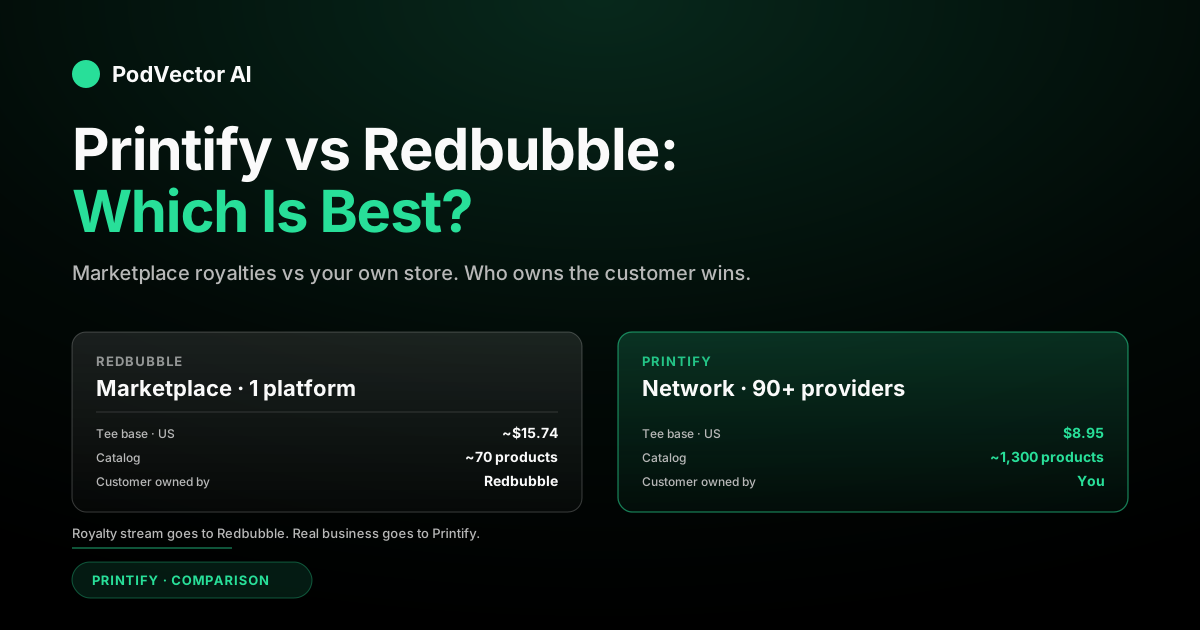
Quick Answer: Printify and Redbubble look like the same thing on the surface but they sit in different categories. Redbubble is a marketplace — buyers shop on redbubble.com, you upload art, Redbubble owns the customer, the brand, and most of the margin. You're an artist on a platform.
Printify is a fulfillment network for your own store — you sell on Shopify, Etsy, TikTok Shop, or your own site, and Printify routes orders to one of 90+ print providers. You own the customer, the brand, and the margin.
If you want zero operational effort and you're happy being one of millions of artists in a search engine, Redbubble wins on simplicity. If you're trying to build a real POD business with control over price, brand, and profit, Printify wins by a wide margin — usually 2–4x the take-home per shirt.
Printify vs Redbubble at a glance
The two platforms are not really competing for the same operator. This table makes the split obvious — every row gets unpacked below.
| Axis | Redbubble | Printify |
|---|---|---|
| Model | Marketplace — buyers shop on redbubble.com | Fulfillment network — you sell, Printify prints |
| Who owns the customer | Redbubble | You |
| Where you sell | redbubble.com only | Shopify, Etsy, TikTok Shop, WooCommerce, your own site |
| Monthly fees | None | Free tier; Premium $24.99/mo unlocks ~20% off base costs |
| Catalog size | ~70 products | ~1,300 products across apparel, home, drinkware, accessories |
| Print network | Centralized — Redbubble's own production partners | 90+ providers, 140+ global locations |
| Profit model | You set a markup on Redbubble's base; they take the rest | You set retail, pay base + shipping, keep the difference |
| Bella+Canvas tee, US base | ~$15.74 (Redbubble's base, your markup on top) | $8.95 (Premium) / $10.95 (Free) |
| Typical margin on a $24.95 tee | ~$5–9 (depending on markup tier) | ~$11–16 (depending on plan and provider) |
| Customer support | Redbubble handles it | You handle it (Printify replaces production defects) |
| Best for | Artists who want zero operational lift | Sellers building a real, branded POD business |
The fundamental difference: marketplace vs supplier network
Most vendor comparisons treat Printify and Redbubble as two flavors of the same thing. They're not. The category difference shapes every other answer on this page.
Redbubble is a marketplace. Buyers go to redbubble.com, search "vintage cat poster," and Redbubble shows them thousands of designs from thousands of artists. You upload art, the marketplace handles everything else, and Redbubble pays you a royalty when something sells.
You don't have a store. You have an artist profile. The customer is shopping on Redbubble, not at your brand.
Printify is a fulfillment network. You already have a store somewhere — Shopify, Etsy, TikTok Shop, your own site — and Printify is the production layer that prints and ships when you sell. The customer is shopping at your brand. Printify is invisible to them.
This is the single most important fact in this comparison. Everything else — pricing, margin, catalog, support — flows from this category split.
What is Redbubble?
Redbubble is an Australia-founded online marketplace launched in 2006. It sells art-printed products — shirts, stickers, posters, phone cases, mugs — from independent artists to consumers worldwide.
The artist's job is to upload designs. Redbubble's job is everything else: storefront, search, payments, printing, shipping, customer service. The artist gets a royalty when something sells.
The platform has roughly 70 product types and a strong organic search presence — millions of buyers a year shop on Redbubble directly, mostly for stickers, posters, and apparel with niche fandom or aesthetic designs.
Two structural facts to keep in mind. First, you don't set the retail price directly — you set a markup percentage above Redbubble's base price, and they handle the retail math. Second, you don't see who bought from you. No email list. No retargeting. No customer relationship.
What is Printify?
Printify is a print-on-demand fulfillment network founded in 2015, not a storefront. You sell wherever you already sell — Shopify, Etsy, TikTok Shop, eBay, WooCommerce, your own site — and Printify sits in the background as the production layer.
When an order comes in, Printify routes it to one of 90+ independent print providers across 140+ global locations. The provider prints the item, ships it under your brand, and Printify charges you the base cost plus shipping.
The Free plan is free — no monthly fee — and most sellers eventually upgrade to Premium at $24.99/month to unlock up to 20% off base costs. That breakeven typically hits around 30–40 orders per month for an apparel catalog.
Printify is the operator's tool. You own the customer relationship, the brand, the data, and the margin. You also own the customer support inbox.
Pricing and profit margins
This is where the two platforms diverge most sharply.
Redbubble's pricing
Redbubble starts with a base price per product. A standard short-sleeve tee sits around $15.74. You add a markup percentage on top — typically 10–25% for most artists.
If you set a 20% markup on a $15.74 tee, the retail price becomes ~$18.89 and you earn ~$3.15. If you push markup higher to lift your take, the retail price climbs and your conversion rate usually drops because buyers compare designs across the marketplace.
Redbubble also runs frequent site-wide discounts — 20%, 30%, sometimes 40% off — which they fund partly out of artist margin. Your earnings can take a real hit during sale periods, and you don't get to opt out.
Printify's pricing
Printify is free to start. The Free plan gives you the full catalog at standard base costs. Premium at $24.99/month unlocks up to 20% off — that same Bella+Canvas tee drops from $10.95 to $8.95 in the US catalog.
The math on Premium: if you net an extra $2 per shirt on 30 shirts a month, Premium pays for itself and starts compounding. Most sellers crossing 50 orders/month should be on Premium. For the full subscription math, see our Printify Premium plan price breakdown and the Premium pricing teardown.
There's no transaction fee on top. Your retail minus base minus shipping is your margin.
The honest margin comparison
On a tee retailing around $24.95, here's the rough math:
| Platform | Base / cost in | Your take | Notes |
|---|---|---|---|
| Redbubble, 20% markup | $15.74 base | ~$3.15 | Retail price floats with markup; you don't set it directly |
| Redbubble, higher markup | $15.74 base | ~$5–9 | Conversion usually drops at higher retail in the marketplace |
| Printify Free | $10.95 + $4.95 ship | ~$9.05 | Customer pays shipping separately |
| Printify Premium | $8.95 + $4.95 ship | ~$11.05 | Customer pays shipping separately |
The Printify operator clears 2–4x more per shirt at the same retail price. That margin difference compounds across a year of orders into a fundamentally different size of business.
That's the honest math, but it hides the catch — Printify operators also do the work of running a store. Marketing, support, listings, taxes. Redbubble eats that work in exchange for the margin.
Product catalog and quality
Printify wins catalog. Redbubble's ~70 products are art-print-friendly classics: tees, stickers, posters, phone cases, mugs, throw pillows, tote bags. The catalog is curated for the marketplace's design-driven buying behavior.
Printify's ~1,300 products span apparel, home goods, drinkware, accessories, wall art, embroidery, and footwear. If you want to test all-over-print hoodies, ceramic mugs, custom socks, and posters in the same store, Printify has the surface area.
Quality is where the comparison flips a bit. Redbubble's centralized production means every order goes through their quality control loop — variance is low and replacements are smooth. Printify's marketplace model means quality depends on which provider routes your order. Top providers like Monster Digital and SwiftPOD print at premium quality. Lower-rated providers can be hit-or-miss. The seller's job is to pin SKUs to specific providers rather than letting Printify auto-route.
If you want predictable quality without picking providers, Redbubble is more forgiving. If you're willing to learn the provider landscape, Printify can match or beat Redbubble on print quality at a much lower base cost.
Fulfillment and shipping
Both platforms ship globally, but the production speed and shipping reach differ.
Redbubble typically prints and ships within 3–5 business days, then delivers via standard mail. International orders can take 2–3 weeks to arrive depending on the destination.
Printify orders typically print in 2–5 business days, then ship from the nearest provider. The fastest providers turn around in 24–48 hours; the slowest can take 5–7 days. The 140+ global locations let you fulfill locally in the US, UK, EU, Australia, and Canada — which kills both international shipping time and cost.
For an EU or Australian seller, Printify's local fulfillment is a structural advantage Redbubble can't match. Your customer gets the product faster and you don't eat trans-Pacific shipping.
Sales channels and integrations
This is the second-biggest structural difference after the marketplace-vs-network split.
Redbubble is its own storefront. You can't sell Redbubble products on Etsy, Shopify, or TikTok Shop. The marketplace is the channel.
Printify integrates with the channels POD sellers actually use:
- Shopify
- Etsy
- TikTok Shop
- WooCommerce
- eBay
- Wix
- BigCommerce
- Squarespace
- Walmart Marketplace
- Direct API for custom storefronts
If you have an audience on a marketplace — and Etsy alone sends most POD sellers more buyer traffic than any standalone storefront ever will — Printify meets you there. Redbubble requires the audience to come to redbubble.com.
That's a real trade. Redbubble's built-in buyer traffic is genuinely useful for artists with no audience. Printify gives you nothing until you bring traffic, but everything you bring stays yours.
Marketing and discovery
Redbubble has discovery. People search "anime sticker" on the marketplace and might find your design. The platform's SEO is strong; designs that nail a niche search term can pull steady passive sales.
The catch: you're competing with millions of artists on the same platform. Most uploaded designs sell zero copies a month. The marketplace's traffic is real but the distribution is brutal — a small percentage of artists captures most of the sales.
Printify gives you zero discovery. You bring the traffic — Etsy SEO, TikTok content, paid ads, your own audience. The upside is that every customer you earn is yours. You can email them, retarget them, send them new product launches. None of that is possible on Redbubble.
For sellers who already have an audience or know how to build one, Printify's "you bring the traffic" model is a feature, not a bug. For artists with no audience and no plan to build one, Redbubble's built-in discovery is genuinely valuable.
Customer support
Redbubble owns customer support end-to-end. Buyer emails Redbubble about a sizing issue, Redbubble handles it. You never see it.
Printify backs you up on production defects — misprints, damaged items, missing orders all get replaced free — but the buyer is your customer and writes to you first. You triage, then loop in Printify if it's a production issue.
For a 5-order-per-month side project, this difference is invisible. For a 500-order-per-month store, it's a real workload — and one of the main reasons Printify operators eventually hire a virtual assistant or use a help-desk tool.
Who Redbubble is best for
Redbubble fits a specific operator profile:
- Artists with no audience. If you want to upload designs and let a marketplace handle discovery, fulfillment, and support, Redbubble's all-in model is the lowest-effort path to first dollar.
- Hobby sellers. If POD is a side hobby and the goal is occasional pocket money, not a real income line, Redbubble removes every operational hurdle.
- Niche fandom and aesthetic designers. The Redbubble buyer base over-indexes on fandom, anime, indie aesthetic, and political/cultural niche art. If your designs sit there, the platform's organic search gives you a tailwind.
- Sticker and poster sellers specifically. Redbubble's strongest product categories are stickers and posters — the catalog and buyer behavior favor these heavily.
Where Redbubble stops fitting: the moment you want to build a brand, own the customer, set retail prices freely, sell on Etsy or TikTok Shop, or pull margins that scale into a real income.
Who Printify is best for
Printify fits the seller who wants a real POD business, not a royalty stream. The right-fit profile:
- Existing Etsy, Shopify, or TikTok Shop sellers. You already have a store and traffic. Printify plugs into the fulfillment seam without forcing you to migrate your customers anywhere.
- Margin-focused operators. Lower base costs and the ability to route the same SKU to different providers to hit price points matter — Redbubble's fixed-base model doesn't give you those levers.
- Brand builders. Custom packaging, branded neck labels, your own returns address — Printify lets the customer experience feel like yours, not the platform's.
- Catalog explorers. If you want to test ceramic mugs, embroidered hats, all-over-print hoodies, and posters in the same store, Printify's ~1,300-product catalog has the surface area Redbubble's ~70 doesn't.
Where Printify stops fitting: you actively don't want to handle support, you have no audience and no plan to build one, or your only goal is to upload art and earn passive royalties.
The per-SKU profitability question
Most vendor comparisons miss the most important question for a POD operator: which platform makes more money per unit on the SKUs I actually sell?
For Printify vs Redbubble, the answer is almost always Printify — the margin gap is structural. But the per-SKU question gets harder inside Printify itself, where 90+ providers each price the same product differently.
A Bella+Canvas tee from Monster Digital and the same tee from SwiftPOD can differ by $2–3 in base cost plus another $1–2 in shipping per region. Across a year of orders, that's thousands of dollars in margin that depends on a single routing decision most sellers never tune.
This is the exact question Victor, PodVector AI's operator, was built to answer. Connect your store and Victor reads your real sales data, costs, and supplier mix, then tells you which supplier would be most profitable on each of your live SKUs — with the numbers. No spreadsheet, no manual modeling.
For more on the cross-supplier picture, see our best Printify alternatives breakdown, the "better than Printify" comparison, and our Bonfire vs Printify guide. The broader landscape sits on the Printify comparison hub and the full Printify topic page.
Bottom line: which to pick
Pick Redbubble if:
- You're an artist who wants zero operational effort
- You have no audience and no plan to build one
- Your strongest products are stickers, posters, or fandom apparel that fit Redbubble's search behavior
- You're treating POD as a side hobby, not a real income line
Pick Printify if:
- You already sell on Etsy, Shopify, TikTok Shop, or your own site
- You want 2–4x the margin per unit and are willing to do the work of running a store
- You want catalog depth beyond apparel basics
- You want to own the customer, the brand, and the data
The two platforms are friends, not enemies, for some sellers. Plenty of artists keep a Redbubble profile running passively for sticker and poster traffic while building a real Etsy or Shopify store on Printify. The platforms don't conflict — they serve different jobs.
For Redbubble's own comparison view, see Printify's official breakdown — useful for the vendor's side of the story, naturally biased toward their own product.
FAQs
Is Printify better than Redbubble for making money?
For sellers building a real business, yes — by a wide margin. Printify operators typically clear 2–4x the take-home per shirt at the same retail price. The trade is that you do the work of running a store. Redbubble eats that work but takes most of the margin.
Can I use Redbubble and Printify together?
Yes. Many sellers keep a passive Redbubble artist profile running for sticker and poster traffic while running a separate Etsy or Shopify store on Printify. The platforms don't conflict and they're targeting different buyer behaviors.
Does Redbubble integrate with Etsy or Shopify?
No. Redbubble is a self-contained marketplace. If you need to sell on Etsy, TikTok Shop, Shopify, or your own site, Printify is the fit.
Which has better print quality?
Redbubble is more consistent because production is centralized. Printify's quality varies by provider — top-tier providers (Monster Digital, SwiftPOD, District Photo) often match or beat Redbubble, but auto-routed orders can land at lower-rated providers. Pin your SKUs to specific providers to control quality.
Does Printify own my customer relationship?
No. The customer buys from your store, you get their email, you own the relationship. Printify is invisible to the end buyer. This is the inverse of Redbubble, where the marketplace owns the customer.
Is Redbubble cheaper than Printify?
Redbubble has no monthly fee. Printify's Free plan also has no monthly fee. Premium at $24.99/month pays for itself above ~30–40 orders/month for most catalogs. The bigger cost difference is margin per unit, where Printify wins decisively.
How much can artists actually make on Redbubble?
Most uploaded designs sell zero copies a month — the marketplace's distribution is heavily long-tail. Successful artists make $50–$5,000/month with a strong niche and a large back catalog. It's rarely a primary income for a single artist working alone.
Can I use my own brand with Printify?
Yes. Printify supports custom packing slips, branded neck labels (provider-dependent), and your own returns address. The customer experience can look entirely yours — Printify never appears.
Stop guessing which supplier is more profitable
Printify vs Redbubble. Printify Premium vs Free. Provider A vs Provider B. Every comparison hides the same question — on the SKUs I actually sell, which choice makes me more money?
Victor, PodVector AI's operator, connects to your store and answers that question with your real data. Per-SKU margin. Per-provider routing. Per-channel breakeven. No spreadsheets. And ask "which supplier would be most profitable for my top 10 products?" — get the answer in seconds.
Try Victor free