
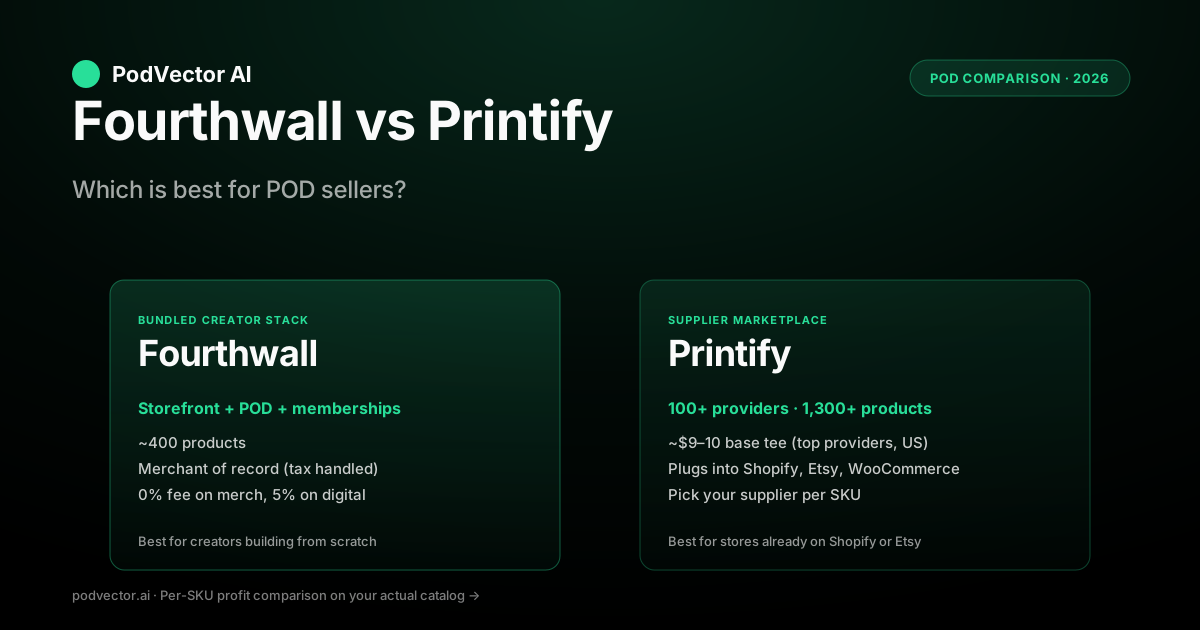
Quick Answer: Fourthwall and Printify both put a custom design on a t-shirt and ship it to your buyer, but they are not the same kind of product. Printify is a print-on-demand supplier network — 100+ third-party providers, 1,300+ SKUs — that plugs into your existing Shopify, Etsy, or WooCommerce store. Fourthwall is a bundled creator commerce platform that ships its own storefront, handles sales tax as the merchant of record, and includes memberships and digital products alongside POD.
Pick Printify if you already sell on Shopify or Etsy, your catalog is price-sensitive, and you want the lowest base unit cost in the category. Pick Fourthwall if you are a creator starting from scratch, want one platform for merch plus memberships plus digital downloads, and would rather pay a platform fee than wire up Shopify and a tax tool yourself.
Underneath the marketing copy, the real question is whether bundled convenience or supplier flexibility wins on your actual catalog and audience. That answer depends on the SKUs you sell, the countries you ship to, and how much you value owning the supplier choice.
The Fourthwall-vs-Printify decision in 60 seconds
Both platforms can take a t-shirt design and turn it into revenue. What they ask you to bring to the table is different.
Printify assumes you already have a store. You pick the product, pick the supplier, sync it to Shopify or Etsy, and Printify routes each order to the supplier you chose. Your storefront, your tax stack, and your customer support are your problem.
Fourthwall assumes you do not. It gives you a storefront, a checkout, a tax setup that names Fourthwall as the legal seller, and customer support handled under your brand, all in one bundle. Merch is one product line inside that bundle. Memberships and digital products are the others.
One is a supplier you plug into your stack. The other is the whole stack.
Side-by-side snapshot table
Use this for orientation. The sections below unpack the nuance behind each row.
| Dimension | Fourthwall | Printify |
|---|---|---|
| Product type | Bundled creator commerce platform | POD supplier network (plugs into your store) |
| Storefront included | Yes (custom domain, themes) | No (basic Pop-Up Store only) |
| Monthly platform fee | Free; Premium ~$15–19/mo | Free; Premium ~$29/mo |
| Extra fees | 5% on digital and memberships; 0% on merch | None from Printify; Shopify ~$39/mo if used |
| Catalog size | ~400 products | 1,300+ products |
| Base unit cost (Bella+Canvas 3001 tee, US) | ~$11–13 | ~$9–10 (top providers) |
| Merchant of record | Yes (Fourthwall remits sales tax and VAT) | No (you handle tax) |
| Memberships and digital products | Yes, native | No |
| Storefront integrations | YouTube, Twitch, TikTok, Instagram, Discord, Spotify | Shopify, Etsy, WooCommerce, Wix, eBay, TikTok Shop, Walmart |
| Best for | Creators building a brand from scratch | Sellers already running Shopify or Etsy |
The architectural difference: bundled platform vs supplier network
Marketing pages frame this as "creator vs ecommerce." The actual axis is bundled vs unbundled.
That choice cascades through pricing, control, lock-in, and the kind of catalog you can build. It is the most important decision in the comparison.
Fourthwall: the bundled stack
Fourthwall hands you one login that covers a storefront, a checkout, a POD fulfillment layer, a memberships engine, a digital products engine, and customer support that answers email under your brand.
The win is speed to first sale. A creator with a YouTube channel and zero ecommerce experience can launch a storefront in an afternoon. Tax, support, and platform plumbing are out of sight.
The trade-off is lock-in. Your storefront, customer list, and order history live inside Fourthwall. If you later want to migrate to Shopify or run a different supplier, you are exporting CSVs and rebuilding the front end.
Printify: the supplier network
Printify is unbundled. It is purely the production layer — 100+ third-party print providers, 1,300+ products — that connects to whichever storefront you bring.
The win is flexibility. You pick the storefront (Shopify, Etsy, WooCommerce, Wix, eBay, Walmart, TikTok Shop). You pick the provider per SKU. You pick the tax tool. Each piece can be swapped without rebuilding the others.
The trade-off is plumbing. You assemble the stack. Most operators end up paying for Shopify (~$39/mo) on top of Printify, plus a tax app, plus a customer support tool. The base unit cost on Printify is the lowest in the category, and the rest of the stack is on you.
Pricing, platform fees, and total cost
Sticker prices on the home pages are not the comparison. The right comparison is total cost to land an order in a buyer's hands.
Subscription tiers
Fourthwall has a free plan that covers all the core features, and a Premium tier around $15–19 per month (billed annually) that removes the platform fee on digital products, adds a monthly sample credit, and unlocks priority support.
Printify has a free plan capped at 5 stores, and a Premium tier at ~$29 per month that delivers a flat 20% discount across most SKUs. That discount usually pays for the subscription past 20–30 orders per month. For the full Premium math, see the Printify Premium price breakdown and the deeper benefits comparison.
Platform fees
Fourthwall takes 0% on physical merch and 5% on digital products and memberships. That fee is on top of the base product cost, not bundled into it.
Printify takes 0% in the form of a platform fee — but the storefront under it does. Shopify is ~$39/month and Etsy charges a $0.20 listing fee plus a 6.5% transaction fee per sale. On a $25 tee, Etsy's cut is around $1.63 plus the listing fee, which is materially more than Fourthwall's 0%-on-merch.
Base unit cost
On a Bella+Canvas 3001 tee shipping to a US buyer, Printify's top providers come in around $9–10. Fourthwall's US production sits around $11–13 for the same SKU.
The gap is $1–3 per unit. At 100 orders a month, that is $100–300. At 1,000 orders a month, that is $1,000–3,000. Whether the gap matters depends on how much you value the convenience layer Fourthwall bundles on top.
The total-cost math
For a small store doing 50 orders a month, Fourthwall usually beats Printify on total cost because the Shopify subscription, the tax app, and the customer support tool are eliminated. The platform fee on memberships is irrelevant if you are not selling memberships.
For a larger store doing 500+ orders a month, Printify wins on total cost because the base unit cost gap compounds and the bundled tooling Fourthwall replaces becomes cheap relative to revenue. The Shopify fee is a rounding error past four-figure monthly revenue.
Catalog size and product range
Printify's catalog is the broadest by raw count. The 1,300+ products span apparel, accessories, drinkware, home goods, stationery, and pet products.
A lot of that breadth is duplicate SKUs across providers — the same Bella+Canvas 3001 tee listed by 8 different providers — but the long tail still includes specialty items Fourthwall does not carry at all.
Fourthwall's ~400 products lean into apparel, headwear, drinkware, and the items creators most often sell. The catalog is curated for consistency rather than breadth. The trade-off is that if you want a niche SKU (a pet bandana, a specialty mug, an embroidered patch hat from a specific brand), Printify is more likely to have it.
Fourthwall also leans on a "Signature" line of premium retail-grade blanks and prints them with DTG and DTFx methods, the bet being that consistent blanks plus consistent print methods beat raw catalog size. Printify exposes more print methods across its network (DTG, DTFx, embroidery, all-over sublimation, AOP), but which one you get depends entirely on the provider you pick per SKU.
Fourthwall also supports custom products, where their team sources and produces a specific item that is not in the standard catalog. That is a real differentiator for established creators with a specific physical product idea, but the lead time and minimum order quantity look more like traditional manufacturing than POD.
Storefront and brand building
This is where the two platforms diverge most sharply. The storefront is bundled on one side and absent on the other.
Fourthwall storefront
Fourthwall ships a storefront with custom domain support, themes, page builders, and a checkout that handles cards, Apple Pay, Google Pay, and PayPal. You can add memberships, donations, digital downloads, and physical products to the same store under one brand.
The store is opinionated. You get a creator-style site with sections for merch, memberships, digital products, and a Discord community link. Customization is meaningful but not unlimited — you cannot strip the platform down to a fully custom front end without leaving Fourthwall.
Printify "storefront"
Printify is not a storefront. The Pop-Up Store feature is a basic landing page that the company itself describes as a stopgap before you connect a real ecommerce platform.
In practice, every serious Printify seller pairs Printify with Shopify, Etsy, WooCommerce, Wix, or one of the marketplace channels. The storefront work is fully on you.
The upside is total control. Shopify themes, custom checkout, custom product templates, headless front ends — none of that is gated by Printify. If you want to build a fully bespoke storefront, Printify never gets in the way.
Branded packaging
Fourthwall offers branded inserts, custom packing slips, and the option to ship in unbranded packaging by default. Coverage is consistent because the production network is curated.
Printify's branding depends on the chosen provider. Some top providers offer custom packing slips and branded inserts; others do not. Switching providers can change whether a SKU still supports branding, which is operational overhead Fourthwall does not have.
Shipping, fulfillment, and customer support
Production speed is roughly comparable between the two on US orders. Both produce most apparel orders in 2–5 business days and ship via standard ground carriers. On total delivered time, Fourthwall's curated US network lands most domestic orders in roughly 4–10 days. Printify's range is wider — most US orders arrive in about 7–15 days, with some lower-tier or international providers stretching toward 30 — because the timeline depends on which provider produced the order.
International shipping is where the two diverge. Fourthwall's production sits primarily in the US with a smaller EU footprint. Printify has providers in the US, the UK, the EU, and a handful of APAC locations, but the international coverage depends on which provider you pick per SKU.
For an in-depth look at how Printify's shipping math actually works once you factor in provider, destination, and cart size, see the complete guide to Printify shipping.
Customer support
Fourthwall handles customer support tickets under your brand. The buyer emails "support@yourbrand.com" and Fourthwall's team responds about order status, refunds, and reprints without the buyer ever knowing.
That is a meaningful operational win for solo creators. You do not need to staff support or pay for a help desk tool, and Fourthwall quotes an average reply time of roughly 12 hours on those tickets.
Printify routes order tickets to whichever provider produced the order. Printify's own team handles platform issues; the provider handles order-specific issues. For US orders from a top provider, response times are reasonable. For lower-tier providers, ticket resolution can take longer and requires you to pass messages between buyer and provider.
Tax handling and merchant of record
This is the line item most comparison articles understate. The merchant-of-record question changes the operational and legal burden in a material way.
Fourthwall is the merchant of record for sales on its storefront. That means Fourthwall is the legal seller, Fourthwall collects sales tax and VAT, Fourthwall remits to the right jurisdictions, and Fourthwall handles the audit risk.
For a US creator selling to all 50 states plus the EU and UK, that is a meaningful operational lift. The alternative is registering in dozens of state and country jurisdictions, integrating a tax tool (Avalara, TaxJar, Stripe Tax), and filing returns.
Printify is not the merchant of record. You are. Whichever storefront you sit on top of (Shopify, Etsy, WooCommerce) is where the tax stack lives. Shopify Tax and Etsy's marketplace facilitator law coverage handle a lot of this automatically, but you are still the legal seller of record.
For a small US-only store, the tax difference is mostly nominal — both can be handled cleanly. For a multi-country store, Fourthwall's merchant-of-record status genuinely saves work.
Integrations: where each plugs in
Both integrate with the platforms that matter for their target user. The lists are different in revealing ways.
Fourthwall integrations
Fourthwall integrates natively with YouTube (Shopping Shelf), Twitch, TikTok, Instagram, Discord, and Spotify. The integrations are creator-channel-first — shoppable shelves on streaming and social channels, role gating in Discord, donation widgets on Twitch, merch surfaced next to a Spotify artist profile.
What it does not integrate with is the wider ecommerce stack. You do not connect Fourthwall to Shopify. You do not connect it to Klaviyo or Mailchimp natively. You stay inside Fourthwall's perimeter.
Printify integrations
Printify integrates with Shopify, Etsy, WooCommerce, Wix, eBay, Squarespace, BigCommerce, PrestaShop, Walmart, and TikTok Shop. The list covers essentially every major selling channel a POD seller uses.
It also integrates indirectly with the rest of the ecommerce ecosystem through whichever storefront you pick. Shopify alone has thousands of apps for email, ads, analytics, and customer support that Fourthwall users cannot tap directly.
If you sell on Walmart or TikTok Shop, Printify is the practical pick. Fourthwall does not have those channels.
The Etsy question
Etsy is the place this comparison matters most. Many POD sellers anchor on Etsy, where marketplace traffic does the customer acquisition work. Printify integrates natively with Etsy. Fourthwall does not.
If your primary channel is Etsy, Fourthwall is structurally the wrong tool. You can sell on both — Etsy for marketplace orders, Fourthwall for direct-to-fans — but the Etsy side of that store cannot use Fourthwall's catalog.
Profit margins: what actually hits your bottom line
Margin per order is a function of selling price, base unit cost, shipping, platform fees, and refund rate. Both platforms can produce healthy margins; the structure of the margin is different.
Fourthwall margin structure
On physical merch, the math is: selling price minus base unit cost minus shipping cost minus 2.9% + $0.30 payment processing. There is no platform fee on merch.
On a $30 tee with $12 base cost and $5 shipping charged to the buyer, the gross profit per order is around $12.13 after payment fees. The clean structure is the upside.
Printify margin structure
On the same $30 tee with $9.50 base cost from a top US provider and $4.50 shipping charged to the buyer, the gross profit before storefront fees is around $14.80.
Then you subtract the storefront cut. On Shopify, that is the $39 monthly fee amortized across orders plus the 2.9% + $0.30 payment processing — minimal at volume. On Etsy, that is the transaction fee (~6.5%), the listing fee, and the offsite ad fees if applicable, which can take 8–15% off the order.
The headline is: Printify on Shopify usually delivers the highest per-order margin in the comparison. Printify on Etsy is roughly comparable to Fourthwall once Etsy's fees are netted. Fourthwall is the simplest to model but rarely the highest-margin option.
The hidden line item
Refund rate is the variable most operators forget to track. Lower-quality suppliers produce more "where is my order" tickets, lost packages, and quality refunds — all of which eat the base-cost advantage. Fourthwall's curated network has a lower refund rate on average than Printify's lower-tier providers, and a higher rate than Printify's top providers. The right Printify provider, in other words, beats Fourthwall on both base cost and refund rate. The wrong Printify provider loses on both.
Pick X if Y
The shorthand most operators end up using.
Pick Fourthwall if
You are a creator (YouTuber, streamer, podcaster, musician) without an existing store, and you want one platform that handles merch plus memberships plus digital products under one brand.
You also pick Fourthwall if tax compliance across states and countries feels like the part of the job you most want to outsource, or if your buyer support volume is high enough that having a team answer under your brand changes how many hours you spend per week on the business.
Fourthwall is also the right pick for a creator audience that finds you through YouTube, Twitch, or TikTok rather than through marketplace search. Those channels are where Fourthwall's integrations actually live.
Pick Printify if
You already sell on Shopify, Etsy, or WooCommerce, or you want to. The base unit cost savings and catalog breadth are real and meaningful at volume, and the integration with the wider ecommerce stack matters more the bigger your store gets.
You also pick Printify if your catalog includes niche SKUs Fourthwall does not carry, if you sell on Walmart or TikTok Shop, or if your audience finds you through marketplace search rather than personal brand. For more on Printify's competitive set, see companies like Printify and the broader companies similar to Printify roundup.
If you are weighing a third option that prints close to the buyer, the Gelato vs Printify comparison is the most useful adjacent read.
Running Fourthwall alongside Printify
It is possible to run both. Most creators who do split their audience by channel: Fourthwall for the direct-fan storefront tied to their YouTube and Discord, Printify on Etsy or Shopify for marketplace and SEO-driven orders.
The split keeps each tool inside the lane it is good at. Fourthwall captures the high-intent fan traffic that comes from the creator's own channels. Printify on Shopify captures the long-tail organic and paid traffic where the creator is not the discovery surface.
The cost is double the operational work. Two product catalogs, two order systems, two reporting surfaces. Most creators do this only past a certain revenue threshold (roughly $5K+ per month in merch) where the channel-specific margin gains justify the overhead.
For a wider competitive lens that includes Fourthwall-style bundled platforms, the broader Printify topic hub and the Printify comparison hub cover the full landscape. The external decision framework that walks the same trade-offs is Bootstrapping Ecommerce's Fourthwall vs Printify breakdown.
The comparison most sellers actually need
Side-by-side feature tables answer the wrong question. The right question is: on the products my store actually sells, in the countries my buyers actually live in, with the channels my traffic actually comes from, which option produces the highest profit per order?
That answer is different for every catalog. A YouTuber with 200K subscribers selling 80% to direct fans through a custom-domain storefront lands on Fourthwall. An Etsy seller with 5,000 orders a month on niche apparel SKUs lands on Printify. A creator brand splitting half-and-half between Etsy marketplace traffic and direct-fan storefront traffic ends up running both.
The right pick is downstream of your data, not downstream of which review article ranks highest on Google. The comparison you actually want is the one computed against your own orders, your own channels, and your own ad spend — not a generic one.
That is the gap PodVector AI sits in. Victor — PodVector AI's AI business employee — connects to your Shopify store, your Printify or Printful account, and your Google and Meta ad accounts, and lets you ask in plain English: which supplier would be more profitable for my products? The answer comes back as an itemized per-SKU view, computed against your live order history and current supplier base costs, with a recommended switch and the projected margin lift.
FAQs
Is Fourthwall cheaper than Printify?
Not on base unit cost. Printify's top providers are roughly $1–3 cheaper per apparel unit than Fourthwall on the same SKU. Fourthwall is cheaper on total stack cost for small stores because the storefront, tax tool, and customer support are bundled in, and those are line items a Printify seller pays for separately.
Does Fourthwall integrate with Shopify?
No. Fourthwall is its own storefront and does not plug into Shopify. If you want POD on a Shopify store, Printify is the structurally correct pick. Fourthwall replaces Shopify rather than sitting inside it.
Can I use Fourthwall and Printify together?
Yes — they do not conflict, and they target different sales channels. Most creators who run both use Fourthwall for direct-fan sales on their custom domain and Printify on Etsy or Shopify for marketplace and SEO traffic. The work is reconciling two reporting systems for one business.
Which has better print quality?
Fourthwall's quality is more consistent because the production network is curated. Printify's quality varies by provider — top providers like Monster Digital and SwiftPOD match Fourthwall, lower-tier providers do not. The variance is the cost of Printify's cheaper sticker price.
Which is better for selling on Etsy?
Printify. Fourthwall does not integrate with Etsy at all. If Etsy is your primary channel, Fourthwall is the wrong tool — you would be building a parallel direct storefront, not a marketplace store.
Does Fourthwall handle sales tax?
Yes. Fourthwall is the merchant of record on its storefront, which means it collects, files, and remits sales tax and international VAT/GST on your behalf. Printify is not the merchant of record — whichever storefront you sit on top of (Shopify, Etsy) handles the tax stack.
Which is better for a brand-new creator with no store?
Fourthwall. The bundled storefront, tax handling, and customer support remove a meaningful amount of operational work from a creator who has never run a store. Printify makes more sense once you have an existing Shopify or Etsy presence to plug it into.
Which has a bigger catalog?
Printify, by a wide margin. Printify lists 1,300+ products against Fourthwall's ~400. If your catalog includes niche items (pet products, specialty drinkware, certain accessories), Printify is more likely to have the SKU.
Which platform is better for selling memberships or digital products?
Fourthwall, easily. It has native memberships, digital downloads, and donations. Printify is a POD supplier only — selling memberships or digital products with Printify means adding a separate tool (Memberful, Patreon, Gumroad) to the stack.
Does Printify cost more once you add Shopify?
Yes, by ~$39/month. The honest comparison is "Printify free + Shopify Basic ($39)" versus "Fourthwall free." For a store doing under 30 orders per month, Fourthwall's bundled stack often beats Printify's unbundled one on total cost. Past that volume, Printify's base unit cost savings start dominating.
Can I see this comparison applied to my own store?
Yes — this is what we built PodVector AI for. Connect your store and supplier accounts, and Victor compares your live SKUs and order history across Printify and Printful, and reports which option wins on each.
Stop guessing which supplier is more profitable.
Victor — PodVector AI's AI business employee — connects to your store and supplier accounts, computes per-SKU landed cost across Printify and Printful on your live order history, and proposes the switches that win you margin. You ask in plain English. He proposes the action. You approve. He executes it with a full audit trail.
Try Victor free