
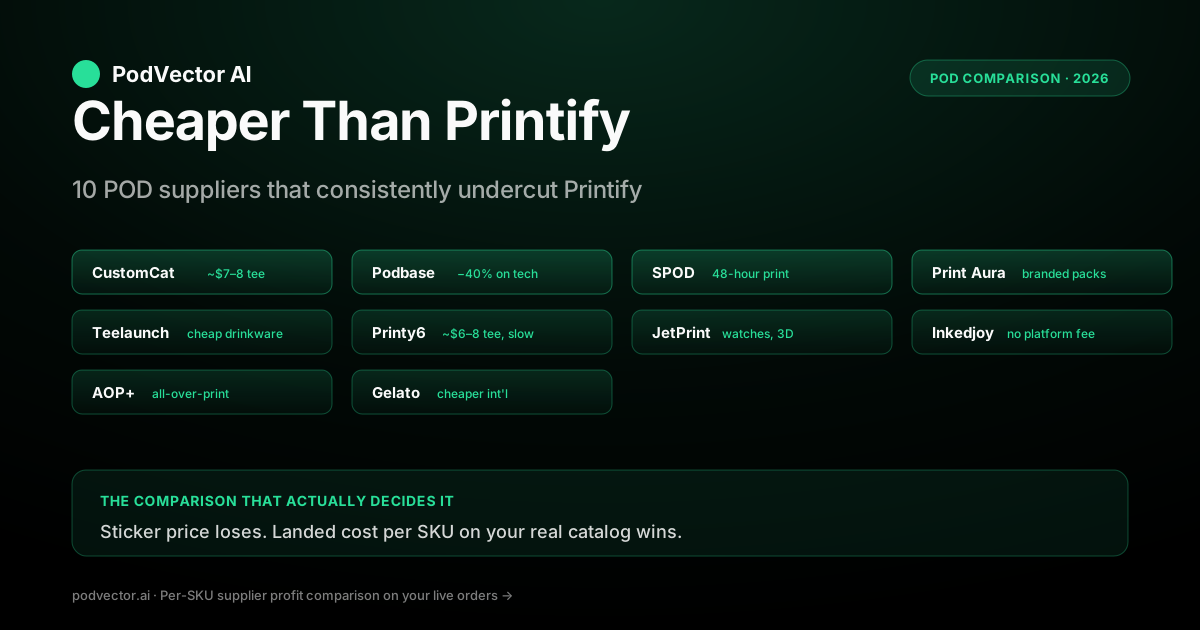
Quick Answer: The print-on-demand options that consistently undercut Printify on base unit cost in 2026 are CustomCat, Podbase, SPOD, Print Aura, Teelaunch, Printy6, JetPrint, Inkedjoy, AOP+, and (for international orders) Gelato. Each is cheaper than Printify along a specific axis — a single US factory, a tech-accessory specialty, a 48-hour turnaround, regional production, or a no-platform-fee storefront.
"Cheaper than Printify" is a moving target. Printify's own top providers price aggressively, and Printify Premium ($29/mo) shaves 20% off most SKUs. The honest comparison is not sticker price — it is landed cost per SKU on your real catalog, in the countries your buyers actually live in, after refund and reprint rate.
This guide profiles all 10 cheaper alternatives, shows where each one actually wins, and ends with how to test before you migrate. For the wider field, see the Printify topic hub and the Printify comparison cluster.
What "cheaper than Printify" actually means
Most "cheapest POD" roundups stop at sticker price on a single t-shirt. That misses the point. Printify itself runs 100+ print providers with different base costs for the same SKU, so "Printify's price" is a range, not a number.
The honest definition of cheaper has four parts. Lower base unit cost on the SKUs you actually sell. Lower shipping to the countries your buyers actually live in. Lower refund and reprint rate (a cheap supplier that ships defects is not cheap). Lower total stack cost once you add the storefront, the tax tool, and any platform fees.
An alternative that beats Printify on one part can lose on the others. CustomCat is cheaper per unit on US apparel but loses on international shipping. Printy6 is cheaper on sticker price but loses on shipping time. Gelato is cheaper on international shipping but is not cheaper on US orders at all.
The list below is grouped by the specific axis each option wins on. Skip to the at-a-glance table for the speed-read, then read the profile that matches your store. For a wider competitive lens that goes past "cheaper" into branding, integrations, and catalog, see other companies like Printify. Spocket's cheaper-alternatives roundup takes a similar angle from a different vendor's lens and is worth a skim as a cross-reference.
At-a-glance comparison table
Base costs are for a comparable Bella+Canvas 3001 (or nearest equivalent) tee shipping to a US buyer, sourced from each supplier's 2026 published pricing. Use this for orientation only — the per-SKU math on your real catalog is what actually decides the call.
| Supplier | Base tee (US) | Where it wins | Where it loses |
|---|---|---|---|
| Printify (top providers) | ~$9–10 | Catalog breadth, integrations | — |
| CustomCat | ~$7–8 | Lowest US apparel unit cost | Catalog, mockup tooling |
| Podbase | ~$8–9 tee · much cheaper on tech | Tech accessories, electronics | Smaller apparel range |
| SPOD | ~$8.50–9.50 | 48-hour production speed | Narrow catalog |
| Print Aura | ~$8–9 | Branding inserts, custom packing | Slower turnaround |
| Teelaunch | ~$8–9 | Shopify integration, mugs | Apparel quality varies |
| Printy6 | ~$6–8 | Lowest sticker prices in the list | 10–20 day ship from China |
| JetPrint | ~$8 · much cheaper on watches | Custom watches, 3D-print goods | Apparel not the strength |
| Inkedjoy | ~$7.50–9 | No platform fees, low tee costs | Smaller integration list |
| AOP+ | ~$11 cut-and-sew tee | Cheaper all-over-print apparel | Higher base on standard tees |
| Gelato | ~$10 US · much cheaper EU | International unit + ship cost | Not cheaper on US orders |
1. CustomCat — the US budget specialist
CustomCat is the most consistent "cheaper than Printify" answer for a US apparel seller. The Detroit-based company runs a single Michigan facility, owns its equipment, and pushes the savings through as the lowest base prices in the standard-apparel category.
On a Gildan 64000 or Bella+Canvas 3001 tee, CustomCat lands around $7–8 against Printify's $9–10 from top providers. The $1–3 per-unit gap compounds fast: at 500 orders a month, that is $500–1,500 in monthly margin recovered without changing your retail price.
The trade-offs are real. The catalog is narrower — mostly tees, hoodies, mugs, and hats with limited home goods. Design tooling and mockups feel a step behind Printify or Printful. International shipping is non-competitive because everything ships from one US location.
Integrations cover Shopify, Etsy, WooCommerce, BigCommerce, and the CustomCat API. A $30/month "CustomCat Premium" tier unlocks additional volume discounts that stack with the already-low base prices.
Best for: US-only sellers running volume on standard apparel SKUs.
2. Podbase — cheapest for tech accessories
Podbase markets itself as up to 40% cheaper than competitors, and on tech accessories the claim holds. The 10+ year manufacturing operation specializes in phone cases, AirPods cases, laptop sleeves, mousepads, and similar electronics goods where Printify's pricing is least competitive.
On a custom AirPods case or a phone case, Podbase often comes in 30–40% under Printify's equivalent SKU. On standard apparel the gap is smaller — around $0.50–1 per tee — but still in Podbase's favor on the most common Gildan and Bella+Canvas SKUs.
The catalog skews toward tech, with growing coverage of apparel, drinkware, and home goods. Production capacity is overseas, which means shipping windows look more like Gelato or Printy6 than Printify's domestic providers. For a US store running paid ads on holiday deadlines, that matters.
Integrations include Shopify, WooCommerce, Etsy, and a direct API. Best for: any store whose catalog leans into custom tech accessories, where Printify's pricing has always been weakest.
3. SPOD — cheap and 48-hour fast
SPOD is Spreadshirt's print-on-demand sub-brand, and the pitch is a 48-hour production guarantee on standard apparel. Base costs sit in the $8.50–9.50 range on a standard tee — modestly cheaper than Printify's average, with the speed as the bigger win.
For a US-based seller running paid ads on time-sensitive promos (holiday gifts, event merch, drop releases), the turnaround difference is decisive. A buyer who orders December 19 expects delivery before Christmas. The faster the production clock starts, the higher your conversion-to-shipment rate before the cutoff date.
The catalog is narrower than Printify — apparel, drinkware, accessories, very limited home goods. Production runs from Spreadshirt's Las Vegas and Henderson NV facilities. International shipping is available but priced like a standard US-export carrier, not regional production.
Integrations are Shopify-first with Etsy and WooCommerce support. Best for: sellers running campaigns where ship-by deadlines are a real constraint and a $0.50 unit-cost saving over Printify is a bonus on top of the speed.
4. Print Aura — low-cost with branding control
Print Aura's pitch is the rare combination of low base prices and meaningful branding control. The New York-based supplier prices most common apparel SKUs in the $8–9 range — clearly under Printify's average — and includes branding options most cheap suppliers do not.
Custom neck labels, custom packing slips, branded poly bags, and removable size labels are available on standard tees and hoodies. Most $7–8 suppliers force you to ship in generic packaging or upcharge heavily for branding. Print Aura treats branding as a per-order add-on, not an enterprise upgrade.
The trade-off is turnaround. Print Aura's production averages 3–7 business days, slower than SPOD and on the high end of Printify's range. For a brand that cares about presentation but is not racing a shipping deadline, the math usually favors Print Aura.
Integrations cover Shopify, Etsy, WooCommerce, BigCommerce, and an API. Best for: sellers building a real apparel brand who want branded unboxing without paying Apliiq or Printful prices.
5. Teelaunch — low base costs, Shopify-first
Teelaunch is the long-running Shopify-first POD option that consistently undercuts Printify on a handful of high-volume SKUs — particularly tees, mugs, and engraved tumblers. The Boston-based company runs production in multiple US facilities and prices common apparel in the $8–9 range.
Where Teelaunch genuinely beats Printify is on drinkware. Standard 11oz ceramic mugs land around $4–5, against Printify's $5–7. On larger SKUs like the 30oz tumbler, the gap can be $3–5 per unit. For a store that does meaningful volume on drinkware, that is decisive margin.
Quality is mixed on apparel — sample before scaling. The dashboard is functional but not as polished as Printify's. There is no first-class Etsy integration; Etsy sellers route orders manually or through a third-party connector.
Best for: Shopify sellers whose catalog leans into mugs, tumblers, and engraved drinkware.
6. Printy6 — China-based, lowest sticker prices
Printy6 produces the lowest sticker prices on this list, with most tees landing in the $6–8 range and accessories often coming in 30–50% under Printify's equivalent SKUs. The Hong Kong-based supplier produces in China and uses standard international shipping to fulfill global orders.
The honest trade-off is shipping time. Standard Printy6 orders take 10–20 business days to reach US buyers — fine for low-urgency lifestyle products, fatal for ad-driven campaigns where ship-by date is part of the offer. Expedited shipping is available but eats most of the unit-cost savings.
The catalog leans into apparel, accessories, drinkware, and lifestyle items. Quality is variable per SKU — sample before scaling, especially on apparel where fabric weights run lighter than US-printed equivalents.
Integrations cover Shopify, Etsy, WooCommerce, and a direct API. Best for: stores selling low-urgency products to price-sensitive buyers, or any seller using Printy6 as the lowest-cost SKU in a multi-supplier setup.
7. JetPrint — cheap on watches and 3D-print goods
JetPrint is a niche cost win on product categories Printify either does not carry or prices badly. Custom watches, 3D-printed goods, custom shoes, and certain accessory categories land 30–60% under what Printify charges through its partner network.
On standard apparel, JetPrint is roughly comparable to Printify — around $8 on common tees. The reason to pick JetPrint is not the apparel pricing; it is the niche SKUs nobody else competes on. A custom watch face on a Printify provider runs $25–40. JetPrint's equivalent watch lands at $15–25.
Production is overseas, with shipping times in the 7–15 day range for US destinations. The dashboard is functional but less polished than the larger US-based suppliers. Integrations cover Shopify, Etsy, and a direct API.
Best for: stores building catalogs around the specific SKUs JetPrint specializes in — watches, 3D-printed items, custom shoes — where Printify's pricing has always been uncompetitive.
8. Inkedjoy — free platform, low unit costs
Inkedjoy is free to use and pays per product, with no subscription tier required to access better pricing. Base costs on common tees and hoodies sit in the $7.50–9 range, undercutting Printify's free-tier pricing on most high-demand SKUs.
The pricing model is the differentiator. Where Printify gates the 20% discount behind the $29/month Premium tier, Inkedjoy quotes its lower base prices to every seller, no subscription required. For a smaller store doing under 30 orders a month, that gets you Printify-Premium-equivalent unit economics without paying for Premium.
The catalog is narrower than Printify and the integration list is smaller — Shopify, Etsy, WooCommerce, and an API, but no Wix, no Squarespace, no marketplace channels like eBay or Walmart. Production capacity is overseas, with US shipping in the 7–12 day range.
Best for: small and mid-volume stores that want low base prices without the Printify Premium subscription, or as a second supplier alongside Printify to handle specific SKUs.
9. AOP+ — cheaper all-over-print apparel
AOP+ ("All Over Print Plus") is the cost specialist for cut-and-sew all-over-print apparel — the SKU category where Printify's pricing has always been weakest. A custom all-over-print tee or hoodie through Printify's partners runs $20–30+. AOP+ produces equivalent cut-and-sew SKUs at $11–18.
The model is straightforward: own the cut-and-sew production, run it lean, price aggressively against the rest of the market's print-then-sew workflow. For any store whose catalog leans into all-over-print designs (festival merch, music tours, streetwear drops), AOP+ structurally beats Printify on cost.
On standard front-print apparel, AOP+ is not cheaper than Printify — that is not the use case. The cost win is entirely on the all-over-print specialty. Production is UK-based with US warehouse fulfillment for North American orders. Turnaround sits around 5–10 business days.
Integrations cover Shopify, Etsy, WooCommerce, and an API. Best for: cut-and-sew all-over-print sellers, especially in apparel categories where Printify's $20+ pricing kills margin.
10. Gelato — cheaper internationally, not domestically
Gelato is the international-shipping cost win, not a US-domestic one. For a US-only seller, Gelato sits roughly even with Printify on base price — around $10 on a standard tee — with no special advantage. The math flips the moment your store sells outside the US.
Gelato's distributed network runs 130+ partners in 32 countries. A German order prints in Germany and ships locally. Shipping a tee from a US Printify provider to Berlin costs $12–18 and takes 10–14 days. The same shirt printed at Gelato's Berlin partner ships for €4 and arrives in 3–5 days.
For any store with 20%+ international order share — particularly in the EU, UK, or APAC — Gelato beats Printify on landed cost by a meaningful margin. The base unit cost is the same; the saving is entirely in shipping.
Catalog and integrations are strong: Shopify, Etsy, WooCommerce, Wix, Squarespace, and a robust API used by enterprise customers. Paid tiers (Gelato+ at $24/month, Gelato+ Gold at $119/month) unlock additional product discounts.
Best for: sellers with 20%+ international orders, especially in the EU. For a deeper feature comparison, see the Fourthwall vs Printify breakdown and the Gooten vs Printify analysis, which both touch on the same regional-production trade-offs.
The three ways "cheaper" actually wins
The 10 options above split into three different definitions of cheaper. Knowing which one matches your store decides which supplier to test first.
Lower base unit cost (CustomCat, Print Aura, Teelaunch, Inkedjoy, AOP+ on cut-and-sew)
This is the most direct definition. The supplier prices the same SKU $1–4 lower than Printify, period. The saving compounds linearly with volume and is the cleanest case to model.
Pick this path when your catalog is concentrated in 5–20 SKUs you can sample, validate, and switch deliberately. The unit-cost saving justifies the operational lift of running a second supplier account.
Lower category-specific cost (Podbase on tech, JetPrint on watches, AOP+ on all-over-print, Teelaunch on drinkware)
This is the niche play. Printify is not specialized in every category — its weakest pricing is consistently on tech accessories, all-over-print apparel, watches, and certain home goods.
If your store leans into one of those categories, a specialist supplier beats Printify by 30–50%, not 10%. The math is decisive enough that running the specialist as a second supplier for that category alone usually pays off.
Lower shipping cost (Gelato on international, SPOD on speed-sensitive)
This is the geography play. Same base unit cost, much lower shipping. Gelato wins on international orders because of regional production. SPOD wins on US orders where the saving is in time, not dollars — faster turnaround means more orders ship before deadline, which raises effective revenue per order.
Lower sticker price but slower shipping (Printy6, JetPrint apparel)
This is the conditional path. The sticker price is the lowest on the list, but the 10–20 day shipping window kills it for ad-driven or seasonal campaigns. For evergreen, low-urgency products sold to price-sensitive buyers, the math can work. For everything else, the slow shipping eats the saving in refund and chargeback rate.
Printify Premium vs switching suppliers
Before migrating to a new supplier, check whether Printify Premium closes the gap. Printify Premium is $29/month and shaves roughly 20% off most SKU base prices.
On a $10 base tee through Printify's top provider, Premium drops the cost to ~$8 — right in CustomCat or Print Aura's range. For a store doing 50+ orders per month, the Premium subscription pays for itself, and you avoid the operational overhead of running a second supplier account.
For the full Premium math — break-even order count, discount coverage by SKU type, and the cases where Premium does not close the gap — see the Printify Premium cost breakdown. There is also a separate guide on Printify Premium coupon codes for the seasonal promos that reduce the effective subscription cost further.
The switch-vs-Premium decision is not symmetric. Premium is one click and reversible. Switching suppliers means new product mockups, new SKU IDs, customer support retraining, and reconciling reporting across two systems. The pure unit-cost saving has to be material — usually 15–25% on your top SKUs — to justify the lift on top of what Premium already gets you.
How to test before you switch
Migrating wholesale to a new supplier on a guess is the most common way POD sellers lose a quarter of revenue to refund-rate spikes. The cheap unit cost does not show up until orders arrive in buyers' hands.
Step 1: order samples of your top 5 SKUs
Order the same SKUs you sell most through Printify, in your most-shipped sizes, to your own address. Compare print quality, fabric weight, color accuracy against the Printify equivalent. Photograph both side by side under the same lighting.
Step 2: pilot with 10% of orders
Route 10% of new orders for one specific SKU through the candidate supplier for 30 days. Track shipping time, customer support tickets, refund rate, and chargeback rate. Do not migrate the SKU until you have 30 days of comparable production data.
Step 3: model landed cost, not sticker cost
The right comparison is: sticker price + shipping to your buyer's location + refund probability × replacement cost. A supplier with a $7 sticker price and a 6% refund rate is not cheaper than a $9 supplier with a 1% refund rate at typical apparel margins. Pull your real refund-rate data before deciding.
Step 4: switch SKU-by-SKU, not store-wide
Migrate one SKU at a time, in order of monthly volume. The biggest unit-cost-saving SKUs go first because they pay off the fastest. Niche or seasonal SKUs may not be worth migrating at all if the operational cost of running two supplier accounts exceeds the savings on low-volume products.
The comparison most sellers actually need
Roundup tables answer the wrong question. The right question is: on the products my store actually sells, in the countries my buyers actually live in, with the refund rate my catalog actually generates, which supplier produces the highest profit per order?
That answer is different for every store. A Shopify seller doing 80% US apparel orders on Gildan tees lands on CustomCat. An Etsy seller with a tech-accessory catalog lands on Podbase. A creator running international drops on all-over-print hoodies lands on AOP+ paired with Gelato for EU fulfillment. A holiday-gift store racing December deadlines lands on SPOD even if the unit cost is only a dollar lower.
The right pick is downstream of your data, not downstream of which review article ranks highest on Google. The comparison you actually want is the one computed against your own orders, your own destinations, and your own refund rate — not a generic one.
That is the gap PodVector AI sits in. Victor — PodVector AI's AI business employee — connects to your store and supplier accounts, and lets you ask in plain English: which supplier would be more profitable for my products? The answer comes back as a per-SKU view, computed against your live order history and current supplier base costs, with a recommended switch and the projected margin lift.
FAQs
What is actually cheaper than Printify in 2026?
On US apparel, CustomCat and Print Aura are consistently $1–3 cheaper per unit on standard tees and hoodies. On tech accessories, Podbase undercuts Printify by 30–40%. On all-over-print apparel, AOP+ beats Printify by $9–15 per unit. On international orders, Gelato wins on landed cost despite the same sticker price.
Is CustomCat really cheaper than Printify?
Yes, on standard US apparel. CustomCat's single-factory model produces Gildan and Bella+Canvas tees around $7–8 against Printify's $9–10 from top providers. The trade-off is a narrower catalog and non-competitive international shipping.
Should I just buy Printify Premium instead of switching?
For stores doing 50+ orders a month on common apparel SKUs, Printify Premium ($29/mo) shaves about 20% off most base prices — usually enough to close the gap with cheaper suppliers without the operational lift of running a second supplier account. See the Printify Premium cost breakdown for the full math.
Why is Printy6 so much cheaper than Printify?
Printy6 produces in China and uses standard international shipping. The lower labor cost shows up as lower sticker prices ($6–8 on standard tees), but shipping times stretch to 10–20 days for US buyers — fine for low-urgency products, fatal for ad-driven campaigns where ship-by date is part of the offer.
Which cheaper-than-Printify option has the best quality?
Print Aura and SPOD are the most consistent on apparel quality among the cheaper options. AOP+ leads on cut-and-sew all-over-print quality. CustomCat is acceptable for standard apparel but quality varies more than the larger US-based suppliers.
Can I use multiple cheaper suppliers alongside Printify?
Yes — most experienced POD sellers run two to four suppliers. The common pattern is Printify for catalog breadth and niche SKUs, plus one specialist (CustomCat for US apparel volume, Podbase for tech, Gelato for international) for the SKUs where Printify's pricing is worst. The cost is operational complexity in reporting and customer support.
What about Gooten — is it cheaper than Printify?
Roughly comparable to Printify on overlapping apparel SKUs. Gooten's win is breadth in home goods and pet products, not cost. For the full comparison see the Gooten vs Printify breakdown.
Does Fourthwall count as cheaper than Printify?
No — Fourthwall's base unit cost is higher than Printify on most SKUs. Fourthwall is cheaper on total stack cost for small stores because the storefront, tax tool, and customer support are bundled in, but per-unit it loses. See the Fourthwall vs Printify breakdown for the total-cost math.
How do I know if switching suppliers is worth it?
Pull the per-SKU saving against your monthly volume on that SKU. If the saving covers 4+ hours of operational work per month at your hourly rate, switch. If not, stay on Printify and revisit if your volume on that SKU grows. Sample, pilot on 10% of orders, and migrate SKU-by-SKU rather than store-wide.
What about niche options like ShineOn or Apliiq?
Neither is cheaper than Printify on standard SKUs. ShineOn is jewelry-specialized and prices to that niche. Apliiq prices premium for cut-and-sew streetwear apparel. Both are the right pick for their specific category, but neither belongs on a "cheaper than Printify" list.
Where can I see this comparison applied to my own store?
This is what PodVector AI builds. Connect your Shopify store, Printify, and Printful, and Victor computes per-SKU landed cost against your live order history — and surfaces where supplier cost is eating margin so you know which SKUs to reprice, drop, or replatform.
Stop guessing which supplier is cheaper for your catalog.
Victor — PodVector AI's AI business employee — connects to your Shopify store, Printify, and Printful, computes per-SKU landed cost on your live order history, and surfaces the margin gaps that decide which SKUs to reprice, drop, or replatform. You ask in plain English. He proposes the action. You approve. He executes it with a full audit trail.
Try Victor free