
Quick Answer: Printify is the catalog-breadth, margin-first option in the POD supplier market — over 1,300 products, competitive base costs, and a network of third-party print providers whose quality is excellent where they're good and inconsistent where they aren't. The ten alternatives worth evaluating in 2026 each solve a different Printify weakness: Printful wins on quality consistency and branding; Gelato wins on local fulfillment across 32 countries and global delivery speed; Gooten wins on backend automation and multi-manufacturer routing for established stores; CustomCat wins on US-only 1–3 day production speed and aggressive DTG pricing; Sellfy wins on built-in storefront for sellers without a Shopify; Spreadconnect (SPOD) wins on 48-hour European production SLA; Fourthwall wins on creator-audience monetization with site and POD bundled; Teelaunch wins on drinkware and home-goods pricing; Apliiq wins on premium streetwear apparel with woven labels; Amazon Merch On Demand wins on Prime-shipping reach with a royalty-model fulfillment.
One structural update for 2026: Printful and Printify merged in November 2024 and now operate under a parent brand called FYUL (also including Snow Commerce). As of September 2026, both platforms continue to run completely independently, with separate catalogs, pricing, account systems, and fulfillment workflows — so every comparison below still holds. None of the ten wins on all axes, and the supplier you pick silently decides your gross margin before a single ad dollar runs. This pillar comparison scores all ten on the four POD-specific metrics that actually move a store's P&L, maps each to a specific seller stage, and walks the switching playbook.
Why POD sellers look for Printify alternatives
Most roundups answering "what are the best Printify alternatives" start with a feature list. That frames the question wrong.
POD sellers don't churn off Printify because a feature is missing — they churn because Printify's specific weak spot collided with a specific constraint in their business, and a different supplier relaxes that constraint. The right way to evaluate alternatives is to identify which Printify weakness is actually biting you, then pick the supplier that solves it.
For the baseline — what Printify actually is, how it works, and where it fits relative to every supplier below — see the complete Printify guide: what it is and how it works. Four reasons show up consistently in seller interviews and across the broader SERP when people look past Printify in 2026.
First, quality variance. Printify's great insight was routing the same product across a network of third-party print providers, which kept base costs low and expanded the catalog fast. The tradeoff is that a Bella+Canvas 3001 tee printed by Printify's Monster Digital provider looks and feels different from the same tee printed by SwiftPOD or Drive Fulfillment — same SKU, different shop floors, different DTG machines, different ink batches. Sellers who run tight brand standards hit a wall when a customer complains about color accuracy and the answer is "that order routed to a different provider."
Second, branding limits. Printify offers inside labels on a handful of SKUs at a handful of providers, but nothing like Printful's full branding stack (custom hang tags, packing slips, pack-ins, custom packaging). Stores building a brand above commodity POD hit the branding ceiling somewhere around year one, and that's the inflection point where many migrate or add a second supplier.
Third, geography. Printify's network is US-weighted. If you're shipping a significant share of your orders to Germany, the UK, or Australia, Printify can technically do it, but transit times and shipping costs are worse than what Gelato, Spreadconnect, or a hybrid setup delivers. Shipping SLA is the single most customer-lifetime-value-sensitive operational metric in POD, and it's the specific pressure that drives this migration. Suppliers like Gelato and Spreadshirt have extensive global fulfillment centers that produce items closer to the end customer, reducing shipping costs and delivery times while helping sellers provide a better experience for international customers.
Fourth, diversification risk. A POD seller whose entire operation sits on one supplier's API has a single point of failure. When Printify had provider-side fulfillment slowdowns in 2024 (documented by sellers in the Printify Facebook group and on Trustpilot), stores single-sourced on Printify watched their delivery SLA slip for weeks. Running Printify plus one alternative as a hot-standby is cheap insurance — and for stores above a certain monthly revenue threshold, it's almost always worth the complexity.
A fifth reason, softer: cost pressure. Printify is already one of the cheapest providers in POD, so "base cost" rarely drives migrations away from Printify specifically. But sellers looking at Printify's Premium tier (billed annually — see Printify's pricing page for current rates) against the aggregate cost of running a multi-supplier stack often find they can beat Premium's discount on some SKUs by picking the lowest-cost supplier per product rather than leaning on one.
Printify has also rolled out an Express Delivery option (2–3 business days on select products), narrowing one of its historical gaps against in-house suppliers. That's worth knowing before you migrate purely for speed.
For a head-to-head look at where Printify sits on price specifically, see which suppliers are cheaper than Printify and which is best for POD sellers.
The FYUL merger: what it means for your supplier choice in 2026
One development worth naming before the comparison: Printful and Printify announced a merger on November 5, 2024 and now operate under a parent brand called FYUL, which also includes Snow Commerce. According to ASI Central, "the name, pronounced 'fuel,' was created by joining the ends of Printify and Printful."
For sellers, the practical takeaway is this: as of September 2026, both platforms continue to run completely independently, with separate catalogs, pricing, account systems, and fulfillment workflows — and nothing has changed for sellers at the platform level. Every comparison in this article still holds.
The longer-term implication is supplier concentration. With Printful and Printify now under one roof, sellers who want a genuinely independent alternative have fewer mega-platforms to choose from. That makes the case for adding Gelato, Gooten, CustomCat, or Spreadconnect as a second supplier stronger, not weaker — both for negotiation leverage and for single-point-of-failure insurance. If FYUL ever makes a pricing move that affects both platforms simultaneously, a multi-supplier stack is your hedge. For a deeper look at why supplier-cost tracking matters at scale, see how PodVector AI approaches POD strategy for Shopify sellers.
How we evaluated: the four POD-specific axes
Every supplier below gets scored on the same four axes. These are the axes that actually move a POD P&L — not the ones the supplier marketing pages lead with. A supplier can have a beautiful dashboard, 200 integrations, and a 4.8-star rating and still silently cost you margin points per order because one of these axes isn't handled well for your specific product mix.
- Base cost + per-unit economics. What does a Bella+Canvas 3001 tee (the POD benchmark SKU) land at before shipping, on the supplier's default plan? What does it land at on the supplier's premium tier? How does that scale across hoodies, long-sleeves, and non-apparel?
- Catalog breadth and product depth. How many products, how many variants, how much all-over-print coverage, how many non-apparel categories (home goods, wall art, drinkware, accessories)?
- Fulfillment geography and shipping SLA. Where does the supplier produce? What percentage of orders ship from inside the customer's continent? What is the median order-placed-to-delivered time on the supplier's US, EU, UK, and AU corridors?
- Integration depth and API maturity. How cleanly does the supplier integrate with Shopify, Etsy, WooCommerce, Amazon, TikTok Shop, and eBay? Are supplier-charged line items itemized per order in a machine-readable format, or does your margin math have to fall back to a flat percentage?
A fifth axis — roadmap and diversification risk — is noted in each section but not scored in the table. It matters for pick-a-supplier decisions but can't be quantified on a 2026 snapshot. The four scored axes are what every POD seller needs to reason about before switching or adding, and they're what the comparison table below measures directly.
The full Printify alternatives comparison table
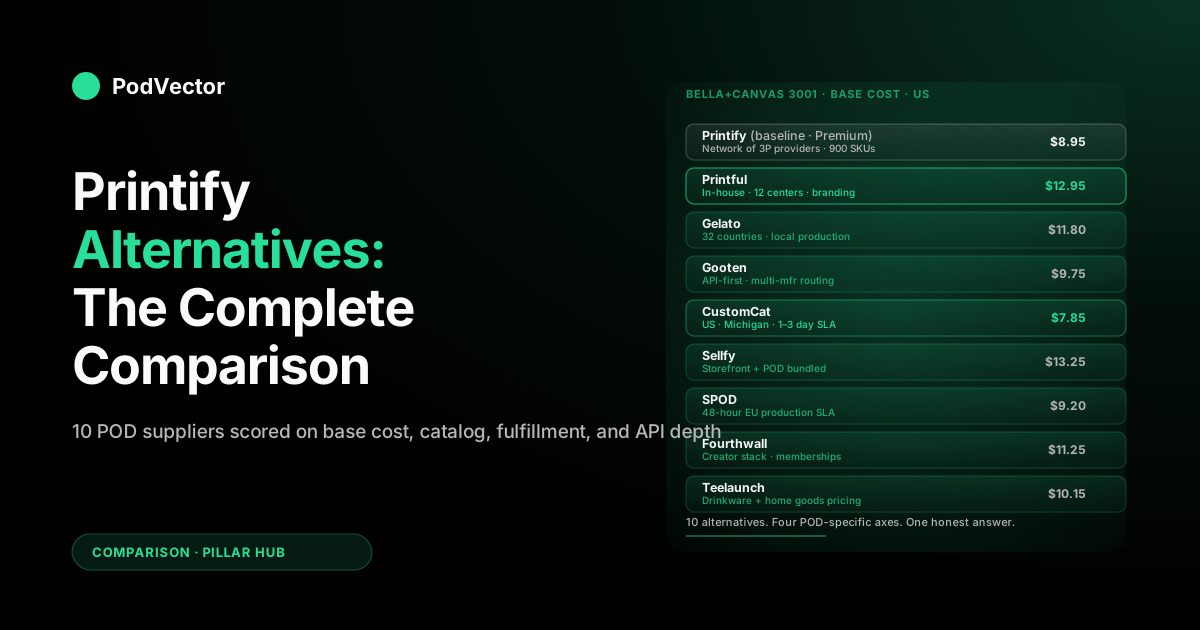
Baseline Printify (Premium plan) sits at the top of the table so the deltas on each row are interpretable as "cost/catalog/speed advantage over Printify." Base cost is the Bella+Canvas 3001 unisex tee in the US, the category's most scrutinized benchmark SKU. All figures are approximate list prices; always verify against the supplier's current pricing page before making a sourcing decision.
| Supplier | Base cost (BC3001, US, approx.) | Catalog size | Fulfillment regions | Integration depth | Strongest-for |
|---|---|---|---|---|---|
| Printify (baseline) | ~$8.95 (Premium, annual billing) | 1,300+ | Global via third-party network (US-weighted) | Deep — Shopify, Etsy, TikTok, Amazon, API | Catalog breadth, margin-first sellers |
| Printful | ~$12.95 | ~400 | 10+ in-house centers across 6 regions | Deepest — all major channels, native | Branding, consistent quality, $25+ retail |
| Gelato | ~$11.80 | ~600 | 130+ partners across 32 countries | Deep — Shopify, Etsy, WooCommerce native | Global stores, EU-weighted sellers |
| Gooten | ~$9.75 | ~500 | Multi-manufacturer US + partner EU | API-first, backend-focused | Established brands, headless setups |
| CustomCat | ~$7.85 | ~550 | US-only (Michigan HQ, 1–3 day production) | Solid — Shopify, Etsy, WooCommerce | US-only sellers, price-first catalogs |
| Sellfy | ~$13.25 (POD via Printful-tier partners) | ~250 POD SKUs + digital | Partner-network fulfillment | All-in-one — hosted storefront included | Sellers without an existing store |
| Spreadconnect (SPOD) | ~$9.20 | ~230 | EU (Leipzig) + US (Pennsylvania) | Shopify, WooCommerce, Magento, API | EU-heavy stores needing fast production |
| Fourthwall | ~$11.25 | ~180 POD + merch drops | Printful-tier network + direct partners | Hosted storefront + creator tooling | Creators with YouTube/TikTok audiences |
| Teelaunch | ~$10.15 (drinkware/home skews lower) | ~400 | US-heavy, partner EU | Shopify, Etsy native | Drinkware, home-goods catalogs |
| Apliiq | ~$17.50 (custom-spec premium apparel) | ~80 but highly customizable | US (Los Angeles) | Shopify-native; manual options | Streetwear, woven-tag brands |
| Amazon Merch On Demand | Royalty model — Amazon sets retail and royalty | ~12 product types | Amazon's own US + EU network | Amazon-exclusive (no external API) | Passive-income designers on Amazon |
A few footnotes on the table that get asked about every time: the "base cost" column is Bella+Canvas 3001 because it's the single most-compared SKU in POD. Hoodies and non-apparel rankings can reshuffle — CustomCat and Teelaunch get more competitive on sweats and drinkware respectively; Printful's gap narrows on embroidery and widens on all-over-print.
The catalog-size column is "products you can meaningfully resell" — not raw count, which can be gamed by counting color variants as products. Integration depth scores for whether the supplier exposes clean, machine-readable cost-per-line-item data an operator can actually act on.
All base cost figures above are approximate and drawn from each supplier's published pricing pages — verify current rates before making a sourcing decision, as supplier pricing changes without notice.
1. Printful — the quality-and-branding alternative
Positioning: The premium in-house fulfillment option. What you get from Printful that you don't get from Printify is production lock-in — every order produced in Printful's own facilities rather than routed to a third party — plus the full branding stack (inside labels, hang tags, packing slips, custom packaging). For sellers building an actual brand rather than flipping designs, that combination is often worth the base-cost premium.
FYUL note: Printful is now part of the same FYUL parent company as Printify. As of September 2026, both platforms still run as separate brands with distinct catalogs, separate pricing structures, and different account systems. All the differentiation below still applies at the seller level.
The four axes:
- Base cost: ~$12.95 on a Bella+Canvas 3001 tee (verify current pricing at Printful's pricing page). Printful's Growth plan, when active, reduces per-item costs — check the current Growth threshold on Printful's site, as the qualification terms can update. Embroidered hats close the cost gap — Printful's in-house embroidery is price-competitive with Printify once Growth is active.
- Catalog: ~400 products. Smaller than Printify's 1,300+ but deeper per category — Printful has fewer throwaway SKUs and more A-tier blanks.
- Fulfillment: 10+ in-house centers across North America, Europe, UK, Australia, New Zealand, Japan. Production 2–5 business days; end-to-end US domestic typically 5–10 business days. SLA variance is lower than Printify's multi-provider network.
- Integration: Deepest in the market. Shopify, Etsy, TikTok Shop, Amazon, eBay, Walmart, WooCommerce, Squarespace, Wix all native. API exposes itemized line-item costs that can be parsed directly per order.
Where Printful beats Printify: quality consistency (single-provider), full branding stack, stronger embroidery, tighter return/reship handling, unified account analytics.
Where Printful loses to Printify: base cost on most SKUs, catalog breadth, all-over-print pricing.
Best for: sellers above $25 retail who want branded unboxing, embroidery-heavy catalogs, established stores where Growth reduces the per-item cost premium. Not for: pure-arbitrage sellers or sub-$20 retail.
2. Gelato — the local-fulfillment alternative
Positioning: The global POD supplier optimized for local delivery. Gelato routes orders to whichever of its 130+ partner facilities is geographically closest to the customer, spanning 32 countries.
In practice this means a German customer's order prints in Germany rather than Latvia or the US, cutting transit time and shipping cost simultaneously. For EU-heavy or truly global stores, Gelato's geographic advantage over Printify is substantial — and it's an independent supplier that sits entirely outside the FYUL umbrella, making it a natural diversification play.
The four axes:
- Base cost: ~$11.80 on BC3001 US. Slightly higher than Printify Premium, but cross-border shipping runs cheaper because orders print locally in the destination country. Net-of-shipping economics often tie or favor Gelato on EU/AU/global orders.
- Catalog: ~600 products, including strong wall art, frames, posters, mugs, apparel, stationery. Wall art and frames are where Gelato outperforms most of this list.
- Fulfillment: 32 countries with local partners. Production typically 1–3 business days in-country; delivery 3–7 business days domestically. Sustainability angle is real — Gelato's carbon footprint per order is materially lower because of shorter transit distances.
- Integration: Native Shopify, Etsy, WooCommerce, BigCommerce, Wix, Squarespace. API is well-documented. Line-item cost breakdown is clean.
Where Gelato beats Printify: global shipping speed and cost, local-market production (critical for EU sellers), wall art and framed prints, sustainability messaging, fully independent supplier (no FYUL concentration risk).
Where Gelato loses to Printify: base cost on US-only orders, catalog breadth, community support (Printify's seller community is larger and more active).
Best for: stores shipping a significant share outside the US, wall-art-heavy catalogs, sustainability-forward brands. Not for: US-only sellers unless you sell poster/frame product lines.
3. Gooten — the backend-automation alternative
Positioning: The supplier built for established POD operations. Gooten's differentiator is backend automation and intelligent routing — it has fewer flashy frontend features than Printify but handles order volume, variant management, and multi-SKU fulfillment workflows at enterprise scale. Stores crossing significant monthly volume often add Gooten as a second or third supplier precisely because its API and automation are better suited to volume than Printify's seller-first dashboard. Like Gelato, Gooten is independent of FYUL, which matters for sellers thinking about supply-chain concentration.
The four axes:
- Base cost: ~$9.75 on BC3001 US. Price-competitive with Printify Premium and sometimes cheaper on sweatshirts and home goods.
- Catalog: ~500 products spanning apparel, home goods, wall art, accessories. Depth per category is good; breadth is narrower than Printify.
- Fulfillment: US-weighted via multi-manufacturer routing. Production 2–5 business days; occasional slowdowns when a single manufacturer is overloaded.
- Integration: API-first; integrations are deep on Shopify, Etsy, WooCommerce, BigCommerce. Built-in automations for order routing, variant mapping, and tax handling are above average.
Where Gooten beats Printify: API sophistication, bulk-volume handling, order-routing logic, headless-commerce support, independent of FYUL.
Where Gooten loses to Printify: dashboard UX for new sellers, community size, mockup generator quality.
Best for: established stores with substantial POD revenue, headless storefronts, sellers who've outgrown Printify's seller-first dashboard. Not for: new sellers learning the POD flow — Gooten's learning curve is real.
4. CustomCat — the US-speed alternative
Positioning: US-only DTG fulfillment with aggressive per-unit pricing and 1–3 day production SLAs. CustomCat runs its own Michigan facility and undercuts most of this list on raw DTG tee pricing. The tradeoff is limited branding, limited international fulfillment, and a narrower catalog. Like Gelato and Gooten, CustomCat is fully independent of FYUL.
The four axes:
- Base cost: ~$7.85 on BC3001 US — the cheapest mainstream option for a recognized blank in this comparison (verify current pricing at CustomCat's site). Hoodies and sweatshirts also competitive. No premium tier needed.
- Catalog: ~550 products. Apparel-heavy; limited all-over-print; decent drinkware.
- Fulfillment: US-only, Michigan-based. Production 1–3 business days — roughly half the industry average. US-domestic end-to-end delivery 4–7 business days is achievable.
- Integration: Shopify, Etsy, WooCommerce native. API available. Line-item cost data is accessible but less polished than Printful's.
Where CustomCat beats Printify: raw base cost on apparel, US production speed, simplicity (no provider-routing variance because it's all one facility).
Where CustomCat loses to Printify: international fulfillment (essentially none), catalog breadth, branding, community/resources.
Best for: US-only stores optimizing for margin and speed, drop-ship-style sellers without branding needs, test-and-kill design velocity. Not for: international stores or brands that rely on inside labels and hang tags.
For a detailed price-by-price breakdown, see which POD suppliers are cheaper than Printify.
5. Sellfy — the all-in-one storefront alternative
Positioning: The alternative for sellers who don't already have a Shopify. Sellfy bundles a hosted storefront (a paid monthly subscription — current tiers are on Sellfy's pricing page) with its own POD catalog and fulfillment network.
For first-time POD sellers — or anyone who wants to skip the Shopify learning curve entirely — Sellfy collapses store + supplier into one platform. You lose Shopify's ecosystem depth, but you gain simplicity.
The four axes:
- Base cost: ~$13.25 on BC3001 US via Sellfy's POD catalog (fulfilled by Printful-tier partners). Higher than Printify standalone but the storefront comes included — so total monthly cost can still work out.
- Catalog: ~250 POD SKUs. Also supports digital products (ebooks, music, courses) and physical inventory, making it a genuinely all-in-one creator commerce platform.
- Fulfillment: Partner network. Production 2–7 business days; reliability is solid but slower than CustomCat or Spreadconnect.
- Integration: The store IS the integration. Built-in email marketing, upsell flows, discount engine, and analytics. Less useful if you want to drive traffic to a Shopify.
Where Sellfy beats Printify: zero-setup storefront, built-in email/upsell tools, digital-product support, no Shopify monthly fee.
Where Sellfy loses to Printify: base cost, catalog breadth, ecosystem (no equivalent of Shopify's extensive app store), integrations with marketplaces like Amazon and Etsy.
Best for: first-time sellers who want one tool instead of two, creators monetizing digital + physical, sub-$5K/month stores testing concepts. Not for: established stores already on Shopify or with serious multi-channel ambitions.
6. Spreadconnect (SPOD) — the 48-hour European alternative
Positioning: The Spread Group-owned POD arm focused on speed. SPOD has rebranded to Spreadconnect, with the platform, integrations, and fulfillment carrying over under the new name. Its headline promise is a 48-hour production SLA from its Leipzig, Germany and Greensburg, Pennsylvania facilities. For EU sellers whose customers get antsy after a week-long transit window, Spreadconnect's in-region fast production is the clearest advantage in this list. Spreadconnect is independent of FYUL.
The four axes:
- Base cost: ~$9.20 on BC3001 US. Mid-pack but with the 48-hour SLA factored in, net delivery time often beats cheaper alternatives.
- Catalog: ~230 products. Narrower than Printify; apparel-heavy. No all-over-print.
- Fulfillment: 48-hour production SLA honored on most orders (peak season slippage limited). Germany + US. Europe-domestic delivery 2–4 business days after production — end-to-end 4–6 business days is achievable, which is best-in-class for EU.
- Integration: Shopify, WooCommerce, Magento native. API available. Clean cost-line-item exposure.
Where Spreadconnect beats Printify: production speed (clear win), EU-domestic delivery, SLA consistency.
Where Spreadconnect loses to Printify: catalog breadth, integration count, branding.
Best for: EU-heavy stores, sellers competing on delivery speed, last-minute-gift brands. Not for: catalog-heavy stores needing 500+ SKUs.
7. Fourthwall — the creator-focused alternative
Positioning: The creator-stack option. Fourthwall bundles hosted creator storefront + POD + membership tiers + digital products, positioning itself specifically for YouTubers, TikTok creators, streamers, and podcasters who want to sell merch without running a separate Shopify. Pricing is mid-range; the real value is the creator-specific feature set (tiered memberships, Patreon-like recurring revenue, gated content).
The four axes:
- Base cost: ~$11.25 on BC3001 US via Printful-tier partner network. Not the cheapest, not the most expensive.
- Catalog: ~180 curated SKUs plus limited drops, bundles, and non-POD merch. Curation is a feature — lowers decision fatigue for creators.
- Fulfillment: Partner network (Printful-tier), US + EU. Production 3–6 business days; delivery on par with Printful.
- Integration: Hosted storefront; integrates with YouTube memberships, Twitch, TikTok, Discord. Less useful if you're not a creator.
Where Fourthwall beats Printify: creator-audience monetization, bundled storefront + fulfillment, membership tooling, drops/preorder workflows.
Where Fourthwall loses to Printify: base cost, catalog breadth, ecosystem (no Shopify-scale app universe), multi-channel reach (no Amazon/Etsy integration).
Best for: creators with established audiences driving traffic themselves, streamers and YouTubers, newsletter writers monetizing a backlist. Not for: search-traffic-driven stores or brands without an audience.
8. Teelaunch — the drinkware and home-goods alternative
Positioning: Apparel is table stakes for every supplier in this list. Teelaunch is where POD sellers go when drinkware, mugs, bottles, coasters, and home goods are the core of the catalog rather than the afterthought. Its pricing on a 15oz mug, a YETI-style tumbler, or a canvas print is often the lowest in this list, and the quality is reliable.
The four axes:
- Base cost: ~$10.15 on BC3001 US (mid-pack), but drinkware and home-goods pricing is materially better than most alternatives — a 15oz mug lands noticeably below Printify's Premium price.
- Catalog: ~400 products, weighted toward drinkware, home goods, and accessories. Apparel present but not the star.
- Fulfillment: US-heavy (multiple US facilities), partner EU. Production 3–6 business days; drinkware sometimes slower than apparel.
- Integration: Shopify and Etsy native. API available. Integration polish is good but not best-in-class.
Where Teelaunch beats Printify: drinkware pricing, home-goods depth, curated non-apparel catalog.
Where Teelaunch loses to Printify: apparel pricing, international fulfillment, brand-building tools.
Best for: drinkware-first catalogs, home-goods brands, seasonal (Mother's Day, Christmas) giftable stores. Not for: apparel-only stores — there are cheaper, better alternatives.
9. Apliiq — the premium-streetwear alternative
Positioning: The specialist for premium apparel. Apliiq does woven labels, embroidered patches, custom sewn garments, and finished-piece customization that most POD platforms can't touch.
Base costs are materially higher than Printify — but so is retail, because sellers using Apliiq price at premium-streetwear levels rather than commodity-tee levels. For streetwear and fashion-forward brands, Apliiq is the only POD supplier that produces something genuinely indistinguishable from a small-batch private-label run.
The four axes:
- Base cost: ~$17.50 on a premium blank with a woven neck label and patch. Much higher than Printify, but apples-to-oranges — the output is a different tier of product.
- Catalog: ~80 core SKUs but each is deeply customizable (pocket placement, label position, patch style, garment dye).
- Fulfillment: Los Angeles facility. Production 5–10 business days (longer than commodity POD because of the added customization steps).
- Integration: Shopify-native. API available for custom setups. Manual options for higher-complexity orders.
Where Apliiq beats Printify: apparel quality (no contest), woven-label branding, sewn-patch customization, streetwear-specific product catalog.
Where Apliiq loses to Printify: base cost, production speed, catalog breadth, ease of setup.
Best for: streetwear brands, fashion-forward drops, stores with premium average order values. Not for: volume-first sellers or commodity tee shops.
Running premium-priced SKUs alongside a broader catalog? See how to increase average order value with AI for tactics that work specifically at the premium-apparel price point.
10. Amazon Merch On Demand — the Prime-reach alternative
Positioning: A fundamentally different model. Amazon Merch On Demand isn't a supplier you plug into your store — it's an Amazon-exclusive platform where you upload designs, Amazon fulfills the orders from its own facilities under Prime shipping, and you collect a royalty on each sale.
Base cost, shipping, catalog, and customer experience are all managed by Amazon. You don't set retail; you set royalty tier.
The four axes:
- Base cost: Not a base cost — a royalty. You earn a fixed per-sale amount set by Amazon's published royalty schedule, which already nets out Amazon's production cost and marketplace fee. No monthly fee, no branding cost; also no upside control.
- Catalog: ~12 product types — tees, hoodies, long-sleeves, sweatshirts, pop sockets, throw pillows, tote bags, and a handful of others. Narrower than any alternative on this list.
- Fulfillment: Amazon's own US + EU network. Prime shipping. This is the strongest fulfillment on the list, full stop.
- Integration: Amazon-only. No Shopify, no Etsy, no external storefront. You live and die on Amazon search.
Where Amazon Merch beats Printify: shipping (Prime), marketplace reach, near-zero operational overhead.
Where Amazon Merch loses to Printify: everything else — margin control, retail pricing, branding, catalog, multi-channel reach, audience ownership.
Best for: designers who want passive-income upside with no operational work, Amazon-exclusive sellers, side-project designers. Not for: anyone building a brand or optimizing for margin. Application-only (acceptance rates are low and unpredictable).
Which alternative fits each POD stage
The question "which Printify alternative" should always be a function of where your store actually is. The right answer for a zero-revenue designer testing ideas is the wrong answer for a brand hitting quality ceilings at scale.
| POD stage | Top alternative | Why |
|---|---|---|
| Zero revenue, testing designs | Amazon Merch OR keep Printify | Amazon Merch = zero operational cost. Printify = cheapest catalog. Don't add complexity before traction. |
| $0–$5K/month, no store yet | Sellfy | Collapses store + POD into one tool. Eliminates the Shopify learning curve. |
| $5K–$25K/month, Shopify-based | Printful (add to Printify) | Quality lock-in for your best-selling SKUs while keeping Printify for catalog test products. |
| $5K–$25K/month, US-only apparel | CustomCat | Straightforward margin expansion — same catalog concept, lower base cost. |
| $5K–$25K/month, EU-heavy | Gelato OR Spreadconnect | Gelato for breadth, Spreadconnect for speed. The right EU choice cuts 3–5 days off transit. |
| $25K+/month, established brand | Printful + Gooten hybrid | Printful for flagship SKUs, Gooten for backend automation and volume routing. |
| Drinkware / home-goods catalog | Teelaunch | Pricing edge is real and repeats across the category. |
| Streetwear / premium apparel | Apliiq | No other POD supplier produces finished-piece quality at this level. |
| Creator with YouTube/TikTok audience | Fourthwall | Membership + merch + drops bundled. The creator stack Printify doesn't try to be. |
| Concerned about FYUL concentration | Gelato or Gooten as primary non-FYUL supplier | Both are independent, well-funded, and cover the core Printify gaps (geography and API, respectively). |
The pattern to notice: above a certain monthly revenue threshold, the answer is almost never "replace Printify" and almost always "add a second supplier optimized for your constraint." Single-supplier setups make sense before traction; multi-supplier setups dominate once you have enough volume to justify the operational complexity. For how that multi-supplier tracking actually works in practice, see the tracking profit section below.
Supplier choice is also where your net profit margin benchmark becomes concrete — see net profit margin benchmarks for POD sellers to understand what margin to target before and after a supplier switch.
How to switch from Printify without breaking your store
Most Printify switches break stores for the same reason: sellers treat it like a flip-the-switch migration. It isn't. It's a parallel-run process where you run both suppliers simultaneously for a few weeks, verify fulfillment quality on the new one, and only then cut over. Rushing this costs a lot more than waiting.
- Pick your replacement or supplement. Use the by-stage table above. If you're replacing Printify entirely (rare), pick one. If you're adding a second supplier (common), pick the one that relaxes your specific constraint.
- Connect the new supplier without removing Printify. Every supplier on this list supports parallel install alongside Printify — both integrations run on the same Shopify/Etsy. No need to disconnect Printify yet.
- Duplicate 3–5 of your bestselling SKUs on the new supplier. Use the same design files. Set these as hidden or unpublished products at first — they're not for customers yet.
- Sample each duplicated SKU. Order samples of the new supplier's version of your top 3 SKUs. Compare color accuracy, fabric feel, print quality, and packaging against Printify's output side by side. If the new supplier fails any of these for your specific SKU, don't switch — try a different alternative.
- Publish the new supplier's versions on a handful of SKUs (not all). Start with your #5–#10 sellers, not your #1. That way any fulfillment issues on the new supplier don't hit your revenue drivers.
- Run parallel for 30 days. Track delivery time, reship rate, customer complaint rate, and margin per order for both suppliers. The decision isn't "which is cheaper" — it's "which performs better on my actual orders."
- Migrate your hero SKUs only after the new supplier proves itself. Switch your top-selling SKUs one at a time, not all at once. Keep the Printify version as a fallback on each.
- Keep Printify connected permanently. Even once you've migrated your hero SKUs, keeping Printify live as a secondary supplier costs you nothing and gives you catalog depth for test designs and supplier-outage insurance.
The single most common mistake sellers make during a supplier switch is forgetting to update product descriptions. Printful's "unisex fit" for a Bella+Canvas 3001 runs slightly different from Printify's description of the same garment because Printify had multiple provider-specific blanks that they described as one. Sellers who don't audit product descriptions get a spike in "wrong size" complaints two weeks after the switch.
Switching suppliers also changes your cost structure — and if your ad spend doesn't reprice accordingly, margin can quietly compress. See CRO techniques for POD sellers for how to convert the same traffic more efficiently while you stabilize a new supplier, and the standard Google Ads campaign strategy for Shopify POD stores for making sure your ad economics are rebuilt on the new cost floor.
Tracking profit when you run more than one POD supplier
Here's where the supplier-comparison conversation usually ends and the operator problem actually begins. You can pick the perfect Printify alternative, but if you can't track profit per SKU per channel per supplier in near-real-time, you don't actually know whether the switch worked.
Consider the typical multi-supplier setup after a 6-month transition: Printify for catalog test designs; Printful for flagship branded SKUs; Gelato for EU orders; CustomCat for a subset of US-only apparel. Four integrations, four different line-item cost structures, four different shipping-rate tables, and all four feeding into one Shopify (or Shopify + Etsy + TikTok Shop). The right question is never "what did I make on Printify last month." It's "what did I net on this SKU on this channel produced by this supplier at this size tier this week." That's a query most POD sellers cannot actually answer.
The gap between "what I sold" (obvious, in Shopify) and "what I netted" (invisible without cost-level tracking) is where the metrics that matter live. For perspective on how that gap appears in practice, see average checkout completion rate benchmarks for ecommerce — conversion rate and net margin move together once you control for traffic quality.
For POD sellers running multi-supplier setups, you need to know your real margin before you ever make a sale. Victor pulls your product costs straight from Printify, Printful and Gelato, so he can show you the margin on a product even with zero orders. That means you can check your numbers before you set a price, not after. Still, it helps to understand where these cost numbers come from and where they can go wrong before you trust any per-product margin. See how POD cost reconciliation works when you're fulfilling across platforms for how those numbers are built.
That's also where PodVector AI's AI employee Victor works. Victor connects to Printify and Printful alongside your Shopify store and your Meta and Google ad platforms, reading supplier order data at line-item granularity and joining it to orders at the SKU-variant-channel level, so the margin picture is real rather than a flat-percentage guess. On that foundation Victor proposes actions: repricing thin-margin Printify listings to a target margin, creating or updating discounts, flagging which designs to move between suppliers — each as a structured action you approve before it runs. He never acts unilaterally. Try Victor at app.podvector.ai.
For POD sellers running Meta and Google traffic alongside a multi-supplier stack, the ad-to-margin attribution layer matters as much as the supplier cost layer. See how data reconciliation works across fulfillment platforms for how that layer connects.
FAQs
Is there a free alternative to Printify?
Every supplier in this comparison (except Sellfy and Fourthwall, which bundle storefront costs) has a free tier where you only pay per order. Printful, Gelato, Gooten, CustomCat, Spreadconnect, Teelaunch, and Amazon Merch all operate on pay-per-order economics. There's no "free POD supplier" in the sense of free production — you always pay base cost + shipping — but free-to-join is the norm.
Which Printify alternative has the best quality?
Printful and Apliiq lead on consistent apparel quality. Gelato leads on wall art and framed prints.
Teelaunch leads on drinkware. Spreadconnect leads on speed-to-quality tradeoff in the EU.
Printify's own quality is competitive at its best and variable at its worst, because different third-party providers handle different orders. For brand-critical SKUs, Printful or Apliiq are the safer picks.
What is the cheapest alternative to Printify?
CustomCat on apparel, Amazon Merch on royalty math (but you give up pricing control), Teelaunch on drinkware. Spreadconnect is cheaper than Printify on many EU-fulfilled SKUs after shipping. For pure base-cost-minimization, CustomCat wins in the US. See the full breakdown at which suppliers are cheaper than Printify.
Is Printful better than Printify?
On quality, branding, and consistency — yes, Printful is better. On catalog breadth, base cost, and all-over-print — Printify is better. The honest answer is that most established POD sellers eventually run both, using Printify for catalog depth and Printful for flagship branded SKUs. Both now sit under the FYUL parent company, but operate as fully separate platforms.
Does the Printful/Printify merger (FYUL) change which supplier I should use?
At the seller level, no — not yet. As of September 2026, both platforms continue to run completely independently, with separate catalogs, pricing, account systems, and fulfillment workflows. The strategic implication is that sellers who want supply-chain diversification should weight independent alternatives (Gelato, Gooten, CustomCat, Spreadconnect) more heavily, since Printful and Printify now count as a single concentration point.
Can I use multiple POD suppliers at once?
Yes, and it's the standard setup for any store operating at meaningful volume. Shopify, Etsy, and WooCommerce all support multiple supplier integrations simultaneously. The operational complexity is real but manageable; the harder half is acting on the cost data — and that's what Victor, PodVector AI's AI employee, takes off your plate: repricing and reallocating rather than just displaying the numbers. Get started with Victor here.
Which alternative has the best Shopify integration?
Printful has the deepest Shopify integration in the POD space — native app, instant sync, full variant control, API exposes itemized costs. Gelato and Gooten are a close second. Printify's own Shopify integration is solid; the gap is mostly at the cost-data-granularity level, which matters for profit tracking.
How long does it take to switch from Printify to another supplier?
A parallel-run switch (recommended) takes 30–60 days from connection to full migration. A hard-cutover switch (not recommended) can be done in a weekend but usually breaks something. The bottleneck isn't the technical setup — it's sample ordering and quality validation per SKU.
Which Printify alternative is best for Etsy sellers?
Printful for branded quality, Gelato for international Etsy orders, CustomCat for US-only Etsy price-optimization. Etsy's listing quirks mean integration maturity matters — Printful, Gelato, and Teelaunch all have Etsy-specific handling for variants and shipping profiles that shows up as fewer operational headaches.
Is Gelato really cheaper than Printify?
On US-domestic orders, no — Gelato's base cost is slightly higher. On cross-border and EU/global orders, often yes once shipping is factored in, because Gelato produces locally in the destination country. Run the net-of-shipping comparison on your actual traffic mix before deciding.
Which alternative ships fastest?
CustomCat (US) and Spreadconnect (EU) are the speed leaders on production — both typically 1–2 days. Amazon Merch has the fastest end-to-end delivery because of Prime. On international shipping speed, Gelato's local-production model usually wins.
Does Printify have a better catalog than its alternatives?
Printify has the widest catalog of any single supplier on this list — over 1,300 products, per Printify's own published product count. Gelato (~600) and Printful (~400) are narrower but typically higher-quality per SKU. If "most products" is the criterion, Printify wins. If "best product per category" is the criterion, it depends on the category.
Can I use Printify alternatives on TikTok Shop?
Printful, Gelato, and Gooten have mature TikTok Shop integrations. Printify also integrates with TikTok Shop. CustomCat and Spreadconnect support TikTok Shop via API or Shopify middleware. If TikTok Shop is a primary channel, Printful's integration is currently the most seamless.
What's the best Printify alternative for beginners?
Sellfy (because it bundles storefront + POD) or staying on Printify itself is usually the right beginner answer. Most of the alternatives on this list are optimized for a specific constraint that beginners don't hit yet.
The order of operations for a new seller is: learn POD → get traction → then switch or add suppliers based on the binding constraint you've actually hit.
Where can I read the original top-ranking article on this topic?
For a broader industry perspective that doesn't focus on POD-specific P&L, Printful's own Top 10 Printify alternatives roundup is the most-linked article in this SERP. Treat it as informational rather than objective (Printful is a direct competitor, and now a sibling company to Printify under FYUL).
Running multiple POD suppliers? Let Victor work the margins.
The guide you just read is the easy part. The hard part is acting on it — repricing the right SKU, on the right channel, from the right supplier, before the margin leaks for another month. PodVector AI's AI employee Victor plugs into Printify, Printful, your Shopify store, and your Meta and Google ad platforms — then runs the moves: reprices listings to a target margin, creates and updates discounts, and flags which SKUs to migrate between suppliers, each as a proposed action you approve before anything executes. Not another dashboard to read. An AI employee that acts.
Try Victor free