
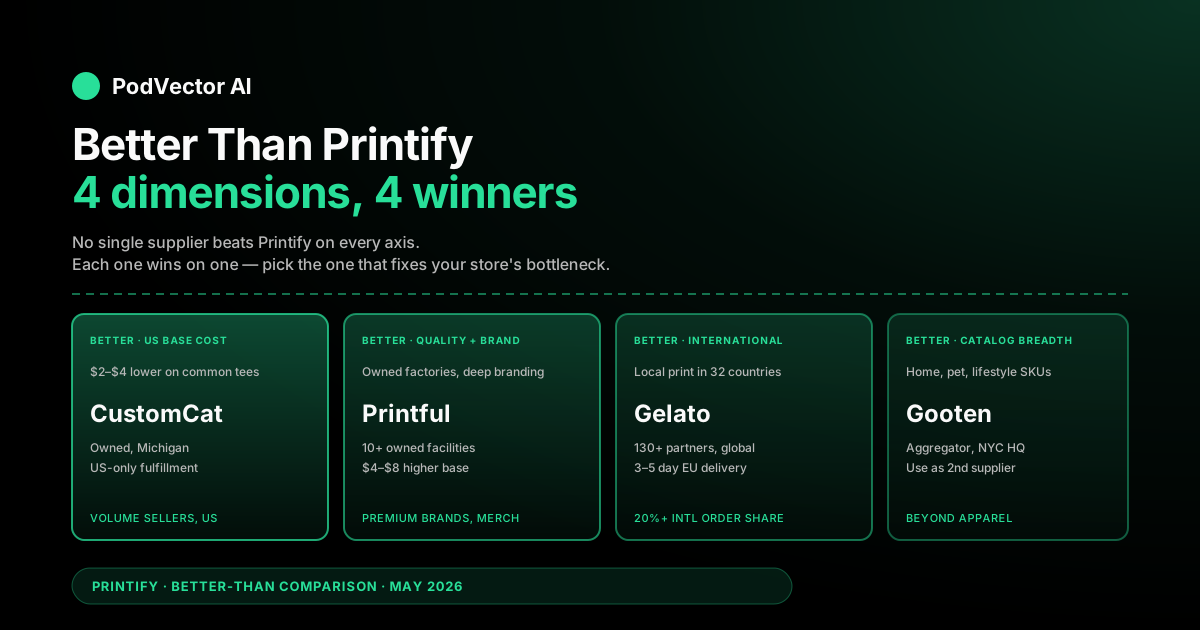
Quick Answer: Nothing is universally "better than Printify" — but specific suppliers beat it on specific dimensions. CustomCat beats it on US base cost. Printful beats it on print consistency and branding. Gelato beats it on international shipping. Gooten beats it on catalog breadth.
The right answer depends on which dimension matters most for your store: margin per unit, brand quality, geographic mix, or product range.
This guide ranks the suppliers that actually beat Printify on each axis a POD seller cares about — with the trade-offs that come with each switch. For the broader category view, see our Printify topic hub or the full Printify comparison cluster.
What "better than Printify" actually means
"Better than Printify" is the wrong framing on its own. Printify is the default for a reason — broad catalog, deep integrations, a print-partner network in 30+ countries, and a free tier that lets anyone start without commitment.
What sellers usually mean when they ask the question is one of four more specific things. They want lower base costs to widen margin. They want more consistent print quality. They want better international fulfillment. Or they want products Printify's catalog doesn't carry.
Each of those goals has a different "best" answer. There's no single supplier that beats Printify on every axis — every alternative wins on one dimension and loses on another. (Printful's vendor-side roundup of Printify alternatives covers the same suppliers; this guide ranks them by which Printify weakness they actually fix.)
The sections below take each dimension separately. Pick the one that matches your store's biggest constraint, then read that section first.
Better on US base cost: CustomCat
If margin per unit is the bottleneck, CustomCat is the answer for US-only sellers. The Detroit-headquartered company runs a single owned facility in Michigan, prints everything in-house, and pushes base prices that beat Printify on the most common SKUs.
The gap is real. On a Bella+Canvas 3001 tee, CustomCat's base is typically $2–$4 lower than Printify's standard-tier price. On Gildan hoodies, the gap can hit $5. For a store selling 1,000 units per month, that's $2,000–$5,000 of additional monthly margin on the same retail price.
The trade-offs are sharp. The catalog is narrow — mostly apparel, mugs, and hats. Design tooling and mockups feel a generation behind Printify's. International shipping is non-competitive because everything ships from Michigan.
CustomCat works best for a specific seller: US customers, standard apparel SKUs, decent volume. If that's your store, the margin math compounds fast. If you ship internationally or sell oddball products, CustomCat will hurt more than it helps. For the deeper supplier-by-supplier view, see stores like Printify.
Better on print quality and branding: Printful
If your brand is the asset and you can't afford inconsistent prints, Printful beats Printify on the dimension that matters most — production control. Printful owns and operates its production facilities in Charlotte, Los Angeles, Toronto, Riga, Birmingham UK, Tijuana, and more.
That ownership translates into measurable quality consistency. Printify's aggregator model means your order might print at any of dozens of independent partner facilities, each with their own equipment, calibration, and ink. Print results vary. Printful's owned model means every facility runs the same playbook, gets the same QA, and produces results closer to a small-batch private-label run than a generic POD order.
The branding options are also unmatched in the category. Custom inside labels, branded packing slips, custom packaging inserts, and custom hangtags are all available — at extra cost, but available. Printify's branding options are thinner and partner-dependent.
The trade-off is base cost. Printful runs $4–$8 higher per unit on common SKUs. For a seller charging $25 for a tee, that gap is the difference between $11 and $5 of margin per sale.
Printful is the right answer when print consistency and brand presentation are worth more than $4–$8 per unit of margin. For premium streetwear, fashion brands, or creator merch where returns from bad prints kill the brand, the math usually works. The deeper comparison lives in our companion guide on Tapstitch vs Printify, which contrasts a similar quality-first supplier.
Better on international shipping: Gelato
If 20% or more of your orders ship outside the US, Gelato beats Printify on the dimension that matters most for cross-border POD — fulfillment geography. Headquartered in Oslo, Gelato operates a distributed network of 130+ print partners in 32 countries.
The model rewrites international economics. A German customer ordering from a US seller through Printify usually waits 10–14 days for a shirt that cost $12–$18 to ship. Through Gelato's Berlin partner, the same shirt prints locally, ships for around €4, and arrives in 3–5 days. The customer experience flips from "international order" to "domestic order."
For US-only stores, Gelato has no special advantage — pricing sits between Printful and Printify with no structural edge. The flip happens at roughly 20–30% international order share. Above that line, Gelato pays for itself in shipping savings alone, before any conversion-rate gains from faster delivery.
The catalog is narrower than Printify's — strongest on posters, framed prints, photo books, and apparel basics. If you sell custom socks, all-over-print hoodies, or oddball SKUs, check availability before switching.
Integrations cover Shopify, Etsy, WooCommerce, Wix, Squarespace, plus a strong API. Gelato also offers Gelato+ and Gelato+ Gold tiers that unlock discounts and premium support for stores at volume.
Better on catalog breadth: Gooten
If you're expanding beyond apparel into home goods, pet products, and lifestyle categories, Gooten beats Printify on catalog breadth in the directions Printify is weakest. The New York–headquartered aggregator partners with a different set of print networks, and its catalog leans into bedding, bath, pet products, custom home goods, and oversized wall art.
The differentiation is concrete. Gooten regularly carries SKUs Printify doesn't list at all — duvet covers, dog bandanas, shower curtains, large canvas prints in non-standard sizes. For a store building a home or lifestyle brand, that catalog gap is the difference between a one-supplier setup and a two-supplier setup.
Base costs are competitive with Printify on overlapping SKUs. Apparel pricing is roughly a wash. Home goods and lifestyle pricing is where Gooten typically beats the rest of the field, because the partner network is built around those categories.
Quality varies by partner — same caveat as Printify. Test samples on every SKU before committing inventory or running ads. The dashboard is functional but less polished than Printify's.
Gooten works best as a second supplier alongside Printify rather than a full replacement. Use Printify for apparel where its network is strongest, route home and lifestyle SKUs through Gooten. The two-supplier setup is common at $50K+/month stores. For the full alternative landscape, see Teespring vs Printify.
Better for creators with an audience: Spring & Spreadshirt
If you're a YouTuber, TikTok creator, or Twitch streamer with an audience but no e-commerce setup, Spring and Spreadshirt beat Printify on the dimension Printify isn't built for — selling without a store.
Spring (formerly Teespring) integrates directly with YouTube's merch shelf, TikTok Shop, and Twitch's merch features. A creator with a YouTube channel can list a tee and have it appear under their videos within minutes, with no store, no checkout, no customer service to manage. Spring is the merchant of record — they handle taxes, returns, and shipping inquiries.
Spreadshirt offers a hosted shop product called Spreadshop. It's a Shopify-lite that takes 10 minutes to spin up, with Spreadshirt handling production from their owned facilities in Pennsylvania, Las Vegas, and Germany. Designed for creators who want a real store but not the Shopify learning curve.
The trade-off in both cases is the same: you give up customer data and full brand control in exchange for zero infrastructure. For creators monetizing an existing audience, that's usually the right trade. For sellers building a long-term brand with email lists, ads, and remarketing, it usually isn't.
Base costs are mid-tier. The economics work because creator stores typically have high conversion (warm audience) and low CAC (free traffic from the platform).
Better as a built-in marketplace: Redbubble & Zazzle
If you have designs but no marketing channel at all, Redbubble and Zazzle beat Printify on the dimension Printify deliberately doesn't compete on — built-in buyer demand.
Both are consumer-facing marketplaces. You upload a design, choose products to enable it on, and Redbubble or Zazzle handles everything else — listing, SEO, ads, fulfillment, customer service. When a buyer searches "funny cat tee" on Redbubble.com and your design comes up, the platform takes a base cost and a marketplace fee, and you keep the rest as royalty.
This is fundamentally not the same product as Printify. With Printify, you run a store and drive traffic. With Redbubble or Zazzle, you license designs to a marketplace and let their traffic do the selling. Royalties per sale are lower — typically $2–$5 vs $8–$15 on your own store — but volume can compensate if your designs catch search demand.
Use Redbubble or Zazzle as a passive income stream alongside your main Printify store, not as a replacement. Upload your best designs to both, set fair royalty rates, and let the marketplaces do the work in the background. The trade-off is exposure: anyone can see and screenshot your designs.
For more on this model, see stores like Printify, which compares marketplace-led suppliers in more depth.
Better for specific niches: Teelaunch, Apliiq, SPOD
Three more suppliers beat Printify on narrow dimensions worth knowing about.
Teelaunch is the drinkware specialist. If mugs, bottles, tumblers, and home goods are the core of your catalog, Teelaunch often has the lowest base price in the category. A 15oz mug through Teelaunch can run $1–$2 below Printify's standard-tier price. The catalog is narrower than Printify's, and Teelaunch is US-only for fulfillment, but for drinkware-heavy stores the margin math is decisive.
Apliiq is the streetwear and fashion specialist. The Los Angeles–based supplier produces small-batch, brand-quality apparel that's structurally different from generic POD — cut-and-sew options, custom hangtags, embroidered patches, sewn-in labels. Base costs are materially higher (often 50–100% above Printify), but for streetwear brands competing on fit and feel, Apliiq is the only POD-adjacent option that produces something indistinguishable from a private-label run.
SPOD is the speed specialist. Owned by Spreadshirt, SPOD's claim is 48-hour production on 95% of orders, often beating Printify's typical 3–7 day production window. For stores running flash sales, holiday rushes, or time-sensitive promotions, that production speed translates directly into customer satisfaction and lower refund rates.
Comparison table
| Supplier | Better than Printify at | Production model | Geographic strength | Best for |
|---|---|---|---|---|
| CustomCat | US base cost ($2–$4 lower) | Owned, Michigan | US-only | US volume sellers, standard apparel |
| Printful | Print consistency + branding | Owned, 10+ facilities | US + EU | Premium brands, creator merch |
| Gelato | International shipping | Network, 32 countries | Global, EU-strong | Stores with 20%+ international orders |
| Gooten | Home + lifestyle catalog | Aggregator network | US-strong | Stores expanding beyond apparel |
| Spring | Creator-platform integrations | Owned | US + EU | YouTubers, TikTok creators, streamers |
| Spreadshirt | Hosted shop + EU fulfillment | Owned | US + DE | EU creators, store-free sellers |
| Redbubble | Built-in marketplace traffic | Network | Global | Designers with no marketing |
| Zazzle | Built-in marketplace traffic | Owned + network | US-strong | Designers with no marketing |
| Teelaunch | Drinkware base cost | Owned, US | US-only | Drinkware and home-goods stores |
| Apliiq | Streetwear / fashion quality | Owned, Los Angeles | US-strong | Premium streetwear, fashion brands |
| SPOD | Production speed (48h) | Owned, Spreadshirt | US + DE | Flash-sale and time-sensitive stores |
How to pick — by seller profile
The right "better than Printify" depends entirely on which Printify weakness is actually costing you money. Pick the profile closest to your store.
US-only seller, standard apparel, decent volume: Try CustomCat first. The $2–$4 base-cost gap compounds fast at volume, and the trade-offs (narrower catalog, no international) probably don't matter to you.
Premium brand or creator merch where prints have to be perfect: Try Printful. The $4–$8 base-cost premium buys you measurable quality consistency and the best branding options in the category.
Store with 20%+ international orders, especially in the EU: Try Gelato. The shipping math alone usually pays for the switch. Domestic-to-domestic fulfillment also lifts conversion rates because customers see realistic delivery windows.
Store expanding beyond apparel into home, lifestyle, or pet: Add Gooten as a second supplier. Don't replace Printify — route apparel through Printify, home and lifestyle through Gooten.
Creator with a YouTube, TikTok, or Twitch audience and no store: Try Spring. Zero infrastructure, native platform integrations, merchandise live in minutes.
Designer with strong designs but no marketing channel: Run Redbubble and Zazzle in parallel as passive income. Use Printify for the store you actually control.
Switching from Printify without breaking your store
The switch itself is the part most sellers underestimate. Order routing, product mockups, customer expectations, and SKU consistency all move when you change suppliers.
Three rules keep the switch clean.
First, order samples from the new supplier before changing live products. Confirm print quality, fabric weight, and color accuracy match what your customers expect. A Bella+Canvas 3001 from Printify and from CustomCat are technically the same shirt — but slight ink, mockup, and sizing differences can drive returns if customers don't get what they saw in the listing.
Second, switch one SKU at a time. Run the new supplier on a low-volume product for two weeks. Track refund rates, customer complaints, and review sentiment. If those hold steady, expand. If they spike, stop.
Third, run both suppliers in parallel rather than fully cutting Printify. Most stores at $20K+/month run two or three suppliers — Printify for catalog breadth, plus a specialist for the dimension that matters most. The two-supplier setup is the norm, not the exception.
The hardest part: knowing which is actually better for your products
The framework above tells you which supplier wins on which dimension in general. It doesn't tell you which supplier wins for your specific product mix, your customer geography, your retail prices, and your order volume.
That answer requires connecting your store's actual data — Shopify orders, supplier base costs, ad spend, shipping data — into a single view and asking a structured question: "If I had run my last 90 days of orders through CustomCat instead of Printify, what would my margin have been?"
This is what Victor — PodVector's AI employee — was built for. Victor connects to your Shopify store, Printify and Printful, and Meta and Google ad platforms, builds a live data warehouse, and answers questions like "which supplier would be more profitable for my products?" with real numbers from your store, not industry averages.
Ask Victor "what would my margin be if I moved my top 10 SKUs from Printify to CustomCat?" and you get a per-SKU breakdown grounded in your actual order history. The answer is store-specific, not generic.
FAQs
Is anything actually better than Printify in 2026?
Yes, but on specific dimensions only. CustomCat is better on US base cost. Printful is better on print consistency and branding. Gelato is better on international shipping. Gooten is better on home and lifestyle catalog. No single supplier beats Printify on every axis — they each win on one or two and lose on others.
Should I leave Printify entirely or run multiple suppliers?
Run multiple suppliers. The standard setup at $20K+/month is Printify plus one or two specialists — Printify for catalog breadth, a specialist for the dimension that matters most (cost, quality, international, or niche catalog). Full replacement is rarely the right move because Printify's catalog and integration depth are hard to match with any single alternative.
What's the cheapest alternative to Printify?
For US-only sellers on standard apparel SKUs, CustomCat is typically the cheapest with $2–$4 lower base costs on common tees and hoodies. For EU-fulfilled orders, SPOD often beats Printify on shipping-inclusive cost. The cheapest-overall answer depends on your specific SKUs and geography.
Which Printify alternative has the best print quality?
Printful is the consistent answer for general POD quality, because it owns and operates its own production facilities. Apliiq beats Printful on streetwear-specific quality (cut-and-sew, branded labels, premium fabrics) but at materially higher base costs.
What's the best alternative for international orders?
Gelato. Its 130+ partner facilities in 32 countries mean orders fulfill locally instead of shipping internationally. Stores with 20%+ international order share usually see immediate margin and conversion gains after switching international orders to Gelato.
Can I sell on Printify and Redbubble at the same time?
Yes, and most established POD designers do. The two models don't conflict — Printify powers your owned store and brand, Redbubble lets the same designs earn passive royalties from its marketplace traffic. Upload your best designs to both.
Is Printify Premium worth it instead of switching suppliers?
It depends on volume. Printify Premium ($29/month) unlocks discounts that can match a CustomCat-level cost gap on standard SKUs, without the switching cost. For details on whether it pencils out, see our Printify Premium analysis and the deeper Printify Premium plan benefits review.
Stop guessing which supplier is better. Ask Victor.
Industry roundups tell you which supplier wins in general. They don't tell you which one wins for your products, your geography, your retail prices.
Victor — PodVector's AI employee for POD sellers — connects your Shopify store and Printify/Printful supplier data into a live warehouse and answers questions like "what does my margin look like after Printify supplier cost on my top SKUs?" with real numbers from your store. And get a per-SKU supplier-cost breakdown for your store.
Try Victor free