
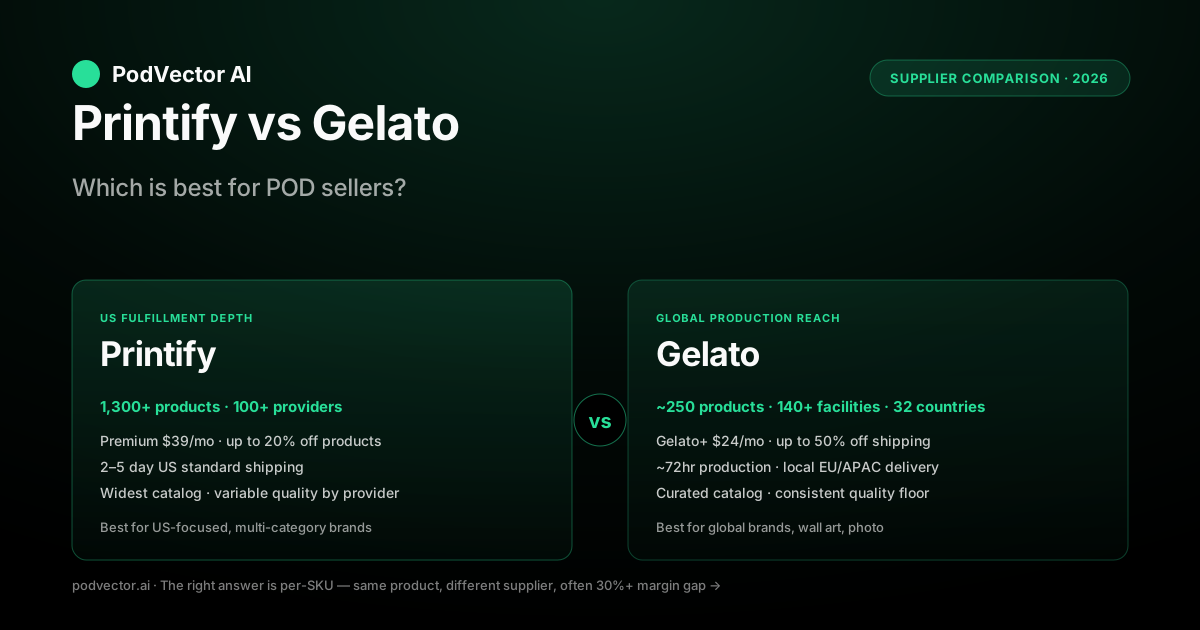
Quick Answer: Printify wins on catalog breadth, lower base costs, and US fulfillment depth. Gelato wins on global production speed, consistent quality, and a more curated catalog built around posters, wall art, and apparel.
If most of your buyers are in the US and you want maximum product variety at the lowest base cost, Printify is the default pick. If your buyers are split across continents or you sell premium wall art and need fast EU/APAC fulfillment, Gelato pays back its slightly higher base price in shipping cost and delivery time.
For almost every POD operator, the supplier choice doesn't decide profit — per-SKU margin does. The same product, same audience, can net 30%+ more margin on one supplier vs the other once you factor in shipping zones, refund rates, and reprint frequency.
The quick verdict
Most Printify vs Gelato articles dodge the call and tell you to "try both." That's only useful advice if you have unlimited time. Here's a sharper answer.
Pick Printify if: your buyers are primarily US-based, you sell across many product categories (apparel, drinkware, accessories, home goods, novelty), and you want the lowest base cost to maximize margin. Printify's 1,300+ product catalog and 100+ print provider network is the widest in the industry.
Pick Gelato if: your buyers are split across multiple continents, you sell premium wall art, posters, or photo books, and consistent print quality matters more than the absolute lowest base cost. Gelato's distributed production across 32 countries gets orders delivered locally in most markets.
Pick both if: you're past hobby stage and your catalog spans both apparel and wall art. Running two suppliers in parallel through Shopify or WooCommerce is straightforward, and per-SKU you'll find one supplier consistently out-margins the other.
Side-by-side snapshot
Quick orientation. Each row hides nuance unpacked below.
| Dimension | Printify | Gelato |
|---|---|---|
| Product catalog size | 1,300+ items | ~250 items |
| Print provider network | 100+ third-party providers | 140+ partner facilities in 32 countries |
| Catalog focus | Apparel, drinkware, accessories, novelty, supplements, candles, home goods | Posters, wall art, apparel, photo books, mugs, phone cases |
| Base cost (Bella+Canvas tee, US) | ~$9–10 free tier, ~$7–8 Premium | ~$10–12 |
| Production time | 2–3 business days average | ~72 hours for 90% of orders |
| US shipping | 2–5 business days standard | 4–6 business days standard |
| International shipping | Variable; depends on provider | Local production in 32 countries; faster across EU/APAC |
| Monthly subscription | Free / Premium $39 / Enterprise custom | Free / Gelato+ $24 / Gold $119 |
| Subscription discount | Up to 20% off most products on Premium | Up to 50% off shipping, 10% off some products on Gold |
| Sales channel integrations | Shopify, Etsy, WooCommerce, Wix, eBay, TikTok Shop, Squarespace, Amazon, Walmart, PrestaShop | Shopify, Etsy, WooCommerce, Wix, Squarespace, BigCommerce, ShopBase, Amazon (US, added late 2024) |
| Mockup generator | Built-in, AI-assisted | Built-in, AI-assisted |
| Sustainability angle | Available with select providers | Local production reduces shipping emissions; FSC paper on wall art |
| Best for | US sellers, broad catalogs, lowest base cost | Global sellers, wall art, quality consistency |
Product catalog and variety
This is the biggest single difference. The two platforms approach product breadth from opposite directions.
Printify: maximum breadth
Printify's catalog is 1,300+ products across 100+ providers. That includes the obvious POD lines — t-shirts, hoodies, mugs, posters, phone cases — plus categories most POD platforms don't touch: nutritional supplements, scented candles, scrubs, pet products, custom shoes, and a deep selection of home goods.
The tradeoff: variety across providers means variety in quality and pricing. A Bella+Canvas tee from one Printify provider may print differently from the same blank at another provider in another state. You pick the provider per product, which gives control but also adds a step.
For the catalog-by-catalog view of what's actually profitable to sell on Printify, the complete guide to Printify's most profitable products breaks down which SKUs net the strongest margin in 2026.
Gelato: curated focus
Gelato lists around 250 products. The catalog leans heavily into wall art (canvas, framed prints, posters), apparel, photo books, drinkware, and phone cases. You won't find supplements, candles, or the niche novelty items Printify carries.
The upside of a curated catalog: Gelato's quality control is tighter because they're managing a smaller set of products across their partner network. If your business is built around posters and wall art, Gelato's catalog is purpose-built for you.
Verdict on catalog
Printify wins on breadth. Gelato wins on depth in wall art and photo products. Neither is "better" — the right answer depends on what you sell. A general-purpose POD seller covering apparel, drinkware, and accessories defaults to Printify. A wall art–focused brand defaults to Gelato.
Print quality and consistency
Print quality is the single most-debated topic in the Printify vs Gelato conversation, and both sides have legitimate points.
Printify: variable, provider-dependent
Quality on Printify depends entirely on which provider you select for each product. Top-rated providers like Monster Digital, SwiftPOD, and District Photo turn out work that's competitive with anything in the industry. Lower-rated providers in the same Printify network can be hit or miss on color accuracy and stitching.
This is the structural cost of an aggregator model. You can run sample orders to vet a provider, but you also need to monitor consistency over time — providers change blanks, ink batches, and printers, and quality can drift.
Gelato: more consistent across the network
Gelato runs a tighter partner spec and consolidates orders to local facilities that meet their quality threshold. The result is fewer high points than Printify's best providers, but a higher floor — bad orders are rarer.
The 2025 Bootstrapping Ecommerce review found Gelato's wall art consistently better than Printify's — sharper prints, more accurate color, sturdier packaging. Apparel quality was comparable across both. Print on Demand Business's 2026 comparison reached a similar conclusion: Gelato's quality floor is higher; Printify's quality ceiling is higher if you find the right provider.
Branding options
Both platforms support branded packing slips, inside-shirt labels, and branded thank-you cards on select products and providers. Gelato's branding suite is slightly more consistent because of its tighter network. Printify's is broader but varies by provider.
Verdict on quality
Gelato for predictable quality without provider vetting. Printify for higher potential quality once you've found and vetted the right providers for each SKU. New sellers usually prefer Gelato's lower variance; experienced sellers often prefer Printify's upside once they've done the vetting.
Fulfillment, shipping, and geography
This is where the geographic split of your customer base decides which supplier wins.
Production time
Both platforms average roughly 2–3 business days to produce an order before it ships. Gelato claims 90% of orders are produced and shipped within 72 hours thanks to their distributed network. Printify averages similarly but varies more by provider — high-volume providers turn around faster than smaller ones.
US shipping
Printify has more US print providers than Gelato, so US-to-US shipping is typically 2–5 business days on standard service. Gelato's US production goes through partner facilities and tends to deliver in 4–6 business days. For a US-focused brand, Printify's shipping speed and shipping cost are the structural advantage.
International shipping
Gelato's value proposition. They produce locally in 32 countries — the UK, Germany, France, Spain, Italy, Sweden, Norway, the Netherlands, Australia, Japan, Brazil, and others. An order from a German buyer ships from a German facility. That collapses delivery time and shipping cost compared to producing in the US and shipping internationally.
Printify has international providers too, but the network is less dense. International orders on Printify often route to the nearest provider, which may still mean crossing borders and longer delivery windows.
That said, Printify has closed some of the gap. Its 2026 network now spans 140+ facilities across a dozen countries, and Printify reports 92% of partner-facility orders were fulfilled in the same region as the buyer. Gelato still routes more automatically — you list once and orders auto-assign to the nearest facility — but the raw local-fulfillment gap is smaller than it was two years ago.
Shipping cost
The shipping cost difference compounds at scale. On a $35 t-shirt sold to a UK buyer, US-origin shipping might add $10–15 in shipping cost vs Gelato's UK-local shipping at $5–7. That's $5–10 of margin per order — meaningful when you're running paid ads to that market.
Verdict on fulfillment
Printify for US-focused brands. Gelato for international or multi-region brands. If you're 80%+ US, Printify wins on speed and cost. If you're below 60% US, Gelato's distributed network usually pays back.
Pricing, plans, and base costs
Subscription plans, base costs, and shipping all stack into the final margin. Both platforms have a free tier and paid upgrades.
Printify pricing
- Free: $0/mo. Standard catalog pricing. No subscription discount. Up to 5 stores.
- Premium: $39/mo, or $24.99/mo billed annually (raised from $29/mo in early 2026). Up to 20% off most products, and up to 33% off select new products. Up to 10 stores.
- Enterprise: Custom pricing for 10,000+ orders/mo. Negotiated discounts and dedicated account management.
Printify's cheapest unisex tee runs around $8.80 standard and about $5.90 on Premium. A Bella+Canvas 3001 from a top US provider lands closer to $9–10 free and $7–8 on Premium.
The Premium subscription pays back at roughly $200/mo in product spend.
For the deeper margin breakdown across product categories, the complete profitability analysis for Printify walks through what each tier and provider combination actually nets.
Gelato pricing
- Free: $0/mo. Standard pricing. Single store.
- Gelato+: $24/mo or $239/year. Up to 50% off shipping, 10% off some products, branded packing slips, premium support. Up to 3 stores.
- Gold: $119/mo or $1,185/year. Higher discounts, advanced analytics, dedicated account manager, multi-store management.
A Gildan or Bella+Canvas equivalent from Gelato US production runs around $10–12. Gelato's pricing edge sits on shipping rather than product cost — Gelato+ takes a meaningful chunk off shipping for international orders, which can be the deciding factor for global sellers.
Real-world all-in cost at three scales
Hobby — 10 orders/mo: Free on both. Pick whichever supplier's catalog matches your products. Subscription cost is $0/mo on either side.
Side-hustle — 100 orders/mo, US-focused: Printify Premium ($39/mo) typically pays back within the first ~$200/mo of product spend. Gelato+ ($24/mo) makes sense only if you're shipping internationally often.
Real business — 1,000 orders/mo, mixed geography: If 60%+ international, Gelato Gold ($119/mo) pays back on shipping discounts alone. If US-focused, Printify Premium plus a separate Gelato free account for international SKUs is a common dual-supplier pattern.
Integrations and store setup
Both platforms integrate with the main ecommerce stacks. Printify covers more channels; Gelato covers the major ones cleanly.
Printify integrations
Shopify, Etsy, WooCommerce, Wix, Squarespace, BigCommerce, PrestaShop, eBay, Walmart, TikTok Shop, Amazon (via Merch on Demand and via third-party integrations), and Printify's own Pop-Up Store. The Shopify and Etsy integrations are the most mature.
Gelato integrations
Shopify, Etsy, WooCommerce, Wix, Squarespace, BigCommerce, ShopBase, and Gelato's own store. Gelato added a native Amazon US integration in late 2024, which closed a real gap. But as of mid-2026 there's still no native eBay, Walmart, or TikTok Shop integration — you'd need a third-party connector or order-API integration to plug into those marketplaces.
What the integration handles
On both platforms, the integration syncs products, mockups, base costs, and variant inventory status from supplier to storefront. Orders flow back from storefront to supplier the moment payment clears. Refunds, reprints, and customer support are handled separately on the supplier dashboard.
API access
Both platforms expose an order and product API for advanced setups. Printify's API is more widely documented in third-party tools and Zapier integrations. Gelato's API is cleaner for high-volume custom flows but less covered in the community.
Verdict on integrations
Printify if you sell on eBay, Walmart, or TikTok Shop alongside your main store — those still lack native Gelato support. Amazon US is now covered on both. Gelato is a clean fit if Shopify or WooCommerce is your only channel — the core integrations are equally solid.
Support and ease of use
Both platforms have improved support meaningfully in the last two years. Differences are smaller than they used to be.
Onboarding and UI
Gelato's UI is cleaner and more opinionated — fewer settings to configure, faster path from upload to live product. Printify's UI gives you more control over provider selection, mockup customization, and variant pricing, but takes longer to learn.
New sellers tend to find Gelato easier in the first week. Experienced sellers tend to prefer Printify's depth once they've learned where things live.
Customer support
Printify offers 24/7 chat support across all tiers; merchant support is faster on Premium. Gelato's support is responsive but more business-hours weighted unless you're on a paid tier. Both handle reprint and refund cases reasonably; the structural difference is that Gelato manages the production facility directly while Printify routes the issue to the third-party provider, which can add a step.
Documentation and community
Printify has a much larger seller community — Reddit, YouTube creators, Facebook groups, third-party guides. If you hit a question, you'll likely find the answer in a community post. Gelato's community is smaller but the official documentation is cleaner and better maintained.
When Printify wins
Default to Printify if any of these match your business.
Your buyers are mostly US-based
US shipping is faster, US provider density is higher, and US base costs on Printify are typically lower than Gelato's US production. For a brand with 80%+ US revenue, Printify is the structural default.
You sell across many categories
Apparel plus drinkware plus accessories plus home goods plus novelty. Printify's 1,300+ catalog covers categories Gelato doesn't, and you'd otherwise need a second supplier to fill the gaps.
You're optimizing for the lowest base cost
Premium-tier discounts on Printify are aggressive — up to 20% off most products. If you compete on price (Etsy, Amazon Merch, or budget Shopify niches), the base cost advantage compounds across your catalog. For the Amazon Merch–specific comparison, see Printify vs Amazon Merch on Demand.
You sell on marketplace channels
eBay, Walmart, TikTok Shop, Amazon. Printify's native integrations across these channels are more mature than Gelato's. If your business is multi-channel rather than Shopify-only, Printify removes friction.
When Gelato wins
Default to Gelato if any of these match your business.
Your buyers are international or multi-region
Production in 32 countries means a German buyer's order is printed in Germany, not shipped from Atlanta. Delivery time, shipping cost, and customs friction all collapse. For brands selling to EU, UK, APAC, or Australia, the difference is often $5–10 of margin per order vs Printify's US-origin shipping.
You sell wall art or photo products
Posters, framed prints, canvas, photo books. Gelato's catalog and quality are built around these categories. The print quality on wall art is consistently sharper than Printify's average, and FSC-certified paper is available across the wall art line.
You value quality consistency over upside
You don't want to spend time vetting providers and chasing quality drift. Gelato's tighter partner spec means a higher quality floor — bad orders are rarer even if you never optimize. For a one-person operation, the time saved on QA is real.
Sustainability is part of your brand
Local production reduces shipping emissions. Gelato publishes per-product CO₂ data. If "eco-friendly" or "carbon-conscious" is in your brand voice, Gelato gives you the data to back it up.
Where neither is the right answer
Printify and Gelato are both strong, but they're not the only options. A handful of situations push you toward a different supplier.
Owned-facility quality requirements
If you need the consistency of a supplier that owns its own production end-to-end, Printful is a closer fit. Higher base cost, but no provider variance and a more mature branding suite for premium brands.
Tight niche or specialty product
If your catalog centers on a specific category — embroidered apparel, specialty drinkware, custom shoes, packaging — a category-specialist supplier often beats a generalist. Several of these are covered in the broader other sites like Printify roundup and the places like Printify comparison for the full alternatives landscape.
Marketplace-native model
If your business runs entirely on Amazon Merch on Demand or Redbubble, you're not picking Printify or Gelato at all — you're picking a marketplace POD model where the platform handles fulfillment, payments, and audience. Different tradeoff entirely; the Printify vs Amazon Merch on Demand comparison covers that fork.
The comparison that actually decides profit
The Printify vs Gelato framing assumes the question is which supplier to pick. Once you've made that call, a different question takes over — and it's the one that actually decides whether your store is profitable.
The real question: which products in your catalog, sold to which buyer geographies, through which supplier, net the most margin after base cost, shipping, payment processing, refunds, and reprints? That answer is per-SKU.
A unisex tee selling to US buyers nets different margin on Printify than the same tee selling to UK buyers on Gelato — and the gap can be $3–6 per order in either direction depending on shipping zone and refund rate. A poster line might lose money on Printify and clear 40% margin on Gelato. A drinkware SKU might be the reverse.
Independent 2026 tests show how wide the swing gets. On a $20 tee, reviewers put Printify's net margin around 29% and Gelato's around 37% once local fulfillment cut the shipping distance — even though Printify's base cost was lower. Lower base cost does not always win; the shipping zone flips the result.
The supplier comparison gets you 80% of the way. The last 20% — the part that decides whether you're profitable — is in your own order data, broken down per product, per supplier, per geography, per month. Most operators never run that breakdown because the data lives in three or four different dashboards. Without it, supplier choice is a guess.
FAQs
Is Gelato better than Printify?
Not categorically. Gelato wins on global fulfillment speed, quality consistency, and wall art quality. Printify wins on catalog breadth, US shipping speed, and base cost. The right answer depends on where your buyers are and what you sell.
Is Printify cheaper than Gelato?
Usually yes on US-produced products, especially with Premium's 20% discount. A Bella+Canvas tee from a top US Printify provider lands at $7–8 on Premium vs $10–12 on Gelato US production. Gelato's pricing advantage sits on shipping for international orders, not base cost.
Which has better print quality?
Gelato is more consistent across its network. Printify has a higher ceiling — its top providers print at premium quality — but quality varies by provider. Gelato is the safer pick if you don't want to vet providers; Printify is the higher-upside pick if you'll do the work.
Which integrates better with Shopify?
Both Shopify integrations are mature and stable. Printify's app has been around longer and has slightly more community documentation. Gelato's app is cleaner UI-wise. Functionally they're comparable.
Which is better for Etsy sellers?
Both integrate with Etsy. Printify is more common in the Etsy POD community simply because of its install base and broader catalog. For Etsy wall art specifically, Gelato's product quality often pays back the slightly higher base cost.
Can I use Printify and Gelato together?
Yes, and many POD operators do. Run each supplier on a Shopify or WooCommerce store with separate apps installed. Use Printify for the categories where its base cost and US speed dominate; use Gelato for international fulfillment and wall art. Per-SKU sourcing is one of the highest-leverage moves in POD.
What about Printful — how does it compare to both?
Printful owns its production facilities, charges a higher base cost than either Printify or Gelato, and competes on quality consistency and branding maturity. Note that Printful and Printify now sit under common ownership after their 2024 merger, but they still run as separate platforms with separate catalogs, apps, and pricing — so the comparison still holds. If you're picking between all three, the simplified rule: Printful for premium consistency, Gelato for global reach, Printify for catalog breadth and cost.
Does Gelato have an Amazon Merch–style passive model?
No. Gelato is a supplier; you need to bring your own storefront and audience. Amazon Merch on Demand is a separate marketplace model where Amazon owns the audience and the platform handles fulfillment. The two aren't comparable.
Which is faster to set up?
Gelato is slightly faster — fewer settings, more opinionated defaults. Both can have a working store and live product in under 60 minutes. Printify takes more time because of provider selection per product, but that same step gives you more control once you know what you're doing.
How much do shipping discounts on Gelato+ actually save?
Up to 50% off shipping in their published rates, but real savings depend on your shipping mix. For a brand shipping mostly within the EU or APAC, Gelato+ usually pays back within $250–400/mo of order volume. For a US-only brand, the savings are smaller and Printify Premium's product discount typically wins.
Where can I read more independent comparisons?
For a deeper third-party walkthrough of pricing, quality, and shipping side by side, Print on Demand Business runs a detailed 2026 Printify vs Gelato comparison. For the wider Printify comparison landscape, see the Printify comparison cluster and the full Printify topic hub.
Pick the supplier with the data, not the review article
Printify vs Gelato isn't a single answer — it's a per-SKU answer. The same product, same audience, can net 30%+ more margin on one supplier vs the other once you factor in shipping zones, refund rates, and reprint frequency. Victor looks at your Shopify store, your Printify and Printful cost data, and your Meta and Google ad spend all together, so he can answer margin questions in plain English — and suggest specific actions (price changes, paused SKUs) you can approve in one click.
Try Victor free