
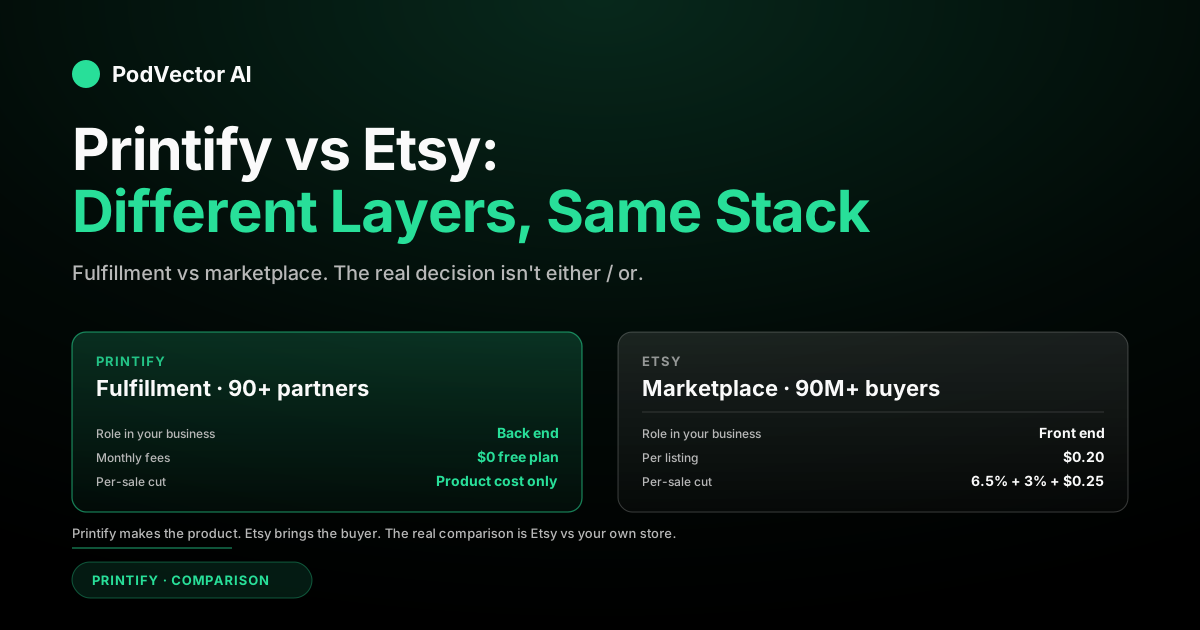
Quick Answer: Printify and Etsy aren't direct competitors. Printify is a print-on-demand fulfillment platform — Etsy is a marketplace where buyers shop. Most successful POD sellers use both together: Printify makes the product, Etsy sells it.
The real decision isn't Printify or Etsy. It's Etsy or your own Shopify store — with Printify (or another POD provider) handling production either way.
Below: a side-by-side breakdown of fees, control, traffic, and the total cost of a $25 t-shirt sale through each path — so you can pick the route that fits your margin goals.
Printify vs Etsy: They're Not Competitors
If you searched "Printify vs Etsy," you've probably seen plenty of guides that punt on the question. Here's why: they answer different problems.
Printify is a print-on-demand (POD) supplier network. You upload a design, pick a product (t-shirt, mug, hoodie, poster), and Printify routes the order to a print partner who manufactures and ships it. No inventory, no equipment, no warehouse.
Etsy is a marketplace. Buyers go there to discover handmade, vintage, and unique products. You list items, Etsy charges fees per listing and per sale, and the marketplace handles checkout and customer payment.
Printify doesn't sell anything to end customers. It plugs into a storefront — Etsy, Shopify, eBay, Wix, your own site — and fulfills whatever the storefront sells.
Etsy doesn't print anything. It's a discovery and checkout layer on top of whatever supplier or maker you've chosen.
That means the question "Printify vs Etsy?" is really "Which sales channel should I pair with a POD supplier?" — and the comparison that matters is Etsy as a marketplace versus running your own storefront.
Side-by-Side: What Each Platform Actually Does
Before comparing where to sell, get clear on what each platform actually does in the workflow.
| Function | Printify | Etsy |
|---|---|---|
| Manufactures products | Yes (via 90+ print partners) | No |
| Ships to customers | Yes | No |
| Hosts a storefront | No (plugs into yours) | Yes (marketplace listing pages) |
| Brings buyer traffic | No | Yes (millions of active shoppers) |
| Handles checkout & payment | No | Yes |
| Sets prices | You do (Printify sets the cost) | You do |
| Monthly fees | Free plan, paid tiers optional | None ($0.20 per listing) |
| Cuts per sale | Product cost + shipping | 6.5% transaction + 3% + $0.25 payment |
Read that table once more. Printify and Etsy don't overlap on a single row. They stack: Printify is the back end, Etsy is the front end.
If you want a closer look at how Printify's pricing tiers stack up, see our Printify Premium plan price breakdown and the Premium benefits analysis for the full math.
The Real Decision: Etsy or Your Own Store
Once you've accepted that Printify is the fulfillment layer, the comparison shifts to where you sell. The two realistic options:
Option A — Etsy + Printify. List products on Etsy. Etsy brings buyer traffic. Printify makes and ships when an order comes in. You pay Etsy's fees on every sale plus Printify's product cost.
Option B — Your own store (Shopify, Wix, WooCommerce) + Printify. Build your own storefront. You bring all the traffic yourself (ads, social, SEO, email). Printify makes and ships. You pay your storefront's monthly fee plus Printify's product cost.
Each path has a different cost structure, a different growth ceiling, and a different daily workload. The right answer depends on your traffic strategy, your branding goals, and how much margin pressure you can absorb.
Same-category comparisons that go deeper on Printify alternatives: sites like Printify, sites similar to Printify, and stores like Printify. For the full lineup of Printify-versus articles, see the Printify comparisons hub, and for everything Printify-related in one place, the Printify guide hub.
Fees Breakdown: $25 T-Shirt Sale, Both Paths
Run the numbers on a specific example. Customer buys a $25 t-shirt. Free shipping built into the price. Printify's t-shirt cost is roughly $9 plus $4.50 shipping (varies by product and partner). Numbers are rounded.
Path 1: Etsy + Printify
| Line item | Amount |
|---|---|
| Sale price | $25.00 |
| Etsy listing fee (amortized) | -$0.20 |
| Etsy transaction fee (6.5%) | -$1.63 |
| Etsy payment processing (3% + $0.25) | -$1.00 |
| Etsy Offsite Ads fee (if applicable, 12-15%) | -$0 to -$3.75 |
| Printify product cost | -$9.00 |
| Printify shipping cost | -$4.50 |
| Profit (no Offsite Ads) | $8.67 |
| Profit (with Offsite Ads) | $4.92 |
Roughly 35% margin without Offsite Ads. Drops to ~20% if Etsy attributes the sale to its ad network. That last hit is a recurring complaint among Etsy POD sellers — and it's largely outside your control.
Path 2: Your Own Store (Shopify) + Printify
| Line item | Amount |
|---|---|
| Sale price | $25.00 |
| Shopify monthly plan ($39 ÷ ~50 sales) | -$0.78 |
| Shopify Payments (2.9% + $0.30) | -$1.03 |
| Printify product cost | -$9.00 |
| Printify shipping cost | -$4.50 |
| Ad cost (assume $5 CPA from paid traffic) | -$5.00 |
| Profit | $4.69 |
Roughly 19% margin once you factor in paid acquisition. If you can drive organic traffic (SEO, email list, social), that $5 line item drops or disappears — and Shopify margins can leapfrog Etsy.
The trade-off is now visible: Etsy gives you traffic and takes a cut. Your own store gives you control and forces you to buy traffic.
When Etsy + Printify Wins
Pick Etsy as your sales channel when one or more of these apply:
- You're starting from zero traffic. Etsy's 90M+ active buyers do the discovery work for you. Your own store starts at zero pageviews on day one.
- Your niche has strong Etsy search demand. Wedding, baby, pet, hobby-specific products often outperform on Etsy because buyers go there with intent. Run a search for your niche keywords — if results are dense, demand is real.
- You're testing designs. Etsy's low listing fee ($0.20) lets you publish 50 designs cheap. Kill the duds, double down on the winners.
- You don't want to learn paid ads. Etsy ads are simpler than Meta or Google. Lower ceiling, lower learning curve.
- You're a solo operator without a marketing budget. Etsy compresses fixed costs into per-sale fees, so you don't pay $39/mo to keep the lights on.
The Etsy ceiling: you don't own the customer relationship. Etsy can change rules, fees, or your shop's visibility overnight. Many veteran sellers treat Etsy as one channel inside a larger business — not the whole business.
When Your Own Store + Printify Wins
Pick your own storefront when:
- You're building a brand. Etsy's marketplace surface makes every shop look similar. Your own store gives you full design control, a custom domain, and brand authority that compounds over time.
- You already have a traffic source. Existing audience on TikTok, YouTube, Instagram, a newsletter, or organic SEO — your own store converts that traffic without paying Etsy a cut.
- You want to own the customer. Email lists, retargeting, customer LTV — all of that is harder on Etsy because Etsy controls the buyer relationship.
- You're scaling past $5K/month. Etsy fees stack as you grow. At higher volume the math of paying a flat Shopify subscription beats per-sale percentage cuts.
- You sell higher-priced or premium products. A $90 hoodie loses meaningful margin to Etsy's transaction fees. A $25 t-shirt is less affected.
The own-store ceiling: traffic acquisition is your full-time job. If you can't reliably drive visitors at a sustainable CPA, the storefront is just an empty building.
Using Both Together: The Hybrid Play
Most POD sellers who scale past hobby income don't pick one. They run both — Etsy as a discovery and validation channel, their own store as the margin and brand engine.
The typical workflow:
- Test on Etsy. Cheap to list, real buyer signal, no traffic acquisition needed. Find what sells.
- Migrate winners to your own store. Once a design has 50+ Etsy sales, list it on Shopify too. Build product pages with better photography and brand story.
- Drive paid traffic to the store. Run Meta or Google ads to the Shopify product, where margins are higher and you keep the customer email.
- Keep Etsy alive for organic. Don't shut it down. The Etsy listing keeps capturing buyers searching that platform.
This split lets Etsy do what it's good at (low-cost discovery) while your own store does what it's good at (margin retention and brand building).
Worth noting: Etsy now requires you to disclose Printify as a "production partner" in your shop settings. It's a one-time setup step, not a fee — but skipping it can get listings flagged. Printify's official Etsy integration page walks through the connection in five minutes, and eRank's beginner walkthrough covers the disclosure step in detail.
Common Mistakes POD Sellers Make Comparing These
Mistake 1: Treating Etsy fees as the only cost. A $25 sale on Etsy doesn't cost you $2.63 in fees — it costs you $2.63 in Etsy fees plus $13.50 in Printify production. Total platform-plus-fulfillment cost is what matters.
Mistake 2: Ignoring Offsite Ads fees. Etsy auto-enrolls sellers above a revenue threshold into Offsite Ads. That 12-15% cut applies to any sale Etsy attributes to its ad network — even if the buyer would've found you anyway. Run the worst-case margin math before relying on Etsy.
Mistake 3: Picking your own store before you can drive traffic. Shopify with no buyers is a $39/mo monument to optimism. If you can't articulate exactly where the first 1,000 visitors come from, start on Etsy.
Mistake 4: Not tracking per-product profitability. Your Printify dashboard shows production cost. Etsy shows fees. Shopify shows ad spend. None of them show net profit per design — which is the only number that tells you which products to scale. POD sellers who don't reconcile across platforms end up scaling losers.
Mistake 5: Picking one and ignoring the other forever. Etsy and Shopify aren't a fork in the road. They're complementary channels with different acquisition economics. Run them in parallel once you're past the proving-it-works stage.
FAQs
Is Printify free to use with Etsy?
Printify's free plan has no monthly fee and works with Etsy out of the box. You pay only the product cost and shipping when an order comes in. Etsy charges its own listing and transaction fees on top of that.
Can I sell Printify products on Etsy without telling Etsy?
No. Etsy requires sellers using a production partner (like Printify) to disclose that partner in shop settings. Failing to disclose can result in listings being removed. Setup takes about two minutes.
How much does Etsy actually take from a Printify sale?
Typically 10-15% of the sale price when you stack listing fee, transaction fee (6.5%), and payment processing (3% + $0.25). Add another 12-15% if Etsy attributes the sale to Offsite Ads. The Printify product cost is separate from Etsy fees.
Is it better to start on Etsy or my own Shopify store?
If you have no existing audience and no marketing budget, start on Etsy. The platform's buyer traffic does the discovery work. Once you have proven winners and an audience, layer in your own store for margin and brand control.
Can I use Printify with Shopify and Etsy at the same time?
Yes. Printify integrates with multiple storefronts simultaneously. Many sellers run an Etsy shop and a Shopify store side by side, with Printify fulfilling both. Inventory and order routing handle automatically.
What's the average margin on a Printify product sold on Etsy?
Most POD sellers target 25-40% net margin after Printify costs and Etsy fees, assuming the sale isn't Offsite-Ads-attributed. Margin drops to 15-25% when Offsite Ads applies. Higher-priced products (hoodies, premium apparel) usually carry better absolute dollars but similar percentages.
Does Printify charge more if I sell on Etsy versus Shopify?
No. Printify's product cost is the same regardless of which storefront the order came from. Printify charges by product and shipping zone, not by sales channel.
Know which sales channel is making you money — without spreadsheets
Running Etsy and Shopify at once means reconciling fees across two dashboards plus Printify's production costs. Most POD sellers don't.
That's why Victor exists. Victor is an AI employee that connects to your Shopify, Printify, and ad accounts, builds a unified data layer, and answers questions like "which channel had higher net margin last month?" or "which design loses money on a given channel?" — with real numbers from your own store.
No CSV exports. No spreadsheet rebuild every Sunday. And ask it your hardest margin question on day one.
Try Victor free