
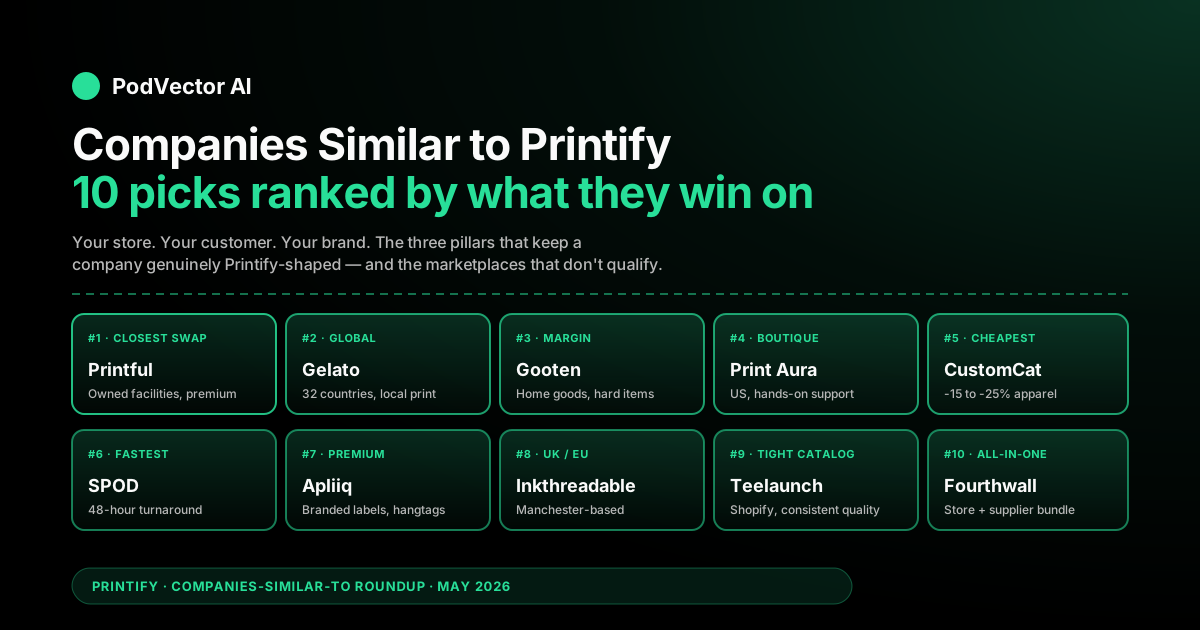
Quick Answer: The companies most similar to Printify in 2026 are Printful, Gelato, Gooten, Print Aura, CustomCat, SPOD, Apliiq, Inkthreadable, Teelaunch, and Fourthwall. All let you keep your own store, your own customer relationship, and your own brand — the three things that make a company genuinely Printify-shaped.
Printful is the closest like-for-like swap. Gelato wins on global production. Gooten and CustomCat compete on margin. SPOD wins on turnaround speed. The right pick depends on which product categories you sell and where your customers live.
This roundup covers each company by catalog, pricing model, integration coverage, and the single seller it suits best. For the full Printify landscape see the Printify topic hub and the Printify comparison cluster.
What counts as a company similar to Printify
Most "companies like Printify" roundups blur the line between supplier networks and marketplaces. They are not the same business.
Printify is a print-on-demand supplier network. You plug it into a store you already own — Shopify, Etsy, WooCommerce, BigCommerce, or Wix. You design the product, set the price, and own the customer relationship. Printify prints and ships when an order arrives.
A company is genuinely similar only when it preserves that shape. Your store. Your customer. Your brand. Drop any of those three and you are looking at a different model wearing a familiar name — usually a marketplace or a creator-royalty platform.
The ten companies below all preserve those pillars. They differ in catalog depth, fulfillment ownership, geographic coverage, and price floor — but the model is the same.
1. Printful
Printful is the company most genuinely similar to Printify, and the first comparison nearly every seller runs. The two sit under the same parent after their 2021 merger but operate as deliberately distinct brands.
The big structural difference is ownership of supply. Printful runs its own fulfillment centers in Charlotte, Los Angeles, Toronto, Riga, Birmingham UK, and Tijuana. Printify aggregates a network of third-party print providers. Same operational shape, opposite supply chain.
Quality is the headline trade-off. Printful's owned facilities deliver more consistent print and color across orders. Printify gives you choice of supplier per product, so you can route to the cheaper or faster one — at the cost of more variance.
Catalog is roughly comparable on apparel. Printful is stronger on embroidered hats and branded inserts. Printify has the edge on niche items like all-over-print apparel and certain home goods through its supplier network.
Best for: sellers who want one quality benchmark across every order and are willing to pay a few dollars more per unit to get it. If you sell premium brand apparel, Printful is the swap.
2. Gelato
Gelato is the leading global-production alternative and the strongest pick for anyone selling outside the US. Its network spans 130+ production facilities in 32+ countries.
Local production is the whole pitch. An order from a German customer prints in Germany, not in Charlotte. Shipping times drop. Carbon footprint drops. International returns become a smaller line item.
Pricing is competitive with Printify on common SKUs and sometimes wins outright on apparel destined for Europe. The catalog is strong on wall art, mugs, and apparel. Photo books and calendars are a Gelato strength most competitors lack.
Integration is wide. Shopify, Etsy, WooCommerce, Wix, BigCommerce, Squarespace, Shopline, and a usable API for custom builds.
The trade-off is US-specific quality control. Because production is distributed, US sellers occasionally see a quality drift between facilities. Most sellers solve this by locking specific products to specific regions.
Best for: sellers with meaningful non-US revenue, or any operator planning to expand internationally in the next 12 months. For the direct head-to-head see Printify vs Gelato.
3. Gooten
Gooten is the supplier-network alternative built for sellers who care about margin more than features. It operates a partner network of 50+ manufacturers across 70+ regions, with most items produced within two business days.
Where Gooten wins is base costs on hard goods. Mugs, tumblers, blankets, pet products, and home decor often price several dollars below Printify on equivalent SKUs. On apparel the gap is smaller.
The catalog skews wider than deeper — 200+ products spanning categories most rivals don't bother with. Phone cases, pet bowls, and shower curtains are real strengths.
The user interface is the weakness most reviews flag. It is functional but dated, and the mockup generator lags Printify's. Operators usually compensate with third-party mockup tools.
Best for: sellers leaning into home goods, kitchen products, or pet accessories — categories where Gooten's pricing advantage compounds across the catalog.
4. Print Aura
Print Aura is the longest-running independent POD company in this list. Founded in 2012, US-based, family-owned, and operationally smaller than Printify by an order of magnitude.
The pitch is direct human support and tight quality control on a smaller catalog. Most products are apparel and accessories. Production is in New York. Turnaround averages two to four business days.
Pricing is mid-pack — competitive with Printify on Bella+Canvas tees and similar staples, sometimes higher on specialty items. The integration story is narrower: Shopify, WooCommerce, Etsy, Amazon, and an API. No native BigCommerce or Wix app, which rules them out for some operators.
What you get in exchange is a real account manager and the kind of responsive support that disappears at scale.
Best for: apparel-focused sellers who value tight quality control and prefer working with a smaller US operation over a global network.
5. CustomCat
CustomCat is the budget supplier network that competes hardest with Printify on raw base cost. Founded in Michigan, US-based fulfillment, with an aggressive pricing model aimed at high-volume sellers.
The price advantage is real on common apparel. A standard tee that prices at $8–9 on Printify often lands at $6–7 on CustomCat. At volume that gap funds the marketing budget.
Catalog runs around 550+ products, weighted toward apparel and including some embroidery options. Turnaround is 2–4 business days for most items.
Two caveats. Quality variance is real on lower-tier blanks — sellers report more sizing inconsistency than with Printful or Printify Premium suppliers. And the platform charges a $30/month "premium" plan that drops base costs further, which only pencils out above a certain volume.
Best for: price-sensitive sellers doing high volume on standard apparel, where every dollar of base cost saved multiplies across thousands of units.
6. SPOD
SPOD is Spreadshirt's print-on-demand arm and the company most credibly competing on speed. The published promise is 48-hour fulfillment on most orders, which holds up in practice on standard products.
For sellers running paid traffic where shipping time materially affects refund rate and review score, that speed advantage compounds. Faster fulfillment means less time for customers to forget they ordered, fewer "where is my order" tickets, and higher review velocity.
Pricing sits between Printify and CustomCat — not the cheapest, not the most expensive. Catalog is narrower than Printify, around 230 products, heavy on apparel and accessories.
The major limitation is integrations. SPOD is strong on Shopify and serviceable on WooCommerce, but the broader catalog of e-commerce platforms supported is narrower than Printify or Gelato.
Best for: Shopify-first sellers where turnaround speed is the conversion lever — typically paid-ads operators selling time-sensitive designs.
7. Apliiq
Apliiq is the company to look at if you want branded private-label POD rather than generic blanks. The product mix leans toward streetwear and premium apparel, with services like custom neck labels, woven patches, custom hangtags, and dyed garments.
That positioning is the whole pitch. Printify will print on a Bella+Canvas tee. Apliiq will print on a Bella+Canvas tee, sew in your branded neck tag, attach your woven patch on the sleeve, and ship it with a hangtag — at a noticeably higher per-unit cost.
For brands trying to build perceived value beyond "print on a blank," that branding stack changes the customer experience meaningfully. Returns drop. Repeat rate climbs.
Pricing reflects the service mix and runs significantly above Printify on comparable garments. Catalog is narrower and centered on apparel and accessories.
Best for: apparel brands targeting a premium price point where the unboxing experience and brand-tagged garments are part of the product.
8. Inkthreadable
Inkthreadable is the UK-based POD company most commonly recommended when sellers ask for a Printify alternative with European production. Based in Manchester, with a particularly strong story on eco-friendly apparel and sustainable inks.
Production is UK-based, which means UK and EU orders ship locally and on a sane timeline. US shipping is available but uneconomic — this is not the company for US-heavy operations.
Catalog is apparel-heavy with a meaningful organic and sustainable line. Pricing is competitive within the UK market. Integrations cover Shopify, Etsy, WooCommerce, BigCommerce, and a usable API.
The trade-off is that catalog depth is smaller than Printify's, and geographic reach is narrow by design.
Best for: UK or EU-based sellers, or any operator whose customer base is at least 50% European.
9. Teelaunch
Teelaunch is the smaller, US-based POD company that most often comes up when sellers want to escape Printify's interface and the third-party-supplier variance that comes with it. Production is consolidated in fewer facilities, which trades catalog breadth for consistency.
Pricing is mid-pack. Catalog leans toward apparel, drinkware, and home goods, with some specialty items (engraved bamboo cutting boards, for instance) that are hard to find elsewhere.
Integrations are narrower than Printify's — Shopify, Etsy, and an API. No native Amazon, Wix, or BigCommerce apps.
Where Teelaunch wins is quality consistency at smaller scale. Where it loses is integration coverage and catalog depth.
Best for: Shopify or Etsy sellers running tight catalogs who value quality consistency and don't need every category Printify offers.
10. Fourthwall
Fourthwall is the company most genuinely similar to Printify for sellers who also want a storefront baked in. It bundles POD fulfillment with a hosted store and supports a creator-friendly tip and membership layer.
The structural difference is the storefront. Printify connects to a store you already own. Fourthwall is the store and the supplier in one. You can also bolt Fourthwall onto a Shopify store as a supplier, but that is not its main use case.
Catalog runs around 200 products with reasonable apparel and accessory depth. Pricing is competitive with Printify on common SKUs. The platform takes no per-sale fee on the storefront tier — it makes its money on product margin.
Fourthwall is closer to Printify than marketplaces like Redbubble or Spring because you keep the customer email, set the price, and control the brand. But the all-in-one packaging makes it a different operational decision than a pure supplier swap.
Best for: creators and small brands who want a simple "store plus supplier" setup without managing a separate e-commerce platform.
Side-by-side comparison
| Company | Catalog size | Base price vs Printify | Production model | Geographic strength |
|---|---|---|---|---|
| Printful | ~370 | +10–25% | Owned facilities | US, EU, Australia |
| Gelato | ~150 | Comparable | Distributed partner network | Global, EU-strong |
| Gooten | ~200 | −5–15% on hard goods | Partner network | US, EU |
| Print Aura | ~150 | Comparable | Single US facility | US |
| CustomCat | ~550 | −15–25% on apparel | US facility + partners | US |
| SPOD | ~230 | +0–10% | Owned (Spreadshirt) | US, EU |
| Apliiq | ~80 | +30–60% | Owned LA facility | US |
| Inkthreadable | ~140 | Comparable in UK | UK facility | UK, EU |
| Teelaunch | ~150 | Comparable | Consolidated US partners | US |
| Fourthwall | ~200 | Comparable | Partner network + storefront | US, EU |
How to pick the right one
The fastest way to narrow ten options to two is to filter by what actually moves the P&L for your store.
Where your customers live
If more than 30% of your orders ship outside the US, Gelato or Inkthreadable will out-perform any US-only option on shipping time and cost. If you are US-heavy, the geographic question is moot and you can optimize on margin or quality instead.
What product categories drive your revenue
Apparel-dominant catalog? CustomCat for margin, Printful for quality, Apliiq for premium branding. Home goods and accessories? Gooten will likely beat the field on base cost. Mixed catalog? Gelato or Printful for breadth.
How sensitive your margin is to base cost
If you compete on price or run paid traffic at thin margins, a dollar of base cost reduction is the difference between scaling and stalling. CustomCat and Gooten are the obvious candidates. If your AOV is high and margin is fat, optimize for quality and consistency instead — Printful or SPOD.
What integrations you already depend on
Shopify-only and never leaving? You have ten options. Selling on Etsy, Amazon, eBay, TikTok Shop, and a Wix site simultaneously? You are down to Printify, Printful, Gelato, and maybe Gooten.
The number that actually decides it
The four filters above narrow the field. The number that decides the winner is per-product margin under each supplier — not their list pricing, but the actual margin you would earn on your products at your shipping mix.
That number depends on which SKU, which variant, which print provider, which destination, and what your ad cost and store fees subtract on the back end. Spreadsheet math gets you close. A live data layer that knows your real order history gets you exact.
This is the question we built Victor to answer. Hook Victor into your store and ask "which supplier would be more profitable for my products?" — and the answer comes back as a per-SKU comparison using your actual orders, not a generic price-list comparison.
Often listed but not actually similar
Several names appear in "similar to Printify" roundups that do not belong there. They are different business models, not different suppliers.
Redbubble, Zazzle, Spring, Teepublic, Society6. These are marketplaces. They own the customer. They pay you a royalty. You cannot migrate the audience to your own brand later. Useful for some sellers; not similar to Printify.
For the head-to-head on the marketplace question see Printify vs Etsy and Printify vs Redbubble.
Merch by Amazon. Same model as the marketplaces above, only on Amazon. Not similar.
Sellfy, Podia, Gumroad. These are digital-product storefronts with bolt-on POD. The center of gravity is digital downloads, not physical fulfillment.
Shopify itself. The platform Printify plugs into, not an alternative. If you switched to a Shopify-only solution you would still need a supplier.
FAQs
What is the closest company to Printify?
Printful is the closest like-for-like. Same model — connect a store, design products, keep the customer relationship. The main differences are that Printful owns its fulfillment centers and prices 10–25% higher on average. Same parent company, deliberately distinct brands.
Is there a cheaper company than Printify?
Yes — CustomCat and Gooten typically price below Printify on common SKUs. CustomCat wins on apparel base costs. Gooten wins on home goods and accessories. Both are legitimate cost-saving swaps for high-volume sellers. For a fuller breakdown see Printify vs Gelato and the topic hub at Printify.
Which company has the best print quality?
Printful is usually rated highest for consistency because it owns its production. SPOD scores well within Europe for the same reason. Within Printify itself, choosing a Printify Premium supplier closes most of the quality gap — see Printify Premium discount breakdown for the math on whether that upgrade pencils out.
Can I use multiple POD companies at once?
Yes, and many sellers do. The most common pattern is using Printify or Printful as the primary supplier and routing specific products to a niche supplier — Apliiq for premium branded apparel, Gelato for international orders, Gooten for home goods. Your store handles inventory routing; the customer never sees which supplier shipped.
Is Printify Premium worth it before switching companies?
Often, yes. The Premium discount can close most of the base-cost gap with cheaper alternatives like CustomCat or Gooten while keeping you on the same platform. The math depends on your monthly volume. For the full breakdown see the Premium discount breakdown and the Premium free trial breakdown.
What is the difference between a POD supplier and a POD marketplace?
A POD supplier (Printify, Printful, Gelato) connects to your store. You own the customer email, set the retail price, and keep the brand. A POD marketplace (Redbubble, Zazzle, Spring) owns the audience. You upload designs, customers shop the marketplace, and you receive a royalty. Different businesses, often confused.
Where can I see all 10 ranked side by side?
The Printful blog's 10-alternative roundup is the most cited public comparison and a good starting point. For Printify-specific deep dives across pricing, premium upgrades, and head-to-heads with each company, see the comparison cluster.
Skip the spreadsheet — find the most profitable supplier for your actual products
Every roundup ranks POD companies on list price. The number that decides your P&L is per-SKU margin on the products you actually sell, given your real shipping mix and ad costs.
Victor connects to your store, reads your orders, and answers questions like "which supplier would be more profitable for my top 20 products?" in plain English.
Try Victor free