
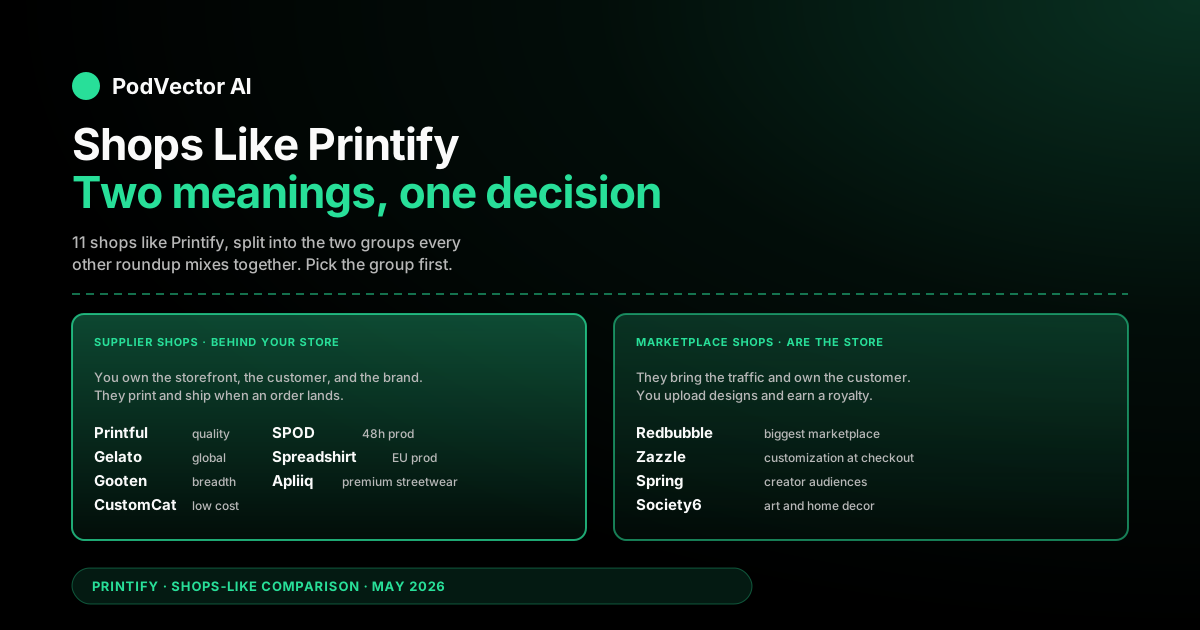
Quick Answer: When sellers search "shops like Printify," they usually mean one of two things — a print-supplier service that sits behind their existing store (Printful, Gelato, Gooten, CustomCat, SPOD, Spreadshirt, Apliiq) or a marketplace shop where the platform is the storefront (Redbubble, Zazzle, Spring, Society6).
Those two groups are not interchangeable. A supplier shop replaces Printify in the back office. A marketplace shop replaces your storefront and your customer relationship.
This guide profiles 11 shops like Printify across both groups, maps each to the storefront platforms POD sellers actually use, and explains the unit-economics question that decides which one is most profitable for your catalog.
Two meanings of "shops like Printify"
Printify itself is not a shop. It's a print-supplier network that routes orders to fulfillment partners like Monster Digital, SwiftPOD, and Stallion Apparel after a sale lands in your shop on Etsy, Shopify, eBay, or anywhere else you sell.
That structural detail matters because the search "shops like Printify" gets used by two very different sellers.
The seller looking for a supplier shop
You already run a store on Etsy or Shopify. Printify shows up on every list, but you want to know what other supplier services are out there before you commit your catalog to one provider. You're shopping for a back-office shop — not a storefront.
For this group, the comparison is base price, product catalog, integrations, geographic fulfillment, and quality consistency. Marketplaces like Redbubble are not real alternatives — they replace your storefront, which is not what you're shopping for.
The seller looking for a marketplace shop
You don't have a store yet, or you want a second sales channel that runs itself. You're shopping for a place that is the shop — handles the storefront, the traffic, the customer, and the fulfillment. You take a royalty per sale.
For this group, the comparison is traffic volume, royalty rate, design competition, and which product types convert best on each platform's audience.
Both interpretations are real, and the SERP for this query mixes them together. We're going to cover both groups clearly so you land on the right one.
7 supplier shops that sit behind your store
These are the closest functional matches to Printify. You upload designs, list products on your own storefront (Shopify, Etsy, WooCommerce, BigCommerce, Wix), and the supplier prints and ships when an order lands.
You own the customer relationship and the brand. Profit per sale is higher than a marketplace shop, but you have to bring the traffic.
1. Printful
The most-compared Printify supplier alternative. Printful runs its own production facilities across the US, Europe, Mexico, Brazil, and Japan instead of aggregating third-party printers.
Base costs run roughly $4–$8 higher per shirt than Printify on common SKUs. The trade-off you're buying is consistency — the same hoodie ordered six months apart looks the same, and the unboxing experience is more polished.
Best for sellers who care more about brand consistency than the lowest possible base cost. The integrations stack matches Printify's — Shopify, Etsy, Amazon, Walmart, WooCommerce, eBay, TikTok Shop. For a deeper head-to-head with Printify itself, see our guide to suppliers similar to Printify.
2. Gelato
The international supplier shop. Gelato operates production in 32+ countries, so an order from Germany prints in Germany rather than crossing an ocean.
For international sellers, that single fact rewrites the unit economics. Shipping drops from $8–$15 to local rates, and delivery moves from 2 weeks to 3–5 days. Returns also drop because the product gets there before the buyer forgets they ordered.
Base prices sit between Printful and Printify. The catalog is narrower than Printify's 900+ SKUs, but the international logistics advantage is hard to beat for stores selling globally.
3. Gooten
The wide-catalog supplier. Gooten covers 200+ products including categories where Printify is structurally weak — bedding, bath, pet products, oversized wall art, blankets, and home goods.
Like Printify, Gooten aggregates a supplier network. Quality varies by product line — the home-goods side is excellent, the apparel side is fine but not standout. Integrations are solid for Shopify and Etsy, weaker for newer channels like TikTok Shop.
Best for sellers who want to expand beyond apparel into home and lifestyle SKUs without setting up a second supplier account.
4. CustomCat
The cheap-US supplier shop. CustomCat operates from a single mega-facility in Michigan and pushes some of the lowest base costs in the industry — often $2–$4 less than Printify on tees and hoodies, $1–$3 less on mugs and drinkware.
The trade-off: design tooling is dated compared to Printify's mockup generator, and integrations are thinner. International fulfillment is non-competitive — you pay full US-to-elsewhere shipping.
Best for US-only sellers running high volume, where every dollar of margin compounds over thousands of orders per month.
5. SPOD (Spreadshirt's POD service)
The fast-production supplier. SPOD runs production in Las Vegas and Leipzig, Germany, with a stated 48-hour production guarantee on most SKUs. Shipping is competitively priced for both the US and EU.
The catalog is narrower than Printify or Gooten, but the SKUs it covers (apparel, accessories, mugs) hit fast. Integrations are solid for Shopify, with a basic Etsy connector.
Best for stores where speed-to-customer matters — fast-fashion drops, trend-cycle SKUs, or premium-priced products where buyers expect under-week delivery.
6. Spreadshirt (white-label POD)
Same parent company as SPOD, but the white-label side of the business. You can use Spreadshirt as a supplier behind your own store, with the company handling production at five owned facilities.
The integrations are oriented more toward European markets. Base costs run similar to Printful, with a premium-quality print pitch and the same in-house production model.
Best for EU-focused stores or sellers who want a backup supplier with owned production rather than an aggregated network.
7. Apliiq
The premium streetwear supplier. Apliiq specializes in custom apparel construction — inside-neck labels, custom hem tags, applique patches, embroidered details, and dyeing techniques that the general supplier networks can't do.
Base costs are 2–3x Printify on equivalent products. The catalog is much narrower — apparel only — but the products feel like a real brand rather than a print-on-demand tee.
Best for sellers building a streetwear or apparel brand who can charge $40–$80 retail and want products that don't look like every other Printify store. For broader context on how Apliiq and other niche suppliers compare to general networks, see our deeper category breakdown of sites like Printify.
4 marketplace shops where the platform is the store
Marketplaces flip the model. Instead of you running a store and a supplier fulfilling, the marketplace runs the store, the customer base, and the fulfillment.
You upload designs, they list them, customers find them through marketplace search, and you take a royalty on each sale. Royalty rates are usually 10–30% of retail.
The upside: zero marketing work — the marketplace's traffic engine drives sales. The downside: you don't own the customer, you can't run retargeting ads, and your margin is capped by the platform's pricing.
8. Redbubble
The biggest POD marketplace shop. Roughly 70+ product types, strong organic SEO traffic, and a royalty rate you set yourself within a 15–25% typical range.
Best for designers who don't want to run a store, don't want to pay for ads, and have a high enough design output to play the marketplace volume game. For a direct head-to-head comparison with Printify's supplier model, browse our Printify comparison cluster.
9. Zazzle
The customization marketplace shop. Zazzle's differentiator is letting buyers personalize designs at checkout — add their name to your template, change the colors, swap the font.
That makes Zazzle dominant in personalized gifts, wedding invitations, party supplies, business cards, and custom stationery. Royalty rates are 5–99%, set per design.
Best for designers building template-based products where the buyer adds the final personal detail. Not a great fit for a fixed-design tee shop.
10. Spring (formerly Teespring)
The creator-monetization marketplace shop. Spring integrates with YouTube, TikTok, Twitch, and other creator platforms — your audience clicks a merch shelf below your video, lands in a Spring-hosted shop, and Spring fulfills.
The "Boosted Network" feature can also distribute your products to Amazon, eBay, and Walmart for an additional cut. Royalty is the difference between your retail price and Spring's base cost.
Best for creators with an existing audience who want a no-store path to merch and don't want to build their own ecommerce stack.
11. Society6
The art-focused marketplace shop. Society6 leans into wall art, framed prints, home decor, and apparel for art buyers rather than meme tees.
Royalty defaults are lower than Redbubble (10% on most products), but average order value is higher because the customer is buying for their home, not their closet.
Best for artists with a cohesive visual style — landscapes, abstract work, illustration, photography — rather than text-on-tee designs.
Side-by-side comparison table
The table below maps each shop to the seller it actually fits.
| Shop | Type | Monthly Fee | Base Cost vs Printify | Best For |
|---|---|---|---|---|
| Printful | Supplier | $0 (Pro: $49) | +$4 to +$8 | Consistent quality, brand-first stores |
| Gelato | Supplier | $0 (Gold: $24+) | +$1 to +$5 | International sellers, local delivery |
| Gooten | Supplier | $0 | ±$2 | Home goods and lifestyle SKUs |
| CustomCat | Supplier | $0 (Plus: $30) | -$2 to -$4 | US-only, high-volume, low base cost |
| SPOD | Supplier | $0 | ±$3 | 48-hour production, fast shipping |
| Spreadshirt | Supplier | $0 | +$3 to +$6 | EU sellers, owned production |
| Apliiq | Supplier | $0 | +$10 to +$20 | Premium streetwear brands |
| Redbubble | Marketplace | $0 | Royalty 15–25% | Designers without a store |
| Zazzle | Marketplace | $0 | Royalty 5–99% | Personalized template products |
| Spring | Marketplace | $0 | Set retail markup | Creators with existing audiences |
| Society6 | Marketplace | $0 | Royalty ~10% | Wall art and home decor |
Which shop fits your existing storefront
Your existing storefront usually narrows the field faster than a feature spreadsheet does. Here's how the 11 shops above map to where you're already selling.
If you sell on Etsy
Printful, Gelato, and Gooten are the strongest Etsy supplier shops. All three have mature Etsy integrations that handle the sync between Etsy listings, order routing, and tracking-back-to-Etsy automatically.
CustomCat works on Etsy but the integration is thinner. Apliiq integrates with Etsy via Shopify — workable but not native. For the math on how Etsy fees stack with supplier costs, our Printify-Etsy calculator walkthrough shows the full equation.
If you sell on Shopify
All seven supplier shops work natively on Shopify. The deciding factor is product category, not integration quality.
Pick Printful for consistent quality and a polished brand experience, Gelato if you sell internationally, CustomCat if margin pressure is the binding constraint, Apliiq if you're building a premium apparel brand. For the full integration map across all of Printify's connectors and how Shopify compares to the other connected platforms, see our complete guide to Printify integrations.
If you sell on Amazon Merch on Demand
Amazon Merch isn't a place you plug in a supplier — Amazon is the supplier. The closer comparison here is whether Amazon Merch's invite-only model is a better fit than a Printify-fed Shopify store.
If you've already been accepted to Amazon Merch, run it as a second sales channel alongside a Printify-or-equivalent store rather than picking one over the other.
If you sell on Walmart, eBay, or TikTok Shop
Printful and Gelato have the most mature integrations here. CustomCat covers Walmart and eBay but not TikTok Shop. The newer marketplaces (TikTok Shop especially) move fast — check current integration status before committing.
If you don't have a store yet
Start with a marketplace shop. Redbubble, Society6, or Spring let you upload designs and learn what sells before you spend $400 building a Shopify store and another $300 on ads.
The royalty is lower, but the feedback loop is fast. Once a niche is validated, move to a supplier shop with your own storefront. For more on how this transition works, see our guide to sites similar to Printify.
The shop math nobody runs
Every roundup of shops like Printify shows base costs side by side. That's the easiest number to publish and the least useful one to act on.
The number that actually decides which shop is best for your store is net profit per order after every variable cost is deducted. That equation looks roughly like this:
(retail price) − (supplier base cost) − (supplier shipping you absorb) − (storefront transaction fees) − (ad spend allocated to this SKU) − (refund and return rate × refund cost) − (your customer-service time × your hourly rate) = profit per order
None of those line items past base cost show up on a public pricing page. They're hidden in your transaction reports, your ad platform, your support tool, and your accounting software — five different systems that don't talk to each other.
That's the gap between "Printful looks $5 more expensive" and "Printful actually made me $3.20 more per sale after lower returns and lower customer-service load." You won't know which is true for your catalog until you track every cost component down to the SKU.
That's the work we built Victor for — a POD-native AI employee that connects directly to your Printify, Printful, Shopify, and ad platform accounts, pulls every cost line into one live data warehouse, and answers questions like "which supplier would be more profitable for my top 20 products?" with real numbers from your store rather than industry averages.
You can ask Victor "if I switched my top-10 SKUs from Printify to Printful, what's the projected profit change?" and get a per-SKU answer in under a minute. Try Victor free while you're evaluating shops like Printify.
How to add a new shop without breaking sales
If your store is already running on Printify and you're adding a second supplier — or migrating fully — do not yank it overnight. Switching shops without a plan is how POD sellers ship the wrong product to a customer and earn their first 1-star review.
Step 1: Order samples on your top 3 SKUs
Pick your three highest-volume products. Order one sample of each from the new supplier shop. Compare print quality, color accuracy, fabric weight, packaging, and the unboxing experience side-by-side with the same product from Printify.
Photograph both. Some quality differences only show up in direct comparison, not isolated inspection.
Step 2: Run both in parallel as variants
For two to three weeks, list the new supplier's version as a separate product variant in your store. Same design, same retail price, different supplier on the backend.
Watch returns, customer messages, and review sentiment. Returns are the lagging indicator that catches quality problems your sample missed.
Step 3: Migrate by margin tier, highest first
Move your highest-margin products to the better-performing supplier first. They're worth the most to optimize and the cost of a mistake at this tier is the most expensive.
Leave low-volume SKUs on Printify until you're confident the new shop handles them well. Don't touch a slow-moving long-tail product to save 80 cents per sale — the migration risk isn't worth it.
Step 4: Keep the old shop connected as a hot backup
Don't disconnect Printify (or whichever supplier you're moving away from) immediately. Keeping the old integration live means you can re-route an SKU in 60 seconds if the new shop has a fulfillment issue, a stockout, or a quality run.
Most operators doing real volume run two supplier shops in parallel permanently — one as primary, one as failover. The complexity is worth the resilience.
FAQs
What is the best shop like Printify?
There is no single best — it depends on what you're optimizing for. Printful is the best for consistent quality and brand polish, Gelato for international fulfillment, CustomCat for cheap US base costs, Gooten for product breadth, Apliiq for premium streetwear, and Redbubble or Society6 for sellers without an existing store.
Is Printful the same as Printify?
No. Printful runs its own production facilities — when you order a Printful product, the same company prints it. Printify is a network that routes your order to one of many third-party print providers. Printful has more consistent quality; Printify usually has lower base costs and a wider catalog.
Can I run two shops like Printify at the same time?
Yes, and most sellers doing real volume do exactly this. Shopify, Etsy, and WooCommerce all support connecting multiple POD apps. You map each product to the supplier that fulfills it most profitably and keep both as active backends. For broader context, see the Shopify guide to print-on-demand companies.
Which shop has the lowest base costs?
CustomCat for US apparel in most SKU categories — often $2–$4 less than Printify on tees and hoodies. The trade-off is older design tooling and US-only production, so international sellers should price the shipping difference before assuming CustomCat wins.
Are marketplace shops like Redbubble actually competitive with Printify?
For a beginner with no audience: yes, marketplaces are better because they bring the traffic. You don't need a store, an ad budget, or a Shopify subscription to earn your first sales.
For an established seller with a store and ad budget: no, marketplaces cap your margin and you don't own the customer. They serve different jobs at different stages.
What's the closest shop to Printify in workflow?
Printful is structurally closest — same integrations, same store-owner model, similar product catalog. Gelato is closest in pricing tier with a stronger international advantage. CustomCat is closest in base cost for US-only operations.
How do I know which shop is most profitable for my products?
You have to run the unit economics product-by-product, including supplier base cost, shipping you absorb, marketplace or storefront fees, ad attribution, returns, and customer-service load. Spreadsheets get unwieldy past a few dozen SKUs.
Most operators move to a POD-native AI employee that pulls every cost line from their live store data and answers profitability questions on demand. Browse our Printify comparison cluster and the full Printify topic hub for deeper supplier-by-supplier cost breakdowns.
Stop guessing which shop is most profitable
Base-cost lists tell you what a product costs. They don't tell you what it earns after shipping, fees, ads, and returns.
Victor connects to Printify, Printful, Shopify, and your ad platforms. It pulls every cost line into one live data warehouse and answers questions like "which shop would be more profitable for my top 20 products?" with real numbers from your store — not industry averages.
No spreadsheets. No five-tab pivot tables. And find out which shop like Printify actually makes you more money.
Try Victor free