
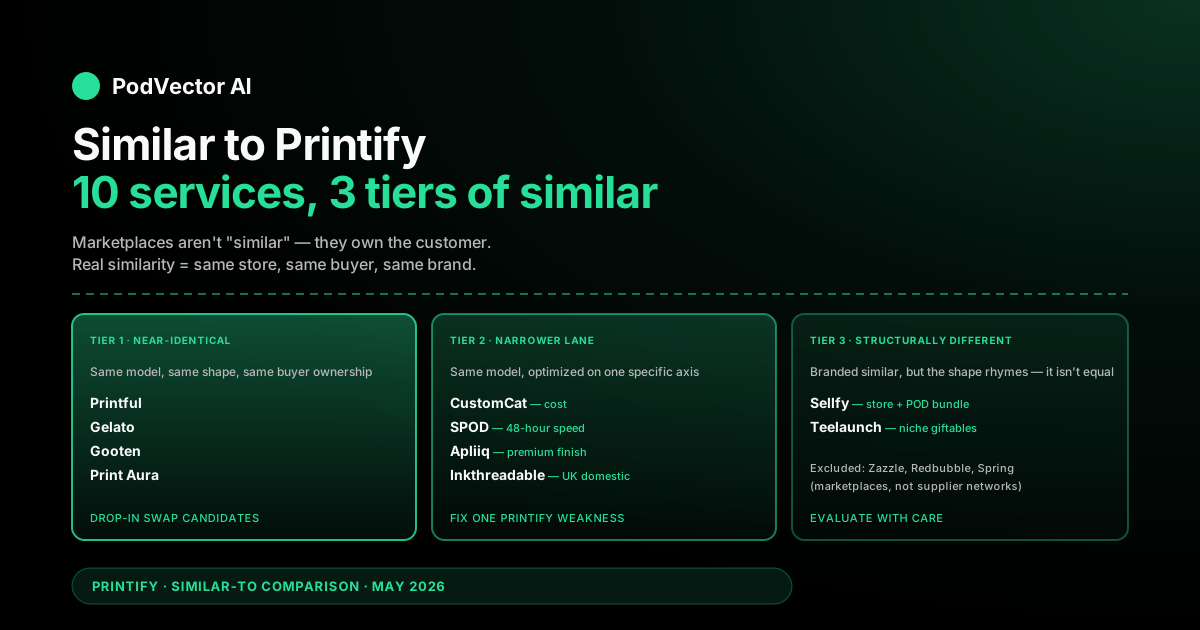
Quick Answer: The services most genuinely similar to Printify are supplier networks that connect to your own Shopify, Etsy, WooCommerce, or BigCommerce store while letting you keep the customer relationship. By that strict definition, the closest in 2026 are Printful, Gelato, Gooten, Print Aura, CustomCat, SPOD, Apliiq, and Inkthreadable.
Many roundups also list Zazzle, Redbubble, and Spring under "similar to Printify." They are not. Marketplaces and creator platforms operate on a fundamentally different model — they own the buyer, they pay you a royalty, and you can't migrate the audience to your own brand later.
This guide ranks 10 services by how operationally similar they really are to Printify, plus the two-tier check for picking the right one. For deeper context, see the Printify topic hub and the Printify comparison cluster.
What "similar to Printify" actually means
"Similar" is the slipperiest word in the POD comparison game. Most roundups treat it as a synonym for "alternative" and toss everything into one list — supplier networks, marketplaces, creator platforms, store builders. They are not the same thing.
Printify operates on a specific model: a print-on-demand supplier network that plugs into a store you already own (Shopify, Etsy, WooCommerce, BigCommerce, Wix). You design the product. You set the price. You own the customer email, the order data, and the brand. Printify takes a base cost when an order comes in and prints and ships it for you.
A service is genuinely similar to Printify only if it preserves that operational shape. Lose any of the three pillars — your store, your customer, your brand — and you have a different business model wearing a similar name.
This guide uses three tiers based on how close each service really is. Skip to the at-a-glance table if you want the speed-read, or to the two-check test if you already know your candidates and just want to validate the switch.
Tier 1: Near-identical supplier networks
These four operate on the same blueprint as Printify. You bring a store, they bring the supplier network, you keep the customer. Switching between them is a configuration change, not a business-model change.
1. Printful
Printful is the closest service to Printify in operational terms and the one most sellers compare first. The two sit under the same parent company after their 2021 merger but operate as separate brands with deliberately different positioning.
The structural difference is ownership. Printful runs its own fulfillment centers in Charlotte, Los Angeles, Toronto, Riga, Birmingham UK, and Tijuana. Printify aggregates a network of third-party print providers. Same shape, opposite supply chain.
For sellers, that translates to tighter quality consistency at Printful but higher base costs — typically $4–$8 more per unit on common SKUs like a Bella+Canvas 3001 tee or a Gildan hoodie. On a $25 retail tee, that gap turns an $11 margin into a $5 margin.
Branding options are the strongest in the category: inside neck labels, custom packing slips, branded inserts, hang tags. Integrations cover Shopify, Etsy, WooCommerce, Wix, Squarespace, Amazon, eBay, and a robust API.
Best for: sellers prioritizing print consistency and brand presentation over the lowest possible base cost.
2. Gelato
Gelato is the most operationally similar option for any seller with meaningful international volume. The Oslo-based company runs a distributed network of 130+ print partners across 32 countries, so a German order prints in Germany and a Japanese order prints in Japan.
For a US-only seller, Gelato's base pricing sits between Printful and Printify with no special advantage. The math flips once 20–30% of your orders ship internationally. A US Printify provider shipping a tee to Berlin costs $12–$18 and takes 10–14 days. Gelato's Berlin partner ships the same shirt for €4 in 3–5 days.
The catalog is narrower than Printify's — strongest on posters, framed prints, photo books, and apparel basics. If you sell custom socks or all-over-print hoodies, check availability before you switch.
Integrations cover Shopify, Etsy, WooCommerce, Wix, Squarespace, and a strong API used by Canva and other enterprise customers. Gelato+ ($24/month) and Gelato+ Gold ($119/month) unlock product discounts.
Best for: sellers with 20%+ international orders, especially in the EU.
3. Gooten
Gooten is the breadth play in this tier. The New York-based company aggregates a print-partner network similar in shape to Printify's but leans into categories Printify is weak in — bedding, bath products, pet goods, custom home decor, and oversized wall art.
If your store sells beyond apparel, Gooten often carries SKUs Printify doesn't offer at all. Duvet covers, dog bandanas, shower curtains, large canvas prints — these are Gooten's bread and butter. Quality varies by partner, same as Printify, so sample orders are not optional.
Base costs are competitive with Printify on overlapping apparel SKUs. Home goods and lifestyle pricing is typically where Gooten beats the field on margin per order.
Integrations cover Shopify, Etsy, WooCommerce, BigCommerce, and the Gooten API. The dashboard is functional but less polished than Printify's — a worthwhile trade if the catalog match is what you need.
Best for: sellers expanding beyond apparel into home, lifestyle, and pet categories.
4. Print Aura
Print Aura is the closest thing to "Printify before Printify scaled" — a single-facility US POD supplier built around the same idea of connecting to your store and keeping the customer with you. The North Carolina-based company has been operating since 2013, predating Printify itself.
The model is straightforward: one production facility, a narrower apparel-and-drinkware catalog, and pricing that lands between CustomCat (cheaper, less polish) and Printful (pricier, more brand options). Order processing typically runs 3–5 business days.
Integrations cover Shopify, Etsy, WooCommerce, BigCommerce, and a manual order entry option for sellers using less common platforms. The Shopify and Etsy apps work, though the dashboard feels closer to 2018 than 2026.
The reason it stays similar to Printify in spirit: no marketplace, no royalty model, no merchant-of-record arrangement. You own the buyer relationship end to end.
Best for: sellers who want a simpler, single-facility US supplier and don't need Printify's catalog breadth.
Tier 2: Same model, narrower lane
These four still operate as supplier networks that plug into your own store, so the business model matches Printify exactly. They just compete on a narrower axis instead of trying to match Printify's full catalog.
For Printify users frustrated by one specific gap — cost, speed, premium finish, or UK-domestic shipping — these are the operationally clean swaps.
5. CustomCat
CustomCat is the cost play. The Detroit-based company runs a single Michigan facility and prices common tees and hoodies $2–$4 below Printify on most SKUs.
The model: own one factory, run it lean, pass savings through. For a US seller pushing volume on standard apparel, the gap adds 10–15% to margin per sale versus the same SKU through Printify's aggregated network. For a deeper cut on this question specifically, see cheaper than Printify.
The trade-offs are real. The catalog is narrower (mostly apparel, mugs, hats). Design tooling and product mockups feel dated next to Printify or Printful. International shipping is non-competitive — everything ships from Michigan.
Integrations: Shopify, Etsy, WooCommerce, BigCommerce, and the CustomCat API. A $30/month CustomCat Premium tier unlocks additional volume discounts.
Best for: US-only sellers running volume on standard apparel SKUs where every dollar of margin compounds.
6. SPOD
SPOD (Spreadshirt's print-on-demand sub-brand) is the speed play. The pitch is a 48-hour production guarantee on standard apparel, faster than Printify's 3–5 business day average and dramatically faster than Printful's 4–7 day window in busy weeks.
For a US-based seller running paid ads on Q4 holiday gifts, that turnaround difference is decisive. A buyer who orders December 19 wants the gift before Christmas. The faster the production clock starts, the higher your conversion-to-ship rate before the shipping cutoff.
Base costs are competitive with Printify. The catalog is narrower — apparel, drinkware, accessories, no home goods or oversized prints. Production runs from Spreadshirt's Las Vegas and Henderson, Nevada facilities.
Integrations are Shopify-first, with Etsy and WooCommerce support. Setup on the Shopify app is straightforward.
Best for: sellers running holiday or event-driven campaigns where ship-by deadlines are a real constraint.
7. Apliiq
Apliiq is the premium finish play. The Los Angeles-based company built its reputation on apparel quality — premium tees, hoodies, hats, beanies. The kind of pieces a streetwear or boutique brand would actually post on Instagram.
The differentiation is finish work, not just base print. Apliiq offers cut-and-sew customization, woven labels, custom hang tags, custom drawcords, and embroidered patches as standard order options. Most POD suppliers treat these as enterprise-only add-ons; Apliiq treats them as the product.
Base costs are higher than Printify — sometimes 50–100% higher on equivalent SKUs. The math only works at premium retail prices ($40–$80 for a tee, $80–$140 for a hoodie) and if the buyer cares about brand finish.
Integrations cover Shopify, WooCommerce, and a manual order entry option. No native Etsy integration.
Best for: streetwear, boutique, and premium-tier apparel brands that compete on finish quality, not catalog breadth.
8. Inkthreadable
Inkthreadable is the UK-domestic play. The Lancashire-based company prints and ships everything from the UK, which makes it the operationally cleanest match for any seller whose buyers are mostly British or European.
For UK sellers, the math is straightforward. Printify's UK fulfillment options are limited — many SKUs route through US providers or trigger Printify's higher-cost EU partners. Inkthreadable runs its own facility, so a UK order ships domestic mail, hits the buyer in 2–3 days, and avoids the post-Brexit VAT-on-import friction that wrecks margins on EU-to-UK and UK-to-EU shipments.
The catalog is mid-sized — apparel, accessories, drinkware, embroidery, sublimation prints. Branding options include neck labels and packing slips. Base costs are competitive with Printify on UK fulfillment specifically.
Integrations cover Shopify, Etsy, WooCommerce, Squarespace, and a CSV upload option. The Shopify app is the most polished of the UK POD suppliers.
Best for: UK and Ireland sellers running domestic-first POD stores.
Tier 3: Branded similar, structurally different
These two get listed in "similar to Printify" roundups, but they bend the operational model in a way that matters. The shape rhymes, but the business reality is different — different setup, different ownership of the customer, different switching cost later.
9. Sellfy
Sellfy bundles a storefront with the POD service. Instead of integrating a supplier into a Shopify or Etsy store you already own, you build a Sellfy store directly and the POD product is one of several things you can sell (alongside digital downloads, subscriptions, and physical goods).
For a seller without an existing storefront, the bundle saves the setup cost of a separate store subscription plus a separate POD subscription. Sellfy starts at $29/month for the storefront; the POD catalog adds no separate fee.
The POD catalog itself is mid-tier — apparel, mugs, phone cases, posters. Production is handled by partner facilities in the US and EU. Print quality and fulfillment times are comparable to Printify.
Why it lands in Tier 3: platform lock-in. Migrating off Sellfy to a standalone Shopify store later is non-trivial because your store URL, customer data, and email subscribers live inside Sellfy's walled garden. You own the customer in name, not in portability.
Best for: first-time sellers without an existing storefront who want one platform for both store and POD fulfillment.
10. Teelaunch
Teelaunch is the niche-product play. The Asheville, North Carolina-based company connects to your store like a normal POD supplier — same Shopify and Etsy integrations, same model where you keep the customer.
Where it differs from Tier 1 is the catalog. Teelaunch leans into product categories most POD suppliers don't carry: custom Bluetooth speakers, wireless chargers, jewelry, kitchenware, and oddball gift items. If you're building a store around quirky giftable goods rather than standard apparel, Teelaunch is structurally aligned.
The trade-off is the apparel catalog itself, which is narrower and less price-competitive than Printify's. Most sellers run Teelaunch alongside another POD supplier rather than as a Printify replacement.
Integrations: Shopify and Etsy primarily, with manual order processing for less common platforms.
Why it lands in Tier 3 rather than Tier 1: Teelaunch is more of a complement to Printify than a swap. Few sellers move their full catalog from Printify to Teelaunch; many add Teelaunch for specific SKU categories.
Best for: sellers whose product strategy depends on electronics, accessories, or oddball giftable goods alongside apparel.
Often listed but not actually similar
Most "similar to Printify" roundups dump Zazzle, Redbubble, and Spring (formerly Teespring) into the same list. They're useful services in their own right, but they're not operationally similar to Printify. Putting them on the same shortlist confuses the decision.
Marketplaces (Zazzle, Redbubble, Society6)
These are marketplaces, not supplier networks. You upload designs to their platform. They host the listings, drive the traffic, handle the checkout, print the product, ship it, and own the customer relationship. You earn a royalty (typically 5–30%) on each sale.
If you're building a brand, that model is structurally wrong. You don't own the buyer email, the URL says zazzle.com or redbubble.com, and you can't migrate that audience to your own store later. The marketplace can also remarket your customers with other artists' designs — they're not really your customers.
If you're a designer who wants passive royalty income on a portfolio, that's a perfectly good model. It's just a different question. For a direct head-to-head on this distinction, see Zazzle vs Printify.
Creator platforms (Spring, Fourthwall)
Spring (rebranded from Teespring in 2021) and Fourthwall are creator-monetization platforms. They're built around YouTubers, TikTok creators, and Twitch streamers selling merch directly to an existing audience. Spring integrates with YouTube's merch shelf, TikTok Shop, and Twitch's merch features.
The operational difference is the merchant of record. Spring and Fourthwall are the seller of record — they handle taxes, returns, customer service. That's a feature if you're a creator who wants merch tied directly to your content platform, and a constraint if you want full customer data and brand ownership.
For sellers without an existing creator audience, neither platform is structurally similar to Printify. They're optimized for a different go-to-market.
Side-by-side at a glance
The high-level view across all 10 sites. Base-cost columns are rough and SKU-dependent — always verify on the specific product you sell.
| Service | Tier | Headquarters | Base cost vs Printify | Best axis | Best for |
|---|---|---|---|---|---|
| Printful | 1 | Charlotte / Riga | +$4–$8 | Brand consistency | Brand-led sellers |
| Gelato | 1 | Oslo | Comparable | International shipping | EU + global sellers |
| Gooten | 1 | New York | Comparable | Catalog breadth | Home + lifestyle sellers |
| Print Aura | 1 | North Carolina | Comparable | Simpler US supplier | Smaller US catalogs |
| CustomCat | 2 | Detroit | −$2–$4 | Lowest base cost | US volume sellers |
| SPOD | 2 | Las Vegas | Comparable | 48-hour production | Holiday + event sellers |
| Apliiq | 2 | Los Angeles | +50–100% | Premium finish work | Streetwear, boutique brands |
| Inkthreadable | 2 | Lancashire UK | Comparable (UK) | UK domestic shipping | UK + Ireland sellers |
| Sellfy | 3 | Riga | Comparable | Store + POD bundle | First-time sellers |
| Teelaunch | 3 | Asheville NC | Comparable | Niche giftables | Electronics + gift stores |
For two adjacent angles on the same field, see better than Printify (which frames the same shortlist as a head-to-head ranking) and Bonfire vs Printify (which goes deep on a single marketplace comparison). Printful's own roundup is worth skimming as a vendor-side cross-reference, though obviously biased.
The two-check test for switching
If you've identified a candidate from Tier 1 or Tier 2, run two checks before migrating. Most sellers skip both and discover the issue after they've shipped 50 orders through the new supplier.
Check 1: Sample your top SKU before you migrate the catalog
Order a sample of your single top-selling product to your own address. Compare it side-by-side with the same product from Printify. Print quality, color accuracy, garment fit, and packaging vary between suppliers — sometimes invisibly to you, but visibly enough to spike return rates 3–5%.
A 4% jump in return rate erases the savings on a $3 base-cost gap. Run the sample test, not the spreadsheet test.
Check 2: Run both suppliers in parallel for 30 days
For the same SKU, set up parallel listings — Printify on half your storefront, the new supplier on the other half. Compare actual gross margin per order at the end of the month: real bank-deposit dollars after fees, shipping, refunds, and returns. Not the list price in the dashboard.
If the new supplier wins by 8%+ on real margin across 30 orders, migrate the rest of the catalog. If the gap is under 5%, the switching cost (re-uploading designs, re-syncing inventory, retraining your customer service responses) wasn't worth it. For a deeper analysis of how to actually measure that margin, see is Printify profitable and the complete Printify review.
The reason most sellers never finish the comparison is the data lives in five different places. The supplier shows base cost. Shopify shows revenue and refunds. Etsy shows fees separately. Your ad platform shows acquisition cost. Your bookkeeping spreadsheet — when you remember to update it — pretends to tie it all together.
FAQs
What is the most similar service to Printify?
Printful is the most operationally similar. Same store-owner model, same major integrations, same broad catalog, same lack of marketplace or merchant-of-record arrangement. The structural difference is that Printful owns its production facilities while Printify aggregates a partner network, which shows up as higher base costs but tighter quality control at Printful.
Is Printful exactly like Printify?
Operationally similar, structurally different. Both connect to your store, both let you keep the customer, both run on a base-cost-per-order model with no monthly subscription required. The difference is the supply chain: Printful runs owned facilities, Printify aggregates third-party print providers. That difference drives a $4–$8 base-cost gap and a consistency-versus-breadth trade-off.
Are there free services similar to Printify?
Yes — Printful, Gelato, Gooten, Print Aura, CustomCat, SPOD, Apliiq, and Inkthreadable all let you start for free. You only pay base costs when an order is placed. Premium tiers (Printify Premium, Gelato+, CustomCat Premium) unlock volume discounts but aren't required to operate.
Which Printify-similar service is best for international shipping?
Gelato is the default answer because its 32-country production network avoids cross-border shipping costs on international orders. For UK-specific sellers, Inkthreadable's UK-domestic facility beats Gelato on UK-to-UK shipping cost and time.
Why aren't Zazzle and Redbubble considered similar to Printify?
They're marketplaces, not supplier networks. You upload designs and earn royalties; Zazzle and Redbubble handle the listings, traffic, checkout, and customer relationship. Printify is a supplier you connect to your own store, where you own the buyer end to end. The royalty model versus the supplier model is a different business — even though both let you sell printed designs.
Can I use Printify and a similar service at the same time?
Yes — most sellers above $10K/month run two or three suppliers in parallel. A common pattern is Printify for catalog breadth, Printful or CustomCat for high-volume SKUs where margin matters, and Gelato for international orders. The constraint is operational complexity, not technical — each supplier adds a dashboard, a reconciliation step, and a customer service training nuance.
Which similar service is best for beginners?
For a beginner with no existing storefront, Sellfy is the lowest-friction option because the store and POD service come in one $29/month subscription. For a beginner who already has a Shopify or Etsy store, Printful's deeper tutorials and integrations make it the gentler learning curve than Printify's broader feature set.
Which Printify-similar service has the most products?
Gooten leads on catalog breadth in the supplier-network category — strongest in home, lifestyle, and pet categories that Printify doesn't fully cover. For pure marketplace catalog size (counting personalization and physical goods together), Zazzle's 1,300+ product types is the largest, but that's a different model from Printify.
Don't pick a "similar" supplier on a spreadsheet — pick the one your numbers say will actually pay you more
Every roundup tells you Printful is more consistent and CustomCat is cheaper. The harder question is which one would have made your store more profitable on the products you actually sell.
Victor is an AI employee for POD sellers that ties your Shopify, Printify/Printful supplier costs, and Meta/Google ad spend into a single source of truth. Ask "which supplier would be more profitable for my top 10 SKUs?" and Victor returns the answer with real numbers from your own orders — not a vendor's marketing copy.
Try Victor free