
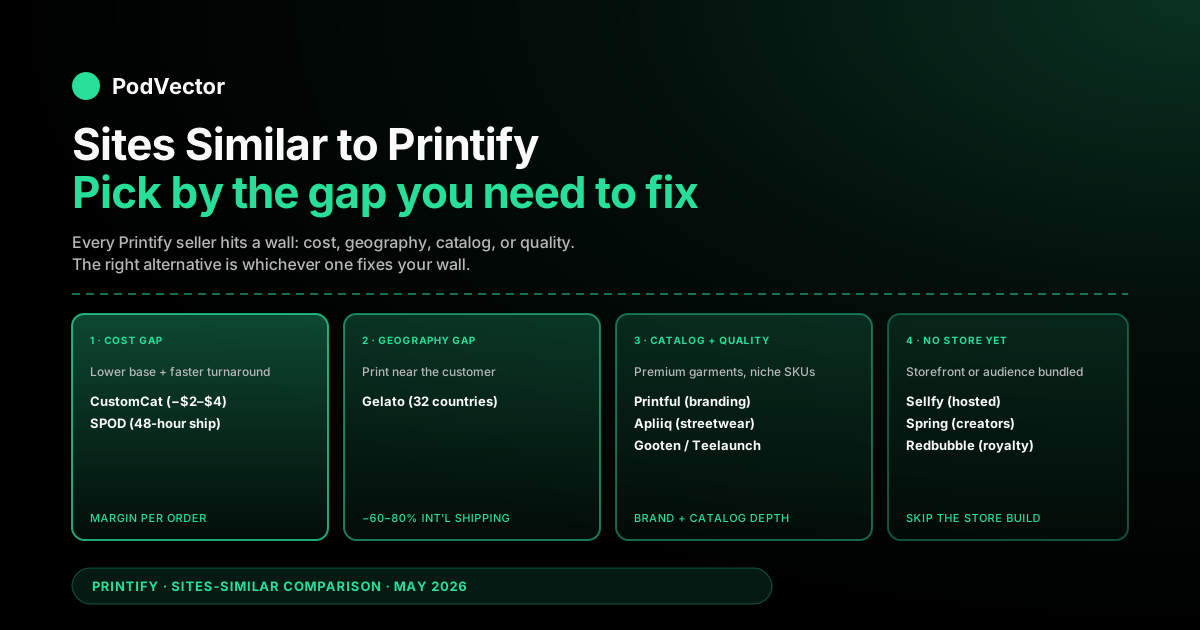
Quick Answer: The best sites similar to Printify each pick up where Printify falls short. Printful and Apliiq cover branding and premium garments. Gelato covers international shipping. CustomCat and SPOD cover US base cost and fulfillment speed.
Gooten and Teelaunch cover catalog gaps (home goods, novelty products). Spring and Redbubble cover the case where you don't have a store at all. Sellfy bundles a storefront with the printer.
This guide profiles 10 sites by the specific Printify weakness each one solves — so you can pick the alternative that actually fixes your bottleneck. For broader context, see the Printify topic hub and the Printify comparison cluster.
The four Printify gaps every seller hits
Printify wins for a reason. It bundles a deep aggregator network, a usable dashboard, the broadest set of storefront integrations, and a generous free tier. Most sellers should start there.
But every Printify seller hits a wall eventually. Usually it is one of four: cost, geography, catalog, or quality. The "best alternative" depends entirely on which wall you hit first.
Cost walls show up when your base prices are eating margin and a tighter operation could undercut you. Geography walls show up when international shipping cost or delivery time kills conversion. Catalog walls show up when buyers ask for products Printify doesn't carry. Quality walls show up when premium garments or branded packaging become the selling point.
The 10 sites below each fix one of those walls better than Printify does. Pick by the wall you've hit. For a vendor-side roundup of the same set, Printful's Printify alternatives post covers similar ground from a different angle.
Skip to the comparison table if you want the grid. Read the profiles if you're deciding which site to test next.
1. Printful — fixes branding and quality consistency
Printful is the closest like-for-like to Printify and the alternative most sellers test first. The two have shared a parent since 2021 but still operate as separate brands with opposite supply chains.
The structural fix is supply ownership. Printful runs its own factories in Charlotte, Los Angeles, Toronto, Riga, Birmingham, and Tijuana. Printify aggregates a partner network. That means Printful's print quality is more consistent SKU to SKU and reprint to reprint.
Branding is where Printful pulls away. Inside neck labels, custom hang tags, branded packing slips, custom packaging inserts — all available without enterprise minimums. For a brand-led store, that gap is the entire reason to switch.
The trade-off is base cost. Printful runs $4–$8 higher than Printify on common SKUs like Bella+Canvas 3001 tees or Gildan hoodies. You're paying for ownership and consistency. Best for sellers building a premium brand where customer perception matters more than per-unit cost. See our Tapstitch vs Printify breakdown for a similar branding-led comparison.
2. Gelato — fixes international shipping economics
Gelato is the site that rewrote international POD math. Headquartered in Oslo, it runs a network of 130+ print partners across 32 countries. A German order prints in Germany, a Japanese order prints in Japan, an Australian order prints in Australia.
For a US-only seller, Gelato pricing sits between Printify and Printful with no special advantage. For anyone shipping 20%+ of orders internationally, the math flips hard. Local production cuts shipping cost by 60–80% and delivery time from 14 days to 3–5.
The catalog leans into posters, framed prints, photo books, and apparel basics. Oddball SKUs like custom socks or all-over-print hoodies may not be available — verify before switching the whole catalog.
Free at base, with Gelato+ ($24/month) and Gelato+ Gold ($119/month) tiers unlocking discounts and premium support. Best for sellers with a real EU or APAC customer share where shipping cost is killing the order economics.
3. CustomCat — fixes US base cost
CustomCat operates from one Michigan facility. The single-location model is the whole pitch — a lean operation that passes savings to sellers. Base prices typically beat Printify by $2–$4 on common tees and hoodies.
For a US seller pushing volume on standard apparel, that gap compounds. On 500 monthly orders, $3 of saved base cost is $1,500 of extra margin per month — enough to cover Shopify, an ad-platform sub, and most of a Klaviyo bill.
The trade-offs are real. The catalog is narrower (mostly apparel, mugs, hats). International shipping is non-competitive because everything ships from Michigan. Design tooling and mockups are dated next to Printify or Printful.
Integrations include Shopify, Etsy, WooCommerce, BigCommerce, and a direct API. A $30/month CustomCat Premium plan unlocks additional volume discounts. Best for US-only sellers running volume on standard SKUs where margin per unit decides the business.
4. SPOD — fixes fulfillment speed
SPOD (Spreadshirt Print On Demand) competes on one metric: production time. Most orders ship within 48 hours from facilities in Pennsylvania and Las Vegas (US) or Leipzig (Germany). Printify's network averages 3–5 production days; SPOD averages 1–2.
For Etsy sellers worried about the late-shipment penalty, that gap matters. Etsy's algorithm weights on-time delivery, and a supplier that cuts two days off production buys you margin against shipping delays.
Base costs sit between Printify and Printful on most SKUs. The catalog is narrower — around 200 products, mostly apparel and accessories. Integrations cover Shopify, WooCommerce, and a Spreadshirt API.
The same parent (Spreadshirt) runs the consumer marketplace and the Spreadshop storefront option, so you can mix SPOD fulfillment with a hosted shop if you don't already have one. Best for sellers where fast turnaround is the actual buying objection.
5. Gooten — fixes the home and lifestyle catalog gap
Gooten is the breadth play. New York–headquartered, the company aggregates a print-partner network similar to Printify, but the catalog leans into categories Printify is weakest in — bedding, bath, pet products, custom home goods, oversized wall art.
If your store sells beyond apparel — duvet covers, dog bandanas, shower curtains, large canvas prints — Gooten often has SKUs Printify doesn't carry at all. Quality varies by partner, same caveat as Printify, so sample testing is non-optional.
Base costs are competitive with Printify on overlapping SKUs. Apparel is a wash. Home goods and lifestyle pricing is where Gooten typically beats the field.
Integrations cover Shopify, Etsy, WooCommerce, BigCommerce, and a Gooten API. The dashboard is functional but less polished than Printify's. Best for sellers expanding beyond apparel into home, lifestyle, and pet niches.
6. Apliiq — fixes premium garment quality
Apliiq is the streetwear answer. Based in Los Angeles, Apliiq specializes in cut-and-sew apparel, private-label branding, and applique embroidery on premium garments that Printify and Printful don't offer.
The differentiator is the catalog of higher-end blanks — heavier-weight hoodies, French terry crewnecks, garment-dyed tees, custom jogger sets. Pair that with inside-the-neck label printing, custom hang tags, and woven label options, and you have a private-label brand without contract manufacturing.
Base costs are notably higher — premium garments cost more, and the cut-and-sew model adds processing. A heavy hoodie that prints for $18–$22 on Apliiq retails comfortably for $65–$85, so the margin math still works for the right brand.
Integrations are Shopify-led with Etsy and WooCommerce support. Best for streetwear, athleisure, and fashion-led brands where Printify's standard blanks read as too generic for the customer.
7. Teelaunch — fixes the novelty-product gap
Teelaunch is the unusual-products specialist. Beyond standard apparel and accessories, Teelaunch carries Bluetooth speakers, neon signs, ceramic dishware, kitchenware, and engraved metal goods that the big networks don't touch.
The supplier model is similar to Printify — an aggregated network with quality that varies by SKU. The differentiation is purely catalog. If your design works on a Bluetooth speaker or a neon sign, Teelaunch is one of the few sites where you can actually sell that product through a POD model.
Integrations are Shopify-first with Etsy and eBay support. The Shopify app is well-rated. Base costs on the unusual SKUs are higher than apparel, but retail markups on novelty items often run 60%+, so margin per unit holds up.
Best for sellers with a creative catalog that needs SKUs outside the standard POD playbook of tees, hoodies, and mugs.
8. Sellfy — fixes the "no storefront yet" problem
Sellfy bundles a hosted storefront with print-on-demand fulfillment. If you don't already have a Shopify, Etsy, or WooCommerce store, Sellfy is one of the few sites where the store and the printer are the same product.
The pitch is speed to launch. Sign up, pick a template, add POD products, share a link — you have a working store in under an hour. No theme purchase, no app stack, no DNS setup unless you want a custom domain.
Sellfy plans start at $29/month (Starter) and go up to $159/month (Premium). The POD catalog is narrower than Printify — apparel, mugs, hats, and accessories — but the integrated checkout and built-in email marketing make up for it for a beginner.
Best for first-time sellers who want a single tool that does storefront, payments, and POD. Sellers already on Shopify or Etsy gain nothing by switching to Sellfy's storefront — keep the existing store and use a dedicated supplier instead.
9. Spring — fixes the creator-platform monetization gap
Spring (formerly Teespring) rebranded in 2021 around creator monetization. The pitch targets YouTubers, TikTokers, and Twitch streamers — Spring integrates directly with YouTube's merch shelf, TikTok Shop, and Twitch's merch features. A creator can sell to their audience without leaving the platform they already publish to.
The POD product is solid — apparel, drinkware, accessories, with Spring handling production, fulfillment, and customer service from owned facilities. You set a retail price, Spring takes a base cost, you keep the spread.
The key model difference: Spring is the merchant of record. They handle taxes, returns, and customer service. That's a feature if you don't want to run a store, and a constraint if you want full customer data and brand control. See our Teespring vs Printify breakdown for the direct comparison.
Best for creators with existing platform audiences who want merch tied to their content channel without the overhead of running a separate store.
10. Redbubble — fixes the "I just want passive royalties" case
Redbubble is a marketplace, not a supplier — a distinction that decides the entire business model. You upload designs, Redbubble handles customer acquisition through their own organic search traffic and ads, checkout, production, and shipping. You earn a royalty per sale.
Production routes through Redbubble's partner network in the US, UK, Germany, Australia, and the Netherlands, with the closest qualifying facility picked per order. The global routing is real — it's similar logic to Gelato, but applied behind a marketplace instead of behind your store.
The trade-offs are what you give up. Royalties run 10–30% — you set markup, Redbubble takes the rest. You don't own the customer relationship. Brand building is impossible — the URL says redbubble.com, not yours.
Best for illustrators and designers who want passive royalty income on a portfolio, not entrepreneurs building a brand on their own store.
Comparison table
The 10 sites side by side. Base-cost columns are SKU-dependent — verify on the specific products you sell before committing.
| Site | Printify gap it fixes | Base cost vs Printify | Integrations | Best for |
|---|---|---|---|---|
| Printful | Branding + quality consistency | +$4–$8 | Shopify, Etsy, Woo, Wix, Amazon | Brand-led sellers |
| Gelato | International shipping | Comparable | Shopify, Etsy, Woo, Wix | Cross-border sellers |
| CustomCat | US base cost | −$2–$4 | Shopify, Etsy, Woo, BigCommerce | US volume sellers |
| SPOD | Fulfillment speed (48h) | Comparable | Shopify, WooCommerce | Etsy on-time-shipping |
| Gooten | Home and lifestyle catalog | Comparable | Shopify, Etsy, Woo, BigCommerce | Multi-category sellers |
| Apliiq | Premium garment quality | +$8–$15 | Shopify, Etsy, Woo | Streetwear, fashion brands |
| Teelaunch | Novelty product SKUs | Varies by SKU | Shopify, Etsy, eBay | Creative niche catalogs |
| Sellfy | Storefront-included | N/A (bundled $29+/mo) | Self-hosted store | First-time sellers |
| Spring | Creator-platform merch | N/A (royalty model) | YouTube, TikTok, Twitch | Content creators |
| Redbubble | Marketplace traffic | N/A (royalty 10–30%) | None (their store) | Designers, passive royalty |
How to pick which gap to solve first
The grid is only useful once you know which Printify wall you've hit. Five common situations, mapped to the site that actually wins.
Your base costs are eating margin
Test CustomCat. A $2–$4 per-order base-cost cut on standard apparel compounds fast, and the Etsy or Shopify buyer never sees which printer fulfilled the order. Keep Printify for SKUs CustomCat doesn't carry.
International orders are killing conversion
Switch the international slice to Gelato. Local production drops shipping cost by 60–80% and cuts delivery time from 14 days to 3–5. Running Gelato for the EU and Printify for the US side-by-side is often the highest-margin setup.
Buyers want branding Printify doesn't offer
Move to Printful (mainstream apparel + branding) or Apliiq (premium streetwear + private label). The base-cost increase is the trade for unlocking inside labels, custom packaging, and consistent print runs.
You're selling beyond apparel
Gooten covers home goods, bath, pet, and oversized wall art that Printify is patchy on. Teelaunch covers Bluetooth speakers, neon signs, and engraved goods that no aggregator network carries.
You don't have a store yet
Sellfy bundles the storefront and the printer in one tool. Spring routes through your existing YouTube or TikTok presence without a store at all. Pick by whether you already have an audience on a content platform.
How to test a new site without breaking your store
The mechanics of testing a new supplier are simple. The mistake most sellers make is switching the whole catalog at once and discovering the print quality is off only after 50 customers email about a faded design.
Start with one SKU. Pick the product where the economic case is clearest — usually your top seller, since the margin gain compounds fastest. Run it on the new site for two weeks before deciding anything.
Order samples to your own address first. Print quality, color accuracy, garment fit, and packaging vary between sites, and a 5% return-rate jump erases any margin gain from cheaper base costs. A $20 sample order saves a $2,000 inventory mistake.
Once one product is stable, run both sites side by side for 30 days. Compare gross margin per order on real bank-deposit dollars after platform fees, shipping, and refunds — not list prices on a spreadsheet. If the new site wins by 8%+ on real margin and return rates hold steady, switch the rest of the category.
The supplier-comparison question is exactly the kind of work POD founders waste weekends on with spreadsheets. The math is easy in principle and miserable in practice because the data lives in five different dashboards — Printify, the new test supplier, Shopify, your ad platforms, and your bank. For the cost-side context that decides whether the switch is worth it, see our Printify Premium plan price breakdown and the Premium pricing breakdown.
FAQs
Which site is the closest to Printify?
Printful is the closest like-for-like. Same store-owner model, similar product catalog, overlapping integrations. The structural difference is that Printful owns its factories globally while Printify aggregates a partner network — which shows up as higher base costs but tighter quality control at Printful.
Which sites are cheaper than Printify?
CustomCat usually beats Printify by $2–$4 on common tees and hoodies because it runs a single lean Michigan facility. SPOD is competitive on speed but not always on price. Teelaunch sometimes wins on specific SKUs. On most apparel, Printify's aggregator pricing is already near the floor.
Which sites similar to Printify ship from Europe?
Gelato prints in 32 countries including Germany, the UK, France, and the Netherlands. SPOD operates Leipzig facilities for EU orders. Printful runs production in Latvia, the UK, and Spain. For EU customers, all three beat US-only sites like CustomCat on shipping cost and delivery time.
Can I use multiple sites like Printify on the same store?
Yes — most Shopify and Etsy sellers run two suppliers in parallel. The common pattern is one primary supplier for 80% of SKUs and a secondary for niches the primary doesn't cover well. Printify + Gooten or Printful + Gelato are common pairings.
Is Redbubble a site like Printify?
Not really. Redbubble is a marketplace where you earn royalties without owning a store. Printify is a supplier you use behind your own store. They solve different problems — Redbubble is passive royalty income, Printify is building a brand. Compare them only if you haven't decided whether to run a store yet.
Which site is best for Etsy sellers?
For US-focused Etsy sellers, CustomCat (cheapest base cost), SPOD (fastest fulfillment), and Printful (best quality) are the strongest options. For international Etsy sellers, Gelato's distributed production beats all three on shipping economics. Test one site at a time against your current Printify margins before switching.
Are there free sites to start a POD business besides Printify?
Printful, Gelato, CustomCat, SPOD, Gooten, Apliiq, and Teelaunch are all free at the base tier — you only pay supplier costs when an order comes in. Spring and Redbubble are free too because they're marketplace-based, taking their cut at sale time instead of charging upfront. Sellfy is the exception — its bundled storefront starts at $29/month.
Stop guessing which site actually makes you money
Comparing 10 POD sites in a spreadsheet is the easy part. The hard part is knowing which one would have made your store more profitable on the products you actually sell.
Victor is an AI employee for POD sellers that ties your Shopify, Etsy, supplier costs, and ad spend into a single source of truth. Ask "which supplier would be more profitable for my top 10 SKUs?" and Victor returns the answer with real numbers from your own orders — not a vendor's marketing copy.
Try Victor free