
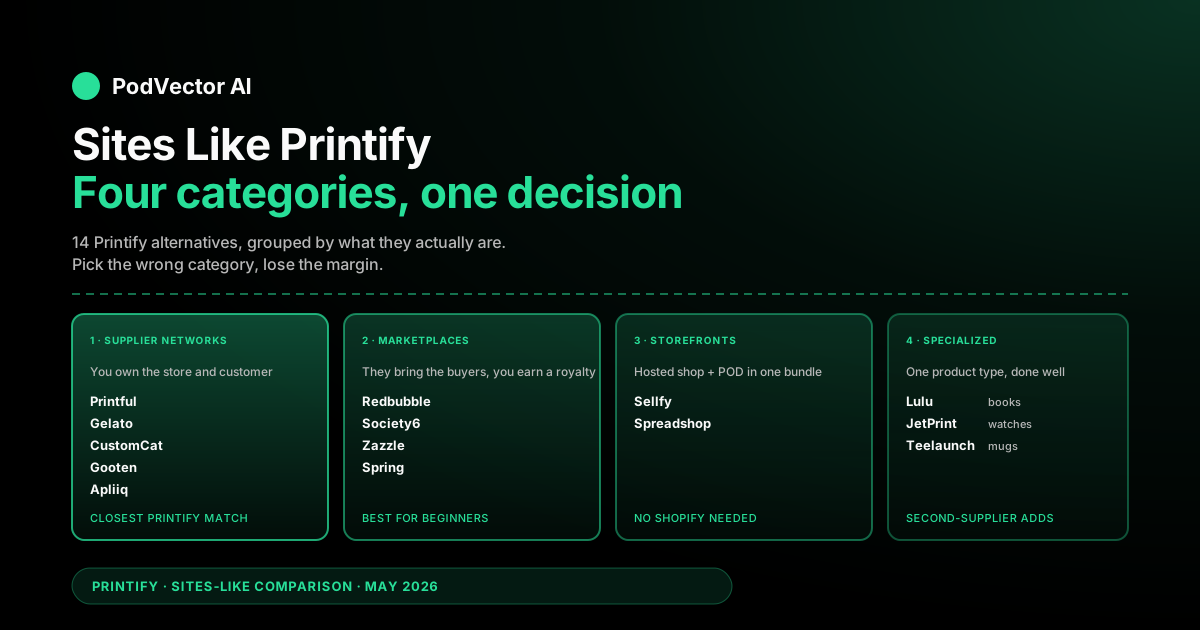
Quick Answer: The best sites like Printify for POD sellers are Printful for premium quality consistency, Gelato for global local production, CustomCat for low-cost US apparel, Gooten for a broad catalog, and Apliiq for branded streetwear apparel. "Sites like Printify" fall into four categories: direct supplier networks, print-on-demand marketplaces, storefront-included platforms, and specialized services.
Picking from the wrong category is the most expensive mistake new POD sellers make. A supplier network is not interchangeable with a marketplace, and a storefront platform is not interchangeable with either.
This guide groups 15 Printify alternatives by category, shows the seller profile each serves, and explains the margin math behind the choice.
Why sellers search "sites like Printify"
Most searches for "sites like Printify" come from one of three situations.
You're new to POD and Printify shows up on every list, but you want to know what else is out there before committing. Or you've been using Printify and a specific friction — pricing on a key SKU, slow shipping to your top country, a missing product type — is making you look elsewhere.
The third reason is the one most lists miss. Sellers are trying to add a second supplier, not replace Printify entirely. Diversifying across two networks gives you a fallback when one supplier raises prices, has a quality run, or runs out of stock on a hot SKU.
One structural update worth knowing: according to Wikipedia, Printify and Printful merged in 2024, making them part of one of the largest print-on-demand groups globally. That changes the competitive landscape — you're now effectively choosing between branches of the same parent company or genuinely independent alternatives.
This article covers all three scenarios. We'll group every credible Printify alternative by what it actually is, so you can match the platform to the job.
The four categories of sites like Printify
Printify itself is a supplier aggregator — it doesn't print your products, it routes orders to a network of print providers. According to Wikipedia, Printify's network includes print providers across North America, Europe, Asia, and Australia. Most "sites like Printify" lists ignore this structural detail and lump everyone together.
That framing fails. A marketplace like Redbubble works nothing like a supplier network like Printful, and grouping them under "Printify alternatives" leads sellers to the wrong choice.
Here are the four categories every site in this guide fits into.
1. Direct supplier networks
You upload designs, list products on your own store (Shopify, Etsy, WooCommerce, etc.), and the supplier prints and ships when an order comes in. You own the customer relationship and the brand.
Examples: Printful, Gelato, CustomCat, Gooten, Apliiq, Merchize. This is the closest functional match to Printify.
2. Print-on-demand marketplaces
You upload designs to their marketplace. They handle the storefront, the customer, the checkout, and the fulfillment. You get a royalty on each sale.
Examples: Redbubble, Society6, Zazzle, Spring. Lower margin, lower work, no store of your own.
3. Storefront-included POD platforms
Hybrid model. The platform gives you a storefront (a hosted shop with your domain or theirs) and fulfills the orders. You get more control than a marketplace but less than running your own Shopify.
Examples: Sellfy, Spreadshirt's "Spreadshop," Teemill.
4. Specialized POD services
These do one product category exceptionally well and the rest poorly or not at all. Lulu prints books. JetPrint specializes in watches and accessories. Teelaunch leans into mugs and engraved goods.
Use them as a second supplier when your catalog includes a SKU type the supplier networks struggle with.
Category 1: Direct supplier networks
If you want a true one-for-one Printify replacement, you're shopping in this category. All six suppliers below let you connect Shopify, Etsy, WooCommerce, and other stores, keep your customer data, and own your brand.
Printful
According to Blogging Wizard, Printful is "the best like-for-like alternative to Printify" because it controls its own fulfillment centers rather than relying on third parties, producing more consistent quality. Base costs run higher than Printify on common SKUs, but you get tighter print consistency and slightly faster US fulfillment.
Best for sellers who care more about consistency than the lowest possible base cost. Note: since the 2024 Printify–Printful merger, both brands operate under the same parent group — so "switching" to Printful is less of a departure than it once was.
Gelato
The global one. Gelato runs local production across dozens of countries, so an order from Germany prints in Germany rather than shipping from the US. For international sellers, that single fact rewrites the unit economics — shipping drops to local rates, and delivery compresses dramatically compared to cross-continental shipping.
Base prices sit between Printful and Printify. The catalog is narrower than Printify's, but the international logistics advantage is hard to beat for sellers with meaningful non-US traffic.
CustomCat
The cheap-US one. CustomCat operates from a single mega-facility in Michigan and pushes some of the lowest base costs in the industry on tees and hoodies. The trade-off: design tooling is dated and integrations are thinner than Printify or Printful.
Best for US-only sellers running high volume, where every dollar of margin compounds. See our guide on net profit margin benchmarks for POD to understand what margin targets to aim for before choosing a supplier.
Gooten
The breadth one. According to Shopify's guide to print-on-demand companies, Gooten offers a diverse catalog of more than 200 products — including apparel, wall art, premium home décor, drinkware, and accessories — with a fulfillment network spanning over 50 manufacturers in more than 70 global regions. Like Printify, it aggregates a supplier network, so quality varies by product line.
Best for sellers who want to expand beyond apparel into home goods and lifestyle SKUs.
Apliiq
The premium streetwear one. Apliiq specializes in custom apparel construction — inside-neck labels, custom hem tags, applique, and embroidered patches that other suppliers can't do. Base costs are significantly higher than Printify, but you can build a streetwear brand that doesn't look like everyone else's.
Best for sellers building a real apparel brand, not chasing trend tees.
Merchize (newcomer worth watching)
Merchize is increasingly appearing on top comparison lists. According to Printify's own blog on Printful alternatives, Merchize offers in-house production in Vietnam, the US, the EU, and China, with over 400 print-on-demand products and a dedicated one-day production category for faster fulfillment. It also integrates with Shopify, Etsy, and Amazon.
Best for sellers who want competitive pricing with broad catalog depth and don't want to sacrifice storefront SEO — Merchize includes storefront services with SEO capabilities built in.
Category 2: Print-on-demand marketplaces
Marketplaces flip the model. Instead of you running a store and the platform fulfilling, the platform is the store. You upload art, they list it, customers find it through their search, and you take a royalty.
The upside: zero marketing work — the platform's traffic is the engine. The downside: you're competing with millions of other designs and you don't own the customer.
Redbubble
The biggest marketplace in this group. Strong organic SEO traffic, a wide range of product types, and a base royalty rate you set yourself. For context on how Redbubble compares head-to-head with Printify, see our Redbubble vs Printify comparison.
Best for designers who don't want to run a store or pay for ads.
Society6
The art-focused marketplace. Society6 leans into wall art, home decor, and apparel for art buyers rather than meme tees. Average order value tends to be higher because the customer base is buying for their home.
Best for artists with a cohesive visual style — landscapes, abstract work, illustration — rather than text-on-tee designs.
Zazzle
The customization marketplace. Zazzle's differentiator is letting buyers personalize designs (add their name to your template, change colors). According to Blogging Wizard, Zazzle already attracts tens of thousands of monthly visitors, so your designs are visible to shoppers without any marketing effort on your part. Strong for invitations, party supplies, business cards, and personalized gifts.
Best for designers building template-based products where buyer personalization drives conversion.
Spring (formerly Teespring)
The creator-monetization platform. Spring leans into integrations with YouTube, TikTok, Twitch, and other creator platforms. The "Boosted Network" feature can also list your products on Amazon, eBay, and Walmart for an additional cut. For more on how Spring stacks up against Printify directly, see Printify vs Teespring.
Best for creators with an existing audience who want a no-store path to merch.
Category 3: Storefront-included POD platforms
These platforms try to do both jobs at once — give you a store and fulfill the orders. The pitch is simplicity: one login, one bill, one support team. The cost is flexibility.
Sellfy
According to Blogging Wizard, Sellfy is the best Printify alternative for users who don't already have an existing website. It's a full-fledged ecommerce platform that includes a drag-and-drop site builder, order and inventory management, integrated checkout, and marketing tools — plus built-in print-on-demand functionality. Sellfy charges a monthly subscription rather than taking a cut of each sale.
Best for sellers who want a turnkey store without learning Shopify, and who already have a way to drive traffic.
Spreadshirt (Spreadshop)
According to Printify's blog, Spreadshop handles production, inventory, and fulfillment in the US and Europe, with most orders ready to ship within 48 hours. Direct integrations are available for Etsy, Shopify, TikTok Shop, WooCommerce, Squarespace, Shopware, Order Desk, and Magento — a broader integration list than most comparable platforms.
Best for designers who want zero upfront cost and fast US/EU turnaround on a hosted storefront.
Teemill
A sustainability-focused storefront platform. According to Printify's Printful alternatives guide, Teemill lets you build a website directly on its platform and provides a subdomain for your store, with catalog integrations for Shopify, Etsy, and Amazon. Their free plan covers around 30 products; upgrading to TeemillPro unlocks 999+ products and additional features including localization and marketing tools.
Best for UK-based sellers or brands with a sustainability angle who want a hosted storefront without the setup overhead of Shopify.
Category 4: Specialized POD services
These aren't full Printify replacements. They're suppliers you add when your catalog includes something the general networks do poorly.
Lulu
Books, journals, and printed paper goods. Lulu's xPress API integrates with Shopify and lets you sell custom books, photo books, planners, and notebooks that print on demand. No other Printify alternative covers book printing this seriously.
JetPrint
Watches, shoes, bags, and high-fashion accessories. JetPrint's specialty is products that need precision cutting and assembly — exactly the SKUs the supplier networks struggle with quality on.
Teelaunch
Mugs, drinkware, jewelry, and engraved goods. Teelaunch maintains tight quality control on a narrower catalog and is a common second-supplier choice for sellers whose hot SKU is a coffee mug rather than a t-shirt.
Side-by-side comparison table
The table below shows what each platform actually is, what it costs to start, and where it shines.
| Platform | Category | Monthly Fee | Best For |
|---|---|---|---|
| Printful | Supplier network | $0 (paid tiers available) | Consistent quality, in-house production |
| Gelato | Supplier network | $0 (paid tiers available) | International sellers, local production |
| CustomCat | Supplier network | $0 (Plus tier available) | US-only, high-volume, low base cost |
| Gooten | Supplier network | $0 | Wide catalog, 200+ products, global fulfillment |
| Apliiq | Supplier network | $0 | Premium streetwear branding |
| Merchize | Supplier network | $0 (Lite free) | Broad catalog, competitive pricing, SEO storefronts |
| Redbubble | Marketplace | $0 | Designers who don't want a store |
| Society6 | Marketplace | $0 | Art and home decor buyers |
| Zazzle | Marketplace | $0 | Personalized and template products |
| Spring | Marketplace | $0 | Creators with existing audiences |
| Sellfy | Storefront | Paid subscription required | Turnkey store without Shopify |
| Spreadshop | Storefront | $0 | Fast US/EU fulfillment, broad integrations |
| Teemill | Storefront | $0 (Pro tier available) | Sustainability-focused, UK sellers |
| Lulu | Specialized | $0 | Books and paper goods |
| JetPrint | Specialized | $0 | Watches, shoes, accessories |
| Teelaunch | Specialized | $0 | Mugs and engraved goods |
Which category fits your seller stage
The right category depends less on your taste and more on where you are in your POD journey.
Just starting (no store, no sales)
Go marketplace first. Redbubble, Society6, or Spring let you upload designs and learn what sells before you spend time and money building a Shopify store. The royalty is lower, but the feedback loop is fast and the upfront investment is zero.
Validated a niche, want a real store
Move to a supplier network. Printful for quality, Printify for cost and catalog breadth, Gelato for international, CustomCat for US margin. Build the Shopify or Etsy store yourself, and treat the POD network as a backend. Understanding your checkout completion rate early helps you know whether a traffic or conversion problem is eating your revenue before you blame the supplier.
Doing volume, want to optimize
Add a second supplier. Most operators at meaningful scale run two networks side by side — Printify or CustomCat for cost-sensitive SKUs, Printful or Apliiq for premium ones. The specialized services (Lulu, JetPrint, Teelaunch) come into play when a hot SKU type falls outside what generalist networks do well.
Building a real apparel brand
Apliiq or another premium supplier becomes the primary, with one of the cheaper networks as a fallback for low-margin SKUs. Custom labels and construction matter at this stage in a way they don't at the listicle-tee stage. This is also the stage where increasing average order value becomes more impactful than chasing further base-cost reductions.
The margin question nobody asks
Every roundup of sites like Printify shows you base costs side by side. Almost none show you the number that actually matters: net profit per order after every variable cost is deducted.
Base cost is the start. Then come supplier shipping, marketplace or transaction fees, ad spend allocated to that SKU, your share of the storefront subscription, returns and refunds, and the time you spent on customer service. None of those line items show up in a public pricing page.
This is the gap between "Printful looks more expensive" and "Printful actually made me more per sale." You won't know which is true for your catalog until you track every cost component down to the SKU. See our net profit margin benchmark guide for the targets that healthy POD stores hit.
It's also worth understanding how supplier costs actually flow into your data. We explain the mechanics in our piece on whether Printify charges you or the customer — and the short answer is more nuanced than most sellers expect.
That's the work we built Victor for — a POD-native AI employee that reads your Printify, Printful, Shopify, Meta Ads, Google Ads, and Klaviyo data directly into a live data warehouse, and answers questions like "which supplier generates better margin on my top products?" with real numbers from your store. Victor proposes a next move as an approval card — showing old and new values — and executes only after you approve. Try Victor free while you're evaluating alternatives.
How to switch without breaking your store
If you've already got a Printify store running, do not yank it overnight. Switching suppliers without a plan is how POD sellers ship the wrong shirt to a customer and earn their first 1-star review.
Step 1: Test on a single SKU
Pick one product. Order a sample from the new supplier. Compare print quality, color accuracy, fabric weight, and the unboxing experience side-by-side with the same product from Printify.
Step 2: Run both in parallel
For a week or two, list the new supplier's version under a different product variant in your store. Watch returns, customer messages, and review sentiment.
Step 3: Migrate the catalog by margin tier
Move your highest-margin products first — they're worth the most to optimize. Leave low-volume SKUs on Printify until you're sure the new supplier handles them well. Our guide to CRO techniques for POD stores can help you improve conversion on the new listings as you migrate them.
Step 4: Keep Printify connected
Don't disconnect the old integration immediately. Keeping Printify as a hot backup means you can re-route an SKU in 60 seconds if the new supplier has a fulfillment issue. And if you're weighing whether the Printify Premium subscription is still worth keeping during the transition, check our Printify Premium discount and pricing breakdown.
Step 5: Re-engage buyers after the switch
A supplier switch is a good moment to re-engage your list. If you're on Klaviyo, setting up a browse abandonment flow ensures visitors who land on the newly migrated products don't slip away without a follow-up.
FAQs
Is there a free site like Printify?
Yes. Printful, Gelato, CustomCat, Gooten, Apliiq, Merchize, Redbubble, Society6, Zazzle, Spring, Lulu, JetPrint, and Teelaunch all have free tiers that let you upload designs and only pay when an order is placed. Sellfy is the main exception — it charges a monthly subscription. Teemill and Spreadshop also have free starting tiers with paid upgrades available.
What's the closest site to Printify?
Printful is structurally closest in workflow — same integrations, same store-owner model, similar product catalog — and since the 2024 merger, both are now part of the same parent group. Gelato is closest in pricing tier with a stronger international advantage. CustomCat is closest in base cost for US-only operations.
Can I use Printify and another supplier at the same time?
Yes, and most sellers doing real volume do exactly this. Shopify, Etsy, and WooCommerce all support connecting multiple POD apps. You map each product to the supplier that fulfills it most profitably.
Which Printify alternative is best for international sellers?
Gelato, hands down. Local production in countries across Europe, North America, and beyond means a German customer's order prints in Germany rather than shipping internationally from the US — compressing both shipping cost and delivery time significantly.
Which Printify alternative has the cheapest base cost?
CustomCat for US apparel, in most SKU categories. The trade-off is older design tooling and US-only production. Merchize is worth comparing for a wider product range at competitive prices. For more on Printify pricing as a baseline, see the Shopify guide to print-on-demand companies for industry-wide context.
Did Printify and Printful merge?
Yes. According to Wikipedia, Printify and Printful merged in 2024, making them part of one of the largest print-on-demand groups globally. The two brands continue to operate separately with distinct catalogs, pricing, and integrations — but they share the same parent company. This matters if you were planning to "switch" from one to the other as a way to diversify supplier risk.
Are marketplaces like Redbubble actually competitive with Printify?
For a beginner with no audience: yes, marketplaces are better because they bring the traffic. For an established seller with a store and ad budget: no, marketplaces cap your margin and you don't own the customer. They serve different jobs.
How do I know which alternative is actually more profitable for my products?
You have to run the unit economics product-by-product, including supplier base cost, shipping, fees, ad attribution, and returns. Spreadsheets get unwieldy past a few dozen SKUs. Victor — PodVector's AI employee — reads your live Shopify, Printify, Printful, Meta Ads, Google Ads, and Klaviyo data and answers profitability questions on demand, then proposes and executes approved changes to your store. Browse our other Printify comparisons and the full PodVector strategy guide for deeper context on how this works in practice.
Stop guessing which POD site is more profitable
Base-cost lists tell you what a shirt costs. They don't tell you what it earns after shipping, fees, ads, and returns.
Victor — PodVector's AI employee — reads your Printify, Printful, Shopify, Meta Ads, Google Ads, and Klaviyo data into one live data warehouse. He answers questions like "which supplier generates better margin on my top products?" with real numbers from your store, then proposes a move as an approval card and executes it after you approve.
No spreadsheets. No guessing. And find out which Printify alternative actually makes you more money.
Try Victor free