
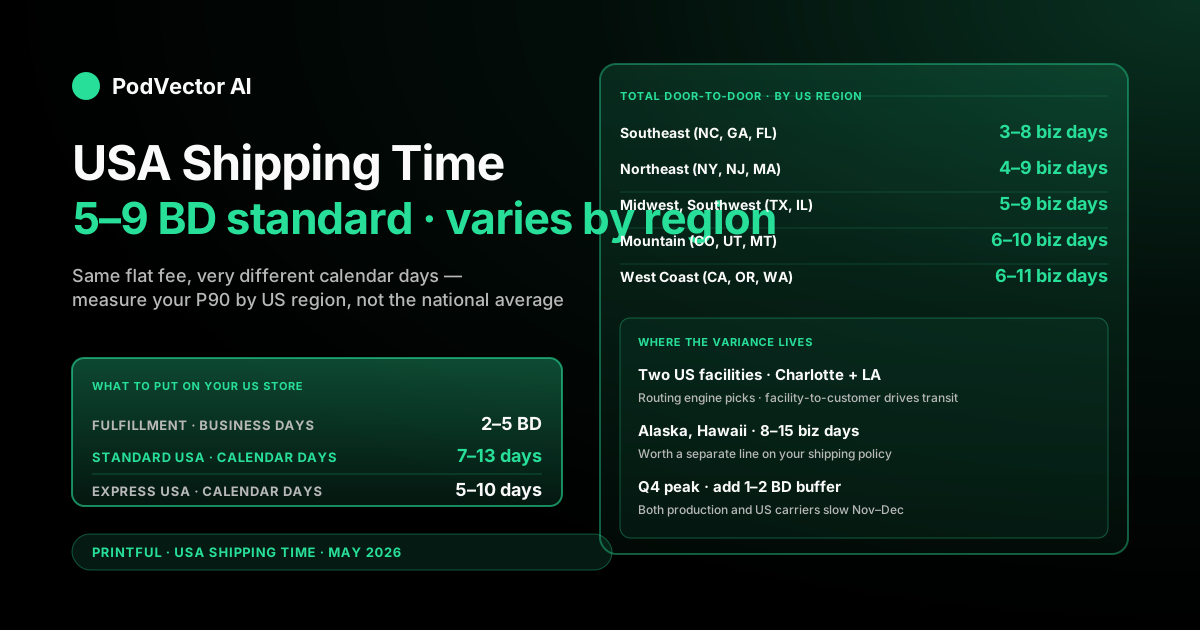
Quick Answer: A standard Printful order shipped inside the USA takes 5–9 business days door to door — 2–5 business days fulfillment plus 3–4 business days transit. Express trims the transit half to 1–3 business days.
Where you ship inside the USA matters more than most sellers realize. An order printed in Charlotte and delivered in North Carolina rides one zone; the same order delivered in Seattle rides eight. The shipping fee is flat, but the calendar days are not.
The metric to plan around isn't Printful's published average — it's your own 90th-percentile delivery time, broken down by US region and product category. That's the number that decides whether your shipping policy survives Q4.
The headline USA window — and why it shifts
If you need one number for your shipping policy, use 5–9 business days for standard USA delivery on a Printful order. That maps to roughly 7–13 calendar days once you include weekends.
That window is wide for a reason. It has to cover a Tuesday order to a customer ten miles from the Charlotte facility and the same order to a customer in Anchorage on the same week.
The 5-day floor assumes a fast production run and a short carrier route. The 9-day ceiling assumes a full 5-day production window and a cross-country carrier route — Charlotte to the West Coast, or LA to the Northeast.
Printful's own shipping page publishes the two halves separately: 2–5 business days fulfillment, then 3–4 business days transit for Flat Rate inside the USA. Add them together for the customer-facing number.
Fulfillment vs. carrier transit: two clocks, one promise
Customers don't think about fulfillment. They think about delivery. But the two halves of a Printful USA order behave very differently, and you have to manage them differently.
Fulfillment time is Printful's production window — receiving the order, queuing it on the right machine, printing or embroidering, quality-checking, and handing off to the carrier. The published range is 2–5 business days; Printful reports 97.66% of orders fulfilled within five.
That 97.66% number is a fulfillment metric, not a delivery metric. It does not include the days the package spends on a truck or in a sorting facility after it leaves Printful.
Carrier transit time is whatever the contracted carrier — USPS, UPS, FedEx, or a regional partner — takes from pickup to your customer's door. For domestic USA standard shipping, that's typically 3–4 business days. Express is 1–3 business days but costs more.
The split matters because the two clocks have different failure modes. A slow fulfillment week usually means a production backlog; a slow carrier week usually means weather, holiday volume, or a misrouted package.
If a customer messages you about a late USA order, the first question to answer is which clock is the problem. The tracking number tells you when production finished and the carrier scan started — anything before that scan is on Printful, anything after is on the carrier.
USA shipping time by region
Printful's flat-rate shipping price hides a big variance in transit time. The fee is the same coast to coast, but the delivery date is not.
| US region | Standard transit | Total (standard) | Express transit |
|---|---|---|---|
| Southeast (NC, SC, GA, TN, FL) | 1–3 BD | 3–8 BD | 1–2 BD |
| Northeast (NY, NJ, MA, PA) | 2–4 BD | 4–9 BD | 1–2 BD |
| Midwest (IL, OH, MI, MN) | 3–4 BD | 5–9 BD | 2–3 BD |
| Southwest (TX, AZ, NM) | 3–4 BD | 5–9 BD | 1–3 BD |
| Mountain (CO, UT, ID, MT) | 4–5 BD | 6–10 BD | 2–3 BD |
| West Coast (CA, OR, WA) | 4–6 BD | 6–11 BD | 2–3 BD |
| Alaska, Hawaii | 6–10 BD | 8–15 BD | 3–5 BD |
BD = business days. Saturdays, Sundays, and US federal holidays don't count. A Friday-evening shipment from Charlotte to Seattle is on the truck for the full weekend before the carrier clock starts.
The biggest variance is between the Southeast and the West Coast on standard transit. Same fee, but four to six extra business days depending on which Printful facility prints the order and which carrier route the package takes.
Alaska and Hawaii are the outliers and deserve a separate policy line on your store. If you sell apparel and a customer in Anchorage orders on a Wednesday, the realistic window is two to three calendar weeks.
Where Printful prints US orders
Printful has multiple US fulfillment facilities and routes each order to the closest one that can print the product. The big ones for US orders are in Charlotte, NC and Los Angeles, CA, with additional capacity in Dallas, TX for select product lines.
You don't pick which facility prints your order. Printful's routing engine picks based on the product, current capacity, and shipping destination. A T-shirt order to a Texas customer might print in Charlotte or Dallas depending on the day.
That matters because facility-to-customer distance is what drives the transit half of the window. An order routed to LA for a California customer is a 4–6 hour drive at the longest leg; the same product routed to Charlotte for the same California customer is a five-day cross-country truck.
Multi-item orders sometimes ship from a single facility even when one product would normally route elsewhere. Printful prefers to keep an order together rather than split shipments, which can mean the slowest-routing product sets the ship-from facility for the whole order.
Standard vs. Express inside the USA
Standard shipping inside the USA — Printful's "Flat Rate" option — is 3–4 business days transit. Express is 1–3 business days transit, and the price difference per order is typically $5–$12 depending on weight.
Express changes the transit clock, not the fulfillment clock. A T-shirt that needs 5 business days to print still needs 5 business days to print whether you paid for Express or not. Express only matters for the back half of the timeline.
That makes Express most valuable when fulfillment is fast and the customer is geographically far from the facility. A West Coast customer who orders a fast-fulfilling product on a Monday can realistically receive an Express order by end-of-week; the same Express upgrade on a slow-fulfilling product saves less.
Pass-through Express pricing at checkout almost never works for a POD store. The math: your margin per T-shirt is typically $5–$12 after product cost, and Express adds roughly that much. Either you eat the cost on selected orders (gift orders, replacements, customer-service recovery) or you build it into a higher product price for everyone.
USA delivery time by product category
The fulfillment half of the window depends on which production line your product comes off. Embroidery is usually fast, DTG is medium, all-over-print is slow:
| Product category | Fulfillment | Standard total (USA) |
|---|---|---|
| T-shirts, tanks (DTG apparel) | 2–5 BD | 5–9 BD |
| Hoodies, sweatshirts | 3–6 BD | 6–10 BD |
| Hats, beanies (embroidery) | 2–4 BD | 5–8 BD |
| Mugs, drinkware (sublimation) | 2–5 BD | 5–9 BD |
| Posters, wall art | 2–5 BD | 5–9 BD |
| All-over-print apparel | 4–7 BD | 7–11 BD |
| Embroidered apparel (jackets, polos) | 3–6 BD | 6–10 BD |
All-over-print is the slowest because of the cut-and-sew step — the fabric is printed flat, then the garment is cut and sewn. That's two production steps instead of one, and it can't be shortcut even with Express shipping.
Mixed orders default to the slowest item's fulfillment window. If a customer buys a T-shirt and an all-over-print hoodie in the same checkout, the T-shirt waits for the hoodie.
For comprehensive shipping-cost numbers across products, see the full Printful shipping cost breakdown for POD sellers, which itemizes fees alongside the time data here.
Why USA windows stretch in November and December
Printful's published windows assume normal-week volume. In late November and December, three things stretch the calendar:
Production volume spikes. Black Friday through mid-December is Printful's busiest stretch. The 2–5 day fulfillment window can drift toward the upper bound — closer to 5 days standard, occasionally 6 — even though the headline number doesn't change.
Carriers slow down. USPS and UPS both publish later peak-season cutoffs and longer transit times in December. A 3–4 business day Flat Rate window can become 5–6 business days for cross-country deliveries during peak weeks.
Customer expectations compress. Even though delivery is slower, customers expect orders to arrive by Christmas. The gap between "you ordered on the 18th" and "it's the 24th" is where the refund tickets come from.
For USA orders specifically, the practical rule is: the cutoff date you advertise for "guaranteed by Christmas" should sit one to two business days earlier than what Printful publishes. The buffer absorbs both production drift and carrier drift.
That buffer is also where Express stops being optional and starts being the only honest answer for last-minute orders. If a customer orders on December 17 and expects delivery by December 24, only Express has a shot — and only for products with fast fulfillment.
Setting a USA shipping policy that survives a bad week
The trap most POD operators fall into is quoting Printful's average instead of Printful's range. Your shipping policy needs to cover the bad week, not the good one.
A policy that says "3–5 business days for delivery in the USA" will fail roughly one order in five even in a normal week, because that's not what Printful publishes — it's not even close.
A policy that says "7–13 calendar days for standard USA delivery, longer for Alaska and Hawaii" matches what Printful actually does. It quotes the realistic window, lets you under-promise and over-deliver, and gives you cover when one order in twenty hits the long tail.
Three lines worth putting on every product page and order confirmation for USA orders:
- Fulfillment: 2–5 business days after order placed
- Standard USA delivery: Add 3–4 business days transit (4–6 for West Coast)
- Express USA delivery: Add 1–3 business days transit, available at additional cost
For marketplace sellers, the same window translates to handling-time and processing-time fields. Etsy's "processing time" field should sit at 5–7 business days for Printful-fulfilled products — that's the production half plus a small buffer. Set it lower and you risk late-shipment penalties on the orders that hit the upper bound.
The handling-time logic carries over to general Printful shipping time across countries, but USA orders have the tightest expectations of any market because customers are used to two-day Prime.
How to measure your real USA delivery times
Printful's published numbers are useful for setting expectations. They're not useful for telling you whether you have a problem.
The number that matters is your own 90th-percentile USA delivery time — what percent of your USA orders arrived inside the window you quoted, by product category and by US region. Without that number, every late order looks like an outlier.
With it, you can see whether your hoodies are dragging the average, whether your West Coast customers consistently fall outside the policy window, or whether Q4 weeks systematically blow the SLA. Those are three different problems with three different fixes.
The raw data lives in your Printful order export (created and shipped timestamps), your store platform's order data (placed timestamp and customer state), and the carrier tracking events (delivered timestamp). Joining those three sources is what turns "shipping feels slow lately" into a number you can act on.
The reason most sellers don't measure this is the join itself — it requires pulling three data sources into one place and keeping them in sync as new orders come in. That's also why Victor pulls all three into a single live data warehouse for you, so the question "what's my P90 delivery time for West Coast hoodies?" gets a real answer in seconds instead of a Saturday-morning spreadsheet.
For the cost side of the same join — how much you're paying Printful in shipping fees per order — see the full Printful shipping fees breakdown, which pairs naturally with delivery-time analysis.
For a similar regional analysis on the other side of the Atlantic, see how the same logic applies to Printful shipping time to France.
If your USA volume is heavily T-shirt-weighted, the Printful T-shirt USA shipping rates guide pairs the cost numbers with the time data here. Both live under the broader Printful shipping hub and the full Printful guide for POD operators.
FAQs
How long does Printful take to ship an order in the USA?
5–9 business days door to door for standard shipping — 2–5 business days fulfillment plus 3–4 business days transit. Express trims transit to 1–3 business days but does not change fulfillment. In calendar days, that's roughly 7–13 days standard and 5–10 days Express.
Does Printful ship faster to the East Coast than the West Coast?
Yes, when the order prints in the Charlotte facility. East Coast and Southeast US customers typically see 1–3 business days transit; West Coast customers see 4–6 business days for the same shipping option. The fee is the same; the calendar days are not.
Where does Printful print US orders?
Charlotte, NC and Los Angeles, CA are the primary US facilities, with additional capacity in Dallas, TX for select product lines. You don't pick the facility — Printful's routing engine assigns each order to the closest facility that can print the product, balanced against current capacity.
Is Printful Express shipping worth it inside the USA?
For gift orders, replacement orders, and customer-service recovery, yes. For default checkout, usually no — the $5–$12 per-order cost is most or all of the margin on a typical POD T-shirt. Standard inside the USA is fast enough that Express upgrades work better as a managed exception.
What's the realistic USA delivery time during Q4?
Add 1–2 business days to the standard window. Both Printful production and US carriers run slower from late November through mid-December. A normal 5–9 business day standard window becomes a realistic 7–11 business days, and a strict by-Christmas guarantee needs Express plus an order cutoff 1–2 days earlier than Printful publishes.
How long does Printful shipping to Alaska or Hawaii take?
8–15 business days standard, 3–5 additional days on top of the lower-48 transit. Both states ship via USPS or UPS Air freight from the Charlotte or LA facility, and weather can extend the window further in winter. Worth a separate policy line on your store if Alaska/Hawaii buyers are a non-trivial share of your USA volume.
What happens if a USA Printful order arrives later than quoted?
The carrier scan timestamp tells you whether the delay is on production (no carrier scan within 5 business days of order placement) or transit (scan happened but delivery is overdue). Printful's missing-package policy requires you notify within 30 days; for customer-side refunds and replacements, your store policy applies, but pricing for replacements falls on you, not Printful.
Can I see real-time USA shipping performance against my own orders?
Printful's dashboard shows aggregate fulfillment time but not your own delivery-time distribution by US region or product category. To answer "what's my P90 delivery time for hoodies to California buyers?" you need to join Printful order data, store data, and carrier tracking data into a single warehouse — which is what Victor sets up for POD sellers so the question takes seconds, not a Saturday morning.
Stop quoting averages. Start quoting your own numbers.
Printful's headline metric covers production, not delivery. Your customers don't separate the two. Victor pulls Printful order data, your store data, and carrier tracking into one live data warehouse, then answers shipping-time questions against your real orders — by US region, by product, by week.
Try Victor free