
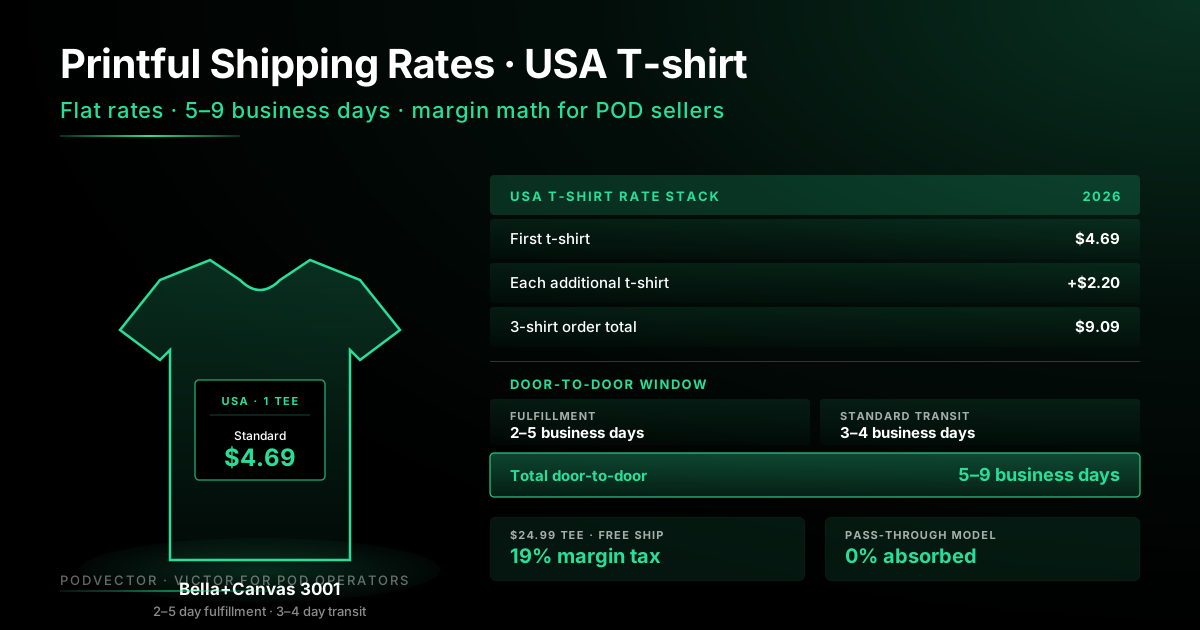
Quick Answer: Printful charges a flat $4.69 for the first t-shirt shipped to a US address, then $2.20 for each additional t-shirt in the same order. Standard delivery is 3–4 business days after fulfillment, and fulfillment itself averages 2–5 business days — so plan for a 5–9 business-day door-to-door window.
That $4.69 base is the line item most POD sellers underprice for. If your retail price assumes one shirt per order, the first-item rate is a fixed margin tax on every transaction — not an "if the customer buys multiple" cost.
Current USA T-shirt Shipping Rates
Printful uses flat, zone-based shipping rates for the USA. For t-shirts specifically — including tanks, long-sleeves, and most cotton blanks — the published rate is $4.69 for the first unit and $2.20 for every additional t-shirt in the same order.
The rate is the same whether your order is fulfilled in Charlotte, NC, Dallas, TX, or one of Printful's other US facilities. Printful's flat-rate model bakes the routing decision into a single number so you don't have to estimate carrier zones at checkout.
A few quick examples of what shipping costs on common cart sizes:
- 1 t-shirt: $4.69
- 2 t-shirts: $4.69 + $2.20 = $6.89
- 3 t-shirts: $4.69 + ($2.20 × 2) = $9.09
- 5 t-shirts: $4.69 + ($2.20 × 4) = $13.49
Mixed orders work differently. If your customer buys one t-shirt and one hoodie, the system charges the higher first-item rate (the hoodie's) and applies the t-shirt's lower additional-item rate. We'll cover mixed-cart logic in more detail below.
For a deeper dive on the per-product math, see the Printful shipping calculator walkthrough and the practical view on why Printful shipping feels expensive. For the full Printful shipping guide hub, jump up one level.
Delivery Times: Fulfillment + Transit
Door-to-door delivery time is two numbers added together: fulfillment and transit. Neither is set by the carrier alone, and confusing them is the most common cause of "where is my order?" support tickets.
Fulfillment time is how long Printful takes to print and pack the shirt before it leaves the warehouse. For t-shirts, this averages 2–5 business days, with most orders shipping within 3.
Transit time is how long the carrier takes to move the package from the warehouse to your customer's door. For standard US delivery, this is 3–4 business days after fulfillment.
Add those together and your customer should expect 5–9 business days from order placement to delivery — call it a 1–2 week window. During Q4 holiday peak (mid-November through late December), fulfillment can stretch to 5–7 business days as production capacity tightens.
A useful rule for store copy: never quote "Printful ships in 3–4 days" alone. That's transit only. Customers read it as door-to-door, and you'll spend the saved word answering tickets.
How Printful Charges Shipping
Printful's pricing is structured in three layers, and it helps to see them separately:
Layer 1: Product cost. The base price of the blank shirt plus print. You pay this to Printful when an order is fulfilled.
Layer 2: Shipping cost. The flat per-item rate above. Printful charges you, not your customer, when the order ships. What your customer pays at checkout is whatever you set in your store's shipping settings — which may or may not match what Printful charges you.
Layer 3: Fees. Printful doesn't charge a monthly fee on its free tier, but if you've upgraded to Printful's paid membership, that's a separate recurring cost. If you're on the free no-monthly-fee tier, only product and shipping apply per order.
The shipping rate doesn't change with your membership tier. The product cost does (paid members get a per-unit discount). So shipping is the fixed margin line you can't optimize away by upgrading. For the bigger picture on all Printful costs, see the Printful topic hub.
Express vs. Standard: When Is the Upgrade Worth It?
Printful offers two USA shipping tiers for t-shirts:
- Standard: $4.69 first / $2.20 additional. 3–4 business days transit.
- Express: Variable — typically $15–$30 first unit. 1–3 business days transit.
Express only saves 1–3 business days on transit. It does not speed up the 2–5 day fulfillment window — that part is set by your spot in the production queue.
For most t-shirt stores, standard is the right default. The exceptions:
- Last-minute holiday orders within Printful's posted express cutoff dates.
- Replacement orders where the original was lost or damaged and the customer is already frustrated.
- B2B orders with a hard event deadline (corporate giveaways, wedding party shirts).
If you offer express at checkout, charge what it costs you. A $20 express upcharge that gets ignored 95% of the time is fine; one that subsidizes the 5% who pick it will quietly erode your margin.
The Margin Impact Nobody Talks About
Here's the part most shipping-rate articles skip. Your $4.69 first-item rate isn't a customer charge — it's your cost. Whether you pass it through, absorb it, or split the difference is a margin decision that compounds across every order.
Run the math on a typical $24.99 retail t-shirt:
- Retail price: $24.99
- Printful product cost (Bella+Canvas 3001, single-color print): ~$9.50
- Printful shipping: $4.69
- Gross profit before ads/fees: $10.80
If you charge the customer $4.99 shipping, you net an extra $0.30 — fine. If you offer "free shipping" and bake $4.69 into the $24.99 price, your effective retail is $20.30 and your margin is the same $10.80. Same outcome, different psychology.
Where this gets ugly is when you advertise free shipping without raising prices. Now you're absorbing the full $4.69 on every order. On a $24.99 shirt that's a 19% margin cut — and that's before Meta or Google ad costs, processing fees, and chargebacks.
The same dollar of shipping cost looks completely different at $24.99 vs. $34.99 retail. Higher AOV stores have more headroom to absorb it; impulse-priced stores don't.
Flat Rates vs. Live Carrier Rates: Which to Use
Printful gives you two shipping configurations for your storefront:
Flat rates use Printful's published per-item table. Simple, predictable, and what most stores ship with by default.
Live shipping rates pull carrier quotes in real time at checkout, based on the actual destination ZIP code. This is closer to what carriers like USPS, UPS, or DHL would charge if you shipped the package yourself.
Live rates aren't always cheaper or more expensive — they're more accurate. For a single t-shirt going to a nearby ZIP, live rates can be a dollar or two under the flat rate. For a 5-shirt order crossing two zones, they can be a dollar or two over.
If you want to dig into setup mechanics, see the Printful API shipping rates endpoint guide — that's the underlying call powering live rates on supported integrations.
Decision rule: if your average cart is 1–2 items and you sell across the US, flat rates are almost always cleaner. If your average cart is 4+ items or you sell heavily to specific regions, live rates are worth testing for a month and comparing.
How to Diagnose If Shipping Is Eating Your Margin
"Is shipping killing my margin?" is one of the most common questions a POD seller asks — and one of the hardest to answer with the standard Printful or Shopify reports.
The reason: Printful tells you what shipping costs per order. Shopify tells you what shipping you collected per order. Neither natively rolls those up across SKUs, design variants, time windows, or marketing channels.
To do this right, you need to itemize four numbers per order, then aggregate them:
- Revenue collected (product + shipping charged to customer)
- Printful product cost (blank + print)
- Printful shipping cost (what they billed you)
- Ad spend allocated to this order (channel-specific)
The gap between shipping charged and shipping paid is your shipping margin per order. Sum that across a week and you'll see whether free shipping is sustainable, whether one product line is dragging the average down, and whether a specific ZIP-code cluster is unprofitable.
Most operators run this once per quarter in a spreadsheet, get spooked, and never re-run it. The fix is to have it answered automatically against your live order data — which is the kind of question Victor is built for. Ask "how much margin did shipping cost me last week, by SKU?" and get the answer pulled from your store's order history without exporting CSVs.
For now, even a once-a-month spreadsheet pass is better than no answer. The shipping line is not noise — it's the second-biggest cost on a t-shirt order after the blank itself.
What to Charge Customers for Shipping
Three pricing models work for POD t-shirt stores. Pick one and run it for at least 30 days before changing.
Pass-through: Charge the customer exactly what Printful charges you ($4.69 first / $2.20 additional). Honest, simple, hurts conversion slightly because shipping shows as a line item at checkout.
Free shipping, baked in: Raise retail prices by ~$5 and advertise free shipping. Best for impulse purchases and ad-driven traffic — shoppers see one number and decide faster.
Threshold free shipping: Free over $X, flat rate below. Raises AOV by nudging customers to add a second item to clear the threshold. Best for stores with strong cross-sells.
Don't mix. If your store inconsistently offers free shipping on some campaigns and charges on others, your conversion data becomes uninterpretable and your customer service load goes up.
FAQs
How much does Printful charge to ship a t-shirt in the USA?
$4.69 for the first t-shirt and $2.20 for each additional t-shirt in the same order. Rates are flat across the continental US and don't vary by ZIP code under the standard tier.
How long does Printful take to ship a t-shirt in the USA?
2–5 business days for fulfillment plus 3–4 business days for standard transit, for a typical door-to-door window of 5–9 business days. Express transit cuts that to 1–3 business days but doesn't speed up fulfillment.
Does Printful ship the same day?
No. Printful prints to order, so the 2–5 business day fulfillment window applies even on express. Same-day shipping isn't offered on any tier.
Are Printful t-shirt shipping rates the same everywhere in the US?
Yes for the continental US. Hawaii, Alaska, and US territories have separate higher rates because they require different carrier routing.
Can I pass the exact Printful shipping cost to my customer?
Yes — most integrations support either flat-rate pass-through or live rates pulled directly from Printful's API at checkout. Live rates are more accurate; flat rates are simpler to display.
What happens if a t-shirt arrives damaged or doesn't arrive?
You file a claim with Printful within 30 days of expected delivery. They reprint and reship at their cost. The customer doesn't pay shipping again, and you don't either — but the second order still counts toward your fulfillment volume.
Does the shipping rate change for higher-priced t-shirts?
No. Printful's shipping is priced per item, not by retail price. A $19.99 shirt and a $34.99 premium shirt ship at the same $4.69 base rate.
Where can I see Printful's full shipping rate table?
Printful publishes the current rate table at printful.com/shipping — it covers every product category and destination. Rates update annually.
Stop Guessing What Shipping Costs You
Most POD sellers know their shipping rate. Far fewer know what shipping has actually cost them this month, by SKU. Victor is an AI employee that connects to your store data and answers margin questions — including the slow-bleed ones like "how much did shipping cost me on free-shipping orders last week?" — without spreadsheets.
Ask in plain English, get the answer pulled from your live order data.
Try Victor free