
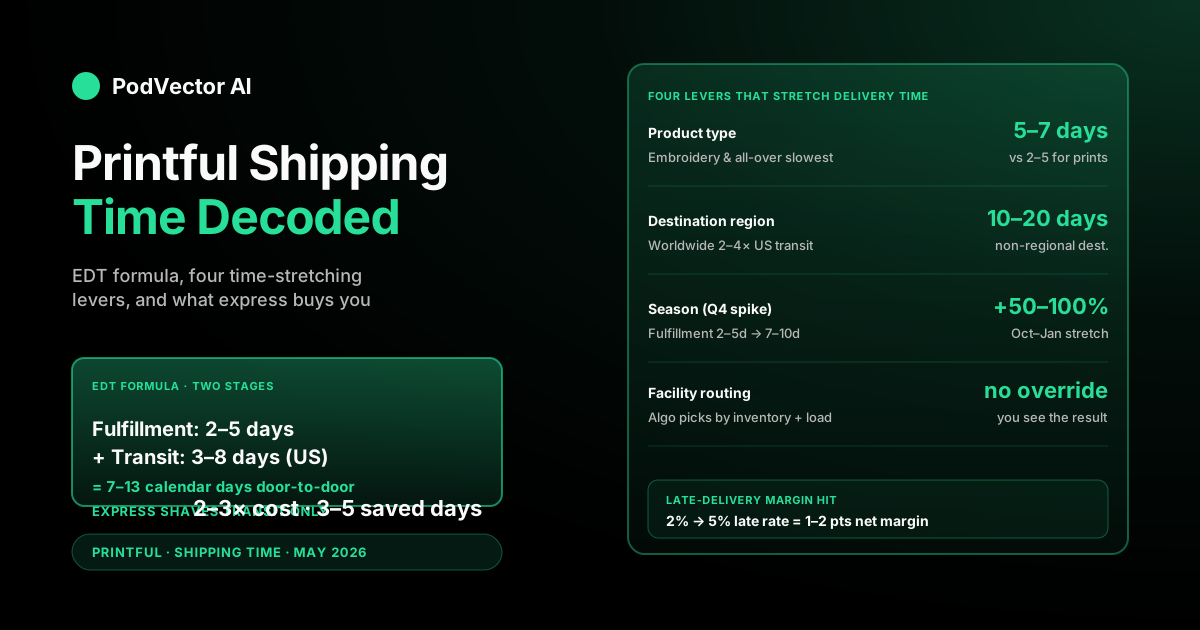
Quick Answer: Printful shipping time = fulfillment time + carrier transit time. The two are different stages, run by different teams, and stretch for different reasons.
Fulfillment averages 2–5 business days for apparel and 1–3 days for mugs and posters. Carrier transit adds 3–8 business days inside the US and 5–20 days internationally. Total for a typical US t-shirt: 7–13 calendar days.
Most orders land on time. The ones that don't follow predictable patterns — product type, destination region, season, facility routing — and once you can name the lever that stretched, you can quote the right window on your product page.
How Printful calculates estimated delivery time
Printful's estimated delivery time (EDT) is the only number the customer sees. It's the sum of two estimates, not a guarantee.
The formula is plain: EDT = estimated fulfillment time + estimated shipping time. Fulfillment is the print-and-pack stage at Printful's facility. Shipping is the carrier leg from the facility to the customer's door.
What the customer reads as "shipping time" is actually the second number alone. Most of the variance — and most of the late deliveries — come from the first.
Printful publishes a useful baseline: roughly 97% of orders ship within 5 business days, and more than half ship within 3. That's the fulfillment side. Carrier transit is on top.
One implication that confuses sellers: paying for express shipping shaves the transit leg, not the fulfillment leg. A rush hoodie still spends 2–5 days printing before the express carrier touches it. We dig into this in the express vs standard section below.
Fulfillment time by product type
Different products print on different equipment. Equipment runs at different speeds. Apparel goes through a DTG (direct-to-garment) printer, mugs through a sublimation press, embroidered items through a needle machine. Each has its own queue.
Typical fulfillment windows by product type:
- T-shirts and most printed apparel: 2–5 business days
- Embroidered apparel (hats, polos): 5–7 business days
- All-over-print clothing: 3–6 business days
- Mugs (11 oz, 15 oz): 1–3 business days
- Posters and wall art: 1–3 business days
- Stickers and decals (custom-cut): 2–4 business days
- Phone cases: 2–4 business days
- Engraved metal goods: 4–7 business days
Embroidery is the slowest category by a margin. If you sell embroidered hats alongside printed tees, your blended fulfillment window is longer than the t-shirt number suggests. The sibling guide on Printful international shipping walks through how product mix and region compound the stretch.
One catch: the "business days" number excludes weekends and Printful's facility holidays. An order placed Friday afternoon enters the queue on Monday. That alone adds 3 calendar days to the timeline a customer reads as "5 days from now."
Transit time by region
Once a package leaves the facility, transit speed depends on the carrier and the destination. Printful uses USPS, UPS, FedEx, DHL, Royal Mail, DPD, and a roster of national carriers, picked per order.
Transit averages by region (standard shipping, after fulfillment):
- USA: 3–8 business days
- Canada: 5–10 business days
- Europe (intra-EU): 3–7 business days
- UK: 4–8 business days
- Australia and New Zealand: 7–14 business days
- Japan and East Asia: 6–12 business days
- Latin America (excluding Mexico): 10–20 business days
- India and South Asia: 10–20 business days
- Worldwide (everywhere else): 10–20 business days
A practical example. A US customer in Texas orders a hoodie on a Monday. Printful routes the print job to its North Carolina facility. Fulfillment runs 3 days (Thursday). USPS picks it up and delivers in 4 days (the following Wednesday). Total: 8 business days, or about 10 calendar days.
The same hoodie shipped to a customer in Berlin would print at Printful's European facility (Riga or Spain), saving the transatlantic crossing. Cross-border to a country without a regional facility — Brazil, India, much of Asia — adds the customs leg and the long-haul carrier hop. That's where the 10–20 day window comes from.
For destinations that consistently run long, see the India shipping breakdown for a region-specific example of how transit time compounds with customs.
Express vs standard: what you actually save
Express shipping costs roughly 2–3× standard and cuts only the transit leg. Fulfillment is the same.
The math, with a US hoodie order:
- Standard: 3 days fulfillment + 5 days transit = 8 business days. Shipping cost: ~$8.49.
- Express: 3 days fulfillment + 2 days transit = 5 business days. Shipping cost: ~$22–$28.
Express saves 3 business days and costs an extra $14–$20. For a $40 hoodie, that's a meaningful chunk of margin if you absorb it. If the customer pays, it's a meaningful uplift on their cart total.
When express makes sense:
- Birthday / occasion-driven orders. The customer is willing to pay because the date matters.
- Replacement reshipments. You're already eating the cost on a damaged-item reship — paying express signals service quality.
- Peak season "Christmas guarantee" pricing. Late November orders where standard shipping won't make Christmas. Express might.
When it doesn't:
- Standard orders with the date open. Most apparel buyers don't have a deadline. Paying 2–3× shipping for 3 saved days converts poorly.
- International orders held up at customs. Express doesn't speed customs. A package sitting at a Mexican customs office takes the same time whether it arrived via DHL Express or standard mail.
The full express breakdown — when it does and doesn't pay — sits in our holiday shipping deadlines guide, which covers the Q4 calculus in detail.
The four levers that stretch shipping time
When an order takes longer than the EDT, one of four levers moved.
Lever 1: Product type. A cart with both a t-shirt and an embroidered hat takes the longer of the two windows (5–7 days), not the average. Bundle SKUs containing slow-fulfillment items inherit the slow timeline.
Lever 2: Destination region. Same product, different country, different timeline. A Mexican customer's t-shirt order can take 14 business days where a US customer's takes 7. The retail price often stays the same — the margin doesn't.
Lever 3: Season. October through January, fulfillment stretches 50–100%. A 3-day average becomes 5–7 days. Carriers are also at peak load, so transit stretches too. We unpack the Q4 mechanics in the holiday shipping deadlines piece.
Lever 4: Facility routing. Printful's algorithm picks the print facility based on proximity to the destination, inventory availability for the specific SKU and color, and current facility load. A US east-coast customer who ordered a rare color might get routed to Spain because that's where the blank is. The transit time changes, the cost can change too.
You don't pick the routing. You see the result.
"Why is my order slow?" — a diagnostic
A customer emails you 6 days in: "where's my order?" Here's how to read the situation without bouncing the ticket back to Printful.
Step 1: Check the EDT against the order date. If the EDT is still ahead, the order is on schedule and the customer is impatient. Send the EDT date back to them with a tracking link.
Step 2: Check the order status in Printful. If the order is still in "in production," fulfillment is the stretching leg. Look at what product it is. Embroidery or all-over-print explains 7–10 days. A plain t-shirt taking 7+ days means the facility is at load — usually season-driven.
Step 3: Check the tracking number. If tracking exists but hasn't updated in 5+ days, the carrier may have lost it or the scan was missed. Check whether the package is moving by the city scans. A package showing "label created" but no scans is genuinely stuck.
Step 4: If past EDT by 5+ business days, file with Printful. Their policy: wait 5 business days past the EDT before raising a delay claim. After 4 weeks (domestic) or 6 weeks (international), a lost-package claim is in scope and they reprint at no cost.
Most "lost" packages arrive between weeks 2 and 4. The truly lost ones — single-digit percentage — are reprinted on file. The diagnostic above triages 80% of the customer tickets without escalation.
What a late delivery actually costs you
The line on your P&L for shipping doesn't capture the second-order cost of being late. Three real costs that don't show up on the invoice:
Refund requests. Customers who escalate to a refund instead of a reship cost you the product (Printful charges you for the production), the original shipping, and any payment processor fees. A $30 t-shirt order that lands as a refund costs you roughly $12–$15 net.
Chargebacks. A customer who can't reach you and files a chargeback through their card issuer costs you the order plus a $15–$25 chargeback fee. Win rates on "merchandise not received" disputes hover around 30%, and only with documented tracking.
Lifetime value damage. The strongest signal in POD repeat-purchase data: customers whose first order arrived on time return to buy again at meaningfully higher rates than customers whose first order was late. Late deliveries don't just cost the order — they cost the next two orders that customer would have placed.
Across these three costs, a late-delivery rate that creeps from 2% to 5% can change net margin by 1–2 points. Quietly. The shipping rate card on Printful's site stays the same. Your blended per-order margin doesn't.
Setting expectations on your product page
The cheapest way to prevent late-delivery tickets is to quote a longer window on the product page than you actually expect.
What works for most stores:
- Use calendar days, not business days. Customers don't count weekends. Saying "7–14 business days" reads as "7–14 days" and gets a complaint on day 9. Quote in calendar days.
- Quote the upper end of the range. Say "10–17 days" for US apparel even though most orders land in 7–10. The customer who reads 17 and gets it in 10 is delighted. The customer who reads 10 and gets it in 12 is angry.
- Add a multi-item note. "Orders with multiple items may ship in separate packages." Prevents 80% of the "why two tracking numbers" tickets.
- Switch your copy in Q4. From late October through mid-December, your standard window stretches. Add 3–5 days to the quoted range during peak.
- Publish a holiday cutoff prominently. "Order by December 10 for delivery by Christmas (US standard)." After that date, switch to "January delivery" copy.
The store policy that quotes 5–7 day delivery for a 7–13 day actual is the policy that books a customer-service ticket on every fifth order. Cleaner to over-quote and over-deliver.
Shipping costs and time, in one table
Time and cost both vary by product and region. The fast option is rarely the cheapest one.
Typical US standard shipping costs for common products (first item / each additional):
- T-shirts: $4.75 / $2.20
- Hoodies and sweatshirts: $8.49 / $2.50
- Hats: $3.99 / $1.60
- Mugs (11 oz): $4.95 / $2.55
- Posters (small): $4.99 / $1.50
- Phone cases: $3.99 / $1.60
European rates run roughly parallel to US. Worldwide rates are the steep ones — 2–4× the US numbers for the same product. A hoodie that costs $8.49 to ship US-domestic can cost $25–$30 to a worldwide destination.
For the full live rate card and every shipping region, Printful's official shipping page is the source of truth. Our cluster hub at Printful shipping indexes every shipping-specific guide we've published, and our Printful topic hub covers the rest of the operator surface.
One pattern worth noting: shipping cost and shipping time are weakly correlated. The hoodie that costs $8.49 to ship and the t-shirt that costs $4.75 take roughly the same transit time within the US. You're paying for weight and bulk, not speed. Express is the only lever that actually buys you speed — and as covered above, it doesn't touch fulfillment.
Subscription tier matters here too. The Printful Growth plan shifts your product cost down, and the Growth plan pricing breakdown covers when the math swings positive for shipping-heavy stores.
Watching shipping time across your live orders
Most stores answer "how is shipping time trending?" by eye, off a few recent customer tickets. That's noisy and reactive. The data exists in your Printful order log to answer it properly.
The numbers worth pulling, per week:
- Average fulfillment lag. Days from order placed to shipped status. Trending up signals facility load or product-mix drift.
- Average transit time. Days from shipped status to delivered. Trending up signals carrier or regional issues.
- Percent past EDT. Orders that have not arrived by their estimated date. This is your leading indicator for support volume.
- Region breakdown. US fulfillment time looks fine while worldwide stretches — without the breakdown you can't see it.
None of this requires a new tool. Printful exposes the timestamps in their dashboard and API. Pulling them into a sheet weekly takes 20 minutes. Most operators don't, and find out about a fulfillment regression two weeks late.
The right setup is to pipe the order log into the same place as your revenue and product cost, then look at margin per order with shipping time as a dimension. You'll see things like: "orders fulfilled in 6+ days have a 3× refund rate." That's the kind of read that changes how you set up your product mix and your retail prices.
FAQs
How long does Printful shipping take?
Fulfillment runs 2–5 business days for most apparel and 1–3 days for mugs and posters. Carrier transit adds 3–8 days US domestic and 5–20 days international. Total for a typical US t-shirt order: 7–13 calendar days from order to delivery.
How is Printful's estimated delivery time calculated?
EDT = estimated fulfillment time + estimated shipping time. Fulfillment is the print-and-pack stage at Printful's facility, shipping is the carrier leg from facility to customer. Both are estimates, not guarantees. Printful publishes 97% of orders shipping within 5 business days as their fulfillment baseline.
Does Printful express shipping speed up fulfillment?
No. Express only shaves the transit leg, not the fulfillment leg. A rush hoodie still spends 2–5 business days at the facility being printed and packed before the express carrier touches it. Express buys you 3–5 days of transit time at 2–3× the standard shipping cost.
Why is my Printful order taking longer than expected?
One of four levers stretched: product type (embroidery and all-over-print are slower), destination region (international takes 2–3× longer), season (Q4 stretches fulfillment 50–100%), or facility routing (Printful's algorithm picked a farther facility based on inventory). Check the order status — if it's still "in production" 6+ days in, fulfillment is the issue. If tracking has stalled, the carrier is.
When should I tell a customer their late Printful order is lost?
Printful's policy: wait 5 business days past the EDT before raising a delay claim. File a lost-order claim after 4 weeks past expected delivery for domestic or 6 weeks for international. Most "lost" packages arrive between weeks 2 and 4 — slow-tracking, not actually lost.
What carriers does Printful use for shipping?
USPS, UPS, FedEx, and DHL in the US. Royal Mail and DPD in the UK. DPD and national carriers in the EU. Australia Post and DHL in Australia and New Zealand. National carriers and DHL elsewhere. The carrier is assigned per order based on destination, product, and capacity — you don't pick it.
How long does Printful take to ship internationally?
Fulfillment is the same as domestic: 2–5 business days for apparel. Transit varies widely by region — 5–10 days for Canada, 7–14 for Australia, 10–20 for Latin America, India, and most worldwide destinations. Customs can add an unpredictable extra leg. See our Printful international shipping guide for the regional breakdowns.
Does Printful ship on weekends?
No. Fulfillment runs on business days only. An order placed Friday afternoon enters the queue on Monday morning. This silently adds 2–3 calendar days to the timeline customers read as "business days from now."
How can I set realistic shipping time expectations on my product page?
Quote in calendar days, not business days. Use the upper end of the range — "10–17 days" for US apparel even though most arrive in 7–10. Add a multi-item shipping note. Switch your copy in Q4 to add 3–5 days. Publish a holiday cutoff date prominently. Over-quoting and over-delivering costs nothing and prevents most late-delivery tickets.
Does Printful shipping time change in Q4?
Yes — significantly. October through January, fulfillment can stretch from 2–5 days to 7–10 days. Carrier networks run at peak capacity and miss delivery dates more often. Most stores publish a holiday cutoff (typically December 10 for US standard) and switch product page copy to "January delivery" afterward. See our holiday shipping deadlines guide for the full Q4 calendar.
Late deliveries cost more than the shipping line on your P&L.
The refund hits. The chargeback fee hits. The lifetime-value hit on a customer whose first order was late doesn't show up for months. Your shipping rate card stays the same. Your blended per-order margin doesn't.
Victor connects to your Printful account and pulls every order's fulfillment and transit time into your live data warehouse. Ask "what percent of last week's orders shipped past EDT?" or "how is shipping time trending by region this month?" in plain English. Real numbers from your live orders — no spreadsheet, no end-of-quarter surprise.
Try Victor free