
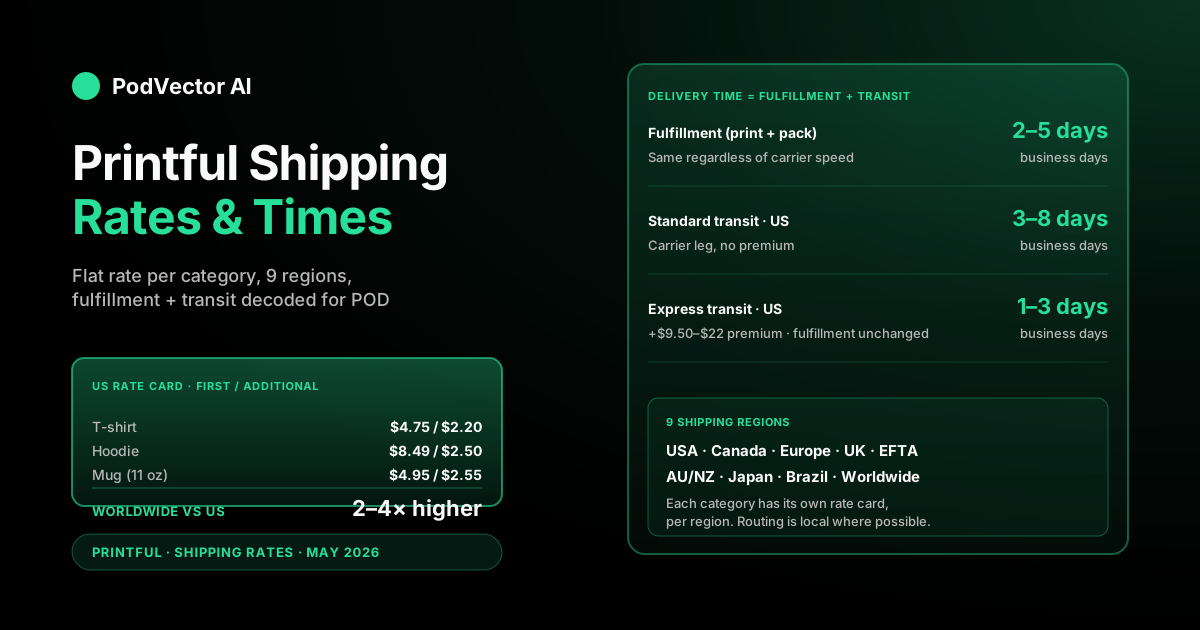
Quick Answer: Printful charges flat shipping rates by product category and destination region. A single t-shirt to the US runs $4.75, with each additional shirt at $2.20. A single hoodie is $8.49, then $2.50 per extra. Mugs, bags, and posters each have their own rate card.
Delivery time has two parts: fulfillment (2–5 business days, the printing) and shipping transit (3–8 business days standard, 1–3 days express). Express speeds up the carrier leg only — it does not skip fulfillment.
For POD sellers the real question is not "what's the rate" but "what's shipping doing to my per-order margin this month?" Rates shift quietly, region mix drifts, and a 30¢ change on a high-volume SKU can move quarterly profit by four figures. The rate card below is the input. Tracking the impact is the work.
Printful shipping rates at a glance
Printful uses a flat-rate model: every product category has a base shipping fee for the first item and a lower fee for each additional identical item. Rates are set per shipping region, not per country.
Here are typical 2026 rates for the most-shipped categories to a US address. Single-item rate first, additional-item rate second.
- T-shirts: $4.75 / $2.20
- Hoodies and sweatshirts: $8.49 / $2.50
- All-over print clothing: $6.49 / $2.50
- Hats and beanies: $3.99 / $1.60
- Mugs (11 oz): $4.95 / $2.55
- Posters (small): $4.99 / $1.50
- Backpacks: $10.49 / $4.50
- Tote bags: $4.49 / $2.00
- Phone cases: $3.99 / $1.60
Two things to notice. The first-item fee is what hurts on single-unit orders — the biggest order type for most POD stores. And the spread between categories is wider than people expect: a hoodie ships for almost twice what a t-shirt does to the same address.
If your bestseller mix is hoodie-heavy, your effective shipping cost per order is much higher than the t-shirt rate card suggests. That's a margin number worth knowing before you set your prices.
For the full set of guides on every shipping topic in this cluster — rates, times, regions, the API, free-shipping mechanics, drop-shipping flows — see the Printful shipping hub. For everything Printful, including pricing, products, and integration topics, the Printful topic hub indexes the full library.
Flat rates vs live rates: which to charge customers
Printful gives you two ways to charge shipping at checkout. The choice matters more than people realize.
Flat rates mean you set one or a few fixed shipping prices in your store and absorb the difference between what you charge and what Printful actually bills you. Easier to configure. Predictable for the customer. You eat the variance.
Live rates mean your store queries Printful's API at checkout and passes Printful's actual shipping cost through to the customer, with no markup and no discount. The customer pays exactly what Printful charges. You take no margin hit and no margin gain on shipping.
Live rates are the default-correct choice for stores with mixed product catalogs or international customers. If you sell hoodies, mugs, and posters in one cart, a single flat rate either overcharges the t-shirt buyer or underprices the hoodie buyer. Live rates solve that by quoting per-cart.
The tradeoff: live rates require an active Printful connection at checkout, and outages on Printful's side will block your checkout from quoting shipping. Rare in practice but worth knowing.
For a deeper look at when Printful waives shipping entirely on customer-facing orders, see our full breakdown of Printful free shipping.
The 9 shipping regions and what they mean for your costs
Printful groups countries into nine shipping regions. Every product category has a separate rate card per region. Same product, different region, different fee.
The nine regions are:
- USA — your highest-volume region for most POD stores
- Canada
- Europe (EU member countries)
- UK
- EFTA (Switzerland, Norway, Iceland, Liechtenstein)
- Australia / New Zealand
- Japan
- Brazil
- Worldwide (everything else)
The pricing is not linear with distance. Shipping a t-shirt within the EU often costs less than shipping the same shirt from a US facility to a US address, because Printful operates printing partners across regions and routes orders locally where possible. Your Europe-bound order is likely printed in Latvia or Spain, not Charlotte.
Worldwide is the bucket nobody plans for. Rates here are 2–4× the USA rates for the same item. A single hoodie that ships for $8.49 to a US address may run $25 to a worldwide destination. If your store ships to "anywhere," check whether worldwide orders are actually profitable at your current pricing — they often aren't.
Shipping times: fulfillment plus transit, broken down
Total delivery time is fulfillment plus transit. Confusing these two is the most common reason for customer-service tickets.
Fulfillment is the time it takes Printful to print and pack your order. Average is 2–5 business days for apparel, often shorter for non-apparel like mugs and posters. Fulfillment runs in parallel for items printed at the same facility, but a mixed-category order may split and ship in pieces.
Transit is the carrier leg from Printful's facility to the customer's door. Typical standard transit times by region:
- USA standard: 3–8 business days
- Canada standard: 5–10 business days
- Europe standard: 3–7 business days (intra-EU)
- UK standard: 4–8 business days
- Australia / NZ standard: 7–14 business days
- Worldwide standard: 10–20 business days
Add fulfillment to transit to get the total. A US t-shirt order placed Monday typically arrives between the following Monday and the Friday after — call it 7–13 calendar days. Setting that expectation on your product page kills 60–80% of "where's my order" tickets.
The fulfillment leg is also the leg most affected by seasonal load. November–December fulfillment can stretch to 7–10 business days during peak. If you run holiday promotions, post your fulfillment-time disclaimer prominently.
For category-specific shipping behavior, our Bella Canvas 3001 shipping time breakdown walks through the most-shipped t-shirt blank in the catalog.
Express shipping: when the premium is worth it
Express shipping cuts the transit leg to 1–3 business days domestic and 1–5 international. It does not change fulfillment — you still wait 2–5 days for the order to print and pack.
Premium over standard is typically $9.50–$22 per order depending on region and weight. The math:
- A t-shirt with $4.75 standard shipping might be $14–$16 express.
- A hoodie with $8.49 standard might be $22–$26 express.
- Worldwide express premiums run higher — $20–$40 over standard.
For a POD store, the question is whether express is worth offering at checkout. Three scenarios where it usually is:
- Gift-driven product lines (custom mugs, anniversary tees) where delivery date is a buying criterion.
- High-AOV stores ($60+) where the express premium is a small fraction of order value.
- Holiday cutoff windows where you'd otherwise lose the order to a competitor that ships faster.
For typical $20–$40 AOV t-shirt stores, express usually doesn't earn its keep. The conversion lift from showing express doesn't make up for the customers who pick it expecting next-day delivery and then complain about the fulfillment leg.
How to find exact rates for your product
Three ways to pull current shipping rates for any Printful product.
Product catalog page. Open the product in Printful's catalog, scroll past the description to the "Shipping" tab. You'll see rates for major destinations and the additional-item fee. Quickest way to spot-check a single SKU.
Shipping rate calculator. Printful's shipping rates page includes a destination selector. Pick a region, pick a product category, get the current rate card. Use this when planning store-wide pricing changes.
API shipping rates endpoint. For programmatic pulls — building your own checkout, syncing rates into your margin model, monitoring price drift — call the API endpoint that returns shipping costs for a cart against a destination. Our guide to the Printful API shipping rates endpoint walks through the request format, response shape, and typical integration patterns.
One catch: Printful's website rate display is rounded to two decimals. The API and your invoice are not. If your reconciliation pulls from both sources, you'll see two-cent discrepancies that aren't actually discrepancies.
Multi-product orders and the additional-item math
Multi-product carts are where the additional-item rate matters. The rule is simple: for each distinct shipping bucket, the first item gets the base rate and every subsequent item in that bucket gets the additional rate.
What counts as a bucket depends on which fulfillment center prints the item. Two t-shirts from the same facility share a bucket. A t-shirt and a mug usually do not — they're printed and shipped separately, so each gets its own base rate.
Example: a customer buys 2 t-shirts and 1 mug, US delivery.
- T-shirt #1: $4.75 (base)
- T-shirt #2: $2.20 (additional, same bucket)
- Mug: $4.95 (base, separate bucket)
- Total shipping: $11.90
This is why multi-category bundles look expensive in shipping even when each individual item is cheap. If your store sells "apparel + accessories" bundles, the customer's perceived shipping cost is your competitor's flat-rate $5.99.
Workarounds: bundle items that ship from the same facility, offer free shipping above a threshold (you eat the variable cost but lock in the AOV), or run live rates and let the cart be honest about it.
For sellers who ship variants of the same blank across regions, our Printful drop shipping times and costs breakdown covers the multi-region routing patterns in more depth.
How shipping eats POD margin (and how to spot it)
Here's the part nobody talks about. Shipping is the most volatile line in a POD P&L, and the one most often unaccounted for in pricing.
Three reasons it drifts.
Region mix shifts. Your store starts US-heavy. Then a viral post brings 30% of next month's orders from Europe and worldwide. Worldwide shipping is 2–4× US, your retail price didn't change, and your gross margin just dropped 8 points without you doing anything.
Carrier price changes. Printful re-prices shipping when carrier contracts roll over. Increases of 5–15% on a single category happen quietly between quarterly newsletter announcements. If you set retail prices last year and haven't touched them, your shipping cost has very likely moved.
Product mix drift. You launched at 80% t-shirts and 20% hoodies. A year later it's 50/50. Hoodie shipping is 1.8× t-shirt shipping. Your blended per-order shipping cost moved without anyone updating the spreadsheet.
The fix is not a static spreadsheet. It's pulling shipping cost per order into the same place as revenue, refund, and product cost, then watching the per-order margin over time. The shipping-rate cards on Printful's website are the input. Your live margin number is the output.
POD operators who track this catch the drift in week one. Operators who don't catch it in the quarterly P&L review, three months after the damage is done.
Customs, lost orders, and what's actually on you
Two things that quietly cost POD sellers money on shipping.
Customs. Printful does not pre-pay customs or duties on international orders. The buyer is responsible. For low-value t-shirt orders this is usually fine — duties are small or waived under de minimis thresholds. For higher-value orders to countries like Canada, Brazil, or Australia, the buyer can get hit with a 10–25% duty bill at delivery and refuse the package.
If a customer refuses, the order is treated as a return. You eat the original shipping and don't get refunded for the product. Setting expectations on your international product pages — "additional duties may apply at delivery" — protects you here.
Lost or damaged orders. Printful's lost-or-damaged policy covers reprints for orders confirmed lost in transit or arriving damaged, with photo evidence. The catch: lost orders are only filed after a waiting window (typically 4 weeks domestic, 6 weeks international) past the latest estimated delivery date. During that wait, you're holding the customer's complaint.
Build a lost-order workflow into your customer service script. Acknowledge the delay, set the 4-week window expectation, file with Printful at the threshold, and reprint at no additional cost. Most lost-package complaints resolve themselves when the package actually arrives — the average "lost" order in POD is a slow-tracking order.
FAQs
How much does Printful charge for shipping?
Flat rates by product category and destination region. Typical US rates: t-shirts $4.75 first / $2.20 additional, hoodies $8.49 / $2.50, mugs $4.95 / $2.55. Rates scale up for Europe, Australia/NZ, and worldwide destinations. Each category has its own rate card per region.
How long does Printful shipping take?
Total time is fulfillment (2–5 business days to print and pack) plus carrier transit (3–8 days domestic, longer international). Domestic US orders typically land 7–13 calendar days after order. Express shipping cuts transit to 1–3 days but does not change the fulfillment leg.
What is the difference between flat rates and live rates?
Flat rates mean you set fixed shipping prices in your store and absorb the difference vs. what Printful charges you. Live rates pass Printful's actual shipping cost through to the customer at checkout. Live rates are usually the right default for stores with mixed product catalogs or international customers.
Does Printful ship internationally?
Yes, to most countries via the "Worldwide" rate region or one of the eight named regions (USA, Canada, Europe, UK, EFTA, Australia/NZ, Japan, Brazil). Worldwide rates run 2–4× the US rates for the same product, so international orders may need higher retail prices to stay profitable.
Who pays for Printful shipping — the seller or the customer?
The seller pays Printful directly when the order is fulfilled. Whether the customer pays you back for that shipping depends on how you set up your store: live rates pass the cost through, flat rates absorb the variance, free shipping promotions absorb the full cost.
What are Printful's express shipping rates?
Express adds $9.50–$22 over standard depending on region and weight. Express transit is 1–3 days domestic and 1–5 international. Fulfillment time is unchanged — you still wait 2–5 days for the order to print. Worldwide express premiums run higher, in the $20–$40 over standard range.
Why is my Printful shipping cost different from the rate card?
Two common reasons. First, the website rate card is rounded; your invoice may include a fraction-of-a-cent variance. Second, multi-product carts split into shipping buckets by fulfillment center, so a 3-item cart often has more than one "first item" charge if the items print in different facilities.
How does Printful shipping compare to Printify?
Both use a base-plus-additional flat-rate model with similar US apparel pricing. Printify rates vary by print provider (their network includes multiple providers per product), so the same product can have different shipping costs depending on which provider fulfills it. Printful's rates are uniform per category since they run their own facilities.
Does Printful offer free shipping?
Not on standard orders by default. Free shipping promotions exist around peak seasons and for some product launches, and stores often offer customer-facing free shipping above an order threshold by absorbing the cost into their retail pricing. See our free shipping delivery time breakdown for the specifics.
How do I check shipping rates before publishing a product?
Open the product in Printful's catalog and check the "Shipping" tab for current rates by region. Or use Printful's shipping rate calculator to pull a region-specific rate card. For programmatic checks, call the API shipping-rates endpoint with your cart contents and destination.
Your rate card is one input. Your margin is the answer.
Printful's published rates tell you what one order costs. They don't tell you how your blended shipping cost moved this month, which region just got more expensive, or which SKUs dropped below margin after the last carrier-price update.
Victor connects to your Printful account, pulls every itemized shipping line into your data warehouse, and answers questions like "what's my shipping cost per order this week vs. last quarter?" in plain English. It's an AI employee that reads your live numbers — no spreadsheet, no quarterly P&L surprise.
Try Victor free