
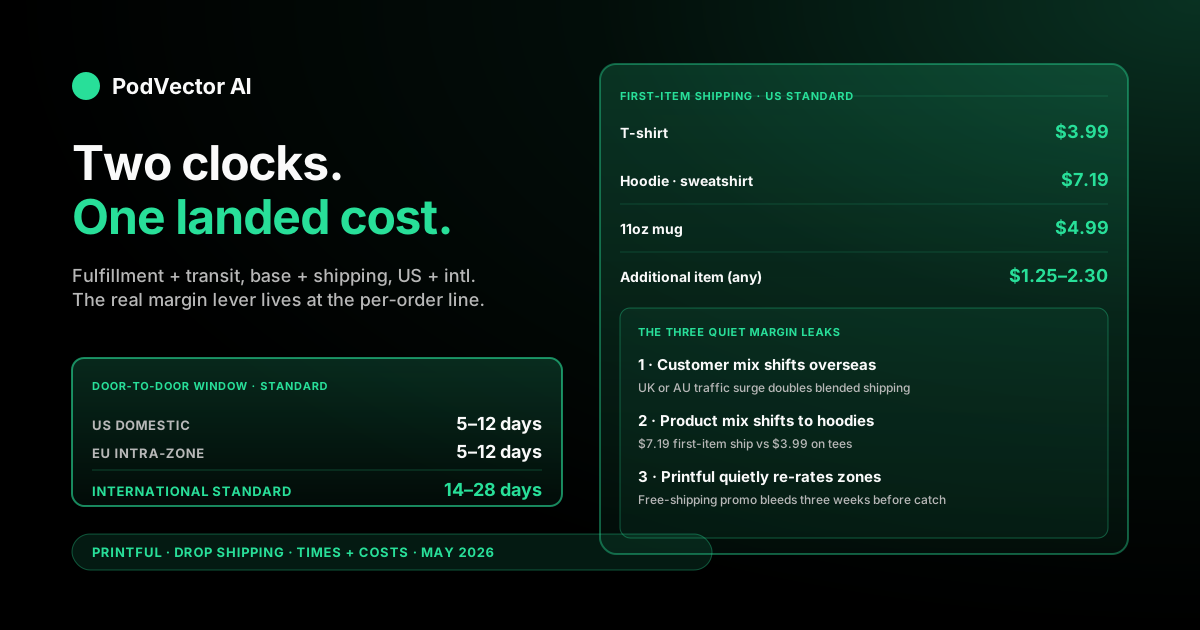
Quick Answer: Printful drop shipping fulfills your orders only after a customer buys — no inventory, no upfront product cost. Total delivery is fulfillment (2–5 business days) plus transit (3–7 days US, 5–20 days international).
Shipping starts at $3.99 for a single US tee and $7.19 for hoodies, with smaller add-on rates for extra items. The real margin lever isn't the headline rate — it's per-order shipping cost across your actual product mix and destination split.
This guide breaks down how Printful's drop shipping actually works, the times and costs to expect by zone, and where the margin leaks live for POD sellers.
How Printful drop shipping actually works
Printful is a print-on-demand (POD) drop shipper. You list products on your store with your designs. When a customer buys, Printful prints the item, packs it, and ships it directly to the customer under your brand.
You never touch inventory. You don't pay for the product until the order is placed. There's no monthly fee on the free tier — you only pay Printful's base cost plus shipping per order.
The flow is six steps:
- Customer places an order on your store at your retail price
- Order syncs to Printful via your integration (Shopify, Etsy, WooCommerce, etc.)
- Printful charges your card on file for base cost + shipping
- Printful routes the order to the closest facility that stocks the product
- Print, pack, ship — typically 2–5 business days of production
- Carrier takes over (USPS, UPS, FedEx, or international partners) for transit
The customer sees one experience: order today, package arrives in a week or two. You see the cost stack: retail minus base cost minus shipping minus fees minus ad spend equals your contribution per unit.
Drop shipping times: fulfillment + transit
Every Printful order has two clocks. Fulfillment (production) is the time from "order received" to "label printed." Transit is from "label printed" to "customer's door."
Fulfillment averages by product category:
- Apparel (DTG t-shirts, sweatshirts): 2–5 business days, 97%+ within 5
- Embroidery (caps, polos, beanies): 5–7 business days
- All-over print apparel: 5–7 business days
- Wall art and posters: 2–4 business days
- Mugs and accessories: 2–5 business days
Transit averages by zone:
- US domestic standard: 3–7 business days
- US express: 1–3 business days
- Canada standard: 4–8 business days
- EU intra-zone standard: 3–7 business days
- UK standard from EU facility: 4–8 business days
- International standard (worldwide): 10–20 business days
- International express: 1–5 business days at premium cost
Add the two together and the realistic door-to-door window for a US customer ordering a tee is 5–12 business days. For overseas standard, 14–28 business days is normal. Set this expectation on your product page or you will get angry support tickets.
US drop shipping costs by product
Printful's US shipping uses a first-item-plus-additional pricing model. The first item in an order pays a base rate; each extra item in the same order pays a lower add-on rate.
| Product | First item (US standard) | Each additional | Express first item |
|---|---|---|---|
| T-shirt | $3.99–$4.69 | $1.85–$2.20 | ~$15.99 |
| Hoodie / sweatshirt | $7.19 | $1.80 | ~$22.99 |
| Embroidered cap | $3.99 | $1.25 | ~$15.99 |
| 11oz ceramic mug | $4.99 | $2.30 | n/a |
| Poster (rolled) | $5.99 | $2.49 | ~$19.99 |
| Tote bag | $3.99 | $1.25 | ~$15.99 |
Numbers move quarterly. Printful does not preannounce shipping-rate changes the same way they do base-cost changes. Cross-check the live rate before you commit to a "free shipping" promotion that ate your margin three weeks ago.
For deeper cost dives on specific zones, see our breakdowns of countries Printful ships to and European t-shirt shipping rates.
International drop shipping costs
International rates scale aggressively. Where a US tee ships for $3.99, the same tee to a UK customer from a US facility runs $10.99+, and to Australia $12+ for a single unit.
The way to keep international margins viable:
- Use Printful's EU facilities (Spain, Latvia) for EU customers — intra-EU shipping is $4.79 first item, often beating US-to-EU by 60%
- Use the Australia facility for Pacific customers when stocking allows
- Bundle products — additional items on the same international order are dramatically cheaper than the first
- Set a minimum cart value for free shipping that actually covers your worst-case international rate
The cheapest international tee combo: customer orders 2-3 items at once, all fulfilled from the closest regional facility. The most expensive: single-item order shipping from US to South America or Asia outside Japan/Australia.
How Printful routes orders to facilities
Printful operates fulfillment centers across the US (multiple), Canada, Mexico, Spain, Latvia, UK, Japan, Brazil, and Australia. Routing happens automatically: each order goes to the closest facility that stocks the requested product.
Two gotchas:
- Not every product is stocked at every facility. A Bella+Canvas 3001 might be available in 8 locations; a specific embroidered polo only in 2. The routing engine picks the closest available facility, which can add a hidden cross-country shipping leg.
- Multi-item orders may split. If you order a tee and a mug in one cart and the closest facility only prints tees, the mug ships separately from a different location. Customers see two tracking numbers and two delivery dates.
You can't override routing manually on standard orders. If routing matters for a specific SKU, check which facilities stock it before launching paid promotions against that product.
Flat rates vs. live shipping rates
Printful gives you two options for how shipping appears to your customer:
Flat rates are Printful's published shipping prices, hardcoded into your store. They don't change based on customer location or order weight. The customer always sees the same shipping line at checkout. Predictable for both sides; risky if your customer mix shifts to higher-cost zones.
Live rates calculate at checkout based on actual destination, weight, and fulfillment center. Available via Printful's Shopify, BigCommerce, and Etsy integrations. The customer pays the actual cost — your margin stays predictable, but conversion can dip when an Australia customer sees $14 shipping instead of $4.99.
Most POD operators with a US-heavy customer mix run flat rates and quietly subsidize the occasional international order. Operators selling globally tend to use live rates plus a clear shipping-policy page setting expectations.
Where drop shipping quietly eats POD margin
Three places per-order shipping cost drifts up without anyone noticing in real time:
- Customer mix shift. A campaign that goes viral in the UK doubles your international shipping average and crushes margin per order, even though base costs and conversion stayed flat.
- Product mix shift. A new hoodie SKU that outsells your tees moves your blended shipping cost up by $2-3 per order.
- Printful rate updates. Quarterly changes that hit specific zones or weight bands. If your store policy is "free shipping over $50" and Printful raises the UK rate, your $50 threshold may now lose money on every UK order.
None of these are visible in the Printful dashboard view. They show up in your accounting once a month, by which point three weeks of revenue is already underwater.
This is the gap PodVector AI built Victor for — an AI employee that sits on top of a unified data warehouse (your Shopify, Printful, and ad-platform data in one place) and answers questions like "how is shipping eating my margin this week?" or "which SKUs went underwater after the last Printful rate change?" against live order data, not month-end spreadsheets. More on Printful operations and the full Printful shipping cluster for related deep-dives.
Peak season: what shifts October–January
From late October through end of December, Printful production times double. Their published 2–5 day fulfillment commonly stretches to 5–8 days. Express transit holds steady, but standard transit can add 1–2 days due to carrier volume.
Practical implications for drop shippers:
- Update your store policy page with peak-season delivery windows by mid-October
- Cut off "guaranteed by Christmas" orders by Printful's published cutoff (usually around Dec 10 for US standard)
- Push customers to express shipping starting early December — the conversion penalty is often offset by avoided refunds
- Plan ad-spend pacing to ramp down by mid-December rather than spending right through the cutoff
The Printful shipping policy breakdown covers exactly what the platform commits to in peak vs. off-peak.
Late and lost orders: what Printful covers
Printful's policy distinguishes two cases:
Production delays beyond their SLA — Printful will reprint or refund the shipping cost when their fulfillment time materially exceeds the published window. You have to file a ticket; it's not automatic.
Carrier delays after handoff — once the carrier scans the package, Printful's responsibility ends. The customer's complaint becomes a USPS/UPS/FedEx tracking issue. You can file a claim, but reimbursement is rare and slow.
Lost packages with no "delivered" scan get reprinted at Printful's expense after a 15-business-day wait. Packages with a "delivered" scan that the customer claims never arrived almost always get refunded by you out of pocket.
Budget 1–2% of revenue as a reship/refund reserve. Operators who don't quietly turn what they think is a 15% margin business into a 13% margin business at year-end.
For membership-tier nuances on production prioritization and discount stacking, see the Printful premium membership benefits breakdown and the broader premium membership cost analysis.
FAQs
How long does Printful drop shipping take?
Total time is fulfillment plus transit. Fulfillment averages 2–5 business days for apparel, 5–7 for embroidery. Transit is 3–7 business days for US standard, 10–20 for international standard. Door-to-door US delivery typically lands in 5–12 business days.
How much does Printful charge for drop shipping?
You pay the base product cost plus shipping per order. No monthly fee on the free tier. US t-shirt shipping starts at $3.99 first item, plus base cost ($13–14 for a Bella+Canvas 3001). Total landed cost on a single US tee is around $17 before any retail markup.
Does Printful charge for shipping or include it?
Printful charges shipping on top of base cost — it is never included. You set your retail price on your store and decide whether to absorb shipping (offer "free shipping") or pass it through to the customer at checkout.
Can I use Printful for Etsy drop shipping?
Yes. The Etsy integration is one of Printful's most reliable. Orders sync automatically, Printful charges your card, prints, ships, and updates Etsy with tracking. Etsy's 6.5% transaction fee plus payment processing comes out of your retail price; factor it into your margin math.
Is Printful drop shipping profitable?
Possible but tight. A $24.99 US tee with $3.99 shipping and a $13.95 base cost leaves about $7 gross before payment processing, store fees, and ad spend. Most sellers end up at $2–5 contribution per unit on first purchase. Profitability lives in repeat purchase, multi-item carts, and AOV expansion.
What's the cheapest Printful shipping option?
Bundling. Adding a second item to the same order costs $1.25–$2.20 in additional shipping versus $3.99–$7.19 for a first item. A two-tee order ships for around $5.99 total. Encourage cross-sells at checkout to dilute your blended shipping cost per unit.
Does Printful drop ship internationally?
Yes, to 100+ countries. International standard shipping runs 10–20 business days transit and costs $7–$15+ for a single tee depending on destination. EU customers should be routed through Printful's Spain or Latvia facility for the cheapest, fastest shipping.
What happens if a Printful drop ship order is late?
Printful reprints or refunds shipping if their fulfillment time exceeds the published SLA. Carrier delays after handoff are not covered — you're on your own to manage customer communication and any refund decision. Budget 1–2% of revenue for reship/refund reserve.
See exactly how Printful shipping is eating your margin this week
Most POD operators check shipping cost at month-end accounting. By then three weeks of orders have already drifted underwater because of a rate change, a customer-mix shift, or a routing surprise.
Victor is an AI employee built for POD sellers. Connect your Shopify, Printful, and ad accounts, then ask plain-English questions: "What did shipping cost me per order in May?" or "Which SKUs went underwater after the last rate update?" Live answers against your real order data.
Try Victor free