
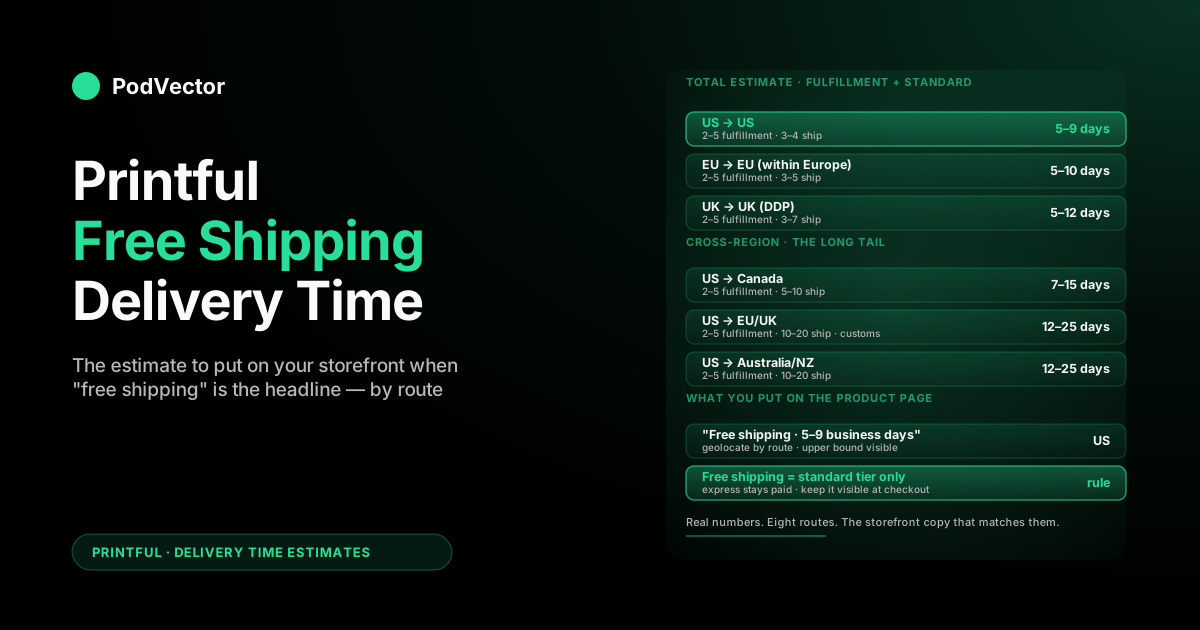
Quick Answer: When you offer free shipping with Printful, the customer rides the standard shipping tier — there is no faster option bundled in. The total estimate you should display on a product page is fulfillment + standard shipping: roughly 5–9 business days for US domestic, 5–10 for the UK or EU within-region, and 7–25 for international cross-region routes.
The number that bites: free shipping locks you out of the 1–3 day express tier, so any customer who needs a fast delivery has to pay for it themselves at checkout — which most won't see until they've added the item to cart. Your job is to set the expectation on the product page, not at checkout.
This guide breaks the actual delivery-time math by product and route, shows what changes the moment you turn free shipping on, and gives you the storefront copy to set expectations without killing conversion.
What "free shipping" does to your delivery estimate
Free shipping in print-on-demand isn't a delivery service — it's a marketing label you apply to the slowest tier Printful offers, the standard rate. Printful itself doesn't run a "free" lane. You absorb the standard shipping fee into your retail price and present the customer with a zero-dollar shipping line at checkout.
The delivery time consequence is the part most sellers ignore. When you offer free shipping universally, you're effectively telling every customer "you get standard, take it or leave it." Express isn't blocked at the platform level — but no customer will pay for express on top of a "free shipping" listing unless your checkout flow surfaces it cleanly.
The total delivery-time estimate is the sum of two phases. Fulfillment runs 2–5 business days (printing, quality check, packing). Shipping runs another 1–25 business days depending on tier and route. Free shipping sets the second number to the slow end of that range.
For the cost side of the same decision, see Printful free shipping: full breakdown for POD sellers.
Delivery time estimates by route and product
The number that goes on your storefront is the total — fulfillment + shipping combined. Below is what to quote for free-shipping orders (which always ride the standard tier) by destination zone and product category.
All numbers are in business days. Fulfillment assumes 2–5 business days for apparel and 3–7 for non-apparel (mugs, posters, phone cases). The shipping leg below is added on top.
| Route | Standard shipping leg | Total estimate (apparel) | Total estimate (mugs/posters) |
|---|---|---|---|
| US → US | 3–4 days | 5–9 days | 6–11 days |
| Canada → Canada (DDP) | 3–5 days | 5–10 days | 6–12 days |
| EU → EU (within Europe) | 3–5 days | 5–10 days | 6–12 days |
| UK → UK (DDP) | 3–7 days | 5–12 days | 6–14 days |
| US → Canada | 5–10 days | 7–15 days | 8–17 days |
| US → EU/UK | 10–20 days | 12–25 days | 13–27 days |
| US → Australia/NZ | 10–20 days | 12–25 days | 13–27 days |
| EU → US | 10–20 days | 12–25 days | 13–27 days |
A few notes on the routing. Printful runs fulfillment centers in the US, Canada, Mexico, Latvia (EU), Spain (EU), the UK, and Australia. Printful's auto-routing picks the closest center to the customer that can produce the SKU. Same-region orders almost always stay short. Cross-region orders are the long tail.
For heavy items (hoodies, sweatshirts) on cross-region routes, add another 1–2 days to the upper bound — they pack heavier and sometimes ship via a different carrier service that runs slower than the apparel default.
How Printful calculates the estimate
Printful's quoted delivery estimate is a sum of two calculations, not a single guarantee. Understanding the two parts is what separates a seller who sets accurate expectations from one who eats refund requests.
Phase 1: fulfillment
Fulfillment is the time from "Printful receives the order" to "Printful hands the package to the carrier." This phase is 2–5 business days for most apparel SKUs, longer for products that require more handling.
The variability inside that window depends on the SKU's print method (DTG t-shirts ship faster than embroidered hoodies), the fulfillment center's current queue, and whether the order contains a flagged design that needs manual quality review. Printful publishes a "fulfillment time" metric on their status dashboard that hovers around 2.5–3 days on a normal week and stretches to 4–5 days during seasonal peaks (Q4, especially the week after Cyber Monday).
Fulfillment time is the same whether you offered free shipping or paid express. The customer who paid for express still waits the full fulfillment cycle before the carrier ever sees the package.
Phase 2: shipping (carrier transit)
This is where free shipping affects the timeline. Standard shipping uses ground or economy carrier services (USPS Ground Advantage, Royal Mail Tracked, Australia Post regular). Express uses air services with carrier guarantees (UPS, DHL Express, FedEx).
Standard is the default for free shipping. Express adds 5–15 USD per order depending on route and product weight — which is the line you're hiding from customers when you "offer free shipping."
Printful's quoted estimate on the product page or in their API is a calculated average across recent historical performance for the route, plus a safety buffer. The result isn't a guarantee. The Printful help center is explicit on this: "estimated delivery time is not a guarantee," and the company doesn't refund late orders unless they miss the upper bound by a wide margin.
What changes when you switch from paid to free shipping
The mechanical change is one line in your shipping settings. The downstream changes are bigger than most sellers realize.
Tier defaults shift. With paid shipping enabled, Printful's integration with Shopify or Etsy displays both standard and express rates at checkout. The customer picks. With "free shipping" enabled, the integration suppresses the paid rates by default — express becomes invisible unless you manually add it back as a paid option alongside the free one.
This is the biggest unintended consequence. Customers who would have paid for express to get a gift in time now see only "free shipping, 5–9 business days" and either accept the slower delivery or bounce. You can recover this by keeping the express tier visible at the paid rate, even when free shipping is the headline offer.
Customer expectations widen, not narrow. Paid shipping shows the customer a precise rate and a precise window. Free shipping shows them "Free" and a range — which mentally translates to "the slow option." Customers who buy expecting fast delivery and don't read the estimate are the customers who file "where is my order?" tickets on day 6.
Order volume on slower routes goes up. If you offered paid international before, international customers self-selected by accepting the shipping price. Switch to free international shipping (rare, but it happens) and you'll see international order volume spike — along with the long-tail delivery complaints from those routes.
Your support load shifts. Free shipping doesn't increase the absolute count of late orders, but it changes which orders the customer flags as "too late." A customer who paid $9.99 for express and the order arrived day 8 is annoyed. A customer who paid nothing and the order arrived day 12 may be fine — unless your storefront promised "5–7 days." The storefront copy is now the bottleneck, not the carrier.
Setting customer expectations on your storefront
The most common margin leak from free shipping isn't the absorbed cost — it's refunds and chargebacks triggered by misset delivery expectations. The fix is in two places.
The product page line
Every product page should show a delivery estimate above the fold, in the same visual weight as the price. The estimate should reflect fulfillment + standard shipping for the customer's country, with the upper bound visible.
Recommended phrasing:
- US store, US customers: "Free shipping. Arrives in 5–9 business days."
- US store, EU customer: "Free shipping. Arrives in 12–25 business days."
- Mixed apparel + mugs cart: Use the longer estimate. Mugs ship separately and almost always arrive after apparel from the same order.
Geolocate the customer's country and surface the correct estimate by route. Most Shopify themes can do this with a simple liquid block; Etsy's listing description has to use the global "ships from" plus a route table. Don't quote "5–9 days" to a customer in Sydney.
The cart/checkout line
The checkout shipping summary should restate the estimate the customer saw on the product page. If you offer express as a paid upgrade, label it clearly:
- "Free standard shipping — arrives by [date upper bound]"
- "Express upgrade $9.99 — arrives by [date upper bound — 5 days]"
Showing the upgrade as a side-by-side line lets customers self-select fast delivery when they need it, which is the lost-revenue scenario most free-shipping stores never recover.
The order confirmation email
The confirmation should restate the delivery window one more time, with the explicit business-day calendar date (not "5–9 business days" — show "estimated delivery: May 23–May 27"). This is the artifact customers refer back to when they file the "where is my order?" ticket.
If you can wire the order confirmation to pull the live Printful estimate via API at the moment of order creation, do it. Static "5–9 business days" boilerplate is the cause of most expectation mismatches.
Why free-shipping orders run late (and what to do)
The five most common causes of late free-shipping orders, in order of frequency:
- Cross-region routing. The SKU isn't produced at the fulfillment center closest to the customer, so Printful routes from a further center. Common example: a customer in Texas ordering a less-common embroidered hat that only the Latvia center produces. Add 7–10 days to the estimate. Fix: filter your catalog to SKUs producible at your primary fulfillment center, or accept the longer estimate and disclose it.
- Customs delay on international orders. US-to-EU orders without DDP (delivered duty paid) routing can sit in customs for 5–15 days. Fix: route EU orders to Printful's EU fulfillment centers wherever possible, or use DDP-enabled carrier services.
- Carrier handoff loss. Standard shipping uses lower-priority carrier services that occasionally lose scans for 24–72 hours. The package isn't actually lost — the carrier tracking just doesn't update. Fix: coach support to wait 72 hours past a no-update tracking event before treating it as lost.
- Q4 fulfillment queue. Late November through mid-December, Printful's fulfillment time stretches from 2–3 days to 4–5 days. Your standard estimates need to widen by 2 business days during this window. Fix: swap your storefront delivery copy to a Q4 estimate from Nov 15 to Jan 5.
- Address quality issues. Apartment numbers missing, ZIP+4 mismatches, or autocomplete-truncated addresses get the package returned to fulfillment and re-routed. Fix: enable Shopify's address validation app or its built-in address verification at checkout — and route Etsy address issues through your support flow before they hit Printful.
The structural pattern: late orders cluster on specific routes (cross-region, international, Q4 windows). Your storefront delivery copy needs to widen for those clusters specifically, not flatten across all customers.
International free shipping: the delivery-time trap
Free shipping on international routes is the most common source of customer-experience damage in POD. The customer pays nothing, the seller absorbs a $7–$15 shipping cost, and the package arrives 12–25 business days later — five times longer than the customer mentally expected.
Three options for handling international with free shipping:
Route to a regional fulfillment center. Printful's EU, UK, and Australia centers can produce most of the apparel catalog. If your store has meaningful EU volume, switch to EU-fulfilled production — the delivery estimate drops from 12–25 days to 5–10 days, and the absorbed shipping cost drops from $7–$15 to €5–€7. This is the highest-leverage change and the one most US-based POD sellers don't make because the catalog mapping is a 90-minute setup.
Restrict free shipping to domestic. Offer free US-to-US shipping and paid shipping for everything else. Most international customers don't notice — international ecommerce buyers expect shipping fees on cross-region orders. You preserve the marketing benefit where it converts (US) and avoid the margin-and-delivery damage where it kills you (international).
Disclose the long estimate. If you do offer global free shipping, the international product-page copy needs to say "Free shipping. Arrives in 12–25 business days for international orders." The conversion hit is real — you'll lose some carts to the slow estimate — but the support-ticket avoidance and the chargeback prevention more than offset it.
For the broader Printful vs. Printify decision that affects your fulfillment routing, see Printful or Printify: the POD seller's guide and the Printful Printify merger: the POD seller's guide.
Tracking real delivery performance per route
One Printful storefront with 5 SKUs and 95% US orders is easy. Thirty SKUs across multiple categories, multiple fulfillment centers, and a mix of free and paid shipping is a tracking problem most operators never solve.
The structural issue: Printful gives you a per-order tracking URL and a per-order estimated delivery date. Reconciling actual delivery date against estimate, by route and by SKU, is a manual export-and-merge exercise. Most stores never do it, which is why "we're hitting our delivery estimates" is a belief, not a measurement.
Two ways to track it.
Manual: Once per month, pull Printful's order export (with shipping carrier, ship date, estimated delivery date). Pull Shopify's order data (with customer country). Pull carrier tracking final-delivered timestamps. Match by order ID. Compute the delta — actual vs. estimate, by route. Flag any route where >20% of orders missed the estimate. The first month takes 90 minutes; subsequent months take 30. Most sellers do it once and stop.
Automated: Pipe Printful's fulfillment timestamps, carrier tracking, and customer routing into a single data layer. Set alerts when the rolling 30-day on-time rate on a specific route drops below your threshold. Same infrastructure as cost tracking — your warehouse (Snowflake, Redshift, or equivalent) holds the data and your dashboard or agent watches it.
PodVector AI's Victor is the employee capability of the second option for POD sellers. Victor pulls per-order Printful fulfillment and shipping data via webhooks into a live data warehouse, watches the on-time rate by route, and surfaces when a route's delivery performance drifts — for example, "your US→AU route's on-time rate dropped from 91% to 73% over the last 30 days, and 8 of the 12 late orders were embroidered hats from the Latvia center." When Victor finds a routing problem that can be fixed in Shopify (a shipping rate adjustment, a country exclusion, a free-shipping threshold change), he proposes the specific change and executes it on your approval — with the audit trail intact. The combination is: POD playbook in the agent, live data from your store, and the ability to act on it.
For the underlying cost math that interacts with delivery decisions, see Printful free shipping delivery time estimate: full breakdown and Printful free shipping over $500: full breakdown. For the cluster overview, see the Printful costs and charges hub; for the topic overview, see the Printful topic hub.
FAQs
How long does free shipping take with Printful?
5–9 business days for US-to-US orders, 5–10 days for within-EU and within-UK, and 12–25 business days for international cross-region routes. The estimate is fulfillment (2–5 business days) plus standard shipping (3–20 days depending on route).
Is Printful free shipping slower than paid shipping?
Free shipping uses the standard tier, which is the slower of Printful's two shipping options. Express adds $5–$15 per order and cuts shipping time to 1–3 business days after fulfillment. Express is still available to customers who pay for it — but only if your storefront surfaces the upgrade at checkout.
What delivery estimate should I put on my product page?
Show the total (fulfillment + standard shipping) for the customer's country. For US stores selling US customers, "Arrives in 5–9 business days" is the right line. For EU customers ordered from US fulfillment, "12–25 business days." Geolocate the customer and surface the correct estimate by route.
Does Printful guarantee delivery times?
No. Printful's published delivery estimate is calculated from historical route performance plus a buffer, and it is explicitly not a guarantee. Late orders are refundable only when they miss the upper bound by a meaningful margin — typically when carrier tracking goes silent for 7+ days past the upper estimate.
Can I offer express shipping alongside free shipping?
Yes, and you should. Keep express as a paid upgrade at checkout even when free shipping is the headline offer on product pages. Customers who need a delivery before a specific date will pay for express — but only if it's visible. Most "free shipping" integrations hide express by default; you have to manually expose it.
How do I handle delivery delays on free-shipping international orders?
Three tactics. First, route EU and UK orders to Printful's regional fulfillment centers — the delivery estimate drops from 12–25 days to 5–10. Second, set the storefront copy to disclose the upper bound for international orders, so the customer's expectation aligns with reality. Third, train support to acknowledge late international orders by day 15 with a proactive update, not a refund — most customers wait if they hear from you.
Why are some orders from the same Printful storefront slower than others?
Routing. Printful auto-routes each order to the fulfillment center closest to the customer that produces the SKU. If a customer orders a SKU that isn't produced at your primary center, the order routes from a further center — adding 7–10 days to the standard estimate. Filter your catalog to SKUs producible at your primary fulfillment center, or disclose the slower estimate on the affected listings.
Does the Q4 holiday season affect free-shipping delivery times?
Yes — significantly. From mid-November through mid-December, Printful's fulfillment time stretches from 2–3 days to 4–5 days, and carrier networks slow under volume. Widen your storefront delivery copy by 2 business days from Nov 15 to Jan 5 and surface a "order by [date]" cutoff for guaranteed pre-Christmas delivery. The cutoff is typically Dec 10 for US standard, Dec 1 for international.
Want to know if your delivery estimates actually match reality?
Most POD sellers set delivery copy once at launch and never check whether their storefront promise matches the carrier outcome. Victor reads your Printful order data live, tracks on-time rate by route, and flags when a route drifts off its estimate — then proposes the Shopify fix (routing change, threshold adjustment, country exclusion) and executes it on your approval. Stop guessing whether your shipping copy is correct. And find out before the next "where is my order?" ticket lands.
Reference: Printful's official shipping speeds and rates are at printful.com/shipping.
Try Victor free