
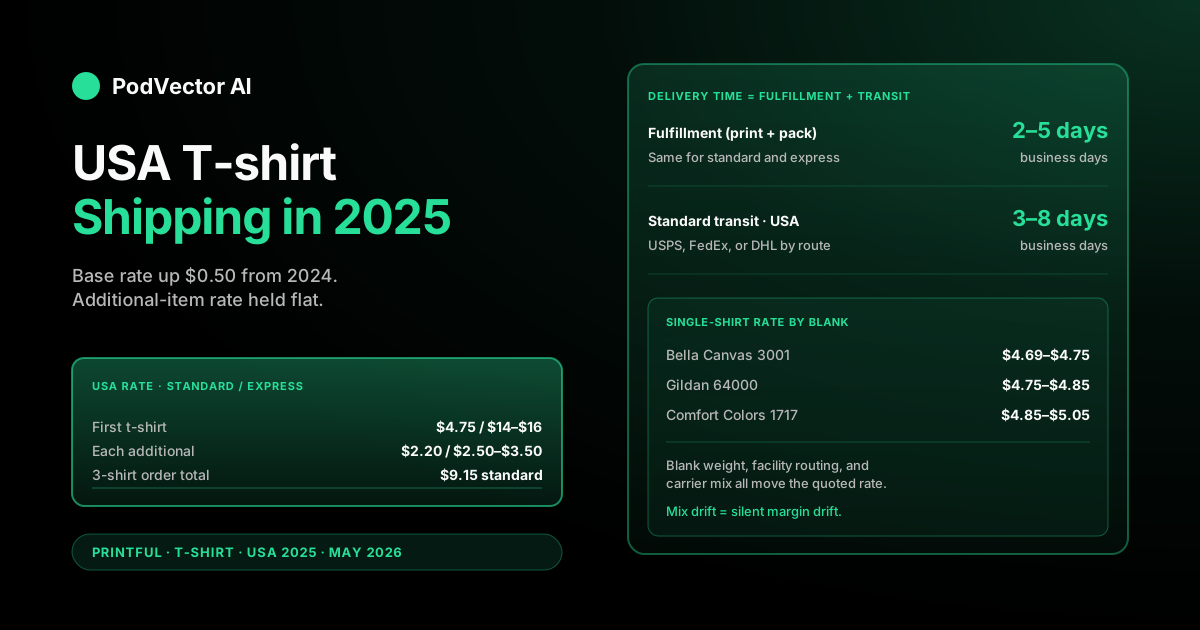
Quick Answer: In 2025 Printful charges $4.69–$4.75 to ship a single t-shirt to a US address, then $2.20 for each additional shirt in the same fulfillment bucket. Express runs roughly $14–$16 for the same one-shirt order. The exact number varies slightly by blank and facility, which is why the rate card shows a range, not a single price.
Total delivery time is fulfillment (2–5 business days to print and pack) plus carrier transit (3–8 business days standard, 1–3 express). A typical US t-shirt order placed Monday arrives by the following Friday to Wednesday — call it 7–13 calendar days end to end.
For POD sellers, the operational number is not the rate itself but the blended shipping cost across an order mix. Single-shirt vs multi-shirt orders, Bella Canvas vs Gildan blanks, and quiet rate updates between quarters all move that blended cost. The rate card is the input. Tracking the per-order impact is the work.
The 2025 USA t-shirt rate card
Printful charges shipping as a flat rate per region and product category. For t-shirts shipped within the USA in 2025, the published rates are:
- Single t-shirt, standard: $4.69–$4.75
- Each additional t-shirt, same order, same bucket: $2.20
- Single t-shirt, express: $14–$16
- Each additional t-shirt, express, same order: $2.50–$3.50
The single-shirt rate sits in a narrow band because Printful runs multiple US fulfillment facilities and the routing engine picks the closest one to the customer. A Charlotte-printed order to a Florida address quotes slightly differently from a Los Angeles-printed order to a California address.
The additional-item rate is flat at $2.20 in 2025 across the standard t-shirt catalog. Print costs more, blank costs more, but the second-shirt shipping does not.
For a deeper look at the underlying rate model across products and regions, see our Printful shipping rates breakdown. The Printful shipping speeds and pricing page publishes the live rate card if you need to spot-check a specific blank.
Why the rate is a range, not a single number
Three reasons the published rate for a "single US t-shirt" lands as a range rather than one fixed number.
Blank weight differs. A Bella Canvas 3001 weighs less than a Gildan 18000 hoodie-weight tee. Printful rolls weight into the rate calculation, so a heavier blank quotes slightly higher even within the t-shirt category.
Facility routing. Printful operates US facilities in Charlotte, NC; Los Angeles; and a handful of partner sites. Routing picks the cheapest valid facility for a given destination. A Texas customer might print in Charlotte one week and Los Angeles the next, depending on facility load.
Carrier mix. Printful uses a combination of USPS, FedEx, and DHL for US delivery. The carrier is picked at fulfillment time based on cost and reliability. Carrier price differences of a few cents propagate to the customer-facing rate.
None of this is something you configure. Printful's algorithm picks the cheapest route. The result is the customer sees a rate within a few cents of $4.75, which is close enough that it doesn't break checkout pricing but wide enough that your invoice-vs-checkout reconciliation will show small variances.
Additional-item math and multi-shirt orders
The additional-item rate matters more than the base rate for stores that bundle. The rule: each distinct shipping bucket in an order pays the first-item rate once, then $2.20 per additional shirt in the same bucket.
A bucket is defined by which fulfillment facility prints the item. Two Bella Canvas 3001 shirts printed at the same facility share a bucket. A Bella Canvas 3001 and a Gildan 64000 may or may not share a bucket — it depends on whether both blanks are stocked at the same facility.
Worked example: a customer in Florida buys 3 Bella Canvas 3001 t-shirts in the same design, sized S, M, L.
- Shirt 1: $4.75 (base)
- Shirt 2: $2.20 (additional, same bucket)
- Shirt 3: $2.20 (additional, same bucket)
- Total shipping: $9.15
Multi-shirt orders are the highest-margin shipping configuration. The customer pays roughly $3.05 per shirt in shipping ($9.15 ÷ 3) instead of $4.75, and you don't eat any of the difference under live rates. If your product page nudges multi-shirt purchases ("3 for $X bundle," "second tee 15% off"), you move per-shipping economics in your favor.
What breaks this math: a mixed-bucket order. If the customer adds a mug or a hoodie to the cart, the mug or hoodie typically prints at a different facility, pays its own base rate, and the t-shirts keep their own first-item charge. You can't combine across categories.
For a deeper walk-through of the same blank under 2024 pricing, our 2024 USA t-shirt rate breakdown shows the year-over-year shift. For the plural-tee variant of this article — multi-shirt design patterns — see our Printful shipping rates t-shirts USA 2025 breakdown.
Express shipping: when the premium earns its keep
Express on a single t-shirt to a US address costs about $14–$16. That's a $9–$11 premium over standard's $4.75. The premium cuts transit from 3–8 business days down to 1–3.
The premium does not change fulfillment time. Printful still needs 2–5 business days to print and pack the order. Express is a transit-leg-only upgrade.
Three scenarios where express usually earns its keep:
- Gift orders. Birthday, anniversary, wedding tees with a known delivery date. The customer happily pays the premium to hit the date.
- High-AOV stores. $60+ average order value where the $10 express premium is a 15% bump on an already-large order. Conversion barely moves.
- Holiday cutoff windows. Late November and December, where the customer would otherwise abandon to a faster competitor.
One scenario where express usually doesn't earn its keep: typical $20–$25 AOV single-tee stores. The premium is 40–50% of the product price. Customers see "express shipping +$11" and convert worse, not better. Some pick it and then complain about the 2–5 day fulfillment leg — they expected a Tuesday delivery and got Friday because they didn't read fulfillment vs transit.
If you offer express, set the post-purchase email with a clear "fulfillment 2–5 days, then express transit 1–3 days" sentence. Kills the worst of the WISMO tickets.
Delivery times: fulfillment plus transit
Total delivery time is fulfillment plus transit. Two legs, two timers, and confusing them is the most common reason for support tickets.
Fulfillment is the print-and-pack leg inside Printful. For US t-shirts in 2025 it averages 2–5 business days. Peak season (November–December) stretches this to 5–10 business days. Off-peak it often runs at the low end — many orders fulfill in 2–3 days.
Standard transit for US destinations is 3–8 business days. Local-to-facility destinations (Charlotte-printed orders to NC, SC, GA, VA) often land in 3–5 days. Cross-country destinations (LA-printed to NY) land in 6–8 days.
Express transit for US destinations is 1–3 business days. The fastest combination — 2-day fulfillment plus 1-day express — gets a US t-shirt to the customer in 3 business days. The slowest — 5-day fulfillment plus 3-day express — takes 8 business days.
End-to-end timeline for a typical US t-shirt order placed on Monday with standard shipping: fulfillment ships out by the following Friday, transit delivers by the Friday after — call it 10 business days, or 12–14 calendar days. Set that expectation on your product page and your "where's my order" volume drops 60–80%.
What changed from 2024 to 2025
Three concrete changes to US t-shirt shipping between 2024 and 2025.
Base rate moved up ~$0.50. The single-shirt USA rate sat at $3.99–$4.49 through most of 2024. It moved to $4.69–$4.75 in 2025. This tracks the carrier rate increases USPS and FedEx pushed at the start of 2025.
Additional-item rate held flat. $2.20 in 2024, $2.20 in 2025. Multi-shirt bundles get more efficient relative to single-shirt orders as the base rate climbs while the additional rate stays.
Express premium widened slightly. 2024 express was $12–$14 over a $4 standard for a $16–$18 total. 2025 express is $9–$11 over a $4.75 standard for a $14–$16 total. The premium shrunk relative to the standard rate, but the absolute express price is roughly flat.
If you set retail prices last year and haven't touched them, your single-shirt shipping cost is up ~$0.50 against a flat retail price. On a $25 tee with $4.00 product cost and a $4.00 effective margin, an extra $0.50 of shipping cost cuts your per-order profit by 12.5% — and most operators don't notice the shift until the quarterly P&L review.
The fix is not a rate-card audit. It's tracking shipping cost per order against revenue per order, week over week, so the drift surfaces in week one rather than quarter four.
Flat rates vs live rates at checkout
Two ways to charge the customer for shipping, both common in POD.
Flat rates mean you set a single shipping price per zone (typically $4.99 or $5.99 for US) and absorb any variance between what you charge and what Printful actually bills you. Easier to configure. Predictable for the customer. You eat the variance.
Live rates pull Printful's actual quote into the checkout in real time. The customer pays the same rate Printful charges you — $4.75 if Printful quotes $4.75. No spread, no markup, no shortfall.
For a 2025 USA-only t-shirt store, the choice is mostly cosmetic. The rate card is tight, the variance is small, and either approach lands within a few cents of the same number. For multi-product or international stores, live rates are the operational default.
One non-obvious advantage of flat rates for US-only single-product stores: you can mark up shipping to $5.99 and pocket the $1.20 spread per order. At 1,000 orders a month that's $1,200/month of additional revenue. Customers don't usually compare flat-rate shipping numbers across POD competitors — they just see "shipping $5.99" and accept.
The risk: undercollecting if your blended shipping cost shifts. A heavy hoodie sale week pushes your real cost above $5.99 and you start losing money on the shipping line. That's the kind of drift only continuous tracking catches.
How rates differ by blank: Bella Canvas, Gildan, Comfort Colors
The "t-shirt" category in Printful's rate card hides per-blank variation. Three of the most-printed blanks in 2025 and their typical US single-shirt rates:
- Bella Canvas 3001 (4.2 oz cotton): $4.69–$4.75 single. The lightest and cheapest-to-ship of the popular blanks.
- Gildan 64000 (5.0 oz cotton): $4.75–$4.85 single. A few cents more than Bella Canvas due to weight.
- Comfort Colors 1717 (6.1 oz cotton): $4.85–$5.05 single. The heaviest of the three; the rate reflects it.
Differences look small per shirt. They compound. A store running 60% Comfort Colors at $4.95 average shipping pays $0.20 more per order than the same store on 60% Bella Canvas at $4.75 average shipping. At 1,000 orders/month that's $200/month, or $2,400/year of shipping cost that didn't exist in the spreadsheet.
If your store mix has drifted toward heavier blanks (which often happens when "vintage feel" Comfort Colors becomes the new bestseller), your blended shipping cost moved without anyone updating the model. The Bella Canvas teardown lives in our Bella Canvas 3001 shipping time breakdown if you want the per-blank shipping detail.
The margin math: shipping as a percent of order value
For a US t-shirt store, shipping is one of the top three line items in your P&L. Product cost, ad cost, shipping cost — in that order for most operators. Each is roughly the same percent of revenue.
A typical 2025 breakdown on a single-tee $25 order to a US address:
- Revenue: $25.00 (product) + $4.75 (shipping pass-through) = $29.75
- Product cost (Bella Canvas + print): $8.50
- Shipping cost to Printful: $4.75
- Ad cost (typical $5–$8 per order): $6.00
- Gross margin: $10.50, or 35% of revenue
Shipping is 16% of revenue on this order. A $0.50 rate increase against a flat retail price drops gross margin by ~$0.50 on the same order — and 35% margin becomes 33%. That kind of move is invisible in a monthly P&L review unless you're watching per-order gross margin as it happens.
The same model applied to a 3-shirt order ($75 product) with $9.15 shipping cost:
- Revenue: $75 + $9.15 = $84.15
- Product cost (3 shirts): $25.50
- Shipping cost: $9.15
- Ad cost (one acquisition, same as single order): $6.00
- Gross margin: $43.50, or 52% of revenue
Three-shirt orders are 50% better margin than single-shirt orders, mostly because shipping and ad spend amortize across more units. If you don't know what percent of your orders are multi-shirt vs single-shirt, you don't know what your blended margin is — and the multi-shirt ratio drifts every time you change your product page or your promo strategy.
For broader cost framing across the catalog, see our Printful mug cost breakdown and the no-upfront-cost POD model walk-through. The cluster index at /articles/printful/shipping covers every shipping topic in depth. The full Printful topic hub indexes pricing, products, integrations, and fulfillment behavior across the catalog.
FAQs
How much does Printful charge to ship a t-shirt in the USA in 2025?
$4.69–$4.75 for a single shirt, standard shipping. Each additional shirt in the same order and same fulfillment bucket adds $2.20. Express is $14–$16 single, with a smaller per-additional premium.
How long does Printful take to ship a t-shirt in the USA?
Total time is fulfillment (2–5 business days) plus transit (3–8 business days standard, 1–3 express). A typical US t-shirt order placed Monday lands the following Wednesday to Friday on the late end. Peak season (Nov–Dec) extends fulfillment to 5–10 business days.
Why is my Printful shipping rate slightly different from the published $4.75?
Three reasons: the specific blank's weight (Comfort Colors is heavier than Bella Canvas), the facility that printed your order, and the carrier picked at fulfillment time. The variance is usually within 10–30 cents of the published rate.
Did Printful raise USA t-shirt shipping rates in 2025?
Yes. The single-shirt base rate moved from $3.99–$4.49 in 2024 to $4.69–$4.75 in 2025. The additional-item rate held flat at $2.20. Express premiums shrunk slightly in absolute terms but the total express price stayed flat.
What's the most efficient Printful order configuration for shipping cost?
Multi-shirt orders in a single design or single facility. A 3-shirt order pays roughly $3.05 per shirt in shipping (vs $4.75 for a single-shirt order). The base rate amortizes across the additional items, which all pay just $2.20.
Does Printful offer free USA shipping on t-shirts?
Not by default. Some stores configure customer-facing free shipping above an order threshold by absorbing the shipping cost into the retail price. Printful itself charges the seller for every shipment.
What's the shipping cost for a multi-color or multi-size t-shirt order?
Same as any multi-shirt order in the same fulfillment bucket: $4.75 first shirt, $2.20 each additional. Size and color don't change the rate. Five shirts in five different sizes still costs $4.75 + 4 × $2.20 = $13.55.
Does Printful charge sales tax on shipping in the USA?
Yes, in states where sales tax applies to shipping charges (varies by state). The Printful integration with WooCommerce, Shopify, and other platforms handles the tax application automatically based on the destination address.
Can I mark up Printful's t-shirt shipping rates and charge customers more?
Yes, if you use flat-rate shipping in your store rather than live rates. You set the price the customer pays; Printful charges you separately for the actual shipping. The spread is yours. Live rates pass the exact rate through with no markup possible.
Why does Printful's express shipping say 1–3 days but my order took longer?
Express is the transit leg only. Fulfillment still takes 2–5 business days. Total time on an express order is 3–8 business days end to end. The "1–3 days" number in the checkout estimate refers to the carrier leg, not order-to-doorstep.
Your rate card is one input. Your margin is the answer.
The 2025 USA t-shirt rate of $4.75 tells you what one order costs. It doesn't tell you what your blended shipping cost was last month, what percent of your orders were multi-shirt, or which SKU mix shifts dropped your margin without anyone noticing.
Victor connects to your Printful account and your store, pulls every itemized shipping line into your data warehouse, and answers questions like "what's my shipping cost per order this week vs. last quarter?" in plain English. It's an AI employee that reads your live numbers — no spreadsheet, no quarterly P&L surprise.
Try Victor free