
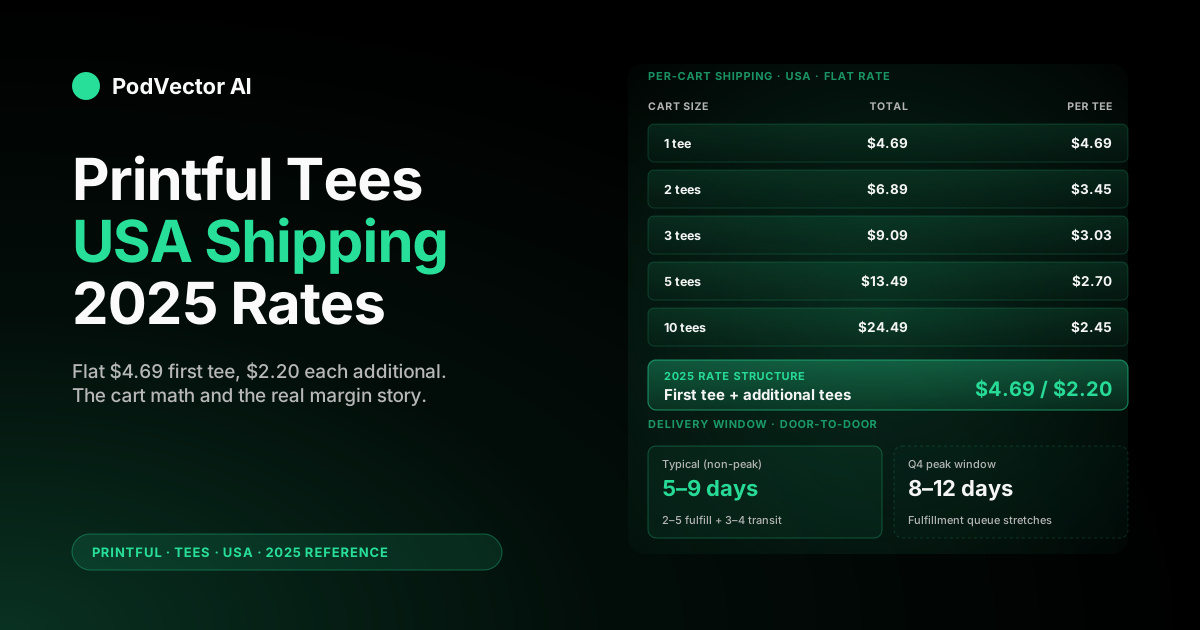
Quick Answer: In 2025, Printful charges $4.69 for the first t-shirt shipped to a US address and $2.20 for each additional t-shirt in the same order. Door-to-door delivery is typically 5–9 business days (2–5 fulfillment + 3–4 transit).
A 1-tee order costs $4.69 in shipping. A 3-tee cart costs $9.09. A 5-tee bulk order costs $13.49. Multi-tee carts scale linearly — Printful does not pool shipping for free.
This guide is the 2025 reference: every tee rate by cart size, the multi-product cart math, fulfillment windows, and the margin math most operators miss.
2025 Printful t-shirt rates for the USA
The 2025 Printful USA t-shirt shipping rate is $4.69 for the first tee and $2.20 for every additional tee in the same order. The rate is flat regardless of which Printful facility fulfills the order — Charlotte, Dallas, Los Angeles, or any other US center.
"T-shirts" in this context covers the most common cotton blanks Printful stocks: Bella+Canvas 3001 unisex tees, Gildan 5000 heavy cotton, Gildan 64000 Softstyle, Gildan 980 lightweight, Champion T425 Heritage, and Stanley/Stella organic tees. Tank tops, long-sleeves, and most apparel-category tees use the same rate structure.
Where the rate diverges: heavier garments (hoodies, zip-ups, sweatshirts) carry a higher first-item rate of $4.99 to $5.69, and accessories like mugs and posters have their own rate structures. We'll cover the mixed-cart math below.
Cart-size lookup: 1 to 10 tees
Multi-tee carts scale linearly. Here's the exact shipping cost for the most common bulk-cart sizes:
| Tees in cart | Math | Total shipping | Per-tee shipping |
|---|---|---|---|
| 1 | $4.69 | $4.69 | $4.69 |
| 2 | $4.69 + $2.20 | $6.89 | $3.45 |
| 3 | $4.69 + ($2.20 × 2) | $9.09 | $3.03 |
| 4 | $4.69 + ($2.20 × 3) | $11.29 | $2.82 |
| 5 | $4.69 + ($2.20 × 4) | $13.49 | $2.70 |
| 6 | $4.69 + ($2.20 × 5) | $15.69 | $2.62 |
| 8 | $4.69 + ($2.20 × 7) | $20.09 | $2.51 |
| 10 | $4.69 + ($2.20 × 9) | $24.49 | $2.45 |
The per-tee shipping figure drops as cart size grows — from $4.69 on a single-tee order to $2.45 on a 10-tee cart. That curve is the basis of every cart-incentive decision your store should be making.
The biggest jump in efficiency happens between cart-size 1 and cart-size 2. Going from one tee to two cuts per-tee shipping by 27%. Going from two to three cuts another 12%. After cart-size 5, the marginal improvement is single-digit percentage points.
Delivery times: fulfillment plus transit
Door-to-door delivery time on a US t-shirt order is two numbers stacked: fulfillment time plus transit time.
Fulfillment is the time from order placement to label-scan. For 2025, Printful's published fulfillment window on apparel is 2–5 business days, with most US tee orders hitting 2–3 business days outside of Q4 peak.
Transit is the time from label-scan to customer doorstep. Standard ground shipping on a US tee lands in 3–4 business days for most addresses. Coast-to-coast routes (LA to NY) trend toward 4 days; regional routes (Charlotte to anywhere in the Southeast) trend toward 2.
The combined 2025 expectation for a US t-shirt order:
- Best case: 4 business days (fast fulfillment + regional shipping)
- Typical: 5–7 business days
- Q4 / peak: 8–12 business days (fulfillment queue stretches)
- Worst case: 15+ business days (lost packages, address corrections, holiday backlog)
For volume t-shirt sellers, fulfillment time is the lever to watch — not transit. Carrier transit is relatively stable; fulfillment can blow out by 3–5 business days during Q4 or after major holidays. That's where Printful's owned-facility model usually wins over contracted POD networks: the fulfillment window stays tighter under load.
How Printful charges per-product, not per-cart
Printful's shipping rate is calculated per-product line, not per-cart line. This is the most common source of pricing-math confusion.
Every product in Printful's catalog has a first-item rate and an additional-item rate. When an order comes in, Printful identifies the product with the highest first-item rate in the cart, charges that as the cart's first-item charge, and then charges every other unit at its product-specific additional-item rate.
For an all-tees cart, this means the math is simple: $4.69 for the first tee, $2.20 for every other tee. For a mixed cart, the math gets more involved — covered in the next section.
Mixed-cart math (tee + hoodie + mug)
Mixed carts use the highest-priced first-item rate as the anchor. Hoodies have a $4.99 first-item US rate and a $2.20 additional-item rate. Mugs have a $4.99 first-item and a $2.49 additional-item rate.
Common mixed-cart examples:
| Cart | Anchor item | Math | Total shipping |
|---|---|---|---|
| 1 tee + 1 hoodie | Hoodie ($4.99) | $4.99 + $2.20 | $7.19 |
| 2 tees + 1 hoodie | Hoodie ($4.99) | $4.99 + ($2.20 × 2) | $9.39 |
| 1 tee + 1 mug | Mug ($4.99) | $4.99 + $2.20 | $7.19 |
| 1 tee + 2 mugs | Mug ($4.99) | $4.99 + $2.49 + $2.20 | $9.68 |
The takeaway: adding a non-tee item to a tee cart shifts the anchor rate by 30 cents and adds another additional-item charge. For most stores, mixed-cart shipping is 8–15% more expensive per unit than a pure-tee cart of the same size.
Did 2025 rates change from 2024?
The 2025 USA tee rates are functionally identical to the 2024 rates. The $4.69 first-item and $2.20 additional-item structure held steady through the year, despite USPS Ground Advantage and UPS Ground pricing both increasing by 5–7% in the broader market.
Printful absorbed the carrier rate increases rather than passing them through to merchants in 2025. The trade-off was a tighter Growth-plan discount structure — the per-SKU base prices climbed 1.5–3% across the catalog during the year, which is the operationally equivalent move.
For US tee sellers planning into 2026, the safe assumption is that the $4.69 / $2.20 structure holds. The most likely change vector is the additional-item rate ticking from $2.20 to $2.35 if USPS implements another mid-year increase. Plan your retail anchors with $2.50 per-additional-tee as a defensive buffer.
The real margin math on a $24.95 tee
A single-tee order at $24.95 retail, paying $4.69 in Printful shipping, charging the customer $4.99 for shipping:
| Line | Amount |
|---|---|
| Customer payment (tee + shipping) | $29.94 |
| Bella+Canvas 3001 base (Growth plan) | −$9.05 |
| Printful shipping | −$4.69 |
| Shopify payment processing (~3.4%) | −$1.02 |
| Pro-rated Growth fee (assuming 50 orders/mo) | −$0.50 |
| Return / reship reserve (~2%) | −$0.45 |
| Contribution margin (pre-ad) | $14.23 (48%) |
That 48% pre-ad contribution looks great in isolation. It's not. Once you layer in ad spend at a typical 50% MER (marketing efficiency ratio) on $29.94, the net contribution drops to roughly $-0.74. The order is structurally loss-making once ads are in play.
The fix isn't always "stop running ads." More often the fix is one of three things: raise retail to $29.95, raise shipping charged to $6.99, or push to a 2-tee minimum cart with a $50 free-shipping threshold. Each of those moves the contribution-after-ads from negative to $4–7 per order.
Free-shipping thresholds that actually pay back
Free-shipping thresholds are the biggest cart-level lever a US tee store has, and most stores set them based on instinct rather than math.
The defensible 2025 framework: set your free-shipping threshold at 2.0× your cheapest-tee retail. For a $24.95 tee store, that's a $50 threshold. For a $29.95 tee store, that's a $60 threshold.
The math at the $50 threshold:
- Cart of 2 tees at $24.95 = $49.90, no free shipping triggers — customer pays $6.89
- Customer adds a small mug ($14.95) to clear $50 → free shipping (you absorb $9.38)
- Net result: cart goes from $49.90 to $64.85 (+$14.95), you absorb $9.38 → net $5.57 contribution lift
The "do customers actually do this?" question is the one that matters. Industry data suggests 33–45% of US e-commerce carts crossed a free-shipping threshold in 2025 when one was offered within 15% of the cart total. That conversion rate is the multiplier on your threshold math.
Flat rates vs live carrier rates
Printful gives every merchant a choice: use Printful's flat published rates ($4.69 / $2.20 for US tees) or enable live carrier rates that pull real-time quotes from USPS, UPS, and FedEx at checkout.
Flat rates are simpler. The customer sees a predictable number. Your margin model is predictable. You lose nothing on cart-design complexity. This is what most stores under 500 orders/month should use.
Live rates make sense once you're shipping 1,000+ tees/month and your average order ships to a wide geographic spread. For mid-volume stores, live rates can save $0.30–$0.80 per tee versus flat, primarily on regional zone-1 and zone-2 destinations.
For the Shopify-specific setup, our Shopify live shipping rates breakdown walks the configuration step-by-step. For the broader picture on shipping cost mechanics, the Printful international shipping guide covers what's different for non-US destinations, and the international rates breakdown has the per-region rate tables. The shipping cluster hub indexes the rest, and the Printful topic hub covers the broader operator coverage.
For external context on Printful's published shipping framework, the ecommerce-platforms reference walkthrough covers the calculator side from a slightly different angle.
If you're trying to figure out whether the membership discount changes the per-unit math for high-volume tee printing, our Printful Plus membership price breakdown and the August 2024 pricing reference walk the per-SKU discount math against the monthly fee.
FAQs
What is Printful's USA t-shirt shipping rate in 2025?
$4.69 for the first t-shirt, $2.20 for each additional t-shirt in the same order. The rate is flat across all US destinations and Printful US facilities. A 3-tee cart ships for $9.09. A 5-tee cart ships for $13.49.
How long does Printful USA t-shirt shipping take in 2025?
2–5 business days fulfillment plus 3–4 business days standard ground transit, for a 5–9 business-day total delivery window. Q4 (October–December) can stretch to 8–12 business days due to fulfillment queue backlog.
Does Printful offer free t-shirt shipping in the USA?
No. Printful charges merchants for every shipped tee — $4.69 first-item, $2.20 each additional. Your store can offer free shipping to end customers and absorb the cost from your margin, but Printful itself doesn't have a free-shipping merchant tier on standard delivery.
How much does it cost to ship 5 t-shirts to a US customer?
$13.49 in Printful shipping ($4.69 + $2.20 × 4). Per-tee that's $2.70 — significantly more efficient than the $4.69 single-tee rate.
What happens to the rate if I mix tees and hoodies?
The cart anchors to the highest first-item rate. Hoodies are $4.99 first-item versus $4.69 for tees, so a mixed tee+hoodie cart starts at $4.99 instead of $4.69. Every additional unit charges its product-specific additional-item rate.
Did 2025 rates change from 2024 Printful USA t-shirt rates?
No, the $4.69 / $2.20 structure was identical in 2024 and 2025. Printful absorbed the carrier rate increases from USPS and UPS rather than passing them through to merchants. The 2026 outlook is the same structure with a defensive plan for $2.35 additional-item if USPS pushes another mid-year increase.
What free-shipping threshold should a Printful USA tee store use?
2.0× your cheapest tee retail. A $24.95-tee store should anchor at $50. A $29.95-tee store at $60. The threshold should sit just above a 2-tee cart total, so customers see "add $0.10 to clear free shipping" friction that drives the third-unit add-to-cart action.
Are Printful's live carrier rates cheaper than flat rates for US tees?
Sometimes. Live rates can save $0.30–$0.80 per tee on zone-1 and zone-2 regional shipments versus the $4.69 flat rate. The savings rarely matter under 500 orders/month — flat rates are simpler and the per-tee delta is small. Mid-to-high volume stores should test live rates against flat over a 30-day window.
See which tee orders are actually shipping at a loss
Per-tee shipping looks fine in the catalog. Per-order, after the multi-tee cart math, the mixed-cart anchors, and the free-shipping threshold absorbing the rest — the picture is different on 12 of your 47 active SKUs.
PodVector AI's Victor agent connects your Shopify orders, Printful invoices, payment fees, and ad spend into a live data warehouse, then surfaces which tee variants are shipping below margin this week and proposes Shopify actions to fix it — per-variant retail pricing, threshold tuning, free-shipping-zone overrides — all executable on your approval.
Try Victor free