
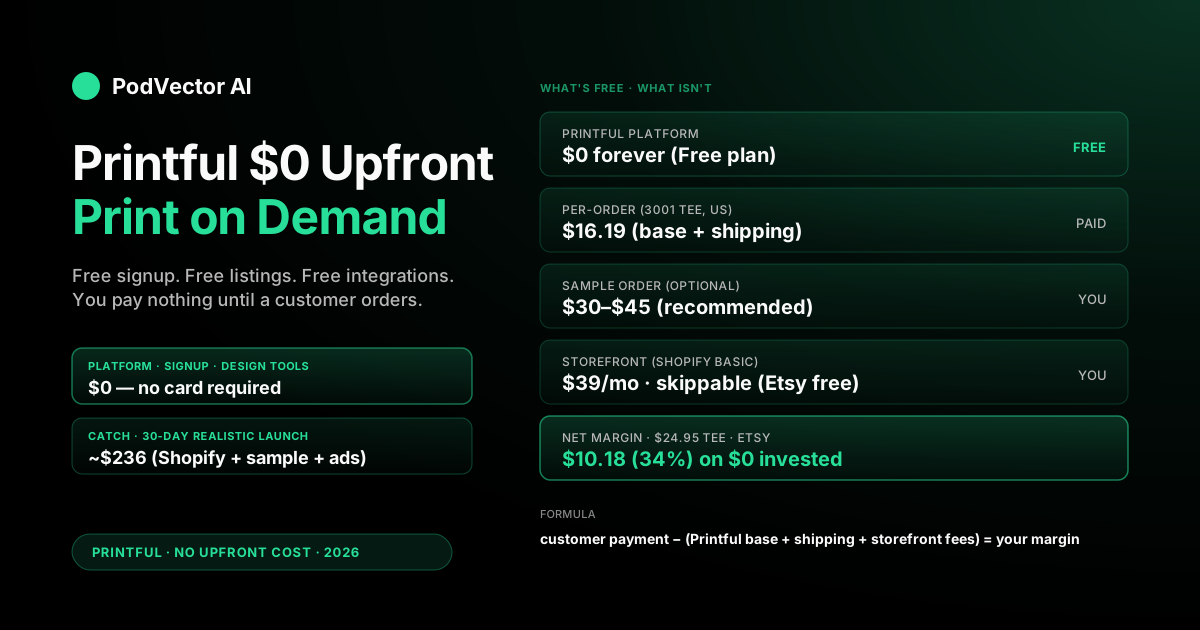
Quick Answer: Yes — Printful is genuinely $0 upfront. No signup fee, no monthly fee on the Free plan, no per-product listing fee, no minimum order, and no card required to design products or connect to Shopify.
The bill only lands when a customer orders. You then pay Printful the product base + shipping, and any optional add-ons (extra prints, branding, embroidery digitization). Whatever's left of the customer's payment is your margin.
The catch most "$0 upfront" pitches skip: realistically launching takes $30–$80 in samples if you want to ship product you'd actually buy yourself, plus first-month ad spend. This breakdown walks the literal-zero path, the realistic-launch path, and the four downstream costs that quietly erode the "zero risk" claim.
What's actually $0 on Printful
Printful's "no upfront cost" claim is real, and it covers more than most operators realize. Every part of the platform you'd expect to hit a signup paywall is free.
Here's the full list of what costs literally $0:
| Capability | Cost on Free plan |
|---|---|
| Account signup | $0 (no card required) |
| Access to 501+ product catalog | $0 |
| Design Maker + Mockup Generator | $0 |
| Product listings (unlimited) | $0 |
| Unlimited stores connected | $0 |
| Up to 10 Quick Stores (Printful-hosted) | $0 |
| Shopify, Etsy, Amazon, WooCommerce integrations | $0 |
| 24/7 customer support | $0 |
| Automatic order fulfillment routing | $0 |
Compare that to a typical Shopify store launch. Shopify itself is $39/month after the trial. A theme can run $200–$350. A logo designer is $100–$500. Printful adds nothing on top of any of that — it slots into your existing stack and stays at $0 until orders flow.
The pay-per-order model is the whole point. Printful only makes money when you make money. If you list 50 products and sell zero, your invoice for the month is $0.
What still costs money before your first sale
"Zero upfront" is true for Printful itself. It's not true for launching a POD store overall. Three categories of pre-sale spend show up for almost every operator.
1. Samples. Optional but strongly recommended. A sample order tests print quality, color accuracy, and the unboxing experience before customers see it. The Free plan gets 20% off samples (one sample order per month, up to three items). A first-sample order with two t-shirts and a mug runs roughly $30–$45 including shipping.
For the full sample-pricing picture, see Printful sample cost and the order-level math at Printful sample order cost.
2. Storefront. Printful itself is free, but the store you connect it to usually isn't. Shopify's Basic plan is $39/month after a 3-day trial. Etsy charges $0.20 per listing plus 6.5% per sale. WooCommerce is free if you self-host but adds hosting costs of $5–$30/month.
3. Domain + email. A .com domain costs $10–$15/year. A custom business email (Google Workspace) adds $7/month per user. Together: about $90 in the first year.
None of this is Printful's fee — Printful would happily fulfill orders from a free Quick Store with no domain at all. But every POD operator running a real brand spends here, so it's honest to count it in the "what does it cost to start?" answer.
The literal $0-to-first-dollar path
If you want to test Printful with zero personal cash at risk, here's the path. It's slower than the standard launch and the conversion rate is lower, but it's genuinely $0.
Step 1: Skip the sample. Use Printful's Mockup Generator to create lifelike product photos from your design files. They're computer-rendered onto template photos of real models. Not as good as photos of real product, but good enough to test demand.
Step 2: List on a free channel. Etsy has no monthly fee (only $0.20 per listing + 6.5% per sale). A Printful Quick Store is free and lives at a Printful subdomain. You can also list on Amazon Merch on Demand or Redbubble, though those have their own catalog and aren't Printful integrations.
Step 3: Drive free traffic. Organic social — TikTok, Pinterest, Instagram Reels. Or list on a marketplace that brings its own traffic (Etsy). Or post in niche communities (Reddit, Discord, Facebook groups) without paid ads.
Step 4: First order pays for itself. When the first sale lands, the customer's payment covers Printful's base + shipping + your storefront fees. You net whatever's left — typically $5–$10 on a $25 t-shirt sale. That's your first "validated dollar" earned with zero upfront capital.
The downside of this path: without sample-tested designs, your first batch of orders carries some risk of color or sizing issues. Printful reprints defective products free, but customer trust takes a hit if the first order disappoints. Most operators who try the pure-zero path eventually order samples anyway after their second or third sale.
What hits your invoice per order
Once orders start flowing, Printful charges you — not the customer — for each fulfillment. Your storefront collects the customer's payment, your platform takes its cut, and Printful invoices you for the production cost.
Three line items hit every Printful invoice:
| Line item | Typical range | Example: Bella+Canvas 3001 tee, US |
|---|---|---|
| Product base price | $1.99 (sticker) – $48 (AOP sweatshirt) | $11.50 |
| Fulfillment shipping | $3.99 – $9.99 first item (US) | $4.69 |
| Add-ons (optional) | $0 – $8.95 depending on choices | $0 (front print only) |
For a single-print US t-shirt sold at $24.95 retail, that's $16.19 to Printful. After your storefront's payment fee (~$1.16 on Shopify), you net about $7.60 — roughly a 30% margin on the order. Add the Growth plan's discount and that net climbs to about $9.90, or 39%.
The full per-order shipping picture, with international rates, lives at Printful shipping cost and the broader fee picture in Printful print on demand pricing.
The four hidden costs of "zero upfront"
The Printful invoice is itemized and honest. Four costs hit downstream that are part of the cost of running a POD store but never appear on Printful's pricing page — so the "$0 upfront" claim quietly understates them.
1. Sales tax on the wholesale invoice. In states where Printful has nexus (most US states), it charges sales tax on the base + shipping invoice to you, not to your customer. That's another 6–9% on every order. You can exempt this by submitting a resale certificate, but new operators almost never know about it and pay tax twice — once on the wholesale invoice, once when collecting from the customer. Net result: 6–9% of every order lost until you fix it.
2. Time-as-money on design. Designing products yourself is $0 in cash but a real cost in hours. A serviceable t-shirt design in Canva or Figma is 1–3 hours. A full launch catalog of 10 designs is 10–30 hours. If you'd otherwise be billing $50/hour, that's a $500–$1,500 hidden investment that "no upfront cost" hides.
3. Returns and reprints from customer error. Printful reprints any defective product free. But if the customer ordered the wrong size or changed their mind, that return comes out of your pocket — and Printful doesn't refund the original fulfillment cost. Industry-average POD return rate is 5–8% on apparel.
4. First-month ad spend (if you go paid). Driving paid traffic from Meta or Google Ads is the fastest way to get to first sale, but it starts at $10–$30/day on a serious test. If you can't crack ad profitability in 2–3 weeks, you'll have spent $200–$600 before learning whether your designs convert. Pure organic launches avoid this but take 3–6× longer to reach the same revenue.
None of these are Printful's fault. They're the real cost of running an ecommerce store. But "no upfront cost" only covers the platform piece — operators should mentally budget $300–$800 in the first three months for the rest.
No-upfront-cost: Printful vs Printify, Gelato, SPOD
Every major POD platform now markets a $0-upfront model. The differences are subtle but real.
| Platform | Signup cost | Monthly Free plan | Card required to start? | Catch |
|---|---|---|---|---|
| Printful | $0 | $0 | No | None — pure pay-per-order |
| Printify | $0 | $0 | No | Quality varies by 3rd-party provider |
| Gelato | $0 | $0 | No | Higher base prices, fewer products on Free |
| SPOD | $0 | $0 | No | Smaller catalog (~250 products) |
| Teespring / Spring | $0 | $0 | No | Marketplace-only, no Shopify integration |
All five platforms are genuinely free to sign up and list products. Where they differ is what you're optimizing for after launch — product quality, catalog breadth, integration depth, or marketplace traffic.
Printful wins on in-house quality control and integration depth. Every print method runs through Printful-owned fulfillment centers, so the quality floor is predictable. Native integrations exist for 20+ ecommerce platforms.
Printify wins on cheapest possible base prices, especially on entry-tier products. The trade-off is quality variance — Printify routes orders through third-party providers, so consistency depends on which provider fulfills your specific design.
Gelato wins on global shipping. Its print-local model means EU customers get product from EU printers, APAC from APAC printers, etc. Faster shipping, smaller carbon footprint, but slightly higher base prices.
SPOD wins on speed — 48-hour fulfillment as a guarantee. Catalog is smaller (~250 products) but every SKU ships in two days.
For the seller-perspective comparison on Printful specifically, see the Printful company review and the Printful print on demand review.
A realistic first-30-day budget
For operators who want a real sense of "what does it actually cost to start a Printful store in 30 days?" — here's a typical budget at the bare-minimum, realistic, and aggressive levels.
| Line item | Bare-minimum | Realistic | Aggressive |
|---|---|---|---|
| Printful (pay-per-order) | $0 | $0 | $24.99 (Growth) |
| Shopify (Basic, after trial) | $0 (3-day trial) | $39 | $39 |
| Domain (.com, first year) | $0 (use myshopify.com) | $12 | $12 |
| Sample order (1–2 items) | $0 (skip) | $35 | $80 (2 sample orders) |
| Design (Canva Pro) | $0 (free tier) | $0 (free tier) | $15 |
| Ad spend (Meta or Google) | $0 | $150 | $500 |
| Email tool (Klaviyo, MailerLite free tier) | $0 | $0 | $15 |
| 30-day total | $0 | $236 | $686 |
The bare-minimum column is technically possible — Printful Quick Store on a Printful subdomain, no samples, organic-only traffic. Most operators who go this route never make it past month two because conversion rates on raw mockups are low and no-sample stores ship more defects.
The realistic column is what we see most often: one sample order to validate, paid Shopify storefront, $5/day in test ad spend. By day 30, this operator typically has 5–15 orders and a sense of whether the niche works.
The aggressive column compresses the timeline. Two sample orders covers more product validation, $500 in ads tests three or four creative angles in parallel, and Growth's discount kicks in early. Most viable POD niches show signal by day 14 on this budget.
Margin math on a $0-investment store
If you launch truly at $0 — no samples, free storefront, organic only — the unit economics still need to work order-by-order. Here's the math on a single t-shirt sale.
| Line item | Amount |
|---|---|
| Customer pays (product) | $24.95 |
| Customer pays (shipping) | +$4.69 |
| Order total | $29.64 |
| Printful base (3001 tee, Free plan) | −$11.50 |
| Printful US shipping | −$4.69 |
| Etsy transaction fee (6.5%) | −$1.93 |
| Etsy listing fee ($0.20 amortized) | −$0.20 |
| Etsy payment processing (3% + $0.25) | −$1.14 |
| Net margin | $10.18 (34% of order total) |
That's a real $10 margin on a $0-invested store. Across 20 orders a month, that's $204 in profit on zero capital deployed. Scale it to 100 orders/month — possible on Etsy in 6–12 months on a viable niche — and you're at $1,000/month profit on a store that cost nothing to launch.
The trap is that this math assumes everything goes right. Defect rate at 5% costs $0.50/order in customer goodwill. Return rate at 5% costs $1.20/order. Failed payments at 0.5% cost $0.12/order. Realistic net margin is closer to $8.30 on this scenario, or 28% — still good, but lower than the headline number.
This is exactly the question PodVector AI's Victor agent is built to answer in real time: which SKUs are netting which actual margin after the full cost stack, and which ones should you re-price, discontinue, or push harder. Not a static spreadsheet. A live read on your store's actual data, with action suggestions you can approve in one click.
For more cost breakdowns across the Printful catalog, browse the Printful costs and charges hub or the broader Printful topic hub. For Printful's own pricing claims, see the official Printful pricing page.
FAQs
Is Printful really free to start?
Yes. There's no signup fee, no monthly fee on the Free plan, no card required to design products or list them, and no minimum order. The only money that flows is Printful's invoice to you once a customer order triggers fulfillment.
What's the catch with Printful's no upfront cost model?
No catch on Printful's side — the platform is genuinely free until you sell. The real catch is downstream: sales tax on the wholesale invoice (6–9% in most US states unless you submit a resale certificate), payment processing fees (~2.9% + $0.30 on Shopify), and the cost of running an actual storefront (Shopify Basic at $39/month, or Etsy's per-listing fees).
Do I need a sample order before launching on Printful?
Technically no — you can launch with computer-rendered mockups only. Practically, most operators who launch without samples regret it. The 20% sample discount on Free (25% on Growth) makes a 2–3 item sample order $30–$50, which is worth it before customers see your product.
Can I sell on Printful without a Shopify subscription?
Yes. Printful integrates with Etsy, Amazon, WooCommerce, eBay, BigCommerce, Wix, Squarespace, TikTok Shop, and 12 other platforms — plus its own free Quick Stores. Shopify is the most flexible but far from required.
What's the bare minimum cost to make my first Printful sale?
Zero, if you use a Quick Store on Printful's subdomain, design with the free Mockup Generator, and drive organic traffic. The customer's payment covers Printful's base + shipping, and you net whatever's left. Most operators using this path report 4–12 weeks to first sale.
How much do I actually pay Printful per order?
On a US Bella+Canvas 3001 t-shirt with one front print: $11.50 base + $4.69 shipping = $16.19. On the Growth plan: $9.20 base + $4.69 shipping = $13.89. Add $0.99–$5.25 per add-on if you use inside labels, back prints, or sleeve prints.
Are there any hidden fees on Printful?
Not from Printful directly — its invoice is fully itemized. Four costs hit downstream: sales tax on the wholesale invoice, FX conversion on non-USD payments (~1.5–2.5%), customer-initiated returns (Printful doesn't refund original fulfillment), and payment dispute fees ($15 from Stripe per chargeback). None are Printful's choice; they're the cost of ecommerce.
Does Printful charge me or my customer for shipping?
Printful charges you. Your storefront collects whatever shipping price you set at checkout, and Printful's shipping fee comes out of your end. The trick is to set retail shipping at least equal to Printful's fee — or build it into the product price and offer "free shipping" at the customer level.
Is the Growth plan worth it if I'm just starting?
Generally no. The $24.99/month fee is only worth paying once you're moving roughly 4+ hoodies, 11+ standard tees, or 15+ mugs per month. Below that, the per-product discount doesn't cover the subscription. Once your store crosses $12,000 in annual sales, Growth becomes free automatically.
How long until my Printful store turns a profit?
If you're tracking unit economics, every individual order is profitable from day one — Printful only charges per order, so there's no fixed cost to amortize. The question is when total monthly profit exceeds the cost of running the business (Shopify, ads, domain). Realistic POD operators hit that breakeven in months 2–4 with consistent paid acquisition, or months 4–9 going organic-only.
Can I use Printful with no money at all?
Yes, with caveats. Printful itself stays $0. But you'll need either (a) a free storefront like an Etsy account or Printful Quick Store, (b) free design tools like Canva's free tier, and (c) free traffic via organic social or marketplace listings. It's slower than a paid launch but genuinely zero out-of-pocket.
"Zero upfront" doesn't mean "zero attention"
Starting a Printful store costs nothing. Running one profitably costs a lot of attention — knowing which SKUs net real margin, where shipping is silently eroding profit, when to switch to Growth, and which orders to push harder.
Victor connects to your Shopify store, ingests every Printful order into your live data warehouse, and answers the questions that decide profitability: which SKUs are netting below margin after fulfillment? Where is shipping eating profit by region? Is it time to flip to Growth this month?
Not a static dashboard. A business employee that reads itemized Printful costs in real time, proposes specific actions (price changes, BXGY discounts, free-shipping thresholds), and executes them on your approval — with a full audit trail.
Try Victor free