
Quick Answer: Printful's shipping time to US addresses runs 5–9 business days door to door for standard service: 2–5 business days of fulfillment plus 3–4 business days of carrier transit. Express compresses transit only — fulfillment is the same.
Calendar-day translation: 7–13 days. That's the number to quote on the product page, in the cart, and in order confirmations. Single-number promises ("ships in 5 days") generate the bulk of "where's my order?" tickets.
The cost side runs $4.75 for the first shirt, $2.20 per additional unit standard; $9–$22 extra for express. On a $26.95 tee at $13 in production, an unbilled express upgrade burns a third of the margin in one click.
The headline US shipping number
For the bulk of Printful's US catalog — t-shirts, hoodies, mugs, posters, hats — the standard door-to-door window is 5–9 business days. That breaks into 2–5 business days of fulfillment and 3–4 business days of carrier transit.
Express upgrades the carrier leg only. Transit drops to 1–3 business days, so an express US order lands in 3–8 business days door to door. Fulfillment is on the same clock either way — there is no "rush production" toggle.
Calendar-day language matters because customers don't think in business days. The 5–9 business day window translates to roughly 7–13 calendar days once a typical weekend is included. That's the figure to quote in shipping policy copy.
None of these numbers are levers the seller can move directly. Production routing is automated, and the carrier's clock is the carrier's clock. The operator's job is to set the expectation and pick the right speed for the right order.
Two clocks: fulfillment and transit
The single most expensive misread on Printful shipping is treating "shipping time" as one number. It's two clocks running in series, and they behave very differently.
Fulfillment (2–5 business days): the order sits in production. Printful prints, cures, quality-checks, folds, and packs the unit. This window is identical for standard and express — paying $15 for express doesn't make the print machine go faster.
Transit (3–4 standard, 1–3 express): the package is on a carrier. USPS, UPS, FedEx, or DHL depending on the facility and the product. This is the only window express actually compresses.
If a customer sees "shipping in 3–4 days" on the product page, they assume their order arrives in 3–4 days. When the order sits in production for 4 days, the support ticket queue fills with reasonable-sounding complaints. The fix is wording: "ships from our facility in 2–5 business days, delivered 3–4 business days after that."
US zones: West Coast to Maine isn't one number
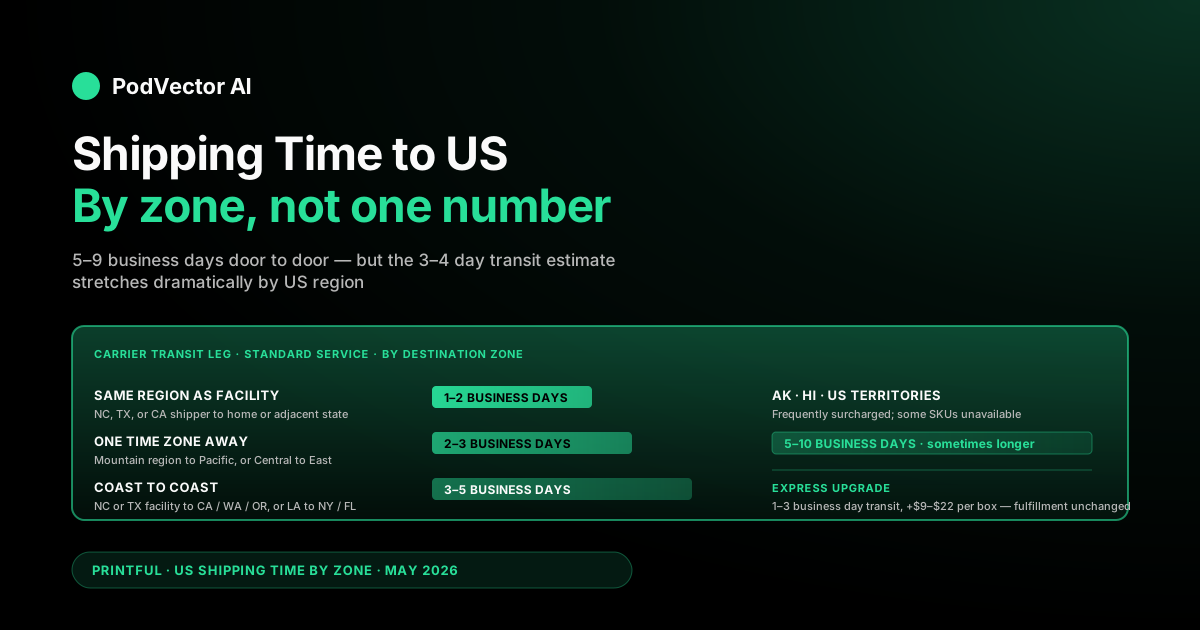
Printful publishes a single 3–4 business day standard transit estimate for the US. The reality is zoned. A package leaving the Charlotte, NC facility for an address in central North Carolina is a 1–2 business day move. The same package going to Anchorage is 5–7.
Rough working bands, standard service:
- Same region as facility (intrastate or adjacent state): 1–2 business days.
- One time zone away: 2–3 business days.
- Coast-to-coast (NC to CA, or CA to NY): 3–5 business days.
- Alaska, Hawaii, US territories: 5–10 business days, sometimes longer, frequently with surcharges.
This matters when you're forecasting holiday cutoffs or running a promotion that promises "by Friday." A blanket "3–4 business day" line misleads roughly a third of orders in either direction.
If you sell heavily to one region — say, Bay Area buyers off a Pinterest funnel — your real-world transit average is materially better than the published number. Conversely, a national lifestyle brand will see a fatter long-tail of 6–8 day transit outliers to AK, HI, and the rural Mountain West.
Which Printful facility ships your order
Printful auto-routes US orders to the closest facility with stock and capacity. The main US footprint covers Charlotte (NC), Dallas (TX), and Los Angeles (CA), with international facilities handling overflow and certain SKUs.
The seller can't choose the facility. Routing is automatic and opaque on a per-order basis. What you can see, after the fact, is which facility a fulfilled order shipped from — that information is in the order detail in the Printful dashboard.
Practical implication: facility variance is a real source of US shipping time spread that no marketing copy will explain to the customer. An LA-fulfilled order to NY traverses the country; a Charlotte-fulfilled order to NY is a short hop. Both are billed at the same flat rate and quoted at the same 3–4 day standard window.
For a deeper teardown of how facility routing interacts with international destinations, see our Printful shipping times US and EU breakdown.
Standard vs. express: the cost table
Printful uses flat shipping rates by product category, not weight or zone. The US standard rates as of 2026:
| Category | First item (standard) | Additional item | Express upgrade |
|---|---|---|---|
| T-shirts | $4.75 | +$2.20 | +$9–14 |
| Hoodies / sweatshirts | $8.49 | +$2.50 | +$12–18 |
| Hats / beanies | $4.49 | +$2.00 | +$9–14 |
| Mugs (11 oz) | $5.95 | +$3.50 | +$12–18 |
| Posters | $5.49 | +$1.50 | +$10–15 |
| Backpacks / bags | $10.49 | +$4.50 | +$14–22 |
Two patterns to internalize. First, the "additional item" rate is a real margin lever — a two-shirt order ships for $6.95, not $9.50. If your storefront upsells a second tee, the shipping math gets meaningfully better. Second, express upgrades scale with the box, not the item — a 3-shirt express order is one upcharge, not three.
Compare these to the official Printful shipping page at printful.com/shipping for the current authoritative figures; rates do drift annually and by product category.
When express is worth $9–22 extra
Express delivery is rarely the right default. The cost-per-day-saved math is brutal for low-AOV stores.
Standard transit: 3–4 business days. Express transit: 1–3 business days. You're paying $9–$22 to save 1–3 business days on the transit leg — not the fulfillment leg, which is fixed at 2–5 business days regardless. The "express" order can still take a full week door to door because production is the bottleneck.
Express makes sense in three narrow cases:
- Customer-paid express upgrades at checkout. Let the buyer self-select. Most won't; the ones who do are price-insensitive and high-LTV.
- Replacement orders for quality issues. The order is already on you — recovering trust is worth $15.
- B2B / event orders with hard dates. Wedding favors, corporate gifts, conference swag. The deadline is real and the customer absorbs the cost.
What express almost never makes sense for is a regular DTC order with no urgency. The Printful flat rate is already absorbed into your retail price, and quietly upgrading to express on every order will eat 5–10 percentage points of margin with zero conversion lift.
Cutoffs, weekends, holidays
Printful's fulfillment clock counts business days, not calendar days. An order placed Friday at 6pm starts production Monday morning. That single fact accounts for a large share of "my order has been processing for 4 days" support tickets.
The practical operator handles for weekend drift:
- Same-day production cutoff is unofficial. Orders submitted before noon Eastern have a reasonable chance of entering production that day. After noon, plan on next business day.
- Federal holidays add a business day. Memorial Day, Independence Day, Labor Day, Thanksgiving, Christmas, New Year's — and carriers observe more days than Printful does.
- Black Friday through mid-December sees fulfillment stretch toward the upper end of the 2–5 day window industry-wide. Quote 7–10 business days for Q4 orders without flinching.
Some operators run a "guaranteed by Christmas" cutoff banner that goes live December 1 and updates daily. The math: pick the last day where (today + 5 fulfillment + 4 transit + 2 weekend buffer) ≤ Dec 24. For most years that lands around Dec 12 for standard, Dec 17 for express.
How shipping time quietly eats margin
Shipping cost is visible in the order math. Shipping time eats margin in two less-visible places: support load and refund rate.
A reasonable rule of thumb on a 1,000-order month: every additional business day quoted-vs-actual generates roughly 30–60 "where is my order?" tickets. At 6 minutes per ticket fully loaded, that's 3–6 support hours of pure waste per day of mismatch.
The refund side is sneakier. A customer who waits 13 calendar days expecting 7 doesn't always file a ticket — they file a chargeback. Chargeback fees run $15–$25 per occurrence, plus the lost margin on the unit. One avoidable chargeback per 200 orders moves a 25% net-margin storefront to roughly 22%.
Most operators don't see this because the dashboards they use show order count and revenue, not the time-quoted-vs-time-actual delta per order. That number is sitting in the Printful order export and the Shopify shipping policy copy — but reconciling them by hand once a week is a Sunday afternoon nobody has.
That visibility problem is one of the questions PodVector AI's Victor agent was built to answer. Victor connects to your store's live data warehouse and reads order-level shipping and margin numbers in plain English: "show me orders this week where actual delivery exceeded the quoted window by 3+ days, broken down by US region and carrier." No spreadsheet, no SQL, no weekly export-and-reconcile ritual.
What to do when something slips
A typical month sees 2–4% of US orders fall outside the 5–9 business day window. Most of those are transit issues on the carrier side; a smaller share are fulfillment delays in the Printful facility. Operator playbook:
- Day 6 (business) with no movement: check the order's facility assignment in the Printful dashboard. If it's still queued, contact Printful support — sometimes a routing edge case stalls a job.
- Day 8 in transit with no scan updates: open a carrier trace via Printful support. Don't promise the customer a date — just acknowledge the delay and confirm you're tracking it.
- Day 14 calendar with no delivery: reship as a replacement order, flagged in Printful as a quality/lost-in-transit issue. Eat the cost; recover the customer.
The proactive version of this is a weekly export of orders aged 7+ business days without delivery. That list is the support team's morning queue. Most stores don't run it because it requires joining Printful's API export against Shopify's order export against the carrier's tracking webhook — three systems, no native view.
For the cost side of the same operational question, our Printful Pro membership pricing breakdown covers when the volume tier starts paying for itself against shipping discounts.
FAQs
How long does Printful shipping take to US addresses?
Standard service runs 5–9 business days door to door: 2–5 business days fulfillment plus 3–4 business days transit. Express drops transit to 1–3 business days for a total of 3–8 business days. Calendar-day equivalents are roughly 7–13 days for standard, 4–11 days for express.
Is Printful's US shipping faster than international?
Yes, materially. US orders fulfilled from a US facility skip customs, which alone is a 2–7 day swing. For a side-by-side comparison see our Printful shipping times US deep dive and the Printful shipping times USA breakdown.
Does Printful offer free shipping to the US?
Not natively. Printful bills the seller the flat-rate shipping cost on every order. "Free shipping" at the storefront level means the seller has absorbed that cost into the retail price — common practice, but a real margin item, not a Printful feature.
Can I see which facility my order ships from?
After fulfillment, yes — the facility is listed on the order detail page in the Printful dashboard. Before fulfillment, no; routing is automatic and not visible until the job is assigned.
What's the fastest a US Printful order can arrive?
3 business days, if production completes same-day (rare, happens with simple SKUs on light-volume weekdays) and the customer pays for next-day express. That's the floor — most express orders still take 4–6 business days because fulfillment takes 2–3 of those days.
Does Printful ship to PO boxes and APO/FPO addresses?
USPS-routed orders ship to PO boxes. UPS and FedEx services don't deliver to PO boxes — if your order auto-routes to UPS for size or destination reasons, a PO-box address will fail. APO/FPO works via USPS Priority Mail International with longer transit windows (10–21 days).
How do I quote US shipping time on my product pages?
"Ships within 2–5 business days. Delivered 3–4 business days after that. Most US orders arrive in 7–13 calendar days." That's the honest version. Avoid single-number promises like "ships in 5 days" — they conflate fulfillment and transit and generate disproportionate support load.
Stop reconciling shipping data in spreadsheets
Printful shipping time looks like one number. It's three: fulfillment, transit, and what your store actually quoted. Reconciling them by hand is the Sunday afternoon nobody has.
Victor is the AI agent that reads your live POD data warehouse and answers shipping-and-margin questions in plain English. "Which US regions had standard orders blow past 9 business days this week?" Answer in 10 seconds, no SQL, no exports. — connect Printful and your store, and the next "where's my order?" investigation takes a sentence instead of a weekend.
Try Victor free