
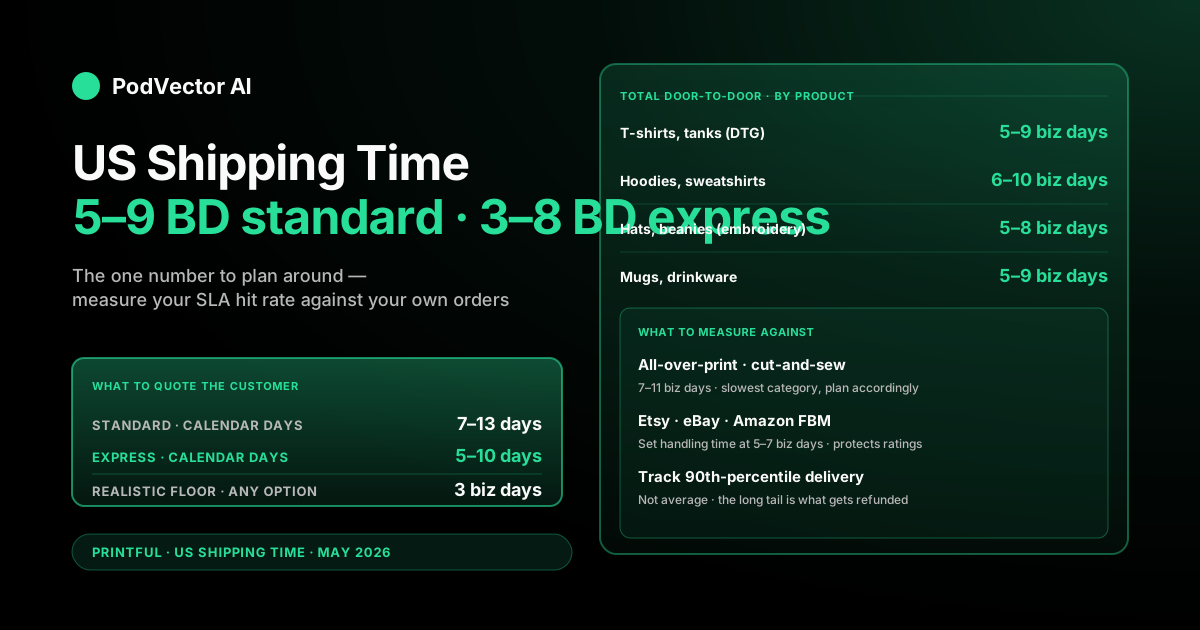
Quick Answer: A standard US Printful order takes 5–9 business days door to door — Printful's fulfillment help article puts the production window at 2–5 business days, with transit adding 3–4 business days on Flat Rate Standard. Express trims transit to 1–3 business days, per Printful's shipping options page, so the realistic floor on any US order is roughly 3 business days even with the fastest option paid. All-over-print products remain an active exception: Printful's Mexico cut-and-sew facility has periodically reported fulfillment stretching to 7–9 business days for those SKUs during elevated order volume — check Printful's recent updates page before quoting AOP timelines.
According to Printful's fulfillment help center, over 97% of orders ship within 5 business days and more than half ship within 3 business days — both figures measure fulfillment only, not delivery. Many sellers quote those numbers to customers and then field "where's my order" tickets when calendar day 7 comes and goes with no tracking update.
The number that actually matters is what you measure against your own order data: what percent of your orders deliver inside the window you promised, by product category, by US region. Without that number, every late order is a one-off; with it, you can see whether your hoodies, your California buyers, or your Q4 weeks are dragging the average.
The one number to plan around (and what it's missing)
If you need a single number for customer-facing copy, use 5–9 business days for standard US delivery on a Printful order. That covers the realistic range from a fast production week with a short carrier route to a slow production week with a cross-country carrier route.
According to Printful's fulfillment help article, fulfillment takes 2–5 business days on average across most production techniques and facilities, with Printful calculating that estimate based on current order volume and capacity. Transit adds 3–4 business days for Flat Rate (Standard) or 1–3 business days for Express, per Printful's shipping options help article.
Crucially, Printful's delivery time help page notes that the day you place your order is not included in the 2–5-business-day fulfillment window — the clock starts the next business day. That's an easy day customers (and sellers) lose in their mental math.
There is also an important nuance in how Printful applies its published estimates: per Printful's fulfillment help center, if fulfillment estimates change after you've placed an order, the updated timeframe applies — not the one that was live when you ordered. During a spike, that means an order you placed at 2–5 days could be reassigned to a longer window without notice.
That breakdown looks tidy on paper. In practice, customers don't think in business days, and they don't separate fulfillment from transit. They placed an order on Tuesday and they want to know when it arrives.
Translated to calendar days for that customer, "5–9 business days" becomes roughly 7–13 calendar days. That's the figure to put in your shipping policy, your product page, and your order confirmation email.
US shipping time by product category
Different product types come off different production lines, with different fulfillment times. According to Printful's fulfillment help article, exact timeframes vary by product category and fulfillment location. The end-to-end window changes accordingly:
| Product category | Fulfillment | Standard transit | Total (standard) |
|---|---|---|---|
| T-shirts, tanks (DTG apparel) | 2–5 BD | 3–4 BD | 5–9 BD |
| Hoodies, sweatshirts (heavier apparel) | 3–6 BD | 3–4 BD | 6–10 BD |
| Hats, beanies (embroidery) | 2–4 BD | 3–4 BD | 5–8 BD |
| Mugs, drinkware (sublimation) | 2–5 BD | 3–4 BD | 5–9 BD |
| All-over-print apparel | 4–9 BD* | 3–4 BD | 7–13 BD* |
| Posters, wall art | 2–5 BD | 3–4 BD | 5–9 BD |
BD = business days. Saturdays, Sundays, and US federal holidays don't count toward either window. A Thursday-afternoon order that takes the full 5-day fulfillment window doesn't ship until the following Thursday at earliest, then add transit.
*All-over-print is the slowest category under normal conditions because of the cut-and-sew step. Check Printful's recent updates page before quoting AOP timelines to customers — this type of spike recurs during busy periods, and per Printful's fulfillment help center, up-to-date fulfillment times based on the past 30 days of live order data are shown there.
Embroidery products are usually faster on fulfillment because the production line is simpler, but they ship from fewer facilities, which sometimes nets out to the same total. If you stock a mix, the slowest product in any order sets the ship date — according to Printful's shipping page, Printful may also split an order into multiple shipments when products have different fulfillment locations or require separate packaging (e.g., hats).
Cost vs. time: what each option actually buys
Printful charges per item, with the first item at a base rate and additional items at a lower rate. Shipping rates are updated periodically — use the live per-product calculator on Printful's shipping page to confirm current costs rather than relying on any memorized figures.
| Option | Delivery after fulfillment | Notes |
|---|---|---|
| Flat Rate (Standard) | 3–4 business days | Most common; use Printful's rate calculator for current per-item cost |
| Standard with CO₂ offset | 3–4 business days | Same speed as Standard; small surcharge supports carbon offsetting |
| Express | 1–3 business days | Shortens transit only — fulfillment floor is unchanged |
Express shipping changes the transit leg, not fulfillment. Paying for Express on a hoodie still leaves you with up to 6 business days in production before the package even enters the carrier network. The effective time saved versus Standard is 2–3 business days of transit — not end-to-end delivery.
The breakeven question for the seller: is the customer paying for Express, or are you eating it from margin? The margin math on absorbing an Express upgrade can turn a healthy contribution into a near-zero one. That math only works when the customer is paying the upgrade. For context on how these decisions interact with your overall store profitability, see our guide on Printful Premium membership — the shipping discounts it unlocks can shift the Express vs. Standard calculus meaningfully at volume.
Where the variance comes from
The 5–9 business day window is wide because it has to absorb several independent sources of variance. Knowing which ones are seasonal and which are structural helps you decide what to communicate.
Production queue depth. According to Printful's fulfillment help article, fulfillment and delivery timeframes are estimates that can change based on current conditions such as order volume or seasonal demand. Quiet mid-winter weeks are closer to the 2-day floor; Q4 queue depth can push orders to the 5-day ceiling or beyond.
Facility assignment. Printful runs facilities in North Carolina, California, and Mexico (among others). Orders route to the nearest fulfillment center that has the SKU and capacity. When the closer facility is overloaded, a North Carolina buyer's t-shirt might ship from California, adding transit days.
Carrier handoff. Per Printful's shipping options page, domestic US shipments use Flat Rate Standard via USPS, UPS, and similar carriers depending on destination. Hybrid carriers — those that hand off to USPS for final-mile delivery — can produce multi-day tracking gaps at regional hubs. Pure USPS Priority or UPS Ground tends to scan more consistently.
Product complexity. Embroidery vs. DTG vs. cut-and-sew all have different production paths and bottleneck differently. A simple DTG t-shirt in stock can clear fulfillment quickly; an embroidered hoodie with a back design and front patch can take closer to 5 business days.
Order content mix. An order with multiple products from different production lines waits for the slowest line. As noted on Printful's shipping page, orders may ship in multiple packages when products have different fulfillment locations — meaning a customer could receive two tracking numbers for one order, which generates confusion if you haven't communicated it upfront.
Large order size. Per Printful's fulfillment help article, large orders may take a bit longer but are still typically fulfilled within 5 business days. If you run bundle promotions or B2B drops, factor this in before quoting.
The variance you can't see from the outside is the live production queue — that's an internal number. You can sometimes feel it in the lag between order placement and the "in production" status update. If the status takes 3 business days to flip, the queue is deep. Printful updates its recent-updates page when fulfillment times drift materially; bookmark it and check weekly during Q4.
Live delay alerts: how to stay ahead of fulfillment spikes
Printful publishes fulfillment advisories on its recent updates page. Per Printful's fulfillment help center, up-to-date fulfillment times based on the past 30 days of order data are posted there — but only if you're watching.
Two practical workflows for staying ahead:
- Bookmark the recent-updates page and check it every Monday, especially during Q4, post-holiday clearance sales, and any viral traffic events in your niche. The page logs facility-specific delays by product type.
- Set a weekly order-status spot-check. Pull your 10 most recent unfulfilled orders every Monday and check whether any have been sitting in "Pending" or "In Production" longer than the published window. A cluster of slow orders is your early warning that a queue spike is underway before your customers start emailing.
When a delay is confirmed, update your product page and order-confirmation email proactively. A customer who reads "we're currently seeing 7–9 day production on all-over-print items" in your confirmation email before they ask is far less likely to request a refund than one who discovers the delay by checking tracking on day 8.
Printful vs. Printify: fulfillment time comparison
Both platforms target similar US fulfillment windows. According to Printful's fulfillment help article, Printful averages 2–5 business days across most production techniques. According to Printify's production times help article, most Printify orders ship within 2–7 business days after the order is placed — a slightly wider window that reflects the variance across Printify's network of third-party print providers.
The structural difference is architecture. Printful operates its own first-party facilities, which gives it tighter variance when those facilities are running smoothly. Printify routes to a network of print partners; the fulfillment speed you get depends on which provider you've assigned to each product. Printify shows average fulfillment time per provider in its product catalog, updated on a rolling 30-day basis — a useful signal when choosing between providers for the same blank.
The tradeoff shows up most clearly on heavier apparel. A Printful hoodie and a Printify hoodie from a well-rated provider may both quote 3–5 business day fulfillment in normal conditions, but the Printify route has more provider-level variance. During a spike, the Printful first-party advantage tends to hold better — but when a Printify provider is uncongested, it can route to a closer facility and trim a transit day. For a full feature and cost comparison, see our guide on Printful vs. Printify: which is best for POD sellers.
Warehouse fulfillment: the faster path for repeat SKUs
If you have high-velocity SKUs that consistently ship to US customers, Printful's Warehousing & Fulfillment service is worth evaluating as a speed lever. According to Printful's warehouse fulfillment help article, orders containing only warehoused in-stock products can ship as soon as the next business day — compared to the standard 2–5 day production window — provided the order is submitted before the facility's 12 p.m. cut-off time.
The trade-off: you carry inventory risk and upfront unit costs. It makes economic sense for proven best-sellers, not for testing new designs. And because warehoused orders ship finished goods rather than print-on-demand, they fall outside the typical POD margin model — your contribution margin calculation needs to account for holding costs and minimum stock levels, not just per-unit COGS. For a deeper look at whether the economics of Printful's paid plans improve the warehouse math, see our Printful Pro membership cost breakdown.
How to set an SLA that won't bite you
The shipping-time SLA you publish should be the 90th-percentile delivery time on your historical orders, not the average. The 90th percentile is the number that's high enough to cover most of your "where's my order" surface area without overpromising on the long tail.
A reasonable starting SLA for a US-only Printful store on standard shipping:
- Product page: "Made-to-order. Ships in 2–5 business days. Total delivery: 7–13 calendar days."
- Order confirmation email: "Your order is in production. Expect a tracking number within 5 business days and delivery within 7–13 calendar days."
- "Where's my order" auto-reply at calendar day 7: "Production typically takes 2–5 business days; transit adds another 3–4. If you haven't received tracking by business day 7 (calendar day 10), reply here and we'll escalate."
The two phrases that prevent the most tickets are "made-to-order" and "business days." The first tells the customer this isn't an Amazon Prime warehouse pull; the second resets the math on weekends.
If you run paid ads to your store, your SLA language also belongs in your ad-to-landing-page flow. Customers who click a Meta or Google ad and land on a product page with vague shipping copy convert at lower rates and refund at higher rates. For ad-level strategy, see our guides on Facebook Ads strategy for POD and the benefits of Google Shopping Ads for ecommerce — both cover how shipping messaging affects conversion at the campaign level.
How to measure shipping time against your own orders
The number that's actually useful — fulfillment SLA hit rate by product, transit SLA hit rate by region, delivery SLA hit rate overall — has to come from your own order data. Printful's published averages cover the entire platform. Your specific product mix, customer geography, and seasonality look different.
The raw data is in Printful's order export: order date, in-production timestamp, ship date, tracking number, delivery date (if you pull from the carrier). Cross-referenced with your Shopify order data, that gives you a per-order fulfillment lag and per-order transit lag.
The questions worth answering monthly:
- What percent of orders fulfilled inside Printful's quoted 2–5 business day window?
- What percent of orders delivered inside the SLA we quoted the customer?
- Which product category has the worst hit rate?
- Which US region has the worst hit rate? (East coast vs. west coast vs. mountain)
- Did Q4 push us off SLA, and by how much?
This is a query against your unified order data, not a spreadsheet you rebuild by hand each month. Once your orders, fulfillment timestamps, and tracking data live in the same place — a live data warehouse where Shopify and Printful data sit together — the answer is a question you can type and receive sourced to the underlying rows.
Victor, PodVector's AI employee, reads your live Shopify and Printful data and can answer exactly these questions — "what percent of my hoodies hit our 13-day SLA last month?" — without dashboards or manual exports. That's especially useful when you're running paid traffic and need to know whether a fulfillment slowdown is affecting your repeat-purchase rate before it shows up in your ad ROAS. For context on how to interpret those ROAS signals once you have them, see our guide on how to calculate ROAS in Meta Ads.
Marketplace SLAs: Etsy, eBay, Amazon
Each marketplace publishes its own shipping-time expectations, and they enforce them with seller-rating penalties, search-ranking demotions, or auto-refunds. None of them are aligned with Printful's actual fulfillment math.
Etsy. Sellers set their own "ship by" date on each listing. The bind is whether the package gets a tracking number by that date — not whether it's delivered. Set your "ship by" window to 5–7 business days on Printful products to leave margin against the 2–5 day fulfillment. Etsy's "Star Seller" status requires shipping the vast majority of orders on time with tracking, and a single missed ship-by date can pull you off the badge for months. Per Printful's Etsy delivery help article, Printful recommends using their NC facility ZIP (28273) as your listing's origin postal code when configuring Etsy shipping profiles.
eBay. Same dynamic, harsher consequence. eBay tracks "handling time" (your stated ship-by) and "estimated delivery date" separately. Late handling drops your service metrics; late delivery (even by carrier fault) hurts your "items delivered on time" rating, which feeds into search placement. Set handling time to at least 5 business days for Printful products.
Amazon. Tightest SLA. Amazon's promised delivery date for FBM (fulfilled-by-merchant) listings is generated from your handling time plus your shipping template. A late shipment rate above a low threshold triggers account warnings. For Printful products, you almost certainly need to disable Prime eligibility and set a handling time of 4–6 business days. Even then, expect the late-shipment metric to be the constraint that limits your Amazon scaling on POD products.
Note: Victor reads Shopify, Meta Ads, Google Ads, Printify, Printful, and Klaviyo data — Etsy, eBay, and Amazon order data are not ingested. Marketplace SLA tracking for those channels has to be done manually or via a dedicated marketplace tool.
When late shipping turns into refund risk
A late Printful order is rarely a problem when the customer was set up to expect 7–13 calendar days. It becomes a refund request when:
- The customer expected Amazon-Prime speed and you didn't reset that expectation.
- The order was placed for a gift, with an event date inside the SLA window.
- Tracking went silent for 4+ days mid-transit (USPS hybrid handoffs cause this).
- The order shipped in two packages and only one tracking number was shared.
- A facility-level delay wasn't communicated to the customer proactively.
According to Printful's shipping page, the estimated delivery time is an estimate and not a guarantee — and Printful's position is that if the order ships on time per their fulfillment SLA and the carrier delivers within their transit window, that's "on time" even if the customer is unhappy. Refund liability sits with you, not Printful, unless the package is lost or damaged.
The defensive moves are upstream: clear shipping copy, a separate gift-order messaging track with extended SLA, and a holiday cut-off banner from late October through mid-December. Once a customer has paid and is waiting, the cost of avoiding a refund is much higher than the cost of preventing the expectation gap in the first place.
If you're running paid acquisition alongside Printful fulfillment, refund rates also affect your ad economics — a spike in refunds from a fulfillment delay compresses the margin that your Meta or Google campaigns are working against. For a framework on building campaigns that account for those dynamics, see our guides on how to create Facebook Ads for ecommerce step by step and the benefits of Google Shopping Ads for POD.
For more on what to communicate when international transit times stretch even further, see our breakdowns on Printful international shipping, international shipping rates, and Printful shipping to India. The full shipping cluster sits under Printful shipping, and the broader Printful topic hub covers pricing, profitability, and operator playbooks.
FAQs
How long does Printful take to ship to the US?
5–9 business days door to door on standard shipping. That's 2–5 business days for fulfillment (per Printful's fulfillment help article) plus 3–4 business days for transit on Flat Rate Standard (per Printful's shipping options page). Express drops the transit leg to 1–3 business days, taking the total to roughly 3–8 business days.
Does Printful ship faster from US facilities to US customers?
Yes — the assigned facility matters more than the shipping option for transit time. Printful routes orders to the nearest facility with the SKU in stock; when that facility is overloaded and the order reroutes to the opposite coast, transit adds days even on Express.
How accurate is Printful's "over 97% within 5 business days" stat?
According to Printful's fulfillment help center, over 97% of orders ship within 5 business days and more than half ship within 3 business days or fewer. Both figures measure fulfillment only — the time to produce and hand off to the carrier — and do not include the 3–4 business days of transit that follow.
Is Printful Express worth it for US orders?
Only when the customer pays for it, or when a gift-date deadline justifies the margin hit. Express shortens transit by roughly 2 business days but doesn't touch the 2–5 business day fulfillment floor, so the upside is capped. For all-over-print SKUs during a fulfillment spike, Express transit savings may be overwhelmed by production delays.
Why does my Printful tracking go silent for days?
USPS hybrid handoffs — where a carrier like UPS Mail Innovations or DHL eCommerce hands the package to USPS for final-mile delivery — cause a multi-day scan gap at regional hubs. The package is still moving; the tracking data just isn't updating. This is most common on Flat Rate Standard shipments going cross-country.
What shipping time should I quote on my product page?
"Made-to-order. Ships in 2–5 business days. Total delivery: 7–13 calendar days." That phrasing handles the vast majority of standard US orders and resets customer expectations away from Amazon Prime timing.
Does Printful ship on weekends?
Fulfillment production does not run on weekends or US federal holidays. Per Printful's delivery time help page, the first business day of the fulfillment window is the next business day after the order is placed — weekends are excluded from both the production and transit clocks for most carriers.
How does Printful shipping time compare to Printify?
Both platforms quote similar windows for US standard delivery. According to Printful's fulfillment help article, Printful averages 2–5 business days; according to Printify's production times help article, most Printify orders ship within 2–7 business days. Printful's first-party facilities tend to have tighter variance; Printify's network can occasionally route to a closer provider and save a transit day, but provider-level variance is wider. See our full Printful vs. Printify comparison for a feature-by-feature breakdown.
What happens during holiday peak season for Printful shipping times?
According to Printful's fulfillment help article, fulfillment and delivery timeframes can change based on conditions including seasonal demand. Printful publishes an annual holiday shipping and order deadline guide with product- and region-specific cut-off dates at Printful's holiday guide. Begin displaying a holiday cut-off banner by late October to manage expectations before customers ask.
Can Victor help me track whether my Printful orders are hitting their SLA?
Yes — Victor reads your live Shopify and Printful data and can answer questions like "what percent of my orders shipped within 5 business days last month?" against your actual order rows. He surfaces fulfillment patterns by product and region without requiring you to build a dashboard or run a manual export. When a pattern reveals a margin problem — say, a spike in late orders correlating with a drop in repeat purchases — Victor can propose and execute a Shopify-side reprice or discount with your approval. Try Victor free and ask your first question in under five minutes.
Stop guessing whether your shipping SLA is holding up
Most POD operators quote a shipping time once and never measure it again. Then a customer complains, you check three orders, and now you're not sure if it's one bad week or a structural problem.
Victor, PodVector's AI employee, reads your live Shopify and Printful data and answers questions like "what percent of my hoodies hit our 13-day SLA last month?" — against your actual orders, by product, by region. No spreadsheets to maintain. No dashboards to build. Just an answer, sourced to the underlying rows. And when the answer reveals a margin problem, Victor can propose and execute a reprice across your store — with your approval.
and ask your first question in under five minutes.
Try Victor free