
Quick Answer: A single Printful shipping price in the US ranges from $4.29 (stickers) to $8.49 (hoodies) for the first item, with $1.90–$5.75 added per extra unit in the same shipment.
International first-item rates start around $4.49–$11.99 depending on region, and Printful raised select shipping fees in February 2026 — phone cases, knitted goods, and a handful of accessory categories all moved up.
The number that actually matters isn't the rate sheet — it's shipping cost as a percent of your retail price. Below: every category × region rate, the multi-item math, and how to know which SKUs are bleeding margin after fulfillment.
The anatomy of a Printful shipping price
Printful shipping isn't a single number. It's a stack of four inputs that combine into the line item you see at checkout.
The first input is the product category rate. Tees ship cheaper than hoodies, hoodies cheaper than backpacks, backpacks cheaper than knitted goods. Printful groups its catalog into roughly a dozen shipping classes and prices each one differently.
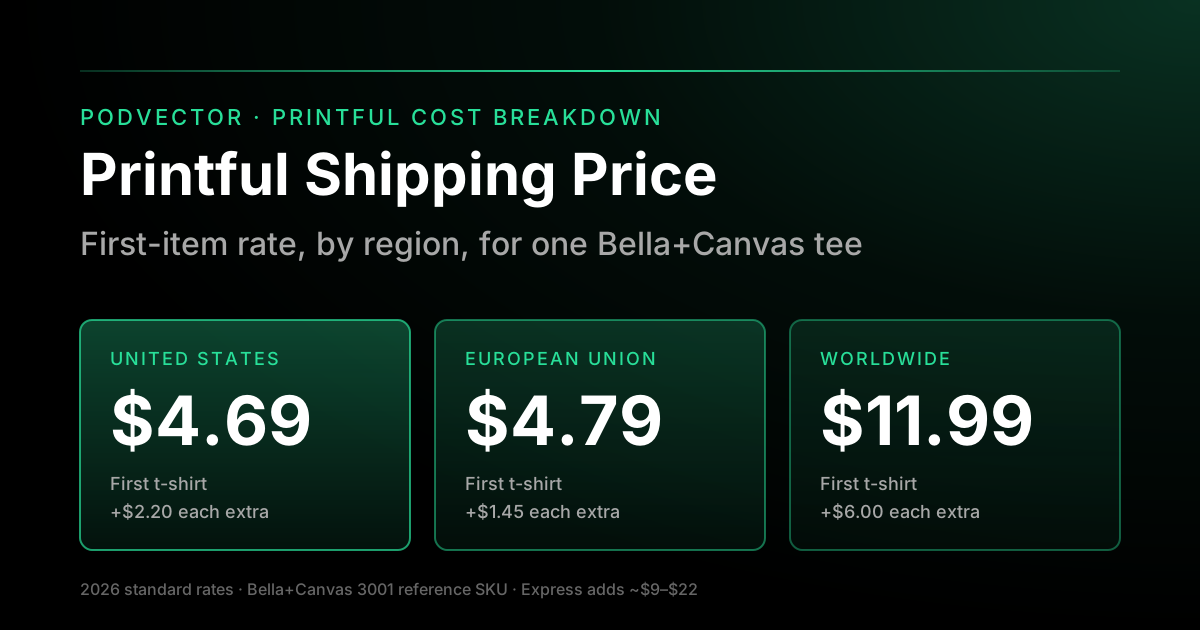
The second input is destination region. The same Bella + Canvas tee ships for $4.69 in the US, $4.79 in the EU, $7.19 to Australia, and $11.99 to a country Printful classes as "Worldwide."
The third input is quantity in the same shipment. The first item in a box pays the full rate. Each extra unit of the same category in that same box pays a much smaller "additional" rate — sometimes 40–80% off the first-item price.
The fourth input is shipping speed. Standard is the default flat rate. Express shipping (DHL or FedEx) adds a meaningful upcharge but cuts transit from 3–5 business days to 1–3.
Add those four together and you have your true Printful shipping price for any given order.
US shipping prices by product category
Here are Printful's standard US shipping rates as of 2026, after the February price update. These are the prices Printful charges you when an order ships — they're separate from whatever you charge the customer at checkout. Printful publishes the full rate table on its shipping speeds and pricing page and updates it whenever a category moves.
| Product category | First item | Each additional |
|---|---|---|
| T-shirts (Bella + Canvas, Gildan, etc.) | $4.69 | $2.20 |
| Hoodies & sweatshirts | $8.49 | $2.50 |
| Hats (embroidered) | $4.49 | $2.00 |
| Mugs (11oz) | $6.49 | $3.50 |
| Throw pillows | $10.49 | $4.50 |
| Stickers, postcards, patches | $4.29 | $0.05 |
| Phone cases | $4.99 | $1.00 |
| Knitted products | $11.49 | $5.75 |
| Wooden ornaments | $4.99 | $1.00 |
| Backpacks | $10.49 | $4.50 |
| Duffle bags | $13.49 | $4.00 |
Two things jump out from this table.
First, stickers are essentially free to add to an existing order — five cents each after the first one. If you sell stickers as bundle add-ons rather than standalone items, the unit shipping cost effectively disappears.
Second, hoodies are nearly twice the shipping price of tees ($8.49 vs $4.69), which means a hoodie SKU needs roughly $4 more retail than the equivalent tee just to maintain the same after-shipping margin.
International shipping prices by region
Printful runs flat-rate shipping zones rather than calculating a per-package rate from origin to destination. That makes pricing predictable but means a shipment to Canada and a shipment to coastal Australia may not cost what your gut expects.
| Region | T-shirt 1st | T-shirt extra | Hoodie 1st | Hoodie extra |
|---|---|---|---|---|
| United States | $4.69 | $2.20 | $8.49 | $2.50 |
| Canada | $8.29 | $1.95 | $10.19 | $2.35 |
| European Union | $4.79 | $1.45 | $6.99 | $2.40 |
| United Kingdom | $4.59 | $1.50 | $6.99 | $2.40 |
| Australia / NZ | $7.69 | $1.40 | $11.29 | $2.05 |
| Japan | $4.75 | $2.00 | $6.99 | $2.40 |
| Brazil | $4.49 | $2.50 | $5.99 | $3.00 |
| Worldwide (everywhere else) | $11.99 | $6.00 | $16.99 | $8.00 |
The EU and UK rates are striking. A first hoodie ships for $6.99 in Europe versus $8.49 in the US — Printful's European fulfillment centers in Latvia and Spain shorten the route enough that European orders are sometimes cheaper to ship than US ones.
The "Worldwide" zone is the trap. Any country not specifically listed (large parts of Latin America, Africa, much of Asia outside Japan) defaults to the highest tier — $11.99 to ship a tee, $16.99 a hoodie, plus 10–20 business day transit. If you sell to those regions at a flat shipping price, you're absorbing the difference.
How multi-item shipping changes the math
The single biggest shipping price lever most Printful sellers ignore is the multi-item discount. The "additional item" rate is dramatically lower than the first-item rate, but only when units of the same category ship in the same shipment.
Two examples make this concrete.
Single-tee order in the US: $4.69 shipping. If your retail shipping charge is $5.99, you net $1.30 toward order overhead.
Two-tee order in the US: $4.69 + $2.20 = $6.89 shipping. If you charged $5.99 flat for shipping, you just lost $0.90 — and that's before your processing fees.
Most sellers either (a) charge per-item shipping at checkout, which kills conversion on multi-item carts, or (b) eat the difference and watch margin shrink as cart size grows. The right answer is usually a tiered shipping rule that approximates Printful's first + additional structure.
One thing to remember — products from different categories often ship in separate shipments. Hats, mugs, stickers, posters, and pillows frequently ship apart from apparel because they fulfill from different facilities. When that happens, each shipment pays its own first-item rate. A "tee + mug" order pays $4.69 + $6.49 = $11.18 in shipping, not the additional-item rate.
Express vs standard shipping price
Printful offers express shipping in the US, Canada, EU, UK, and Australia through DHL or FedEx. The price difference is meaningful.
For a single US tee: standard $4.69, express roughly $13–$16. Transit drops from 3–4 business days to 1–3, but that's only the shipping leg — fulfillment still takes 2–5 business days, so a true rush order is realistically 4–8 days end to end, not next-day.
For sellers, the practical use of express is less about speed and more about pricing optionality. If your store offers an upcharged "express" option at checkout, you can pass the express premium to the customer and capture a higher AOV on rush buyers without absorbing any cost yourself.
For most everyday POD orders, standard shipping is the right default. Express is a margin-neutral upsell, not a baseline.
For the deeper cost-per-day breakdown, see our guide on Printful express shipping: times, costs, and what to expect, and the close cousin on Printful expedited shipping.
February 2026 shipping price changes
On February 26, 2026, Printful raised shipping rates on a handful of accessory categories. The increase wasn't broad — most apparel was untouched — but a few specific categories moved.
| Category | Old rate (US, 1st) | New rate (US, 1st) | Increase |
|---|---|---|---|
| Stickers, postcards, patches | $3.99 | $4.29 | +$0.30 |
| Phone cases | $4.59 | $4.99 | +$0.40 |
| Knitted products | $10.49 | $11.49 | +$1.00 |
| Hats (Canada) | CAD 8.95 | CAD 9.75 | +CAD 0.80 |
| Apparel (Australia / NZ, 1st) | AUD 9.80 | AUD 10.49 | +AUD 0.69 |
Bella + Canvas, Gildan, mugs, and posters — Printful's most-ordered categories — were not affected. If most of your catalog is tees and basic apparel, the February change probably moved your blended cost less than $0.10 per order.
If your catalog leans heavily on phone cases or knitted goods, the change is significant enough to warrant a retail price refresh on those SKUs.
For a deeper teardown of every Printful fee on top of shipping, see our guide on how much Printful charges for shipping, the all-in cost view in how much Printful costs, and the broader Printful costs and charges hub for every fee category at once.
Shipping price as a percent of retail (worked example)
Rate sheets are interesting. Per-SKU margin math is what actually decides which products you should keep listing.
Take a Bella + Canvas 3001 tee, US fulfillment, sold for $24.99 retail with $5.99 charged to the customer for shipping.
| Line item | Amount |
|---|---|
| Customer pays (product + shipping) | $30.98 |
| Printful base cost (3001, white, M) | −$8.95 |
| Printful shipping (US, 1st item) | −$4.69 |
| Payment processing (~3.5%) | −$1.08 |
| Sales tax remittance (varies) | −$0 to $2.50 |
| Net before ad spend | ~$16.26 |
Shipping ate 15.1% of revenue. Once you layer paid acquisition (ads typically run $7–$12 per conversion for tees), the same SKU lands in the $4–$9 net profit window per order.
Now repeat the math for a hoodie at $44.99 with $7.99 customer shipping.
| Line item | Amount |
|---|---|
| Customer pays | $52.98 |
| Printful base cost (Gildan 18500, M) | −$22.95 |
| Printful shipping (US, 1st item) | −$8.49 |
| Payment processing (~3.5%) | −$1.85 |
| Net before ad spend | ~$19.69 |
Shipping ate 16% of revenue, but the absolute net is higher than the tee. Hoodies are higher-AOV, higher-net SKUs even though the shipping price looks scarier on the rate sheet.
This is the math the rate tables don't show you. A "cheap" shipping product (sticker at $4.29) is actually worse margin in absolute dollars than a "expensive" shipping product (hoodie at $8.49) once you factor in retail price.
How to bake shipping price into retail
There are three pricing structures for handling shipping at checkout. Each has a different effect on conversion and margin.
Free shipping, baked into retail. Add the average shipping cost to your product price and offer "free shipping" at checkout. Highest conversion rate. Risk: multi-item orders quietly destroy margin because you absorb the additional-item rates without raising the per-product price.
Flat-rate shipping. Charge $5.99 or $7.99 regardless of cart contents. Predictable for the customer. Risk: under-collects on multi-item or international orders, over-collects on single-item domestic orders.
For more on whether to bundle shipping into the price at all, see our guide on how much Printful costs per month — it walks through the membership math that affects how aggressively you can absorb shipping in your retail price.
Live-rate shipping. Use Printful's calculated rates at checkout via the Shopify or Etsy integration. Most accurate, lowest absorbed loss. Risk: shipping-cost transparency at checkout is a known conversion killer for impulse buys.
For most POD stores doing under 1,000 orders/month, baked-in free shipping at a slightly raised retail price wins. The conversion uplift more than offsets the multi-item leakage. Above that volume, the leakage starts to matter and live-rate becomes worth the conversion hit.
Tracking shipping price per SKU live
The hardest part of Printful shipping isn't the rate sheet. It's keeping track of what each SKU actually nets after shipping, processing, and ad cost — across hundreds of variants, regions, and order sizes.
Most sellers handle this with a static spreadsheet that gets out of sync within a month. Variants get added, costs change (like the February 2026 update), ads scale, and the spreadsheet stops reflecting reality.
The cleaner approach is a live data layer that pulls Printful's actual shipping charge per fulfilled order into your single source of truth alongside revenue, ad spend, and processing fees. Once you have shipping cost per SKU as a live number, questions like "which products lost money this week after shipping?" or "what's my real gross margin in Australia this month?" become a query, not a Saturday afternoon spreadsheet rebuild.
That's the architecture PodVector AI's AI employee Victor runs on. He reads itemized Printful charges, joins them to your store's revenue and ad spend, and answers the per-SKU margin question against live numbers — not last quarter's snapshot.
Five Printful shipping price mistakes
1. Pricing as if every order is a single item. Multi-item shipping is a discount that disappears if your retail structure doesn't account for it.
2. Treating "Worldwide" as the same as "EU." A flat international shipping charge that works for the EU loses money on every order to the Worldwide zone.
3. Ignoring product-category split shipments. A tee + mug order ships in two boxes and pays two first-item rates. If your shipping rule assumes one box, you under-charge.
4. Skipping the February 2026 retail refresh on knitted goods and phone cases. The +$0.40–$1.00 increases compound over hundreds of orders.
5. Confusing express shipping with rush production. Express only speeds the carrier leg. Fulfillment is still 2–5 business days. Sellers who advertise "rush delivery" without paying for express production end up with refund requests.
FAQs
Does Printful offer free shipping to sellers?
No. Printful charges sellers shipping on every order. "Free shipping" in your store means you've baked the cost into your retail price, not that Printful waived it.
How is Printful shipping price calculated?
Flat rate by product category and destination region, plus a smaller additional-item rate for each extra unit of the same category in the same shipment. Express shipping is an upcharge on top.
What's the cheapest Printful shipping rate in the US?
Stickers, postcards, and patches at $4.29 for the first item — and only $0.05 per additional item. Bundling stickers into apparel orders is essentially free postage if they ship together.
Did Printful raise shipping prices in 2026?
Yes. On February 26, 2026, Printful raised shipping on phone cases (+$0.40), knitted products (+$1.00), stickers/postcards/patches (+$0.30), and select international categories. Standard apparel rates were unchanged.
Why does my customer's order have two shipping charges from Printful?
Different product categories often fulfill from different facilities. A tee + mug order ships in two separate packages and pays two first-item shipping rates.
Is Printful shipping price the same as Printify?
Generally no — Printify uses per-provider shipping that varies by which print partner fulfills the order, while Printful uses one consistent flat-rate table. Printful's rates tend to be slightly higher on apparel singles, slightly lower on multi-item orders. The full Printful guide hub tracks every cost, shipping, and platform comparison we've published.
Can I see Printful shipping price before publishing a product?
Yes. The Printful dashboard has a shipping calculator under the product page, and live rates are exposed via the Shopify/Etsy integrations. The most accurate way is to place a test order to your own address and look at the actual charge.
Stop guessing which SKUs survive shipping
Static spreadsheets show you what shipping costs in theory. They don't show you which products lost money after shipping, processing, and ad spend last week.
Victor — PodVector AI's AI employee for Printful sellers — reads your itemized fulfillment charges live and answers per-SKU margin questions in seconds.
Try Victor free